
Luca in the dog park

thinking both sides of the limits of human cognition

My dog knows many things about me, like whether I’m about to take him out for a walk and even what I mean when I say the words “dog park.” He has questions about me–for instance, when will I come home?–and sometimes gets answers. These are his “known unknowns.” He can let me know he has questions by cocking his head.

There are also some things he doesn’t know that he isn’t even aware of not knowing. For example, he’s allowed to run off-leash in the park because the city of Cambridge, Massachusetts has licensed him as a resident pet. That status is designated by the tag under his neck. He knows a lot about the park, and he’s aware of the tag (at least when it’s being put on him for the first time), but there’s no path to his understanding that a city is a political jurisdiction that derives power from the state to grant and withhold rights to dogs, which is why he’s running around in the grass.

To use the vocabulary pioneered by Jakob von Uexküll–which has been influential in very disparate intellectual traditions–my dog has an “umwelt,” a model of his world that is shaped, or perhaps “enacted,” by his biophysical characteristics (such as his sensitive nose and inability to speak) and their interactions with the objects he encounters (Varela, Thompson & Rosch 1991). I have a different umwelt, even though the two of us may be walking together through the same space at the same time. For me, we are in a city park, because I use words and concepts about social organization. For Luca, we are in a field luxuriously supplied with interestingly stinky smells and other dogs.

I know many things about Luca, such as his preference for the park over regular city streets. I know that his sense of smell is at least 10,000 times more acute than mine, and I can infer that he is much more interested than I am in the scents around the perimeter of the dog park because he derives far more information from them than I could. I could learn more about what specifically he smells there and even which chemical compounds are involved.

Some would say that I will never feel what it’s like to smell as well as he does. Others would reply that anything true about what he senses could be captured in my language and tested empirically by human beings, and it’s empty to say that we cannot know what he experiences.

I might have “unknown unknowns” about my dog. They could be unknown from my particular historical position, in the same way that people hundreds of year ago didn’t know to wonder about mammals’ neural networks. Or they could be permanently unknown to homo sapiens because we have a different experience from a dog’s and we don’t even know what to ask.

One view of that last statement is that it’s false, because dogs and people are highly similar. But what would we say about bats (Nagel 1974), or extraterrestrials with far bigger brains than ours? Maybe we miss aspects of their world, much as Luca misses the legal significance of the tag on his collar.

Another view is that talking about permanently unknown-unknowns is empty, or even nonsense. But nonsense is not necessarily bad for one’s character and state of mind. We might ask whether it is wise or foolish to reflect on the abstract possibility of thought beyond our capacity to think. A classic text for that discussion is the Preface to Wittgenstein’s Tractatus, where he says:

The book will, therefore, draw a limit to thinking, or rather—not to thinking, but to the expression of thoughts; for, in order to draw a limit to thinking we should have to be able to think both sides of this limit (we should therefore have to be able to think what cannot be thought).

The limit can, therefore, only be drawn in language and what lies on the other side of the limit will be simply nonsense.

Wittgenstein does not attempt to write about what lies beyond the limit because he does not write nonsense. But I think it remains debated whether he advises us to reflect on the limit “from both sides.” One way to do that would be to grasp and truly feel that we inhabit an umwelt that is not the same as the world in-itself–in other words, that there are things beyond our ken.

On one hand, I am a little suspicious of intimations about the actual nature of what lies beyond the line. I suspect that those vague ideas are generated by our very human hopes and fears and don’t represent signals from beyond our umwelt. On the other hand, I find it consoling that there is a limit to the field in which our sense can run (even with technical assistance), and that there must be much beyond it–just as a whole city begins outside the fence of our park.

This aphorism by Dogen (who lived 1200-1253 CE) suggests a similar idea:

Birth is just like riding in a boat. You raise the sails and you steer. Although you maneuver the sail and the pole, the boat gives you a ride, and without the boat you couldn’t ride. But you ride in the boat, and your riding makes the boat what it is. Investigate a moment such as this. At just such a moment, there is nothing but the world of the boat. The sky, the water, and the shore are all the boat’s world, which is not the same as a world that is not the boat’s. Thus you make birth what it is; you make birth your birth. When you ride in a boat, your body, mind, and environs together are the undivided activity of the boat. The entire earth and the entire sky are both the undivided activity of the boat. Thus birth is nothing but you; you are nothing but birth (p. 115).

References: Varela, Francisco J., Evan Thompson, and Eleanor Rosch. The embodied mind, revised edition: Cognitive science and human experience. MIT press, 2017; Nagel, Thomas. “What is it like to be a bat?” The Philosophical Review 83 (1974): 435-50; Wittgenstein, Ludwig, Tractatus Logico-Philosophicus, English trans. (London, 1922); The Essential Dogen: Writings of the Great Zen Master edited by Kazuaki Tanahashi and Peter Levitt, Shambhala 2013. See also: joys and limitations of phenomenology; let’s go for a walk
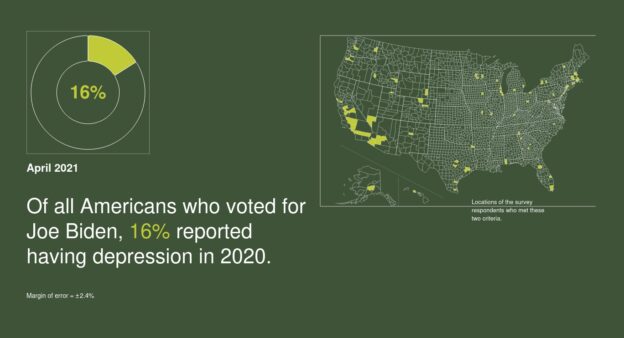
16% of Biden voters reported depression

on the pattern that progressives tend to be less happy

In the American Spectator, under the headline “Leftists Scramble to Explain Why Conservatives Are Happier Than Liberals,” Ann Hendershott quotes our research, which I’d previously reported on this blog:

In the Tufts study, the researchers conclude: “[I]f a liberal and a conservative have the same income, education, race, gender, age, marital status, and religious attendance, the conservative will feel more fortunate … liberals are people who—regardless of their actual social positions—rate their own circumstances relatively poorly, and that attitude drives their ideology and makes them unhappy or else reflects their unhappiness.”

The ellipsis in her quote replaced these words from our report: “A critic might say that …” We hedged because we can’t tell whether negative assessments of one’s own life affect one’s political views (a causal thesis). But Hendershott is a critic of liberals, and she adds a positive assessment of conservatives: “The reality is that true happiness, and a truly satisfying life, comes from caring for others—being physically present to them. Conservatives know that marriage and family life make one happy. … They know that true happiness comes from selflessness—living for others. And this is why they are happier.”

I am not sure about her causal claim. Progressives are less happy than conservatives regardless of marital status (and religious attendance). Using General Social Survey data, I ran a simple regression to predict divorce based on party identification, income, race, gender, and education. Before 2010, identifying as a Republican was associated with lower divorce when these other factors were considered. Since then, party identification has not been related to divorce. Indeed, Democrats and Republicans have had statistically indistinguishable divorce rates in the past decade. These statistics do not settle the issue, but I’d be surprised if progressives derive less happiness from their family involvement than conservatives do in the same social circumstances.

In our model, progressives who are politically active are almost as happy as conservatives who are politically active. Like intensive involvement with one’s family, being an activist is also a way of “living for others.”

Our empirical contribution was the finding that it’s the people with actual depression who make the progressive sample less happy than the conservative sample. Individuals with depression are a minority of those on the left, yet depressed Americans cluster on the progressive side of the aisle. In that case, generalizations about why progressives are less happy than conservatives may be misleading–they don’t apply to people without depression. A better question would be why depression is disproportionately concentrated on the left even once race, gender, and income are controlled for. Musa al-Gharbi has collected previous studies that also find links between ideology and depression. Is this link causal?

Leaving the empirical issues aside, I would pose a very general question about the relationship between mood and knowledge of the world. A standard view might be that any mood is a bias, a source of error; objectivity requires countering all moods. The metaphor of “rose-colored glasses” suggests that optimistic people would have more accurate perceptions if they took off their lenses. Indeed, science since the Renaissance has sought to develop methods and protocols that decrease the impact of the subjectivity of the observer. If scientific methods and instruments work, then a scientist’s mood shouldn’t matter.

An alternative view, which Michel Foucault labeled “spirituality,” is the idea that in order to perceive things correctly, we must first bring ourselves into the best possible mental state. A mood is not a bias; it is the basis of perception. The question is whether our mood is ideal for perceiving well. For example, to perceive what another person is saying, we should probably attain a mood of receptiveness and equanimity. Likewise to perceive that nature is beautiful or that God is good requires an appropriate state of mind. These states can be labeled virtues rather than (mere) moods.

Positive states may not be the only ones that help us to perceive well. Heidegger, for example, sees moods such as anxiety and boredom as advantageous for revealing types of truth. As Michael Wheeler explains:

According to Heidegger’s analysis, I am always in some mood or other. Thus say I’m depressed, such that the world opens up (is disclosed) to me as a sombre and gloomy place. I might be able to shift myself out of that mood, but only to enter a different one, say euphoria or lethargy, a mood that will open up the world to me in a different way. As one might expect, Heidegger argues that moods are not inner subjective colourings laid over an objectively given world (which at root is why ‘state-of-mind’ is a potentially misleading translation of Befindlichkeit, given that this term names the underlying a priori condition for moods). For Heidegger, moods (and disposedness) are aspects of what it means to be in a world at all, not subjective additions to that in-nes

This general view of moods would suggest that being unhappy is not necessarily bad for perceiving the state of our social world. It might reveal insights about current injustices. There is no objective mood, but we might be able to shift negative attitudes into positive ones, or vice-versa. The question is which moods to cultivate in ourselves when we assess society and politics.

One answer might be that we need all kinds of moods and a robust exchange among people who see things differently. Nietzsche is hardly a deliberative democrat, but this remark from his Genealogy of Morals supports the goal of bringing people with diverse moods into conversation: “The more emotions we can put into words about a thing, the more eyes, the more different eyes we can set over the same thing, the more complete is our ‘concept’ of that thing, our ‘objectivity’” (III:12, my trans.). We might then be glad that our society includes both liberals and conservatives who are prone to different states of mind.

I wouldn’t be fully satisfied with that conclusion because it leaves unaddressed the question for individuals. If I perceive the political world sadly, or even in a depressed state, should I strive to change that attitude? Or should I try to convince the positive people to be more concerned?

To answer that question may require a more nuanced sense of an individual’s mood than we can obtain by asking questions about overall happiness (as we did in the reported study). We need a bigger vocabulary, encompassing terms like righteous indignation, empathy for loved ones or for strangers, generalized compassion, sensitivity, caring, agape, technological optimism or pessimism, quietism, acceptance, responsibility, solidarity, nostalgia, utopianism, zeal, and more.

Al-Gharbi reports that the correlation between happiness and conservatism is “ubiquitous, not just in the contemporary United States but also historically (virtually as far back as the record goes) and in most other geographical contexts as well.” He has reviewed the literature, and I am sure he’s right. But I suspect that once we add nuance to the characterization of moods, we will find more change over time and more diversity within the large political camps.

For example, I recognize a current kind of progressive who is deeply pessimistic about economic and technological trends and their impact on the environment. I don’t believe that mood was pervasive on the left immediately after the Second World War, when progressives tended to believe that they could harness technology for beneficial social transformation–not only in Europe and North America but also in the countries that were then overthrowing colonialism. I also recognize a kind of deep cultural pessimism on the right today that seemed much less prevalent in the era of Reagan and Thatcher.

Perhaps measures of happiness have continued to correlate with self-reported ideology in the same way over time and space, but there’s a lot more going on. The content of the ideologies, the demographics of their supporters, the pressing issues of the day, and the most evident social trends have all shifted.

Here’s a possible conclusion: You can’t avoid viewing the world in some kind of mood. Some moods can be more virtuous than others, and it’s up to each of us to try to put ourselves in the best frame of mind.

Liberals and progressives might give some thought to why there is a strong statistical association between their ideologies and unhappiness. Does that mean that we are prone to certain specific vices, such as resignation, bootless anger, or discounting good news? Does it mean that our political messages are less persuasive than they could be? What might we learn from people who seem to be happier while they assess the social world? And what should we do to assist the substantial number of people on our side who are depressed?

Although those questions may be worth asking regularly, they do not imply that we should drop our general stance. People who are happy about the world should also ask themselves tough questions and consider the possibility that those who are unhappy–or even the depressed–might have insights.

See also: perhaps it’s not that conservatives are happier but that people with depression cluster on the left; philosophy of boredom (partly about Heidegger); Cuttings: A book about happiness; spirituality and science; and turning away from disagreement: the dialogue known as Alcibiades I.

shelter

Dog in a shelter
Startles at unknown noises
So he’ll be put down

So he’ll be put down
On the long roll of heroes
He goes over the top

She goes over the top
Merges right and sees the long
Straight way to the end

Straight away to the end
Of the action flies the mind
Neglecting the act

Neglecting the act
The startled noisy mind
Bolts from shelter 

See also: Nostalgia for Now; Mindlessness; When the Lotus Bloomed

what I would advise students about ChatGPT

I’d like to be able to advise students who are interested in learning but are not sure whether or how to use ChatGPT. I realize there may also be students who want to use AI tools to save effort, even if they learn less as a result. I don’t yet know how to address that problem. Here I am assuming good intentions on the part of the students. These are tentative notes: I expect my stance to evolve based on experience and other perspectives. …

We ask you to learn by reading, discussing, and writing about selected texts. By investing effort in those tasks, you can derive information and insights, challenge your expectations, develop skills, grasp the formal qualities of writing (as well as the main point), and experience someone else’s mind.

Searching for facts and scanning the environment for opinions can also be valuable, but they do not afford the same opportunities for mental and spiritual growth. If we never stretch our own ideas by experiencing others’ organized thinking, our minds will be impoverished.

ChatGPT can assist us in the tasks of reading, discussing, and writing about texts. It can generate text that is itself worth reading and discussing. But we must be careful about at least three temptations:

  • Saving effort in a way that prevents us from using our own minds.
  • Being misled or misinformed, because ChatGPT can be unreliable and even unbiased.
  • Violating the relationship with the people who hear or read our words by presenting our ideas as our own when they were actually generated by AI. This is not merely wrong because it suggests we did work that we didn’t do. It also prevents the audience from tracing our ideas to their sources in order to assess them critically. (Similarly, we cite sources not only to give credit and avoid plagiarism but also to allow others to follow our research and improve it.)

I can imagine using ChatGPT in some of these ways. …

First, I’m reading an assigned text that refers to a previous author who is new to me. I ask ChatGPT what that earlier author thought. This is like Google-searching for that person or looking her up on Wikipedia. It is educational. It provides valuable context. The main concern is that ChatGPT’s response could be wrong or tilted in some way. That could be the case with any source. However, ChatGPT appears more trustworthy than it is because it generates text in the first-person singular–as if it were thinking–when it is really offering a statistical summary of existing online text about a topic. An unidentified set of human beings wrote the text that the AI algorithm summarizes–imperfectly. We must be especially cautious about the invisible bias this introduces. For the same reason, we should be especially quick to disclose that we have learned something from ChatGPT.

Second, I have been assigned a long and hard text to read, so I ask ChatGPT what it says (or what the author says in general), as a substitute for reading the assignment. This is like having a Cliff’s Notes version for any given work. Using it is not absolutely wrong. It saves time that I might be able to spend well–for instance, in reading something different. But I will miss the nuances and complexities, the stylistic and cognitive uniqueness, and the formal aspects of the original assignment. If I do that regularly, I will miss the opportunity to grow intellectually, spiritually, and aesthetically.

Such shortcuts have been possible for a long time. Already in the 1500s, Erasmus wrote Biblical “paraphrases” as popular summaries of scripture, and King Edward VI ordered a copy for every parish church in England. Some entries on this blog are probably being used to replace longer readings. In 2022, 3,500 people found my short post on “different kinds of freedom,” and perhaps many were students searching for a shortcut to their assigned texts. Our growing–and, I think, acute–problem is the temptation to replace all hard reading with quick and easy scanning.

A third scenario: I have been assigned a long and hard text to read. I have struggled with it, I am confused, and I ask ChatGPT what the author meant. This is like asking a friend. It is understandable and even helpful–to the extent that the response is good. In other words, the main question is whether the AI is reliable, since it may look better than it is.

Fourth, I have been assigned to write about a text, so I ask ChatGPT about it and copy the response as my own essay. This is plagiarism. I might get away with it because ChatGPT generates unique text every time it is queried, but I have not only lied to my teacher, I have also denied myself the opportunity to learn. My brain was unaffected by the assignment. If I keep doing that, I will have an unimpressive brain.

Fifth, I have been assigned to write about a text, I ask ChatGPT about it, I critically evaluate the results, I follow up with another query, I consult the originally assigned text to see if I can find quotes that substantiate ChatGPT’s interpretation, and I write something somewhat different in my own words. Here I am using ChatGPT to learn, and the question is whether it augments my experience or distracts from it. We might also ask whether the AI is better or worse than other resources, including various primers, encyclopedia entries, abstracts, and so on. Note that it may be better.

We could easily multiply these examples, and there are many intermediate cases. I think it is worth keeping the three main temptations in mind and asking whether we have fallen prey to any of them.

Because I regularly teach Elinor Ostrom, today I asked ChatGPT what Ostrom thought. It offered a summary with an interesting caveat that (I’m sure) was written by an individual human being: “Remember that these are general concepts associated with Elinor Ostrom’s work, and her actual writings and speeches would provide more nuanced and detailed insights into her ideas. If you’re looking for specific quotes, I recommend reading her original works and publications.”

That is good advice. As for the summary: I found it accurate. It is highly consistent with my own interpretation of Ostrom, which, in turn, owes a lot to Paul Dragos Aligica and a few others. Although many have written about Ostrom, it is possible that ChatGPT is actually paraphrasing me. That is not necessarily bad. The problem is that you cannot tell where these ideas are coming from. Indeed, ChatGPT begins its response: “While I can’t provide verbatim quotes, I can summarize some key ideas and principles associated with Elinor Ostrom’s work.” There is no “I” in AI. Or if there is, it isn’t a computer. The underlying author might be Peter Levine plus a few others.

Caveat emptor.

See also: the design choice to make ChatGPT sound like a human; the difference between human and artificial intelligence: relationships

turning away from disagreement: the dialogue known as Alcibiades I

The dialogue known as Plato’s Alcibiades I is now widely believed to have been written after Plato’s death, hence by someone else (Smith 2003). Perhaps that is why no one has ever told me to read it. But it is an indisputably ancient text, and it’s a valuable work of philosophy.

In several places, Michel Foucault discusses Alcibiades I as the earliest text that offers an explicit theory of what he calls “spirituality” (Foucault 1988, 23-28; Foucault 1981, 15-16). For Foucault, spirituality is the idea that reforming one’s soul is a necessary precondition for grasping truth. One way to summarize Alcibiades I might be with this thesis: You are not qualified to participate in politics until you have purified your soul enough that you can know what is just. That is an anti-democratic claim, although one that’s worth pondering.

At the beginning of the dialogue, we learn that Alcibiades will soon give a speech in the Athenian assembly about a matter of public policy. He is talented, rich, well-connected, and beautiful, and his fellow citizens are liable to do what he recommends. Athens is a rising power with influence over Greeks and non-Greeks in Europe and Asia; Alcibiades aspires to exercise his personal authority at a scale comparable to the Persian emperors Cyrus and Xerxes (105d). However, Alcibiades’ many lovers have deserted him, perhaps because he has behaved in a rather domineering fashion (104c). Only his first lover, Socrates, still cares for him and has sought him out—even as Alcibiades was looking for Socrates.

Alcibiades admits that you should not expect a person who is handsome and rich to give the best advice about technical matters, such as wrestling or writing; you should seek an expert (107a). Alcibiades plans to give a speech on public affairs because it is “something he knows better than [the other citizens] do.” (106d). In other words, he claims to be an expert about politics, not just a celebrity.

Socrates’ main task is to dissuade Alcibiades from giving that speech by demonstrating that he actually lacks knowledge of justice. Alcibiades even fails to know that he doesn’t know what justice is, and that is the most contemptible form of ignorance (118b).

Part of Socrates’ proof consists of questions designed to reveal that Alcibiades lacks clear and consistent definitions of words like “virtue” and “good.” The younger man has no coherent theory of justice. This is typical of Socrates’ method in the early dialogues.

A more interesting passage begins when Socrates asks Alcibiades where he has learned about right and wrong. Alcibiades says he learned it from “the many”–the whole community–much as he learned to speak Greek (110e, 111a). Socrates demonstrates that it is fine to learn a language from the many, because they agree about the correct usages, they retain the same ideas over time, and they agree from city to city (111b). Not so for justice, which is the main topic of controversy among citizens and among cities and which even elicits contradictory responses from the same individuals. The fact that the Assembly is a place of disagreement shows that citizens lack knowledge of justice.

In the last part of the dialogue, Socrates urges Alcibiades to turn away from public affairs and rhetoric and instead make a study of himself. That is because a good city is led by the good, and the good are people who have the skill of knowing themselves, so that they can improve themselves. For Foucault, this is the beginning of the long tradition that holds that in order to have knowledge–in this case, knowledge of justice–one must first improve one’s soul.

Socrates verges into metaphysics, offering an argument that the self is not the observable body but rather the soul, which ought to be Alcibiades’ only concern. This is also why Socrates is Alcibiades’ only true lover, for only Socrates has loved Alcibiades’ soul, when others were after a mere form of property, his body.

The dialogue between the two men has been a conversation between two souls (130d), not a sexual encounter or a public speech, which is an effort to bend others’ wills to one’s own ends. Indeed, Socrates maintains from the beginning of the dialogue that he will make no long speeches to Alcibiades (106b), but will rather permit Alcibiades to reveal himself in response to questions. Their dialogue is a meant, I think, as a model of a loving relationship.

Just to state a very different view: I think there is rarely one certain answer to a political question, nor is there a decisive form of expertise about justice. However, good judgment (phronesis) is possible and is much better than bad judgment. Having a clear and structured theory of justice might be helpful for making good judgments, but it is often overrated. Fanatics also have clear theories. What you need is a wise assessment of the particular situation. For that purpose, it is often essential to hear several real people’s divergent perspectives on the same circumstances, because each individual is inevitably biased.

Socrates and Alcibiades say that friendship is agreement (126c) and the Assembly evidently lacks wisdom because it manifests disagreement. I say, in contrast, that disagreement is good because it addresses the inevitable limitations of any individual.

Fellow citizens may display civic friendship by disagreeing with each other in a constructive way. Friendship among fellow citizens is not exclusive or quasi-erotic, like the explicitly non-political relationship between Alcibiades and Socrates, but it is worthy. We need democracy because of the value of disagreement. If everyone agreed, democracy would be unnecessary. (Compare Aristotle’s Nic. Eth. 1155a3, 20.)

Despite my basic orientation against the thesis of Alcibiades I, I think its author makes two points that require attention. One is that citizens are prone to be influenced by celebrities–people, like Alcibiades, who are rich and well-connected and attractive. The other is that individuals need to work on their own characters in order to be the best possible participants in public life. But neither point should lead us to reject the value of discussing public matters with other people.

References: Smith, Nicholas D. “Did Plato Write the Alcibiades I?.” Apeiron 37.2 (2004): 93-108; Foucault, “Technologies of the Self: A Seminar with Michel Foucault,” edited by Luther H. Martin, Huck Gutman and Patrick H. Hutton (Tavistock Press, 1988); Foucault, The Hermeneutics of the Subject, Lectures at the College de France 1981-2, translated by Graham Burchell (Palgrave, 2005). I read the dialogue in the translation by David Horan, © 2021, version dated Jan 1 2023, but I translated the quoted phrases from the Greek edition of John Burnet (1903) via Project Perseus. See also friendship and politics; the recurrent turn inward; Foucault’s spiritual exercises