introduction to Gandhi

This is a lecture that I pre-recorded for Introduction to Civic Studies this semester. It provides some background about the life and fundamental ideas of Mohandas K. Gandhi.

Students will also read these texts:

  • Ramachandra Guha, Gandhi: The Years that Changed the World (2018), chapter 16 (on the Great Salt March)
  • Gandhi, Satyagraha (Ahmedabad: Navajivan Publishing Co., 1951): excerpts
  • Gandhi, Notes, May 22, 1924 – August 15, 1924, in The Collected Works of Mahatma Gandhi, New Delhi, Publications Division Government of India, 1999, 98 volumes,  28, pp. 307-310

In class we will will discuss such questions as these: How (if at all) can one organize voluntary collective action at a sufficient scale to bring about change in Gandhi’s preferred ways? Is Gandhi right to demand sacrifice and to see sacrifice as intrinsically meritorious? How can Gandhi know whether his stance is correct when he finds himself in conflict with other idealists, such as B.R. Ambedkar? And is it fair for Gandhi to claim that he only knows the means, not the result, of the struggle, if the end is actually predicable?

See also: Gandhi: The Years That Changed the World, 1914-1948 by Ramachandra Guha; Gandhi versus Jinnah on means and ends; Gandhi on the primacy of means over ends; notes on the metaphysics of Gandhi and King; Rev. James Lawson, Jr on Revolutionary Nonviolence; etc.

Boston Globe article

synchronize elections

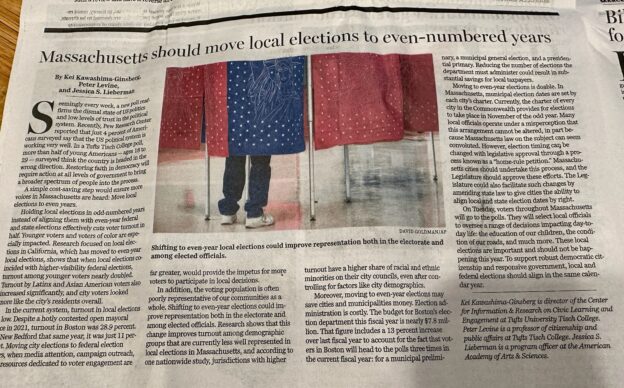
I voted today in Cambridge, MA, but I wish that local elections were synchronized with national ones. Turnout would be far higher, and the electorate would be more representative.

Kei Kawashima-Ginsberg, Jessica S. Lieberman, and I published an op-ed in the Boston Globe today, making that point. It was nicely timed to coincide with an election day in an off-year. It’s entitled Massachusetts should move local elections to even-numbered years. It’s behind a paywall, but the photo of the print edition that accompanies this post should be legible.

Politics by Other Means: Civic Education in a Time of Controversy

Newly published: Levine, P. (2023). Politics by Other Means: Civic Education in a Time of Controversy. The ANNALS of the American Academy of Political and Social Science705(1), 24-38. https://doi.org/10.1177/00027162231189037. Abstract:

After being overlooked in major education debates and policy initiatives for decades, civic education has recently become the topic of highly polarized debates and legislative battles over what and how we should be teaching our young people about the nation’s history. How should racial injustice be discussed in schools? Are schools indoctrinating students? In a robust democracy, controversy about what students should learn is appropriate and desirable, but some of the rhetoric that has dominated the recent discussions violates the deliberative norms that schools should help students to develop. At a time when the public should be carefully deliberating how to educate students, civic education is instead being used instrumentally to win political contests. I present one approach to facing this challenge—the Educating for American Democracy project. This project is not the conclusive answer to the question, “What should we teach?” but rather an attempt to model deliberative values, and I show that it offers important lessons for people and institutions who are attempting to address matters of curricular content.

This article is part of a special issue on Civic Education in a Time of Democratic Crisis and is specifically paired with Paul Carrese’s piece, “Civic Preparation of American Youth: Reflective Patriotism and Our Constitutional Democracy,” under the heading “Finding Common Ground among Progressive and Conservative Visions of Civic Education.” My friend Paul and I represent those two visions, and we discuss the common ground that we and others found.

core curricula without the concept of the West

This post is prompted by Stanford’s new Civic, Liberal, and Global Education (COLLEGE) requirement. Stanford makes no claim to present something called “Western Civilization” in chronological order. Instead, it assigns texts about common themes from diverse sources. I basically want to endorse this approach (which is not unique to Stanford).

Shared readings provide the basis for focused conversation that can encompass disagreement. I also see an argument for choosing works that illuminate the ideas, values, and institutions that have become globally dominant in the wake of European imperialism, which we can assess both critically and appreciatively. However, I cannot see a legitimate rationale for selecting authors and texts that are labeled “Western.”

Important lines of influence have always crossed any border that would demarcate the West, which has itself been deeply diverse. The word “West” sometimes names the countries where the majority populations are seen today as white, but that is an indefensible basis for selecting sources. A tenable justification would have to explain how something called the West is both internally consistent and intellectually distinct (whether for good or ill); and I don’t see a basis for that.

It’s true that some works from non-European regions extoll community and denounce individual selfishness or advance holistic and integrated metaphysical views. These texts are taken as evidence that “the West” is uniquely materialistic, dualistic, and individualistic. But authors from traditions like Buddhism would not have taken the trouble to argue so forcefully against materialism and selfishness if those values had been limited to people thousands of miles to their west. Their elaborate and sometimes urgent arguments to their own compatriots provide evidence that the values labeled “Western” have actually been widespread in many times and places. Meanwhile, Europe has produced powerful voices for mysticism, communalism, and deep ecology.

I’ll quote a passage from Leo Strauss, not to criticize him individually (even though I once published a roman-à-clef about him), but as an illustration of a view that I think was commonplace not long ago:

All the hopes that we entertain in the midst of the confusion and dangers of the present are founded, positively or negatively, directly or indirectly, on the experiences of the past. Of these experiences, the broadest and deepest—so far as Western man is concerned—are indicated by the names of two cities: Jerusalem and Athens. Western man became what he is, and is what he is, through the coming together of biblical faith and Greek thought. In order to understand ourselves and to illuminate our trackless way into the future, we must understand Jerusalem and Athens.

Leo Strauss, “Jerusalem and Athens: Some Introductory Reflections (Commentary, June 1967)

One premise here is that modern European ideas derive from two main sources, classical Greece and ancient Judaism. Perhaps Strauss also thought that the resulting ideas were good or true, although I suspect his own view resembled the deeply skeptical argument that he attributes to Nietzsche in the same article.

Regardless of Strauss’ ultimate position, my focus here is not the claim that it’s valuable to understand the intellectual history that flows from “biblical faith and Greek thought.” I object to following that history only through European countries and their colonies.

We might envision Athens as a label for a set of contesting ideas that emerged in the Greek classical period, and treat it as node. We might likewise use Jerusalem as the name of a node that represents the various strands of ancient Judaism. Some thinkers of the Hellenistic period connected these nodes, forming the basis of Christianity. For example, when John writes (in Greek), “In the beginning was the logos,” he combines these two sources.

Zooming out from those two nodes, we can identify many influences on both. The Hebrew Bible describes a people who were profoundly connected to Egypt and Mesopotamia. Greek thought drew on the same sources, plus South Asia and perhaps Scythia. For example, Pyrrho of Elis may have been a Buddhist and was certainly influenced–as were several other Greek philosophers–by his travels in India.

The nodes labeled Athens and Jerusalem then radiated influences on many periods and places. Leo Strauss was an expert on the ways that Greek philosophy and Hebrew scripture shaped classical Islam. One center of medieval Islam was Spain, from which Greek and Jewish ideas and texts spread to Catholic Europe. The first people to depict the Buddha in statuary were Indo-Greeks, while Catholic monasticism may be modeled on India’s bhikkhus and sanyasis. Examples of such radiating influence could be explored endlessly.

It is then very odd to name the zone that was influenced by Athens and Jerusalem as “the West.” The influences of Greece plus ancient Judaism extend, for example, to predominantly Muslim Indonesia, which lies at the east end of Asia. Jerusalem is also in Asia, and Athens is far to the east of (say) Marrakesh. Until the 1800s, the word “west” referred to a compass direction and bore no other implications. The first use that I can find that clearly defines the West in terms of culture–or race–is from 1892, around the apogee of European imperialism. By the way, one reason that the phrase “Western civilization” then became prevalent was a deep anxiety about the condition and prospects of Europe, especially following the First World War.

Studying a canon of works that relate to Athens and Jerusalem has value. For one thing, it’s an opening to discuss extraordinarily diverse and contesting ideas. But defining its scope as the countries where most people have had white skin is untenable.

See also: the history of the phrase “the West”; Europa was an Asian woman, and other thoughts on the definition of Europeto whom do the ancient Greeks belong?Jesus was a person of color; The lack of diversity in philosophy is blocking its progress (in Aeon)

The Robe (a retelling of The Platform Sutra)

The Patriarch spent almost all his time alone in his study. Everyone assumed he was in there meditating or reading, but usually he was worrying. The finances of the House were fragile; loans barely covered monthly expenses. Although he was the only one who understood the financial situation, everyone seemed tense and unhappy. The Patriarch often saw people whispering and scowling and scurrying away.

Years earlier, the Patriarch had experienced insights that had brought him peace. He still considered himself a person of wisdom, but its actual meaning was now dim.

“I wish I could retire!” he said aloud. “I wish I could give my red robe to someone else. Then I could return to my inner life, before it’s too late. But who would succeed me? Who has enough skill and integrity to keep our House intact? Would my successor even protect me physically? I wouldn’t it put past some of these people to stab me in the back–quite literally!–if I renounced my robe.” And he pulled it tighter around his skinny frame, as if for protection.

The next day, as he received the usual line of tattered pilgrims, the Patriarch mentally tallied the likely expenses of alms for the poor visitors versus any possible revenue from those who might donate, and his mood sank below even its usual level.

One of the supplicants looked particularly poor, a youth in rags who might also be a foreigner. “And what do you want, boy?”

“Sir, I am only an ignorant street beggar, but I heard a man recite a poem that spoke to me as if I had known it already. He said that it comes from a book that brings unlimited merit. I have traveled all the way here in the hopes of being taught to read this work and other classics.”

The Patriarch’s interest was piqued. “Which verse did you hear?” he asked. The boy replied:

A flash in the night sky, a breeze,
All other things are just like these.

The Patriarch thought: “It is very clever to quote this particular couplet to me. He’s hoping to be admitted to our House. Maybe he simply wants daily rations and a warm place to sleep. Or maybe he has been trained and coached by someone who hopes to profit from his advancement. Still, he has talent–or at least someone does–and talent is scarce around here. I will test his obedience and see if I can make use of him.”

The Patriarch assigned the boy to work in the kitchen and asked the head cook to report regularly on his attitude.

A few days later, after much anguished dithering, the Patriarch decided to move ahead with a succession plan despite his own grave reservations. At the daily House meeting, he announced it:

“It is time for your venerable Patriarch to retire so that he can better serve you through private mental exertions. Someone else may gain merit from holding this burdensome office. All of you, go to your cells and write verses that demonstrate your understanding of our essential teachings. The author of the best poem will take the red robe.”

All the brothers except one thought to themselves: “There is no point. S. will write the best poem, or at least, the Patriarch will prefer it to anyone else’s. S. is obviously his favorite. Let S. write something and become our new leader. Maybe he will prove more competent than the boss we have today, and our living conditions will improve at last.”

As for S., he paced back and forth in his cell, thinking, “I must write a poem, but it probably won’t be any good. The truth always seems to elude my words. Maybe my motivations are wrong: I am striving to succeed when I should cease to strive altogether. But then I would write nothing, and the Patriarch would be disappointed. Besides, someone else would take over, and who could possibly do a decent job? I will do my best and post some anonymous lines on the wall. If the Patriarch approves them, I will acknowledge that I wrote them. If not, life will go on as before.”

He spent the night hours scribbling and erasing, sometimes giving up for a while and even wailing, “I’m finished! I’m finished!” At last, near dawn, S. tiptoed into the long main corridor and wrote these words on the wall in the most generic handwriting he could manage:

The body is a holy tree; the mind is a mirror.
Polish it constantly; make it ever clearer.

He scurried away, feeling ashamed, and lay awake until the morning meal.

When the Patriarch went for his rounds, he saw the poem and recognized S.’s hand immediately. The results did not surprise him: two conventional similes. He made a show of enthusiasm, saying: “Everyone, gather around and read these lines. They will do you good.” Then he went back to his study and put his face in his hands and tried to steady his turbulent thoughts.

S. knocked on the door and the Patriarch admitted him. “I presume you wrote the couplet on the corridor wall?”

“I admit it, sir. Is it any good at all? I meant to express the value of continual polishing, not to imply that the mirror can ever be clean.”

“Perhaps it is good enough,” said the Patriarch, privately acknowledging that he could have done no better. At least his plan was unfolding as he had expected. Soon S. would shoulder the burdens of office. The Patriarch did not think that S. would allow anyone to harm him in his retirement–assuming that the House remained in business at all.

At just this moment, in the kitchen, the beggar boy (who was grinding grain as always) overheard a more senior cook recite S.’s new poem. He asked where it came from and heard the story of the competition to become the new Patriarch.

“May I see the verse as it’s written on the wall?” he asked. “I cannot read a word, but I would like to pay my respects.”

The cook thought that this foreign boy was a good kid, quiet and hard-working. He always accepted teasing in a positive spirit. He showed the lad the poem.

Standing before it, the boy said, “Do you think you could write something for me? I promise I will do your chores as well as my own for a whole week.” And with his guidance, the cook wrote these words on the wall:

What's holy is no solid tree; mind is always clear.
What kind of substance could ever leave a smear?

The boy thought to himself, “The Patriarch will sort of appreciate this. Whatever he may privately experience, he at least understands the logic of his own teachings, and this verse expresses the conclusion more precisely than that ignorant poem by some old monk. But maybe I can do better.”

He asked the cook to write just one more couplet below the previous one.

A mirror with no surface or back:
What could that suffer or lack?

The boy thought: “This is the best answer, I think. At any rate, a paradox is always the most intriguing kind of thought, and someone might actually benefit from pondering this one. I have many ideas for running this House, and surely my skills will now be recognized. I cannot believe how many times these brothers have listened to lectures and readings without learning how to write. Honestly, it’s not that hard to come up with an enigma.”

On his evening rounds, the Patriarch encountered a knot of brothers gathered around the three verses, arguing about their meaning and which one was best. He could tell from the way they treated the beggar boy that he added some of the lines. The Patriarch’s first impression was confirmed; this youth understood the moves that one ought to make. But the Patriarch was not sure what to do as a result.

“All of these are useful,” he said, “but none is truly satisfactory.” And he walked back to his study, cultivating a mysterious air.

This time, it was the youth who knocked on his study door and acknowledged having written the verses.

“You can have my robe,” said the Patriarch. “I certainly don’t want it, and it seems that you do. We can say that I transmitted my teachings to you tonight, although I think you already get the point.

“The question is whether you really want this job. I have not disclosed our financial situation, but you may not want to inherit it. And you must realize what a fractious, quarrelsome group we have here. Frankly, if I were you, I would accept the robe as a sign of authority and go as far from here as you can. Use my gift to justify founding a whole new house. But travel quickly and watch your back; I wouldn’t be surprised if some of our friends try to track you down and even kill you for the Patriarch’s mantle.”

“And what of you?” asked the youth. “How will you manage if this House has no leader?” He watched the old man with sudden sympathy.

“Ah” said the Patriarch,

A flash in the night sky, a breeze,
All other things are just like these.