making college much cheaper

Imagine a college with 1,000 undergraduate students. If they all take eight seminars a year, if every class enrolls 20 students, and if each professor has a very manageable teaching load of five courses per year, the 1,000 students need 80 faculty members. If those 80 professors are paid, on average, the national median for an associate professor in the social sciences ($60,064) plus benefits ($20,028), then the total faculty payroll will cost $6,407,360. That comes to $6,407.36 per student per year.

Private colleges and universities are now charging almost eight times as much for a year’s education. Why?

  • Their usual bill includes room and board and various services, such as health plans and career counseling, as well as courses.
  • Universities are buildings, labs, lawns, stadiums, and admissions offices as well as courses and teachers.
  • Lots of people work at colleges beside professors. As I wrote here, “Harvard, for example, employs 5,102 “administrative and professional” staff (excluding clerical and technical workers and those in “service and trades”). Harvard has 112 full-time professional and administrative workers in its athletics department alone. This compares to 911 tenured faculty (or 2,163 total faculty).

When I suggested creating a  “no frills” college from scratch, various friends who work in student affairs, community engagement centers, and other parts of universities wrote privately to ask if I was disparaging their contributions. I would not want to do that. Many adults who work at colleges and universities educate as much and better than many faculty. The distinction isn’t even important to me. But if 80 professors could teach 1,000 students in small classes, then I think 100 educators (including some deans, coaches, counselors, co-curricular leaders, etc.) could serve a student body of 1,000. Even if those educators were paid $60,000 each plus benefits, the per-student cost would still be about $8,000.

I recognize that rent must be paid, lights lit, and diplomas printed. But would it not be possible to build a private, non-profit college whose base tuition was $10,000, whose curriculum was entirely devoted to seminars and labs, and which could employ students on financial aid to perform a substantial portion of its work?

Mitt Romney and the Median Voter Theorem

(Wye River) The sagacious Nate Silver thinks that the odds slightly favor a Republican victory in the 2012 presidential race, and that’s partly because if Mitt Romney wins the nomination, the GOP nominee will be a relative moderate. Silver thinks a moderate Republican nominee would perform about 4 percentage points better than a hard-right nominee would, and that could easily be the edge.

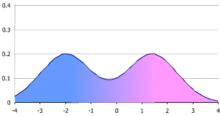
It’s not that most voters are moderates, but rather that a moderate candidate stands as close as possible to the majority of people. This is not always true, but it can apply even when voters are polarized. In the following hypothetical distribution, few of the voters are moderates, yet a mildly right-of-center candidate would draw all of the conservatives plus some of the moderates and could win. At least, he would do better than a hard-right candidate who would cede more moderates to the Democrat:

My question is whether Romney would get the advantages of being perceived as a moderate. He’s an unusual case, with a record of strongly–even passionately–endorsing opposite positions when he runs for different offices. If he’s very lucky, that could work out as the functional equivalent of moderation. Perhaps voters will average out his various positions and conclude that he’s really a moderate. Or perhaps people will mainly notice the positions Romney has taken that they happen to like. Instead of being placed in the middle of the spectrum, a shape-changing candidate could appear near every individual voter’s position on that voter’s own map. That would be even better than moderation.

But if Romney isn’t so lucky, he could see the opposite result. Everyone could remember the positions Mitt has taken that are different from their own. Then Romney would be the opposite of a moderate. Instead of standing in the middle–reasonably close to everyone–he would emerge as everyone’s enemy.

I would guess that the reality will be a mix of the two. I think stories like this one in the Washington Post will make conservatives think Romney is no ally without persuading moderates and liberals that he is a friend: a costly result. But the conservatives won’t have any other option, and some moderates will buy Romney’s conciliatory rhetoric during the general election campaign. The question is not whether Romney is a better GOP candidate than Perry or Cain (who are astoundingly weak), but whether he is as much better as the “moderate” label would suggest.

at Wye, remembering Abu Ghraib

I am at the Aspen Institute along the Wye River on the Eastern Shore of Maryland. Think of tidy fields with picket fences, Georgian brick houses, placid reaches of salt water at every turn, great flocks of starlings on the mowed fields, bald eagles, neat rows of trees aflame in red and gold against the wide pale sky. The last time I was here–for an entirely different meeting–was May 2004. The Abu Ghraib torture story was breaking, and something about the classic American landscape and the bitter news from Iraq prompted me to write these lines, which came back to me today.

O’Connor and Graham on unemployment and civic engagement

Back in September, we released a report entitled Civic Health and Unemployment: Can Engagement Strengthen the Economy? It was based on an analysis of all 50 states and 50 major metro areas and found that their levels of civic engagement before the recession strongly predicted how well they have weathered the economic crisis. I wrote about the study in a HuffPost piece that still seems to draw regular tweets. And now former Supreme Court Justice Sandra Day O’Connor and former Senator and Governor Bob Graham (D-FL) have made the study the focus of a joint op-ed in USA Today, entitled “Jobs and Civics Go Hand in Hand.”

Both of these leaders are dedicating extraordinary attention to civic education and civic renewal:

We should be especially grateful because these two citizens are about as busy as you can possibly be in “retirement.” Graham chairs the Commission on the Prevention of Weapons of Mass Destruction Proliferation and Terrorism, served on the Financial Crisis Inquiry Commission, and co-chaired the National Commission on the BP Deepwater Horizon Oil Spill and Offshore Drilling, whose report has been unusually well reviewed. He has also published a thriller this year. O’Connor hears cases, writes children’s books, serves on boards, and advocates for redistricting and judicial reform.

incivility: the problem behind that problem

Most Americans believe that civility is important in politics and perceive that it has declined, especially if they listen to the radio and/or pay close attention to politics. Half believe that there has been a decline in the tone of politics since Barack Obama was elected [survey by Dan Shea and colleagues: PDF].

But it is not clear that incivility is the root problem. One person’s passion–or righteous indignation–is another’s incivility. It’s easy to find websites in which the author interprets a charge of incivility as an effort to silence the people on his side of the political spectrum. During the civil rights era, respectable opponents of the movement typically accused its leaders of ignoring “the civilities” in order to block their progress.

Even if we can agree that an utterance is uncivil, that is not necessarily an argument against it. Civility can conflict with other values, such as freedom of speech.

Finally, blatant incivility is nothing new in public life. In the election of 1800, John Adams’ “men called Vice President Jefferson ‘a mean-spirited, low-lived fellow, the son of a half-breed Indian squaw, sired by a Virginia mulatto father.’” The incentives in a competitive political campaign have usually favored nastiness–and competition is healthy.

What has changed is the lack of an everyday alternative. I think Americans are responding to a lack of constructive civic engagement in their own communities.

Unions, religious congregations, and neighborhood and membership organizations have all shrunk dramatically since 1970. People are substantially less likely to work on community projects and to attend meetings than they were a generation ago. Newspaper readership has fallen at a similar pace. Jury service plays a shrinking role. School districts have been consolidated to the extent that the proportion of Americans who serve on a school board is down by 95%.

As a result, we cannot react to a nasty fight on the television news by telling ourselves, “That is not how we get along in our community.” Increasingly, we are not involved in the business of our own communities. Because we lack experience making decisions about public matters with fellow citizens who are different from ourselves, we are in no position to judge the quality of arguments among leaders or to choose representatives who are good at dialogue. We cannot distinguish between rudeness and passion, or between obfuscation and complexity.

Civil society is in grave condition, measured not by the proportion of talk that is “civil” (for which no statistics exist) but by the sheer rate of participation in voluntary organizations that involve talk. People are less likely to participate in discussions, and especially discussions that draw diverse citizens and that have meaningful impact on public life.

We are withdrawing from such conversations, by, for example, deliberately enacting policies that disempower juries, school boards, and other local bodies; by choosing to live in politically homogeneous communities; and by leaving multi-purpose, diverse organizations for single-issue lobbies and narrowly-defined professional organizations.

Some of the symptoms of this withdrawal include alienation from public life (with Congress holding a 9% approval rate) and pervasively manipulative communications. Our first instinct now is to develop a “message” to persuade masses of other people to our view—rather than initiate a conversation to decide what would be best. It’s in an environment of dueling “messages” broadcast to passive citizens that incivility feels so toxic.