why no Keynesianism anywhere?

For all the billions of bytes devoted to criticizing Barack Obama’s economic strategies (Why wasn’t the stimulus bigger? Why didn’t he get the debt limit raised earlier?), there seems to be hardly any discussion of a much more significant question: Why hasn’t any major industrialized democracy employed a Keynesian response to the Great Recession?

The economic argument for a Keynesian stimulus says that typical recessions are driven by weak demand and confidence. Governments can help by borrowing and spending temporarily. An argument from justice says that human needs rise acutely in recessions; governments can assist by spending wisely. And a political argument says that people want the state to do something now even if it has to borrow. In fact, one might fear that democratically elected governments would always borrow and spend (regardless of the merits of that policy) and so would grow in every crisis until they became tyrannies.*

Instead, we see the European democracies cutting their budgets in a time of recession or near-recession. President Obama won the passage of a stimulus package, but it was equivalent to less than 6% of GDP, one third of it was devoted to tax cuts, it was largely offset by cuts in local and state spending, and after less than two years, the opposition won an election vowing to repeal it. This Brookings report describes the stimulus policies of the US, China, Spain, and Saudi Arabia as “large.” They mean relative to other countries. There were also “modest” stimulus packages in a few other democracies, such as Germany (3.4% of GDP; two-third devoted to tax cuts) and Canada. I believe all of these were short-lived.

Here are three possible explanations for the lack of Keynesian policies in almost all advanced democracies–or, to put it another way, three reasons why Barack Obama, despite engineering an inadequate recovery package, strikes Kevin Drum (who is a Keynesian) as the best or second-best leader in the whole world today.

1. The Keynesian theory is wrong, and leaders are wisely rejecting it. This Wikipedia article provides a sample of that position plus rebuttals. I don’t buy it because the Keynesian theory makes sense to me and because various influentials (the president of the World Bank, the Chancellor of the UK, the head of China’s Central Bank, and the President of the United States) explicitly recommended stimulus policies. By the way, here’s a primer in rap form on the substance of Keynesianism:

2. Political systems are manipulated by economic interests (corporations and wealthy individuals) that don’t want governments borrowing now and taxing them later. That could certainly be the case, but it raises some interesting questions: How is it that such different democratic systems have all become more susceptible to wealthy interests over time? (Mobility of capital, perhaps?) Also, how do these special interests coordinate their efforts to make them effective? Many corporations actually benefit from stimulus policies. Low taxation is in the interest of wealthy people, but they all share that interest. Game theory predicts that no individuals will actively lobby against a stimulus if they bear the cost of the lobbying but share the benefits.

3. Voters have lost trust in government and so don’t believe that a stimulus will work. Actually, the lack of trust is a fact, demonstrated by consistent survey data. But we could ask whether distrust makes leaders leery of stimulus policies. A second questions is where that lack of trust comes from. Some would say that the special interests noted in #2 have deliberately delegitimized governments through propaganda: Fox, Murdoch, Mediaset. But note that other special interests have explicitly advocated stimulus: Goldman Sachs, for example. I think it’s more likely that a) governments have performed badly and b) the fundamental shift toward individualism and choice in the 1960s biased people against hierarchical organizations.

If you’re a Keynesian, you should work to reelect President Obama (who’s your best available ally) and try to figure out what deep, structural factors explain global resistance to Keynesianism today.

* I thought I could quote Hayek to this effect, but he doesn’t specifically target Keynesian stimulus policies in the Road to Serfdom, and Keynes, intriguingly, wrote to Hayek to thank him for a “grand book.” Keynes said, “Morally and philosophically I find myself in agreement with virtually the whole of it; and not only in agreement, but in a deeply moved agreement.”

badges for civic skills

Here are two proposals for “civic badges” entered in the Digital Media and Learning Competition. Public comments are being welcomed on the DML site–please click through to read and discuss:

(For full disclosure, I played a role in drafting both proposals and might be involved in the work if either was funded.)

Background: Major organizations such as the MacArthur Foundation, Mozilla (which produces the Firefox browser), and the US Department of Commerce are interested in “badges.” The idea comes originally from scouting: scouts win badges for skills or accomplishments like packing a backpack or raking neighbors’ leaves. But in an age of sophisticated and stylish computer games, the “badging” concept no longer feels childish. Youth and young adults are now accustomed to attaining levels of competence and success online.

In the educational context, badging offers several potential advantages: 1) It is an alternative to high-stakes testing. It can motivate people to learn–and schools to teach–without creating new ways to fail. 2) It can make labor markets work better by indicating exactly what skills an individual has. It can thus help people obtain jobs they would otherwise miss–and help firms find the right workers. The same advantages would also apply to unpaid civic work. 3) It allows the tasks of education and assessment to be shared or distributed, instead of being assigned to schools alone. The same badge could be awarded by a school, a church, or a private firm.

I see special advantages for civic skills. They are ignored by today’s high-stakes tests, yet adding new civics exams would simply create new ways for students to fail. Also, teaching active citizenship has traditionally been a shared responsibility of schools and civil society. With badges, many organizations could teach and assess citizenship. Finally, civic skills are intrinsically controversial. Some people think that occupying Wall Street is a valid skill, while others see it as a threat. The same is true of organizing prayer breakfasts in public schools. If states must provide standardized curricula and tests in civics, they will try to strip out all controversy. But a badging system is flexible: diverse groups can create and award badges, contributing to a rich and contentious democracy.

must you be good to be happy?

He who would live rightly should let his desires be as strong as possible and not chasten them, and should be able to minister to them when they are at their height by reason of his manliness and intelligence, and satisfy each appetite in turn with what it desires. … No, in good truth, Socrates—which you claim to be seeking—the fact is this: luxury and licentiousness and liberty, if they have the support of force, are virtue and happiness, and the rest of these embellishments—the unnatural covenants of mankind—are all mere stuff and nonsense.

— Callicles, in Plato’s Gorgias 492, trans. W.R. Lamb, via Project Perseus

Socrates responds that to be happy, you must be virtuous. That would be a good news, because then we would have self-interested reasons to be altruistic and just; everything would hang together nicely. At roughly the same time, far to the east, the Buddha was saying much the same thing.

But pure philosophical arguments probably don’t support their view. Unless one defines happiness as virtue in a way that stretches ordinary language, it is possible to be bad and happy. There are people like Callicles among us. They do not have selfish reasons to be good, because being bad works fine for them. For them, happiness is pleasure, the satisfaction of preferences, or the sheer wielding of will, and they are lucky enough to succeed.

But it is true–and important–that for most people, being good is the best path to being happy. Several different streams of empirical research flow in this direction, but I am thinking of the work of Corey Keyes. Keyes is challenging the assumption that our most serious mental-health problem is mental illness, and we can cure it. Actually, we only treat symptoms of mental illness, and not very successfully. More to the point, mental illness is not our only problem.

Keyes analyzes large national surveys that ask numerous questions about mental and emotional states. He treats each question as a “symptom” of underlying conditions that cannot be directly measured with single survey items. The standard way to find underlying conditions is factor analysis. If our major problem were mental disorders, then factor analysis would detect one underlying issue: mental illness, whose absence would be mental health. Everyone could be placed on a single continuum from mentally ill to free of illness.

But factor analysis actually finds two independent continua. One runs from mental illness to its absence. The other runs from “flourishing” to its opposite, “languishing.”

From the Mental Health Foundation of New Zealand

“Flourishing,” in turn, turns out to encompass three major elements: 1) positive emotions; 2) positive psychological functioning (such as believing that your life has purpose, or having warm and trusting relations); and 3) positive social functioning (which includes positive beliefs about other people, confidence that one’s own daily activities are useful for others, and belonging to a community). “Languishing” is basically the absence of flourishing.

As someone trained in moral philosophy, I immediately want to ask whether the elements of “flourishing” are the true virtues, the elements of a good life. But for our purposes here, that is not the primary question. The question is whether you have self-interested reasons to want to flourish (as Keyes defines that state) .

Keyes has assembled powerful evidence that you should want to flourish even if you are only concerned about yourself. Flourishing predicts physical health later on, to a powerful degree. For example, not flourishing boosts the risk of cardiovascular disease to roughly the same degree as smoking does. Although languishing is different from mental illness, the two correlate. In fact, your odds of having a diagnosed mental illness later on are just as bad if you are languishing now as if you have a mental illness now. If you would like to be free of mental illness in a few years, it’s just as important to start doing purposeful good work for others as it is to treat your depression or anxiety.

Several very significant conclusions follow:

  1. For most people, virtue is a condition of happiness. There may be some modern-day Callicles who are happy and bad. Keyes’ research is statistical; statistics have variance. There are outliers. But by far the best bet is that you will be better off mentally and physically if you feel that you regularly help other people, see valuable potential in other people, hold positive attitudes toward diversity, and belong to a caring community.
  2. Languishing is a big problem. Only 17% of American adults are both flourishing and free of mental illness. Many people do not feel they are helping others or belong to caring communities, and they are tangibly worse off as a result.
  3. Languishing remains a prevalent problem for highly advantaged people, such as average White North American male adults. (In fact, African Americans are less likely to languish.) That reinforces the point I made recently that social justice is not sufficient. Even if we doubled our prosperity and distributed the wealth equitably, we might all languish.
  4. If we do want to make people happy, we must make them socially virtuous. Classical liberalism and all of its philosophical offshoots rightly argue that governments should not make people good. That would violate their freedom; it wouldn’t work; it would degenerate into tyranny; and it implies a contradiction, because virtue that is coerced does not have the inner significance of virtue freely chosen. I agree with all of that. But if governments cannot make people virtuous, perhaps culture and civil society can. Or perhaps governments can remove barriers and disincentives to virtue, such as public schools that teach children to compete instead of cooperate. In any case, merely ignoring the problem will leave us with only 17% of adults fully mentally healthy.

Sources: Corey L.M. Keyes, “Promoting and Protecting Mental health as Flourishing,” American Psychologist, vol. 62, no. 2 (2007), pp. 95-108; Keyes, “The Mental Health Continuum: From Languishing to Flourishing in Life,” Journal of Health and Social Behavior, vol. 43, no. 2, (2002), pp. 207-222; conversations with Keyes.

transparency is not enough

In a recent focus group conducted by Lake Research Partners (and cited in this report for the Campaign for Stronger Democracy), one participant said: “I don’t want to just watch it happen…I want to do something about it.” He was arguing that transparency–disclosing information about the government–is insufficient. A transparent government may still be beholden to wealthy special interests; knowing the gory details won’t enhance one’s trust, confidence, or willingness to participate. Lake Research Partners concluded that the public wants accountability, not transparency.

In a preliminary discussion of these results that I attended, Ellen Miller from the Sunlight Foundation insisted that transparency is a necessary precondition of accountability. Maybe, but it is not sufficient. If you are angry when politicians take money from wealthy interests, then knowing that both major party candidates accepted millions will only disempower you. It won’t change anything.

So we need accountability–but what does the public mean by that? Other research suggests that Americans don’t want a system of carrots and sticks for performance. They think of “accountability” in more personal and relational terms. Famous individuals who behave badly should be punished. Leaders should share our values and motivations. We should feel that we know or could know them personally. In a nation of 300 million, that either means mediated relationships (observed on TV) and anecdotal stories of public shame and punishment–neither of which we should trust–or it means fundamental structural reform. Campaign finance reform would help. Decentralizing power would give many more people opportunities to know and work with public officials. In practice, that could mean granting more power to school boards and juries.

Note that I have shifted–deliberately–from transparency to accountability and from there to active participation. I don’t believe there is any substitute for that.

Planning for Stronger Local Democracy

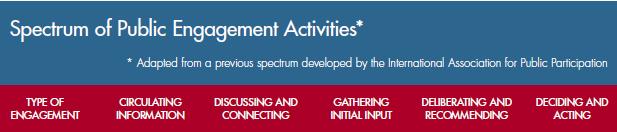
Here is a spectrum of public engagement appropriate for local governments in the United States. The activities range from “circulating information” to giving the public a role in “deciding and acting.”

It is based on a spectrum developed by the IAP2, but I have pasted this version from a new report entitled Planning for Stronger Local Democracy: A Field Guide for Local Officials. Written by Matt Leighninger, the Executive Director of the Deliberative Democracy Consortium,  and Bonnie Mann, Project Manager at the National League of Cities, this report is a practical guide for public officials who recognize a “‘Catch-22’ dilemma: public trust in government has declined steadily, while the active support and engagement of citizens has become increasingly critical for solving public problems.” The local officials who figure as positive examples in the report have figured out how to engage the public in governance–to mutual benefit.

The first part of the report is organized around a series of major questions, each accompanied by additional specific questions, examples of success, and other advice. Some of the major questions are nitty-gritty, such as “What are the legal mandates and restrictions on how you interact with the public?” Other questions indicate that formal structures and processes are not the only factors that matter; local officials ought to be concerned about civil society as a whole. For example: “How well are neighborhood associations and other grassroots groups serving their neighborhoods?” Still other questions raise essential issues of diversity and inclusion. For example: “In what ways are recent immigrants and other newcomers connected, or disconnected, from the rest of the community?”

The second part of the report is a guide for “Developing Shared Civic Infrastructure.” The practical outcomes could range from using social media more effectively to changing laws or even building physical spaces where people can meet.

If it’s true that distrust for government and for other citizens is preventing us from governing ourselves as a democratic people, then this report ought to be required reading for all leaders.