activism without ideology is hard

Traditionally, most student activism had ideological motivations. Most students (and faculty) would take action as muscular Christians, socialists, liberals, anarchists, Young Republicans, Maoists, or under some other label of that type. Their label would not only stand for abstract ideas but also for living heroes, strategies, organizations, career paths, specific publications–even hairstyles and music.

Today, we often ask students to do civic work in a thoroughly open-minded fashion, with full attention to local circumstances and diverse people’s views. I resonate to that philosophy but I think it makes motivation, recruitment, organization, and sustainability much harder.

Or so I argue in my “provocation,” one of 16 in a monograph edited by Don Harward and available free from Bringing Theory to Practice. All the provocations were casual, 10-minute talks delivered at a conference last fall, transcribed, and lightly edited for publication. They adopt very diverse perspectives on civic work, and are worth a read.

the cost of neglecting journalism

Last year, reporters from the LA Times, including Jeff Gottlieb and Ruben Vives, won the Pulitzer Prize for uncovering a staggering scandal in the small city of Bell, which is within Los Angeles County. The LA Times learned from public records that several Bell officials were paying themselves exorbitant salaries. The City Manager was taking home $1.5 million, including salary and benefits. They were paying themselves more for serving a poor community of about 35,000 people than their counterparts would earn in big cities.

The story led to federal prosecutions and a recall election that replaced the city’s whole power structure. The basic facts had been on the public record, but someone had to look for the information and then spread the word. That is a traditional job of the press, and the LA Times did its job for Bell, CA.

But, as Mary Lou Fulton and Fiona Morgan have both noted, this story has a sadly ironic aspect. How could a basic fact like the City Manager’s salary go unknown for many years? The major metropolitan daily newspaper, the LA Times, had cut its newsroom staff so deeply that they were no longer covering small municipalities like Bell. Meanwhile, the suburban weeklies and outlets for citizen journalists (such as community blogs) don’t do “enterprise reporting”: collecting new information on public issues. So, in a sense, the LA Times got a Pulitzer for addressing a gap in its own coverage.

I do not mean to rain on the parade of the LA Times. The problem is systemic and industry-wide. See also this post on the media ecosystem in Baltimore, and this one on media reform, broadly.

global citizenship and justice

Oxfam provides some excellent resources for civic education. Among its products is a guide for schools on “global citizenship” (pdf). This document says:

Oxfam sees the Global Citizen as someone who:

  • is aware of the wider world and has a sense of their own role as a world citizen
  • respects and values diversity
  • has an understanding of how the world works
  • is outraged by social injustice
  • participates in the community at a range of levels, from the local to
    the global
  • is willing to act to make the world a more equitable and sustainable
    place
  • takes responsibility for their actions.

By the way, a Global Citizen (so defined) can also be a good national citizen. But what interests me is the mix of principles on this list, many of which are logically separable. You could value diversity, be outraged by injustice, and take responsibility for your actions, but not think of yourself as a “world citizen” or operate at the global level. Or, if you run a multinational oil company, you could very much take a global perspective, understand how the world works–and even value diversity–but not care a fig for injustice.

In the 1800s, progressive nationalists, like Abraham Lincoln and Charles Dickens, were concerned with profound injustices–slavery and urban poverty–and saw advantages to a strong national consciousness. As I argue here, Dickens thought that British nationalism was a means of enlarging human sympathies, and Lincoln argued that preserving the Union as a democracy would serve human-kind. But other nationalists of the 1800s tried to develop nation-states as a means to wipe out hated minorities and dominate their regions.

Nationalism was a means, not an end. I am inclined to think the same of globalism today.

In the 1800s and early 1900s, political thinkers often romanticized “the people” as a homogeneous and progressive force. Marxists assumed that working people were beginning to share class-consciousness that would prevail in a revolution. Democratic populists assumed that the people would vote for justice if they achieved genuinely equal political power. In fact, the working people of Europe supported slaughtering other working people on the battlefields of World War I and then splintered into left and right.

I fear we risk romanticizing the people of the world in the early 2000s. If they all saw themselves as global citizens and wielded equal power in global forums, that does not mean that they would unite. In Canada, for example, climate change may mean an improved standard of living as the extent of arable land expands and oil and gas reserves become even more valuable. If Canadians (who are already quite cosmopolitan) become more active and influential at the global level, that’s not necessarily good news for Bangladeshis.

All of which is to say that fighting injustice is the important part. Being a global citizen is only desirable to the extent that it promotes justice.
under the Wikipedia hood

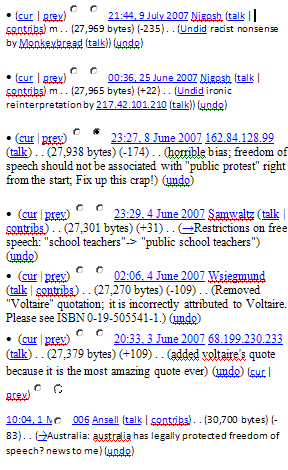
Intrigued by a work of art by Allan Chochinov, I went looking at the Wikipedia entry on “Freedom of Speech” and opened the behind-the-scenes page where you can see all the revisions to that entry. It has been revised 2,551 times, almost once per day, since 2005, by people sitting at 1,142 different computers (or IP addresses, to be precise).

The Freedom of Speech article itself is only about 6,000 words long. It strikes me as a little miscellaneous (frankly), with extensive citations from well-known authorities like J.S. Mill as well as minor figures. Its opening sentence, “Freedom of speech is the political right to communicate one’s ideas via speech,” is actually controversial. (Political right–or moral right? Should you only be free to communicate ideas?)

But what I appreciate most is the large array of obsessive, pseudonymous, multinational, uncivil, unregulated discourse that is collectively generating the 6,000 words about “Freedom of Speech.” Samples:

the changes in voting laws

Craig Newmark has a nice graphic illustrating the rapid changes in state voting laws since 2010, most of which make voting more restrictive. I’ve been thinking about this issue in various ways all week, meeting with key experts in DC on Monday, writing a short op-ed for the Tufts student paper, addressing the issue on a public panel today, and thinking about various forms of useful research we might do during this cycle.

We should worry about the effects of the new photo ID laws and other new restrictions. Perhaps most troubling to me is Florida’s requirement to be licensed before you can register voters; the state also threatens high fines if you don’t submit your lists on time. As a result, a lot of nonpartisan voting organizations are withdrawing from Florida. CIRCLE’s contribution will be some research on the effects of these new policies.

But we shouldn’t allow the new restrictions to occupy our whole attention, because the state laws already varied enormously before 2010. Some were friendly to voting. Election Day Registration is allowed in some dates and has been found to raise youth turnout by some 14 percentage points. Other rules were already very onerous, far more so than in other democracies. As I wrote in my op-ed, “our system is complicated, cumbersome, uneven and easy to tweak for partisan gain.”

It needs a fundamental overhaul, and we should be challenging  basic assumptions. Why, in this day and age, should individuals have to register at all? (There are other ways to verify eligibility.) Why should partisan elected officials get to administer local elections? Why should the voting age be 18?