the state of the classics in 2050

(Washington, DC) In a fairly recent New York Review of Books essay, Mary Beard asks, “Do the Classics have a Future?” Borrowing a bit from her piece, I predict that the study of Greek and Latin will remain vital in the mid-21st century. Classics will not be a musty or ethnocentric discipline but will continue to have strategic centrality in the humanities as a whole. Yet the field will look quite different from the “classics” of 1900.

The study of classics is not valuable primarily because the ancient Greeks and Romans were interesting or admirable. Rather, the classical civilizations had enormous and lasting impact on subsequent cultures, even when the people who have come under their influence have resisted and resented it.

The impact of Greece and Rome was by no means limited to the “West,” whatever that may mean. In any country that is Catholic, Protestant, Orthodox, or (by no means least) Muslim, Greek sources have foundational importance. Those countries cover much of the five continents. Northern India also entered an important conversation with Hellenic civilization before the time of Alexander the Great. Add the Buddhist and Hindu countries to those previously mentioned, and most of the world shows Greek influence. Nor have the classics become less influential in recent years. From recent American poet laureates to Iranian Ayotallahs, serious readers of the Greeks and/or Romans remain very much alive. If one misses their classical referents, one cannot fully understand them.

In order to understand Greco-Roman civilization in any depth you need the ancient languages: not only a passing understanding of their grammars and vocabularies but significant experience in reading the original texts.

For almost 2,000 years, ending in the mid-1900s, privileged Europeans and European-influenced men around the world mastered Greek and/or Latin as a basic marks of education and class status. They did not merely translate from those languages but learned to write and speak in them. Three reasons explain the extraordinary investment in classical education.

  • Originally, it was practical. Latin long remained a living language, widely understood, and a convenient medium of international exchange in science as well as religion.
  • People believed in the special merit of the classical languages because the Christian Bible and liturgy had been conveyed in Greek and Latin and because pagan Greece and Rome were held in high regard.
  • Even when those first two reasons for a classical education had faded, it still offered a way of marking out people of intelligence and social advantage across the European-dominated world. Any difficult discipline would have worked for this third purpose, but people naturally settled on the classical languages because their curriculum was already well established and esteemed.

Since all three reasons have faded and a classical education no longer marks the ruling class, it is unrealistic to imagine that large numbers of people will ever again learn Greek and Latin. That means that our understanding of culture subsequent to the Fall of Rome is threatened.

Fortunately, not many people must master any particular field for that field to be understood. Knowledge is specialized, and the important question is not whether everyone knows everything, but whether the specialists share what they know both with professional collaborators in other fields and with laypeople.

We collectively must understand China and the biology of viruses, but that does not mean that most Americans must know Chinese or virology. Likewise, we need classicists, but we do not need everyone to study the classics. There should always be a strong cadre of professional classicists distributed around schools and universities so that they can influence interdisciplinary research and debates.

In 2050, most educated people will know far less about the classical languages and cultures than their predecessors did in 1950. That will not be lamentable, because they will know things that no one understood in 1950. They will continue to have some basic background in Greco-Roman civilization and will know how to find out more from increasingly sophisticated reference tools.

Professional classicists will be rare but not extinct. They will know more than has ever been known before about Greco-Roman civilization. After all, scholarship is cumulative, and classical scholarship draws on other fields across the humanities, social sciences, and even natural sciences. Although classicists will be rare, they will be in high demand, because the global impact of the Greeks and Romans make them crucial topics of study. And because classics is an interdisciplinary field covering more than a millennium of history, society, and culture, it will seem broad and integrative in ways that many other fields are not.

Ito Jakuchu at the National Gallery

In the National Gallery of Art in Washington DC, a large room replicates a Zen monastery in Kyoto where originally 30 large silk panel paintings of animals were hung with a triptych of the Buddha between two bodhisattvas. Ito Jakuchu painted all these panels between 1757 and 1766.

They are superficially uniform: all the same size and shape, hung on the same luxurious cloth backgrounds, showing small animals in shallow scenes that are gently or evenly lit so that barely any shadows emerge. But they are far from monotonous. Some are placid; others vibrant, crowded, even violent.

The technique varies widely. White paint is sometimes spattered on the back of the sheer silk panel to shine through and represent snow. In other cases, the artist builds up a large patterned area by coloring small planes that are surrounded by negative space (blank silk) instead of painted outlines. Certain objects are depicted with radical abstraction: a stream is just a serpentine block of paint. Other objects are represented in obsessive detail.

The room as a whole is arranged according to subtle patterns, with interesting parallels between each panel and the one facing it from the opposite wall.

I know little about Jakuchu’s cultural context and have read only that he was somewhat eccentric, independent of artistic schools, and a Sinophile Buddhist. But I imagine him saying something like this. “The snow doesn’t form subtle patterns above a pond for our delectation or by anyone’s design. It just falls that way because of what happened to occur before it fell. There is no plan or purpose to nature. Yet, because of the way we have evolved, we happen to find it lovely. We also love any physical object that represents such a scene. It too is the result of random and impersonal forces, the forces that created Ito Jakuchu and ultimately ended his life. Those white paint spatters on the back illustrate the “dependent origination” of this work. And yet they are not random. They were spattered by a man who was trying to recreate nature for his own delight and yours.”

Life may be a bridge
Between darkness and darkness,
But look at the birds.

Hegel and the Buddha

{May 2022: I see that this old and rather casual post gets a fair amount of traffic, presumably from people who are searching for combinations of “Hegel[ian]” and “Budd[ism].” A better post of mine would be “a Hegelian meditation.” See also: T.C. Morton, “Hegel on Buddhism” or Ariën Voogt, “Spirituality in Hegel’s Phenomenology of Spirit: An analysis in the wake of Foucault,” Metaphilosophy 52.5 (2021): 616-627.}

Contrary to popular belief, Hegel’s dialectic has nothing to do with “thesis, antithesis, synthesis.” The characteristic pattern is rather:

  • Consciousness: one experiences, thinks, and acts according to habit, custom, or instinct;
  • Self-consciousness: one becomes aware of one’s habits, customs, or instincts, leading to irony, discomfort, conflict, and creativity;
  • Reason: One chooses a particular way of thinking and being.

The cycle can repeat if one realizes that what looked like “reason” was, from a more distant perspective, an arbitrary choice.

I studied Hegel long ago and have found his structure widely applicable. Only lately have I paid serious attention to the thinker we call the Buddha. A characteristic pattern for him is:

  • Suffering: the experience of all sentient beings, which inevitably includes frustration, fear, pain, and loss;
  • Attachment: suffering that arises from wanting something that one cannot control (and often from knowing that what one wants cannot be had);
  • Cessation of suffering, which arises from renouncing attachment;
  • Equanimity, which is not complete dis-attachment or lack of concern but rather deliberate engagement with the world without a futile sense of frustration.

The parallels seem to me interesting and fruitful, although not exact.

the educational enrichment gap

This is a graph from Duncan and Murnane’s Whither Opportunity?* It shows the average amount of money, adjusted for inflation, that families in the top and bottom quarters of the income distribution spend on “educational enrichment” for their own kids: lessons, summer camps, educational software, nannies, etc. In real terms, the amount has much more than doubled for upper-income families in one generation–but it is flat for people at the bottom of the income distribution.

I would propose three explanations.

The main driver could be the very difficult financial situation of people at the bottom of the income distribution: they can’t afford nannies, for sure.

A second explanation is the declining prevalence and value of free, public opportunities for kids. Extracurricular groups, for example, have shrunk. As schools face financial and accountability pressures and middle-class families exit, there are fewer opportunities to learn by (for example) playing clarinet in the school band.

The third hypothesis is a pretty significant difference in parenting styles. Annette Lareau found that middle-class families (irrespective of race) were using a strategy of “concerted cultivation,” investing time and money in 24/7 educational experiences. Working-class families were opting instead for “the accomplishment of natural growth”: letting kids be kids and not putting excessive pressure on them. I think back in my day–the beginning of the graph above–middle class families also preferred “the accomplishment of natural growth,” but they have decided that it will no longer suffice for their kids.

*From the introduction to Greg J. Duncan and Richard J. Murnane, eds., Whither Opportunity? Rising Inequality, Schools, and Children’s Life Chances, (New York/Chicago: Russell Sage/Spencer Foundation) 2011.

segregation can result even when people prefer diversity

Between 1969 and 1971, Tom Schelling, later my esteemed colleague at the University of Maryland, found that segregation results if people can move freely, even if they actually prefer a modest degree of diversity. For example, if everyone wants their children to attend schools that are racially diverse, but they would prefer their own race to be the majority, they will segregate into mono-racial schools. Similarly, if people prefer to live in politically vibrant communities where many opinions are held–but everyone prefers his own party to be the local majority–perfect partisan segregation will result.

You can test this pattern with a nice app by Uri Wilensky.* It distributes green and red turtles randomly in a “pond,” leaving some spaces open. You can set the turtles’ preference for the diversity of their immediate neighbors. Even if they prefer to sit among 25% turtles of the opposite color, they quickly sort into 99% homogeneous blocks, ringed by empty space. This is the result after the turtles have moved:

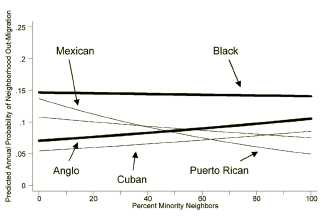
I showed this app to my students last Friday, but we also looked at an empirical study of Americans’ actual movement patterns in recent years.** This graph from Pais et al shows, for example, that a white family has about a 7% chance of moving in any given year if their neighbors are 100% white, rising to an 11% chance if their neighbors are 100% black. (The model controls for economics, crime, etc.)

On one hand, that’s not a very steep curve, and it doesn’t reflect deep racial animosity or aversion. On the other hand, a 4-point annual shift will quickly accumulate, especially since neighborhoods that start with any diversity are quite rare. This means that any integrated neighborhood, school, college, or workplace is endangered even if people prefer a degree of diversity.

Continue reading