why “liberal” can sound like “upper-class”

In an article reporting The New York Times‘ recent battleground state polls, Lisa Lerer and Ruth Igielnik quote Jonathan Ball, a Michigan floor-installer:

[He] said he believed Mr. Trump would do more to help working Americans than Ms. Harris. “I think she’s more liberal. I just don’t think she’s all for the middle class,” said Mr. Ball, 46, who plans to support Mr. Trump for a third time this fall. “I just see her one-sided. You know, for the rich.”

I don’t know how many people associate being liberal with being from (or for) the rich. I would like to see survey data specifically on that question, which would allow us to measure the prevalence of this view in various parts of the electorate. But we know that Mr. Ball’s view is not unique. In her book American Made: What Happens to People When Work Disappears, Farah Stockman discusses an Indiana industrial worker who divides the world between workers (such as himself) and capitalists, urges his union to fight the company, and votes for Trump. His wife is more favorable to management. On that basis, he categorizes her as a “liberal.” I’ve heard real people say the same kind of thing myself.

I grew up believing the opposite: that liberals were more favorable to workers than conservatives were. I acknowledge that this assumption is debatable. Libertarians argue that liberal policies are especially costly to working people. Socialists may distinguish bourgeois liberalism from more radical reform and sometimes see liberals as the main obstacles to social justice. But I doubt either framework is driving these workers’ interpretation of liberalism as favorable to the upper class.

Here is an alternative theory. If you are a worker and a consumer, you are always being notified of rules and policies that constrain and modify your behavior. Some of these rules result from governmental policies that I would code as “liberal.” For instance, the state might pass a law that results in your HR department warning you against sexual harassment. Some of the rules come from government but are not especially liberal, e.g., Don’t use marijuana. And many are not due to the government at all. For example, the same HR department that warns you not to sexually harass your colleagues also warns you not to take unauthorized breaks and not to use the company’s equipment for private purposes.

The tone, format, and consequences of all these rules are similar. The same people deliver and enforce them. These people are managers: white-collar workers with college degrees, sometimes from the corporate HQ in a big coastal city.

They talk and act rather like the most prominent advocates of liberal policies. First of all, politicians in general come from the same professions that set and enforce rules in the workplace. Nicholas Carnes notes that 75% of members of Congress were lawyers or business owners before they ran for office, compared to less than 2% who “came [directly] from working class occupations. … Even districts where working-class people make up disproportionate shares of voters seldom elect working-class politicians” (Carnes 2011). And, among politicians, Democrats are perhaps especially likely to sound like upper management. For instance, Democrats now represent the 17 richest congressional districts.

You’d have to be very politically sophisticated to separate the directives that result from liberal (or progressive, or leftist) governmental policies from those that are meant to profit the company. They all sound like the wishes of highly-educated and well-paid people at corporate headquarters. And the national leaders who advocate for the policies that are liberal sound just the same as your corporate managers.

Regulations can be beneficial and even necessary, but they are not very transparent. It is hard for the recipients to understand who is responsible for a given regulation; and legislators can’t be sure who will be affected, or how. Laws must go through regulatory agencies, courts, and private offices (like a corporation’s HR department) before they reach the people who are regulated, by which time the legislators who voted for them may not recognize the results. And workers and consumers receive a constant stream of directives that reflect companies’ wishes rather than legal mandates.

I am more enthusiastic about taxing and spending as tools of public policy. And I prefer direct, transparent taxes, especially taxes on personal income, rather than sales taxes, tariffs, or corporate income taxes, which have opaque and unpredictable costs for various people. We should be able to say: We compelled these people to pay this proportion of their incomes to buy these goods, which include new jobs for working people.

As long as we deputize private actors to regulate behavior, we must try to mitigate the resulting confusions. Small steps may be worth taking, like nominating Tim Walz instead of yet another big-city lawyer to be a face of the Democratic Party. But the problem may be endemic to the administrative state, in which case it requires more than cosmetic changes.

See also a conversation with Farah Stockman about American Made: What Happens to People When Work Disappears; class inversion as an alternative to the polarization thesis; beyond Chevron

Montaigne and Buddhism

Michel de Montaigne (1533-1592) was deeply influenced by the ancient philosophical school called Skepticism, which he first studied directly in the form of a 1562 translation of Sextus Empiricus’ Outlines. Sextus had called himself a follower of the first Skeptic, Pyrrho of Elis (ca. 360-270 BCE).

Ancient authors report that Pyrrho went to India with Alexander the Great and studied with there with Indian philosophers. Christopher Beckwith makes the boldest case that Pyrrho was in fact a Buddhist, and thus Greco-Roman Skepticism was an offshoot of Buddhism. In turn, Montaigne called Skepticism “the wisest school of philosophy” (see below).

I cannot assess Beckwith’s thesis that Pyrrho was a Buddhist. However, I have found parallels between Montaigne’s writing and a specific text from the Buddhist Pali Canon, The Atthaka Vagga or “Octet Chapter.” Because material from this work has also been traced to the Greco-Buddhist kingdoms of what is now Afghanistan and Pakistan, it may be especially old and close to what Pyrrho might have learned when he went to India.

It is possible to doubt that this early text–when read on its own–really captures what we should call “Buddhism.” The Octet Chapter emphasizes the value of renouncing all kinds of beliefs and presents the model of a sage as one who avoids concepts and arguments. I don’t see anything in this text about nirvana or perfect enlightenment, but rather an argument for a certain way of living as a sage. It sounds a bit like the doctrine of the (non-Buddhist) teacher Sañjaya Belatthiputta, who is presented as misguided in an influential long discourse from the same Pali Canon (DN 2).*

Still, any category as abstract as Buddhism can be defined in many ways, and arguably this text belongs to it. In fact, some have seen the Octet Chapter as presciently Buddhist, foreshadowing the Mahayana School. And whether or not this text is Buddhist, it is also consistent with Skepticism. In fact, there could have been some reciprocal influence from Greco-Roman Skepticism back to Mahayana.

The most interesting questions, for me, are not about who influenced whom or where various ideas began, but rather how we should live now. To that end, I present some characteristically quotable sentences from Montaigne in parallel with verses from the Octet Chapter of the Pali Canon.

From Michel de Montaigne, The Complete Essays, translated by M.A. Screech, PenguinFrom AN Anthology of Discourses: A refreshing translation of the SuttanipAta, TrANS. by Bhikkhu Sujato
Most pleasures, they say, tickle and embrace us only to throttle us… If a hangover came before we got drunk we would see that we never drank to excess: but pleasure, to deceive us, walks in front and hides her train (p. 275).If a mortal desires sensual pleasure and their desire succeeds, [most people] definitely become elated, having got what they want. 
But for that person in the throes of pleasure, aroused by desire, if those pleasures fade, it hurts like an arrow’s strike (Snp 4.1)
My business, my art, is to live my life (p. 425). Now since we are undertaking to live, without companions, by ourselves, let us make our happiness depend on ourselves (p. 269).The chains of desire, the bonds of life’s pleasures are hard to escape, for one cannot free another (Snp 4.2).

Understanding the teaching, [the wise] are independent (Snp 4.15).
The learned do arrange their ideas into species and name them in detail. I, who can see no further than practice informs me, have no such rule, presenting my ideas in no categories and feeling my way – as I am doing here now (pp. 1221-1222).“Purity is spoken of not in terms of view,” said the Buddha to Maga??iya, “learning, knowledge, or precepts and vows; nor in terms of that without view, learning, knowledge, or precepts and vows. Having relinquished these, not adopting them, peaceful, independent, one would not pray for another life” (Snp 4.9).
We are never ‘at home’: we are always outside ourselves. Fear, desire, hope, impel us towards the future; they rob us of feelings and concern for what now is, in order to spend time over what will be – even when we ourselves shall be no more. ‘Calamitosus est animus futuri anxius’ [Wretched is a mind anxious about the future-Seneca] (p. 11).Greedy, fixated, infatuated by sensual pleasures, [many people] are incorrigible, habitually immoral. When led to suffering they lament, “What will become of us when we pass away from here?” That’s why a person should train in this life (Snp 4.2).
That man will be happy and master of himself who every day declares, ‘I have lived. Tomorrow let Father Jove fill the heavens with dark clouds or with purest light’… [Horace] Let your mind rejoice in the present: let it loathe to trouble about what lies in the future. (p. 43).Rid of attachment to the future, [wise people] don’t grieve for the past. A seer of seclusion in the midst of contacts is not led astray among views (Snp 4.10)
So too for our souls: we must therefore educate and train them for their encounter with that adversary, death; for the soul can find no rest while she remains afraid of him. But once she does find assurance she can boast that it is impossible for anxiety, anguish, fear or even the slightest dissatisfaction to dwell within her. And that almost surpasses our human condition (p. 101). Rid of desire for both ends, having completely understood contact, free of greed, doing nothing for which they’d blame themselves, the wise don’t cling to the seen and the heard.  Having completely understood perception and having crossed the flood, the sage, not clinging to possessions, with dart plucked out, living diligently, does not long for this world or the next (Snp 4.2)
That is why it is equally mad to weep because we shall not be alive a hundred years from now and to weep because we were not alive a hundred years ago (p. 102). Short, alas, is this life; you die before a hundred years. Even if you live a little longer, you still die of old age. People grieve over belongings, yet there is no such thing as permanent possessions. Separation is a fact of life; when you see this, you wouldn’t stay living at home (Snp 4.6).
When my convictions make me devoted to one faction, it is not with so violent a bond that my understanding becomes infected by it.
(p. 1144). I am firmly attached to the sanest of the parties, but I do not desire to be particularly known as an enemy of the others beyond what is generally reasonable (p. 1145).
Desiring debate, [many people] plunge into an assembly, where each takes the other as a fool. Relying on others they state their contention, desiring praise while claiming to be skilled. Addicted to debating in the midst of the assembly, their need for praise makes them nervous. But when they’re repudiated they get embarrassed; upset at criticism, they find fault in others (Snp 4.8).
If, maintaining that theirs is the “ultimate” view, a person makes it out to be highest in the world; then they declare all others are “lesser”; that’s why they’re not over disputes. …

[Instead, the wise person] does not grasp any view—how could anyone in this world judge them?  They don’t make things up or promote them, and don’t subscribe to any of the doctrines. The brahmin has no need to be led by precept or vow; gone to the far shore, one such does not return. (Snp 4.5)
Now the Pyrrhonians make their faculty of judgement so unbending and upright that it registers everything but bestows its assent on nothing. This leads to their well-known ataraxia: that is a calm, stable rule of life, free from all the disturbances (caused by the impress of opinions, or of such knowledge of reality as we think we have) which give birth to fear, acquisitiveness, envy, immoderate desires, ambition, pride, superstition, love of novelty, rebellion, disobedience, obstinacy and the greater part of our bodily ills. In this way, they even free themselves from passionate sectarianism, for their disputes are mild affairs and they are never afraid of the other side having its say (pp. 560-561).A mendicant, peaceful, quenched, never boasts “thus am I” of their precepts. They have a noble nature, say those who are skilled, who have no pretensions regarding anything in the world. 
For one who formulates and creates teachings, and promotes them despite their defects, if they see an advantage for themselves, they become dependent on that, relying on unstable peace. 
It’s not easy to get over dogmatic views adopted after judging among the teachings. That’s why, among all these dogmas, a person rejects one teaching and takes up another. 
The cleansed one has no formulated view at all in the world about the different realms. Having given up illusion and conceit, by what path would they go? They are not involved (Snp 4.3).

A person who has given up all judgments creates no conflict in the world.” (Atthakavagga, shorter discourse on ‘arrayed for battle’)
Pyrrhonist philosophers, I see, cannot express their general concepts in any known kind of speech; they would need a new language: ours is made up of affirmative propositions totally inimical to them – so much so that when they say ‘I doubt’, you can jump down their throats and make them admit that they at least know one thing for certain, namely that they doubt. …
(Scepticism can best be conceived through the form of a question: ‘What do I know?’ – Que sçay-je, words inscribed on my emblem of a Balance.)
(pp. 590-1).
[Question:] how do happiness and suffering disappear? 
[Buddha’s answer:] Without normal perception or distorted perception; not lacking perception, nor perceiving what has disappeared. Form disappears for one proceeding thus; for judgments due to proliferation spring from perception. … Knowing that these states are dependent, and knowing what they depend on, the inquiring sage, having understood, is freed, and enters no dispute.
‘No reason but has its contrary,’ says the wisest of the Schools of Philosophy (p. 694, quoting Sextus; and Screech notes that Montaigne had this epigram inscribed in his library.)One who knows, having comprehended the truth through the knowledges, does not visit various teachers, being of vast wisdom. …. The brahmin has stepped over the boundary; knowing and seeing, they adopt nothing. Neither in love with passion nor besotted by dispassion, there is nothing here they adopt as the ultimate (Snp 4.4) That’s why they’ve gotten over disputes, for they see no other doctrine as best (Snp 4.13).
I reckon that it is as injudicious to set our minds against natural pleasures as to allow them to dwell on them (p. 1256). When I dance, I dance. When I sleep, I sleep; and when I am strolling alone through a beautiful orchard, although part of the time my thoughts are occupied by other things, for part of the time too I bring them back to the walk, to the orchard, to the delight in being alone there, and to me (p. 1258).
Guarded in these things, walking restrained in the village, they wouldn’t speak harshly even when provoked. 

Eyes downcast, not footloose, devoted to absorption, they’d be very wakeful (Snp
Attyhakavagga, “With Sariputta”),

To me, the most likely difference is in the last row. In his final essay, “Of Experience,” the elderly Montaigne expresses genuine enthusiasm for the experiences of his present life, whereas the Pali text recommends guarded “wakefulness.” When Montaigne writes about bringing his thoughts “back to the walk, to the orchard, to the delight in being alone there, and to me,” he sounds like a practitioner of mindfulness, but not very much like the author(s) of the Octet Chapter. A little facetiously, we could say that Montaigne was more of a Buddhist than the author(s) of this early Buddhist text. Or we could just acknowledge that he was also an Epicurean.

*Thanissaro Bhikkhu considers evidence that this text is very early and is philosophically distinct from the Pali Canon but largely disagrees. See also: Montaigne the bodhisattva?; some basics; the fetter; Cuttings version 2.0: a book about happiness; what should we pay attention to?

Svetlana Alpers, The Art of Describing

My family and I are going briefly to the Netherlands soon. In preparation, I reviewed Svetlana Alpers’ The Art of Describing: Dutch Art in the Seventeenth Century (1983), which has helped me to think about pictures since I first encountered this book in the 1990s.

Alpers’ theory is subtler than my summary, but a good way to introduce it might be to consider two paintings (neither of them discussed by Alpers).

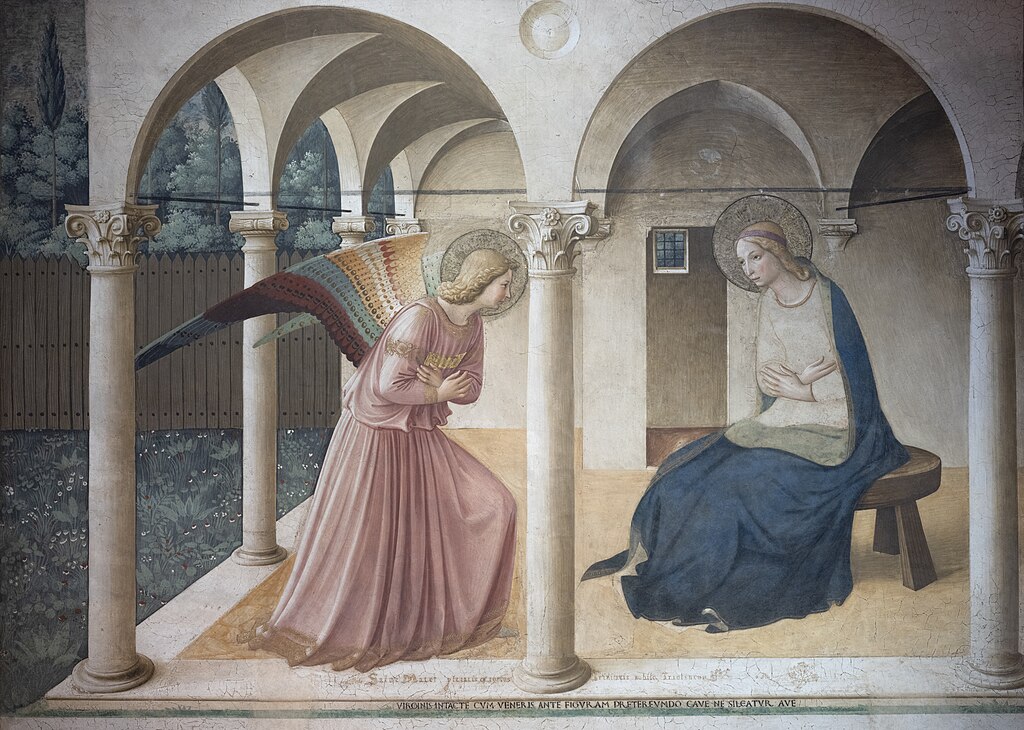
First, an Annunciation by Fra Angelico from 15th-century Florence:

This image conveys a story (Luke 1:26-38). The important questions for the viewer are what is happening and what that signifies. (In this case, the significance is cosmic, since the the Incarnation is underway.) The characters are central; other objects function like scenery and props for these protagonists.

The frame is like a window or a proscenium arch that allows us to look into a defined space. We are assumed to stand or kneel in front of the frame, looking toward the vanishing point right above Mary’s head. Each object is clearly outlined–probably first drawn, then colored in. The artist has analyzed reality in terms of these outlines. For instance, the building is a perfect rectangle; the arches are half-circles. And the bodies of the angel and woman are meaningful shapes, since humans were created in the image of God. By showing the true shape of important objects and people, the artist conveys truths of theology, geometry, and other worthy subjects.

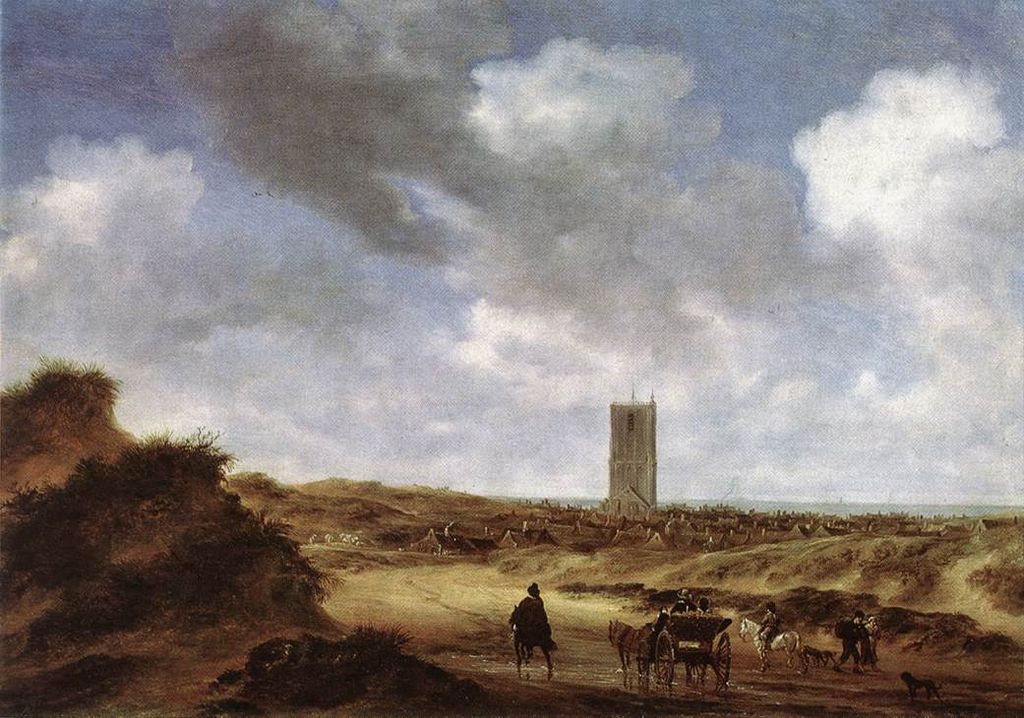
Now compare a View of Egmond aan Zee by Salomon van Ruisdael.

This work also shows a few people in a context. But now we might imagine that we always have a visual field that changes as we move our eyes, our heads, and our locations in space. We can’t even tell the shape of our current visual field because it moves as we try to look at the edges. This picture is like a finite rectangle that has been snipped out of the whole field at a certain moment and hung on the wall. It is formed not of outlines but of brushstrokes. It was probably not drawn but composed with paint.

Van Ruisdael surely had aesthetic reasons for what he included and where he placed these objects, enjoying the location of the bluff, the darker cloud, and the church tower. But he hid his own contrivance by allowing the frame to interrupt the landscape and clouds. We do not imagine that the frame is something real, like a window, but just the edge of the image.

It is not clear where the viewer is located, partly because there are hardly any objects with sharp edges that would allow us to infer a vanishing point. We might be looking gently down on the scene, or we might not occupy any single location. Similarly, a map presents the earth as it would be seen from no particular point, without foreshortening. The Dutch were fascinated by maps and excellent at mapmaking.

All the objects are interesting; the eye does not necessarily settle on anything in particular but moves across the canvas. Everything is bathed in the same light and air. Something is happening–a group moves toward the town–but the painting is not a meaningful story, and the best question is not “What does their activity signify?”

Alpers thinks the purpose of this second work is to describe the reality that the viewer already knows, because the viewer delights both in the physical world and in the art of description. Other critics have supposed that appreciation of the natural world is spiritual, based on the idea of a creator.

Here, “art” has its original, Latin sense, which encompasses what we would call science as well as painting. A Dutch person would buy a van Ruisdael for the same reason that he would look through van Leeuwenhoek’s microscope, Christiaan Huygens’ telescope, a lens ground by Spinoza, or at a map. He wanted to learn more about how things look.

Alpers identifies the first model with Italy and the second with the North, especially the Netherlands, but she resists a simple dichotomy. The two “schools” were in close contact from the 1400s on. Major artists intuitively understood the differences, and some (such as Michelangelo) wrote explicitly about them. Unsurprisingly, some of the most interesting artists disrupted the dichotomy in original ways. Alpers discusses Rembrandt as an example and mentions some Southern cases that are beyond the scope of her book about Dutch art: Titian, Caravaggio, and Velazquez.

The two models are heuristics for understanding a wide range of European painting, but great artists have challenged it.

See also: three great paintings in dialogue;  Velazquez, The Spinnersan accelerating cascade of pearls (on Galileo and Tintoretto); the Dutch secretManet’s “Old Musician” (from 2004); and trying to look at Las Meninas (from 2005).

using a model to explain a single case

Charles Sanders Peirce introduced the logic of what he called “abduction” — a complement to both deduction and induction — with this example:

The surprising fact, C, is observed;
But if A were true, C would be a matter of course,
Hence, there is reason to suspect that A is true.

At least since Harry Frankfurt in 1958, many readers have been skeptical. Can’t we make up an infinite number of premises that could explain any surprising fact?

For instance, Kamala Harris has gained in the polls compared to Joe Biden. If it were true that voters generally prefer female presidential candidates, then her rise would be a “matter of course.” But it is a mistake to infer that Harris has gained because she is a woman. Other explanations are possible and, indeed, more plausible.

Note that “voters prefer women candidates” is an empirical generalization. Generalizations cannot be derived from any single case. If that is what abduction means, then it seems shaky. Its only role might be to suggest hypotheses that should then be tested with representative samples or controlled experiments.

But what if A (the premise) is not an empirical generalization but rather a model? For instance, a model might posit that Harris’ current position in the polls is the combined result of eight different factors, some of them general (voters usually follow partisan cues) and some of them quite unrepeatable (the incumbent president has suddenly bowed out).

Positing a model to explain a single case has risks of its own. Perhaps we add no insight by contriving an elaborate model just to fit the observed reality. And we might be tempted to treat the various components of the model as general patterns and apply them elsewhere, even though one case should give us no basis for generalizing.

But let’s look at this example from a different perspective–a pragmatic one, as Peirce would recommend. After all, Peirce calls his topic “Abductive Judgment” (Peirce 1903), suggesting a connection to practical reason or phronesis.

The question is what should (someone) do? For instance, a month ago, should Joe Biden have dropped out and endorsed Harris? Right now, should Harris accentuate her gender or try to balance it with a male vice-presidential candidate?

Inductive logic might offer some insights. Research suggests that the choice of vice-president has never affected the outcome of a presidential election, and this general inference would suggest that Harris needn’t pay attention to the gender of her VP. But induction cannot answer other key questions, such as what to do when you replace the nominee 100 days before the election. (There is no data on this matter because it hasn’t happened before.)

Besides, various factors can interrelate. The general pattern that vice-presidents do not matter might be reversed in a situation where the nominee had herself been the second person on the ticket until last week.

And the important questions are inescapably normative. For Harris, one good goal is to win the election, but she must attend to other values as well. For instance, I think she should adopt positions that would benefit working-class voters of all races. Possibly this would help her win by restoring some of Biden’s working-class coalition from 2020. Polling data would help us assess that claim. But I favor a worker-oriented strategy for reasons of justice, and I think the important question is how (not whether) to campaign that way.

Models of social phenomena typically incorporate descriptive elements (Harris is down by two points today), causal claims (Trump is still benefitting from a minor convention bump), and normative premises (Harris must win)–all combined for the purpose of guiding action.

Arguably, we cannot do better than abduction when we are trying to decide what to do next. Beginning with a surprising fact, C (and almost anything can be seen as “surprising”), we must come up with something, A, that we can rely on to guide our next steps. A should not be a single sentence, but rather a model composed of various elements.

It is worthwhile to consider evidence from other cases that may validate or challenge components of A. But it is not possible to prove or disprove A. As the pioneering statistician Georg Rasch said, “Models should not be true, but it is important that they are applicable, and whether they are applicable for any given purpose must of course be investigated. This also means that a model is never accepted finally, only on trial.”

If a model cannot be true, why should we make it explicit? It lays out what we are assuming so that we can test the assumptions as we act. It promotes learning from error. And it can help us to hold decision-makers accountable. When evaluating leaders, we should not assess the outcomes, which are beyond anyone’s control, but rather the quality of their models and their ability to adjust in in the light of new experience.

Sources: Peirce, C.S. 1903. Lectures on Pragmatism, Lecture 1: Pragmatism: The Normative Sciences; Frankfurt, Harry G. “Peirce’s notion of abduction.” The Journal of Philosophy 55.14 (1958): 593-597. See also: choosing models that illuminate issues–on the logic of abduction in the social sciences and policy; modeling social reality; different kinds of social models

what should we pay attention to?

In “Your Mind is Being Fracked” (May 31, 2024), Ezra Klein Interviews Princeton professor D. Graham Burnett. Their main topic is how companies manipulate our attention for profit–to our severe detriment.

Klein and Burnett also contrast two senses of “attention.” One is a focus on a practical task, leading to action. The other is an openness to experience or to another person that feels more like quiet waiting. These two forms of attention can conflict. The latter is especially at risk in a world of busy work-schedules and portable electronic devices.

At one point, Klein refers to the “debate that we’re having right now about smartphones and kids.” He acknowledges that there is an unresolved debate about the critique of smartphones that Jonathan Haidt and others are making; “the research is very complicated and you can fairly come to a view on either end of it.” But for Klein, the effects of heavy smartphone use are not really the point. He says,

If you convinced me that my kids scroll on their phones for four hours a day, had no outcome on their mental health at all — it did not make them more anxious — it did not make them more depressed — it would change my view on this not at all. I just think, as a way of living a good life, you shouldn’t be staring at your phone for four hours a day.

And yet, I also realize the language of society right now and parenting doesn’t have that much room for that. And I think we have a lot of trouble talking about just what we think a good life would be. Not a life that leads to a good job, not a life that leads to a high income, but just the idea, which I think we were more comfortable talking in terms of at other points in history, that it is better to read books than to not read books ….

As someone who spends about 3.5 hours a day on my smartphone and who reads somewhat fewer books than I once did, I agree that it is better to read books. Either my attention is being “fracked” (forcibly extracted for profit) or I am making unwise choices, or both.

I would define the benefits of reading much as Klein does later in the interview. A carefully constructed, lengthy written work affords us access to someone else’s thinking, thus allowing us to escape from our own limited selves. As my former colleague Maryanne Wolf said in a previous Klein podcast, “deep readers” display signs of absorption, empathy, and creativity. This mental state may have positive outcomes later, but that’s not really the point. Our life consists of time. What matters is the quality of it. Being absorbed, empathetic, and creative is good. Spending our time in a state of distraction and anxiety is not.

But here are some complications …

Klein is rightly concerned about a simplistic ideal of free choice that blocks us from asking whether some choices are better than others, either for ourselves or for our children. On the other hand, as Klein might acknowledge, choice is important. People differ, and we know things about our own needs and interests that others do not know. Also, we have the right to be the authors of our own lives. If someone forcibly took away my iPhone and ordered me into the library, I would have a good reason to be angry.

John Stuart Mill famously argued that individuals should have the liberty to allocate their time, yet if they are exposed to the higher things, they will freely choose them. If Mill was right, then excellence does not conflict with freedom. Liberal education liberates us by giving us the opportunity to choose higher things.

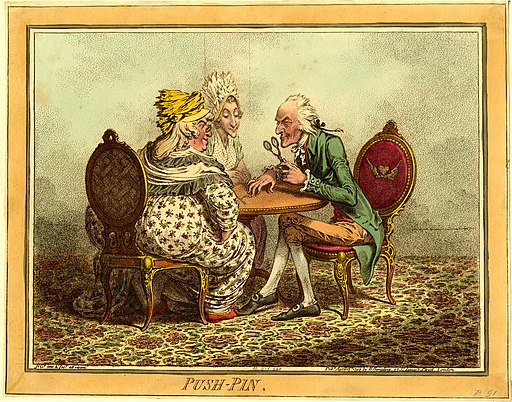
Mill’s predecessor, Jeremy Bentham, had said that poetry was just as valuable as the folk game of “push-pin” (illustrated above by James Gillray). But Mill responded that people who have the opportunity to learn poetry will not want to waste their time on such trivial table games.

Mill may not be right. I was given an expensive and extensive education, yet I am addicted–noticeably, although not overwhelmingly or irretrievably–to my phone. Sure, I sometimes use it for worthy purposes, including episodes of deep reading on its small screen, but I also play Stormbound enough to compete in the Platinum League. Actually, Stormbound has the same basic logic as push-pin–I try to get my tokens over the other player’s baseline, much like the Duke of Queensberry in Gillray’s cartoon.

In short, offering everyone experiences with higher things may not work. Look at me, with my Oxford doctorate in literae humaniores–I spend my day playing Stormbound.

But we should be open-minded and thoughtful when we make value-judgments. The game of push-pin actually doesn’t sound so bad. It was a safe contest of skill between human competitors–maybe a way to sustain relationships.

Meanwhile, Bentham was suspicious of poetry. He saw poets as prone to lies and exaggeration. If we think that Bentham was wrong–poetry is better than push-pin–we owe an account of its value. What is so good about poetry and so bad about games? And is all poetry really worth our time?

I think I can address these questions. Poetry is language that is especially carefully constructed, with particular attention to its formal qualities. As such, it is particularly well suited to promote absorption, assuming that you really attend to it and learn how to analyze it. Reading poetry requires experience, particularly because poems tend to refer to previous poems, and it’s only by reading many of them that you can really begin to see how they operate. Therefore, it is advanced reading that is worthy, not just any reading. As Wallace Stevens says, “Poetry is one of the enlargements of life.”

Games are also worthwhile, particularly when they involve people who know each other and are in physical proximity, so that the players can learn and care about one another and exercise their bodies as well as their minds. I’m for push-pin! In contrast, my smartphone games pit me against the AI or against completely anonymous human opponents, and as such, they offer no human interaction. Besides, they are carefully designed to pull me back in for another round. In these respects, they are worse than poetry. (Yet I sometimes find my mind wandering into worthy topics while I play, so maybe that isn’t so bad.)

The main point here is that our evaluation of various activities should be nuanced and critical, not prejudiced by assumptions about what count as the higher pursuits.

For me at least, the epitome of an absorbing experience that takes me out of my own mind is a classic novel. Because of its length and careful construction, it retains attention. Because it is fictional, it is truly the product of someone else’s thought. Because it is mere text on paper, it requires and promotes imagination. And because I am not a literary critic, I don’t get anything concrete from reading a novel; its value is intrinsic.

Thus we might want to pursue activities that are as much as possible like reading classic novels. However, from his unorthodox Marxist perspective in the 1930s, the great critic Walter Benjamin disparaged novels in favor of “stories.” By the latter word, he meant folktales and other oral narratives that emerge from the masses. Benjamin preferred stories because they are communal and they elicit responses from their listeners, including impromptu additions. In contrast, novels are constructed by solo authors who control the whole narrative, including its end. The relationship between the novelist and the reader is private and consumeristic: I buy the experience that James Joyce manufactured.

If we applied Benjamin’s argument to the present day, it would offer no justification for playing Stormbound. But it might justify spending time interacting with other people on a social network (ignoring, for a moment, the problem of corporate ownership, which Benjamin would decry). Benjamin would see the attention demanded by a novel as individualistic and consumerist.

Here is a different take on somewhat similar issues. In one of the oldest of all Buddhist texts, “The Fruit of Contemplative Life” from the Pali Canon, the Buddha tries to teach a very bad king, Ajatasattu–who is troubled by guilt for having murdered his own father and usurped the throne–to follow a monk’s contemplative path. One recommendation is “sense restraint”:

And how does a mendicant guard the sense doors? When [monks see] a sight with their eyes, they don’t get caught up in the features and details. If the faculty of sight were left unrestrained, bad unskillful qualities of covetousness and displeasure would become overwhelming. For this reason, they practice restraint, protecting the faculty of sight, and achieving its restraint. When they hear a sound with their ears … When they smell an odor with their nose … When they taste a flavor with their tongue … When they feel a touch with their body … When they know an idea with their mind, they don’t get caught up in the features and details. If the faculty of mind were left unrestrained, bad unskillful qualities of covetousness and displeasure would become overwhelming. For this reason, they practice restraint, protecting the faculty of mind, and achieving its restraint. When they have this noble sense restraint, they experience an unsullied bliss inside themselves. That’s how a mendicant guards the sense doors.

DN 2, translated by Bhikkhu Sujato, on suttacentral.net

This passage surprises me a little because I would have thought that “getting caught up in … features and details” is how we achieve attention. Our task, when we read a poem by Wallace Stevens, is precisely to analyze its features and details. I suppose there’s a difference between “getting caught up” in something–so that you drift into “covetousness and displeasure”–versus attending to it with openness and equanimity. But the question remains whether complicated things like poems and novels are appropriate objects of attention or whether we would be better off with bare walls and our breath.

Speaking of the Pali Canon: I struggle to attend to it because the narration is very repetitive. Before King Ajatasattu finds his way to the Buddha, he first meets eight misguided sages, and each of those episodes is narrated with precisely the same text, except that each guru’s name and a sentence about his mistaken doctrine is substituted at a key point.

These discourses emerged as stories, not as novels. The medium was oral, meant for memorization and communal experience, not literature constructed for an individual reader. However, I happen to be an individual reader who sometimes opens translations of the Pali Canon–as well as many other kinds of texts–on my smartphone. “Unskillful qualities of covetousness and displeasure” arise rather quickly in my mind, not because I dislike the text but because I am unable to concentrate on it.

We are not going back to oral recitations or baskets of palm leaves with handwritten text, nor should we want to. However, the technologies of the present have costs as well as benefits, and we are just beginning to learn how to deal with them.

See also: Kieran Setiya on midlife: reviving philosophy as a way of life; are we forgetting how to read?; some basics