the latest on online political engagement

Aaron Smith of the Pew Internet & Public Life Project has released a new report based on Pew’s polling that provides the best current information on how we use the Internet and social media to engage in politics. These are some points that struck me as especially interesting:

  • “39% of American adults took part in some sort of political activity in the context of a social networking site such as Facebook or Twitter.” That would include, for example “liking” political material (which 23% of adults have done) and encouraging other people to vote (21%).
  • For most political activities–online and offline–levels of engagement are strongly correlated with income and education. The gap is also seen in the use of social media, such as Facebook and Twitter, to communicate about politics, but the disparity is smaller in that domain. “In other words, even as the impact of income on political participation is more modest in the context of social networking sites, socio-economic distinctions related to education still play a prominent role in these spaces.”
  • Age matters for social networking but not for the other forms of online political engagement: “There are only modest age-related differences when it comes to getting involved in political groups or in-person activities, speaking out publicly in online spaces, or speaking out publicly in offline spaces.” But two-thirds of young adults had used social media for political communication, as compared to just 13% of seniors.
  • Not only has the use of social networking sites and tools expanded, but the proportion of users who do something political with social media tripled between 2008 and 2012. That surprises me because I might have expected that as social media reached mass scale, it would draw more apolitical users.
  • A key question about social networking is whether it leads to anything, because some social networking behaviors (such as clicking to “like” a post) are so quick and easy that they hardly seem to count. According to Smith, “18% of social networking site users say they have decided to take action involving a political or social issue because of something they read on those sites.” He also finds that those who use social media for political purposes are more engaged in other ways. Overall, it looks as if social media do not detract from other forms of engagement but probably contribute modestly.

I am always worried about over-reporting in surveys of civic behavior–our own as well as other organizations’. One way to test the level of over-report is to ask respondents whether they voted, because we know how many ballots were actually cast. This survey was conducted last summer, before the election, so turnout could not be measured. But respondents were asked whether they were registered to vote, and 75% said they were. The official voter registration rate in November was around 70%, but that may be an overestimate because Alaska, Colorado, Maine, Michigan and Mississippi actually count more people as registered than they have eligible resident citizens. (Citizens who have moved or died are still on their rolls.) Also, many people register after the summer of an election year. So the 75% registration rate reported in this Pew survey is high. It suggests either a bias in their sample toward active citizens or a social desirability bias that causes people to claim they engaged when they did not. These problems are absolutely typical in our business, and I am always more interested in differences within a poll than what we would call the “point estimates” (e.g., “39% of American used Facebook or Twitter for political purposes”). But if you want to estimate the rates of online civic participation, I would cut the reported numbers down by a quarter or so. They remain pretty impressive.

Syria by Eugenio Montale

They said, the ancients, that poetry
is a ladder to God. Maybe it’s not like that
when you read mine. But the day I knew it,
that I had recovered my voice through you–loose
as I was in a flock of clouds and goats
crashing out of a ravine to graze on dribble
of thornbush and bulrush, and the lean faces
of the moon and sun were fusing together–
that day the car broke down and an arrow
of blood on a boulder marked the road to Aleppo.

(“Siria,” from La bufera e altro, 1956, translated by Peter Levine)

Montale

something better than a congressional hearing?

Ted Hesson’s story on ABC News/Univision is headlined “Why Congressional Hearings Aren’t Worth Your Time.” It begins, “There’s a major immigration reform hearing in the Senate today. Don’t bother watching it. The general point of holding these hearings is so that members of Congress can debate a bill and let the public know what’s going on. This hearing won’t do either very well, according to Peter Levine, the director of CIRCLE, a Massachusetts-based organization that looks at civic engagement among young people.”

I am the only person quoted in the piece, but the headline and message (“don’t bother watching”) are stronger than my own views. Hesson quotes these words later on: “I’d be loath to say [a hearing] is of no value,” Levine said. “We want people to follow these important issues, and it’s one way to do so. But it’s not the greatest.”

In fact, I recognize that hearings have many purposes, including generating a legal record. I also acknowledge–and Hesson quotes me saying–that ordinary, low-profile hearings inform Members of Congress and help them refine their views. “But as a hearing grows in stature, it often turns into political theater. ‘When something is very high profile, they switch into entertainment mode,’ Levine said.”

I liked Hesson’s provocative piece, but these would be my own main points (on sober reflection):

1. Congressional hearings have several purposes, two of which are educating the public about the issue in question and letting us observe our representatives’ interactions. For those two purposes, high-profile hearings are not particularly helpful. They are examples of instrumental action (trying to score points) rather than real communication. I am a policy wonk interested in immigration, but I would never take the time to watch the immigration hearings. That is partly because …

2. High-quality journalism still plays an essential role in explaining issues and controversies. A reliable and skillful journalist can watch the hearings and pull out the salient exchanges. She will also read the bill, talk to staffers off the record, and generally tell a more complete picture. The supposedly unmediated access to the hearing that I could get from C-SPAN does not strike me as particularly useful; I want mediation.  I am glad that we have a right to see the whole event, because someone may make useful sense of it. I would not expect most people–even exemplary citizens–to watch it themselves.

3. Hesson quoted Madison (“the mild voice of reason”) at my suggestion. The Madisonian ideal is that our representatives should deliberate: listening, learning, and changing their views. Our culture does not reward that, generally ignoring nuance and treating changes of opinion as “flip-flopping.” I think the underlying reasons include bad news coverage, bad formats for official discussions, and–especially–a lack of civic engagement in the citizenry as a whole. The late, great Elinor Ostrom noted that the proportion of citizens who served on school boards fell by 95% between 1932 and 1982. That was just one example of diminished engagement. If we don’t have experience deliberating, how will we detect and reward it in Congress?

how terrorism made me a Bostonian

This could be the heart-warming story of a slightly alienated outsider–still relatively new to a city of distinctive character–who realizes that he loves it when he lives through an attack. But I want to explore some problematic aspects of my recent psychological journey.

Terrorism typically creates in-groups. I have seen that happen at various stages of my life: as a child in London during the height of the IRA attacks, as a father and husband in DC on 9/11, and now in #BostonStrong. If you watched Neil Diamond leading the entire swaying Fenway crowd in a chorus of “Sweet Caroline” on Saturday, it was hard not to grin. But membership in such passionate mass communities can do harm as well as good. The psychological dynamics are powerful and require attention.

Last Friday, I got my hair cut, as usual, by a middle-aged woman who has never lived anywhere other than Somerville, MA–traditionally, a working-class Irish and Italian city deep in the Boston metro area. I told her that our kid has moved back from LA to work in Boston, and she said, “Oh yeah, people are so much nicer here.” She caught me smiling in the mirror because Bostonians do not, in fact, have a reputation for niceness. Even moving from DC (the city of northern gentility and southern efficiency), we were struck by the brusque manners and chilliness of Boston. I understand where my hair-cutter is coming from, but my smile was the ironic response of an outsider.

On Monday, we heard about the Marathon bombings from Martha’s Vineyard, where we are fortunate to spend a lot of time. That means we were across some salt water and through some dense woods from Boston, which couldn’t have felt much more remote. I started receiving messages of concern and commiseration. I was (and remain) grateful for these sentiments, but they felt undeserved. Although I replied warmly, I was partly thinking: Of course I’m OK. The bombers have killed one person per two million in the greater Boston area. There were 52 murders in the city alone last year, and this is just three more. What all terrorists want is attention. Let us not give them more than we have to.

I now feel a little guilty admitting that we were on Martha’s Vineyard–so safe and far away–because that places us outside of the circle of the victims. We weren’t there when the bombing happened. But of course, if we had been sitting in our suburban house, we wouldn’t have been there, either. What’s interesting is the psychological mechanism that makes me feel mildly embarrassed that we were outside the community when it was attacked.

As I wrote last week, I was not a victim–not harmed, not frightened, and not even inconvenienced. I could have made myself very sad by reading about the actual victims. And I could have put myself in the picture (so to speak) by drawing personal connections to the events. For example, we have close ties to the high school from which the younger bomber graduated. But to follow the human side of the story closely and emotionally would have been a choice, not an obligation. It was the choice that the terrorists wanted, and not one that would have done the victims any good. I do not think that stoking one’s own emotions of pity and fear in reaction to terrorism is likely to yield good results. What terrorists want is attention, and we do not have to give it to them.

Then flash forward to Friday, when we were under “lock down” just blocks from the Watertown town line. Dzhokhar Tsarnaev was on the loose within easy jogging distance. It was an eery feeling, reminiscent of DC in the early days after 9/11 (when we also faced the anthrax mail attacks and the Washington-area snipers). A helicopter hovered overhead. You would have had to talk me into opening our own garage door to look inside.

By now, I was shifting toward a full identification with Boston. An Arkansas state representative named Nate Bell tweeted, “I wonder how many Boston liberals spent the night cowering in their homes wishing they had an AR-15 with a hi-capacity magazine?” I was enraged. I wanted to tweet back something like, “Why don’t you come up here and say that to our faces? We’ll show you how Boston liberals ‘cower.'” On any given day, I read many political statements that I strongly disagree with. It was interesting how this one felt like a personal insult, as if my name were “Boston liberal.”

I was supposed to spend that day with organizers of the International Summer School on Religion and Public Life. It was a small group of deeply committed activists and intellectuals from Uganda, Britain, Canada, and the US, talking about how to live together with solidarity in deep ethical difference. Since we were under lockdown and I felt responsible for the kids, they met at a private house in Newton and I Skyped in from Belmont. A straight line between us would have run through Watertown. We talked soberly about peace while the sirens blared.

By the next morning, the sense of emotional identification was almost complete. I was humming “Sweet Caroline” all day. But a quiet voice said something like this: We now know that one badly injured 19-year-old was hiding in a boat, and an entire metro area shut down for more than 12 hours. I have sympathy for the police, who were actually in danger (unlike me) and who must have expected to lock down a few towns for an hour or so before they caught Tsarnaev. I can hardly imagine their frustration as the hours passed. But still, if a single fugitive teenager can cause our lives to stop–and ignite a national debate about basic constitutional rights, and turn an outsider into a passionate Bostonian–how strong are we?

I do appreciate the emails and Facebook posts of sympathy. But we must make sure 4/15 doesn’t turn into the tragedy of 9/11 repeated as some kind of cruel farce. Nine-Eleven involved one thousand times more deaths, it was genuinely scary because we assumed that more attacks were imminent–and yet we drastically overreacted. We militarized the nation’s capital, violated the Constitution, invaded two countries, and (at a personal level) altered our behavior and expectations. We should have absorbed 9/11 with far more resilience. The lesson for 4/15 is to move on rapidly and with confidence.

But I still care for Boston more than I used to  …

who is segregated?

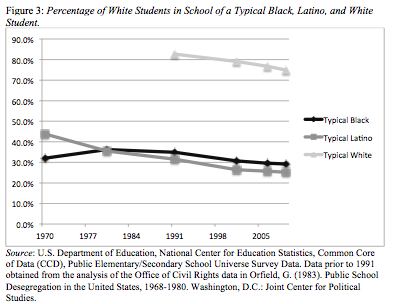
The graph below comes from Gary Orfield, John Kucsera, and Genevieve Siegel-Hawley, E Pluribus…Separation: Deepening Double Segregation for More Students. It shows that African American and Latino students attend schools with decreasing numbers of White students. The trend by itself could be a natural result of growing diversity in the youth population as a whole. In 1970, 79.1% of all public school students were White; in 2009, that was down to 53.7%.  If a lower proportion of all students are White, then White, Black, and Latino students will (as a mathematical inevitability) attend schools with fewer Whites–see the graph. But the graph also displays something else: a large gap between the White students’ line and the other two. Basically, White students still attend overwhelmingly White schools even though they represent just over half of the nation’s public school kids.

Screen Shot 2013-04-19 at 8.49.22 AM

Orfield et al. make a strong case that persistent (and even rising) racial segregation is bad for students of color:

Schools of concentrated poverty and segregated minority schools are strongly related to an array of factors that limit educational opportunities and outcomes. These include less experienced and less qualified teachers, high levels of teacher turnover, less successful peer groups and inadequate facilities and learning materials.

This is important, but I’d like to suggest an additional perspective. Leaving aside questions of inequality for a moment, we can simply define racial segregation as attending schools without people of a different race. That is true today for some students of color. Fifteen percent of Blacks and 14% of Latinos attend schools that have 99%-100% minority enrollments (although, in some cases, the minorities may come from very diverse racial, cultural, and national backgrounds). But what group is more likely to be isolated? By a large margin, the answer is White students. Only 15.2% of them attend multiracial schools (those with at least a tenth of their students coming from at least three groups), as compared to 27.1% of Black students, 26.2% of Latino students, and 42.1% of Asian students.

I am moved to write this because I just heard the British sociologist John Holmwood make an important point about his country. People of color in the UK are socially, culturally, and economically integrated with individuals from diverse overseas backgrounds and also with White citizens who are working-class or middle-class and who live in metro areas. Two groups in the UK remain segregated: some rural Whites and very wealthy White people. The latter are the ones who are most likely to decry segregation and the supposed failure of multiculturalism. But they are the ones who are segregated.