what’s the matter with New Hampshire?

1. “Then, my first gut reaction seeing the horror of that person that has their legs blown off. You know, the bone sticking out? He was not in shock. I looked and I thought there’s something… I don’t know what’s wrong, but it seems surreal to me. I talked to my sister, who’s not into politics at all, and she said, yes, I saw the same thing. He was not in shock. He was not in pain. If I had had those type of injuries, I’d be screaming in agony.”

— New Hampshire state Rep. Stella Tremblay (R), in an interview with Pete Santilli (via Taegan Goddard, who previously reported that Rep. Tremblay believes the federal government planned the Boston bombings.)

2. “One of the things that concerns my constituents — the majority of my constituents — is the appointments that are now being made in Washington by our President and the way he is handling the illegal immigrants, nationalizing them and giving them the opportunity to vote, and wanting to keep track of our guns. They are worried that they are going to have to use these guns because of our own government. Now is there anything in Washington that says — any telltale signs that maybe we might be headed for an internal revolution given the fact that these kinds of things are going on?”

— New Hampshire State Rep. Edmond Gionet (R), quoted by Think Progress (via Taegan Goddard).

3. “New Hampshire State Rep. Peter Hansen (R) sparked a firestorm in the state house after he sent a recent email to an internal house listserv that referred to women as ‘vaginas’.” (via Aviva Shen)

I would by no means condone any of the remarks quoted above. When elected officials abuse their freedom of speech, voters and the press must hold them accountable. The Republicans should denounce these particular characters, or else the party will be associated with them. (That is not necessarily fair, but it’s how politics works today.)

But it is important to realize that the New Hampshire State House has 400 members. The average house district has 3,300 residents. In contrast, California has just 80 State Reps, each representing about 470,000 people, or 142 times more than in New Hampshire. With its town meetings and tiny legislative districts, the Granite State makes politics extraordinarily local and accessible.

I would explain these occasional rebarbative comments as the price of an interactive and accessible political system. If one percent of a state’s elected officials are nutcases, that will yield a fair number of outrageous remarks in a State House with 400 members–but the benefit is a lot more civic engagement. The argument that engagement improves government is a long and complex one, and it comes with caveats. I make the best case I can in my forthcoming book, We are the Ones We Have Been Waiting For: The Promise of Civic Renewal in America, Oxford University Press (fall 2013). For a specific analysis of grassroots democracy in New England, see the classic work by Jane Mansbridge, Beyond Adversary Democracy.

In any case, it’s important to evaluate the whole system rather than outrageous anecdotes. One test will be whether the New Hampshire Republican Party and the state’s voters get rid of the representatives quoted above–but that is not the only criterion of good government. Overall, I would prefer the messiness and occasionally offensive amateurishness of New Hampshire politics to the smarmy professionalism of big states like California and New York. In New York, apparently, the crime rate by state legislators exceeds that of the state’s population as a whole (no thanks to pervasive political corruption). The odds that a nutcase will reach the legislature are lower in professionalized systems, but the chances that someone will speak authentically or learn from a public discussion may be higher in New Hampshire.

the new young Americans’ survey from Harvard

Yesterday, our friends at the Harvard Institute of Politics released their spring poll of 18-29-year olds. Here are some findings that especially interested me:

Conservatives will see some openings. A narrow majority of young people approve of Obama’s job performance, but majorities oppose his performance on each specific issue that was tested, especially the federal budget deficit. Some respondents may think the president is too conservative, or ineffective at achieving liberal ends. That is probably the case with gun control, which they favor although they disapprove of Obama’s performance. However, those who believe that tax cuts stimulate economic growth outnumber those who disagree by two-to-one. Those who think government spending increases growth are outnumbered by those who disagree.  Those who favor more parental choice in schools outnumber those who don’t believe that choice would help the educational system. The sample is very evenly split on climate change: 29% in favor of government action, 26% against, with the rest unsure. Asked whether “homosexual relationships are morally wrong,” 27% agree and 31% are unwilling or unable to say, for a total of 58%.

Just 16% favor affirmative action. Twenty-four percent think it has affected them negatively in their school or workplace. Twelve percent think it has benefited them. We know from a different survey that more than half of White Millennials believe discrimination against Whites “has become as big a problem as discrimination against blacks and other minorities.” I think there is an under-explored and important issue about young White people who are hostile to some of the traditional planks of the civil rights movement.

On the other hand, 42% support a government-guaranteed right to health care. Just one quarter think recent immigration has harmed the US. More respondents think the government should spend more to reduce poverty than disagree with that idea, although the plurality is unsure.

Election-Day Registration (EDR)–i.e., being allowed to register the same day you vote–has been found to boost youth turnout. In the IOP poll, 60% of young adults favor this reform if they are simply asked about it. But support plummets to 35% (with 44% not sure) if instead they are asked, “Some people say that Same-Day Registration … reduces the barriers to voting; other people say that Same-Day Registration increases voter fraud. Based on what you know now, do you support or oppose Same-Day Registration?” In other words, support for this reform is very soft; concerns about fraud can easily be activated.

Pluralities of young Americans think that politics is relevant and that political involvement does have tangible results, although a lot them are unsure. In our own focus group research, we often find respondents waver on these issues. Asked whether voting makes a difference, for example, an individual may give a short monologue that drifts between yes and no and then back again, passing by way of such ideas as “no, but you should do it anyway,” and “yes, but only if other people do it, too.” A survey forces a choice, which is helpful in some ways but obscures the deep ambivalence a lot of people feel.

Thirty-one percent say that “working in some form of public service is appealing to me,” but only 35% think that “running for office is an honorable thing to do” (with 46% unsure). Forty-seven percent think that politics is no longer able to meet our country’s challenges, and only 16% disagree with that.

One in five say that their previous experiences with politics have left them disappointed. Large majorities distrust all the major institutions tested–from the presidency to Wall Street and the UN–with the exception of the US military, which has 54% trust.

About 11% identify with the Tea Party, 5% say they would very likely participate with Organizing for Action (after it is defined for them), and 14% contributed to an online political discussion or blog. I’d emphasize that these are all rare forms of engagement.

effects of debate, discussion, and simulation in k-12 schools, and persistent civic gaps

Today, CIRCLE released a new study entitled “Do Discussion, Debate, and Simulations Boost NAEP Civics Performance?,” by our lead researcher, Kei Kawashima-Ginsberg. The NAEP surveys a representative sample of 26,000 students. It asks them detailed questions about their civic knowledge, plus some items about what they have experienced in social studies classes. We find that students who have discussed current events, debated current issues, and participated in simulations (such as mock trial, Model UN, or iCivics) score higher on the NAEP. These pedagogies have other purposes, such as teaching young people to deliberate and interesting them in the news. The NAEP does not test those outcomes. Thus it is especially good news that these interactive teaching methods are associated with higher NAEP scores.

However, three concerns arise. First, upper-income students and White students are more likely to receive these experiences. Second, the expected patterns do not apply at the fourth grade level, where more discussion, debate, and simulation is associated with lower NAEP scores. And third, White and affluent students appear to benefit the most from these experiences.

I would guess that the fourth grade results can be explained by the extremely small amount of time allocated to social studies: about 1.7 hours per week. That may produce a real tradeoff: either learn to discuss current events or learn the material tested on the NAEP Civics (such as the Bill of Rights).
The unequal impact of these practices at 8th and 12th grade requires more attention. We often see the opposite pattern–disadvantaged young people benefiting more from good education, because they don’t get the same experiences elsewhere. It could be that the quality of these pedagogies is worse, on average, in schools that serve low-income and minority youth.  Or perhaps the curricular modules are not culturally appropriate–for example, if the topics that the kids debate are more relevant in suburbia than in the inner cities. Or perhaps we were unable to account for other factors in the local environment (such as bad governments) that reduce the impact of civic education.

In any case, these practices do benefit all groups at the 8th- and 12th-grade levels, so they should be encouraged and supported.

Emerson’s advice on how to decline a meeting

One of the stresses of modern office work is being called to do more than one thing at the same moment. How painful to decline an important meeting because another event has been scheduled simultaneously, and how often the scheduling process creates intricate moral tangles. But not for Ralph Waldo Emerson:

Why should I fret myself because a circumstance has occurred which hinders my presence where I was expected? If I am not at the meeting, my presence where I am should be as useful to the commonwealth of friendship and wisdom, as would be my presence in that place.
(From Experience, 1844)

That is not what I would write in an apologetic response to a Doodle or Meetingwizard request, but I admire the sentiment. Of course, in the same essay, Emerson also suggests a deeper aversion to being helpful in the customary ways: “A sympathetic person is placed in the dilemma of a swimmer among drowning men, who all catch at him, and he give so much as a leg or finger they will drown him. … In this our talking America we are ruined by our good nature and listening to all sides.”

(See also: Ben Franklin’s fundraising advice.)

do fixed beliefs prevent reasonable deliberation?

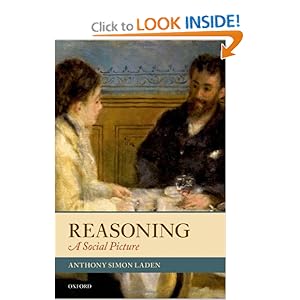
In Reasoning: A Social Picture, Anthony Simon Laden (who’s visiting Tufts today) argues that there’s a “standard picture of reasoning” in which the goal is to reach conclusions. You can reason alone, but when people reason together, they assert propositions, back them up with reasons, and strive for assent. Success means reaching a conclusion as reliably and efficiently as possible.

Laden argues that this picture cannot make sense of a valuable and pervasive kind of reasoning that is quite different. Sometimes when we reason, it is not to reach a conclusion but to engage in an activity with someone else that strengthens the relationship, whether that is a civic bond, a friendship, or a romantic or familial tie. I reason with you to learn what you think, to share my views with you, to seek whatever common ground we can, and to see if we can live together rather than in parallel. A characteristic activity of this kind of reasoning is not asserting that P, but inviting a response: What do you think–can we agree that P? Reasoning is “responsive engagement with others as we attune ourselves to one another and the world around us.”

Just as there are good and bad arguments that P, so there are good and bad ways of reasoning together in Laden’s sense. But some of the norms are quite different. A particularly strong argument is one that ends the discussion. But a particularly skillful conversational invitation is one that prolongs the discussion in ways that satisfy both parties. Laden says that his view is anti-foundationalist, because one unhelpful kind of reasoning involves asserting beliefs as bedrock, self-evident, or transcendent. If someone asserts that Jesus is his personal savior, that all history is the history of the class struggle, or that science produces the only truths, that ends the conversation and so makes the individual less reasonable, on Laden’s view.

Here is where I prefer my own account of moral thought as a network of beliefs connected by various kinds of ties (not just logical entailments, but also empirical generalizations, rules-of-thumb, and family resemblances). I don’t think we can declare a person unreasonable because he holds strong commitments. None of the beliefs I listed above happen to persuade me, but I am equally fixed on other beliefs, such as my love for my own family. The fact that I am not really open to discussing that doesn’t render me unreasonable.

But to converse reasonably with others, it does help to have a moral network map with certain features:

1. You shouldn’t keep returning to a few nonnegotiable principles. It’s fine, for example, to hold religious beliefs as a matter of faith. But if you constantly and immediately cite those beliefs, it’s impossible to reason with you. To put the point in network terms, your map can include nodes that are fixed points, but they ought not carry all the traffic. It should be possible to route around them.

2. You should have more beliefs rather than fewer. It is easier to converse with someone who has many interests, commitments, and ideas, because these are points of contact. Such a person is like an organic molecule with lots of surfaces for other molecules to bond to. Yet,

3. Each belief should connect to others in ways that you can explain. That way, to engage me on my belief A provides an entree to discussing my beliefs B and C. If many of my beliefs and commitments are singletons (in network terms), the conversation quickly dies.

Network analysis helps us see what makes a good conversationalist, but it does not show that being a reasonable conversation-partner is morally valuable. Perhaps it is more important to be good and right. That is what people typically say when they have neatly organized and simple mental networks that revolve around a few nodes, whether God, science, liberty, nature, or something else. They say: “It’s all very well to reason civilly and responsively with other people, but what really matters is my belief P.”

Well, it could be true that P. For instance, it could be true that God has laid out all the commandments for how to live, and we’ll see that for certain in the next life. But in this life, I don’t know how we can know that P except by reasoning with other people. Conclusive arguments are scarce in the moral domain; mainly, they are refutations of particular views that turn out to be inconsistent. But although conclusive arguments are scarce,  we come to believe things collectively by discussing them. When the discussion is inclusive, fallibilist, and responsive to everyone’s contributions, the results are better. I am not quite sure whether reasonable conversations increase the odds that we reach the right conclusions, or rather that we create something desirable when we make our moral world by reasoning together. (In other words, I am not sure whether to characterize the activity as discovery or creation.) But the practical conclusion is the same either way. It is most important to be a reasonable interlocutor. That does not rule out holding fixed beliefs, but they must supply just some of the nodes in your moral network, and they cannot be overly central.