you can’t find pro bono help if your opponent employs all the law firms

(Washington, DC) Let’s say you’re a nonprofit or an individual with a meritorious claim and you are in conflict with a big company. You should look for a law firm to take your case pro bono. But the firm will need a waiver (and a lot of persuasion) to take you on if they also work for the big company that is giving you trouble. That means that you’re out of luck if all the law firms in town work for that company. I’m told that this is the case with major banks and other corporations of their size: they have current or recent business arrangements with all the large law firms.  I could not find a way to tell how many outside counsel are employed by a corporation like Bank of America or Microsoft, but I did find this article from The Wall Street Journal in 2010:

Law firms usually can’t sue or investigate banks that they have represented, unless the clients take the unusual step of waiving the conflict. … [But] consolidation in the banking business has made it only harder for law firms to handle lawsuits against banks. It is increasingly difficult, lawyers said, for firms to find a major bank they haven’t represented at some point.

This piece doesn’t address the question of pro bono representation. It is mainly about the rise of small, specialty firms that gain market advantage by deliberately avoiding all banks as clients–so that they can sue banks. But that doesn’t solve the problem for pro bono clients.  I wonder whether consolidation in the legal profession is the root of the issue. Could companies be intentionally hiring every law firm in town so that nobody can sue them?
patriotism as a rhetorical tool

Patriotism is much in the news, with the IRS allegedly investigating groups that have the word “patriot” in their name, and various people accusing others of being unpatriotic. In reality, patriotism is rarely just a matter of loving a particular country. It is almost always a particular story of a country that emphasizes some people’s core values and excludes some of their compatriots.

Sen. Ren Paul’s recent fundraising letter says, “President Obama and his anti-gun pals believe the timing has never been better to ram through the U.N.’s global gun control crown jewel. I don’t know about you, but watching anti-American globalists plot against our Constitution makes me sick.”

Paul is not the only one who feels that way. As part of an experiment that we recently conducted, representative Americans told us about any political videos they had shared. This response was far from typical of the whole sample, but also hardly unique:

Mostly of the Obamas….Michelle Obama whispering to B.O., “all this over a flag!” I come from a military family and I am extremely offended by the both of them. I have never seen a more unamerican couple in the White House! This done at a 9/11 ceremony.and now the lack of concern for our flag and our diplomats…Obama should never have been elected…The media has a lot to do with what we are going thru as a Country…Clower and Pivens, Olinsky.. [sic] they are destroying the American way from within and those are the subject matter of most videos I share.

But the Obama administration also adopts a very strong–if different–patriotic narrative. For example, the president’s second Inauguration wove a story in which the Civil War and the Civil Rights Movement were central to the great drama of American Freedom. A multiracial Brooklyn choir sang “The Battle Hymn of the Republic,” a song about crushing the serpent of rebellion beneath the heel of the Union Army. The president had been reelected by states that fought on the Northern side, and the only Southern voice at the whole event was Sen. Lamar Alexander’s. Implicitly if not deliberately, the message was the glory of the national government that has triumphed over its enemies, domestic as well as foreign. Obama’s strongest critics fear that same government and admire armed resistance against it, at least in the form of the lost confederate cause.

My point is not that one position is more authentically patriotic than the other, although I certainly prefer the substantive values of the administration. The debate is not between patriots and anti-patriots, but among Americans whose reading of their country is strictly at odds.

youth voting declined in 2012

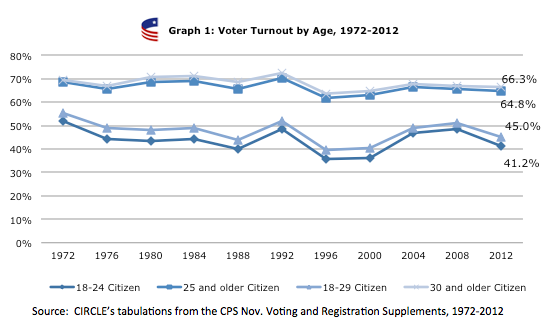
(Washington, DC) After the Census Current Population Survey November Supplement data became available this week, we calculated final estimates of young people’s voting in the 2012 election. Please see this new fact sheet for detailed results. In short, the story has changed from what we believed immediately after the election. Using the best available data, we then said that youth turnout had reached the same level as in 2008–somewhat surprisingly. The CPS data suggests that there was actually a decline. This CIRCLE blog post explains the methodology.

We now estimate that approximately 14.8 million voters under 30 cast their votes for Barack Obama in 2008. But only about 12.3 million young voters chose Obama in 2012 — a drop of close to 2.5 million votes. Voter turnout in 2012 was 45% for people between the ages of 18-29, down from 51% in 2008.

youthturnouttrend

big gender gap in political leadership

I must admit that I have neglected gender as an issue in youth civic engagement. My organization (CIRCLE) generally focuses on common behaviors, like voting and community service, and on political knowledge and attitudes as assessed by surveys and tests. On all those measures, young women are somewhat ahead of young men, much as one might expect since young women do somewhat better in school and college. I have obviously been aware that Congress and other powerful institutions are dominated by men, but I chalked that up to campaign finance and other flaws in the political system. Our work is concerned with young people rather than systems, so I thought we could contribute little to the problem of gender inequality in politics.

But CIRCLE’s led researcher, Dr. Kei Kawashima-Ginsberg, recently presented at a White House Conference on Girls’ Leadership and Civic Education. In preparing to present, she analyzed survey data and revealed troubling patterns. Basically, young women are more “civically engaged” than young men but much less confident in their own ability to hold leadership positions and less likely to pursue leadership roles. Below is just one example of a troubling result. By the time men leave college, almost one third place themselves in the top 10% for leadership, and that rate has risen since freshman year. Less than one in five women rate themselves that high, and that rate falls from freshman to senior year.

See this page for Kei’s fact sheet and links to other CIRCLE materials. We also propose some strategies for addressing the problem. If you are interested in discussing the issue with a very well-informed group, please consider attending this year’s Frontiers of Democracy conference, which will include a learning exchange on gender.

Justice Souter on civic education

(Concord, NH) I am here for one of a series of fairly regular meetings on civic education in New Hampshire. Justice David Souter is an engaged and thoughtful participant in the group. To get a sense of his underlying values, see his comments at a Harvard Law School event recently. He was on a panel with Justice O’Connor, Prof. Lawrence Tribe, and Kenneth Starr (in his new role as president of Baylor University). But I thought Justice Souter stole the show with an impassioned and substantive mini-speech that starts around minute 7 on the video below. His thesis: America fortunately promotes freedom and diversity, but we need some commonality to counter the “disuniting tendencies” of our time, the “wealth disparities,” the impact of money on politics, and other “atomizing and disuniting” forces.  Our common ground is a constitutional value-system that is neutral with respect to religion and culture. In order to appreciate that constitutional creed or heritage, you must understand it. That requires facts–hence, civic education.

My own remarks earlier in the same conference don’t seem to be on YouTube, but I had argued for setting a high standard and not settling for kids being able to memorize the answers to a civics test. I made a similar point in my recent CNN piece.