The recent increase in student loan rates is a significant injustice for people who hold student loans. But the politics of this issue is often presented misleadingly. It is treated as a generational question, much as a decrease in Social Security benefits would be a threat to seniors. There are two problems with that analysis: (1) most young people are not conventional college students or college graduates, and (2) many college students are not young.
The National Journal’s Elahe Izadi has a good piece making those points. She also notes that the most severe student loan burden falls on older grads (age 30+). She quotes me on politicians’ tendency to ignore issues that confront the non-college-bound youth. I say that working-class young people are “not really part of the political situation.”
More generally, young people do not act like a political interest group because their circumstances and interests vary too much, and because their horizons extend beyond youth, which is a short phase. The fact that they do not act like an interest group is one reason they are easy to ignore in politics.
This week and all of next week, my colleague Karol Soltan and I will be leading the fifth annual Summer Institute of Civic Studies, an intensive seminar for scholars, practitioners, and graduate students. I love the atmosphere of the class every year. I attribute it in part to the serious subject matter and in part to the fact that we charge no tuition and give no grades. People attend because they really care about the material.
Over the past 10 years, I have blogged about almost all of the voluminous readings. We begin with “inspirations and provocations.” One is the magnificent poem “The Republic of Conscience” by Seamus Heaney, which confronts you with the question: are you a citizen of the republic of conscience? We read it in a style pioneered by my friend Elizabeth Lynn of the Project for Civic Reflection. Our list of guiding questions is here.
I also like to use this as a provocation: “Never doubt that a small group of thoughtful, committed citizens can change the world. Indeed, it’s the only thing that ever has.” It’s attributed to Margaret Mead, but I like to provoke people by suggesting that it is wrong on several levels. A brief definition of “civic studies” would be the discipline that provides more accurate and valid theories than this one.
Still on Day One, we move to our first actual theorist, the late and much lamented Elinor Ostrom. She essentially defined “good citizenship” as solving problems of collective action, such as free-riding and the tragedy of the commons. She showed that people can solve those problems, but they must design rules and norms well.
We alternate between theorists (in the mornings) and “venues” of civic action (in the afternoons). The first venue is the individual person in development. During the session devoted to that venue, we consider civic education and youth (not otherwise prominent themes in the course). We consider the individual in development because what it means to be a “good citizen” depends on how old you are—the answer is different if you are 8 or 80. Also, people don’t automatically learn to be good citizens; that has to be taught, which raises difficult issues: Who has a right to decide that they should learn? How should the state relate to parents if they have different goals? See the “civic education” entry in the Stanford Encyclopedia of Philosophy for a summary.
As new and unexpected issues arise in discussion, I may blog about them here.
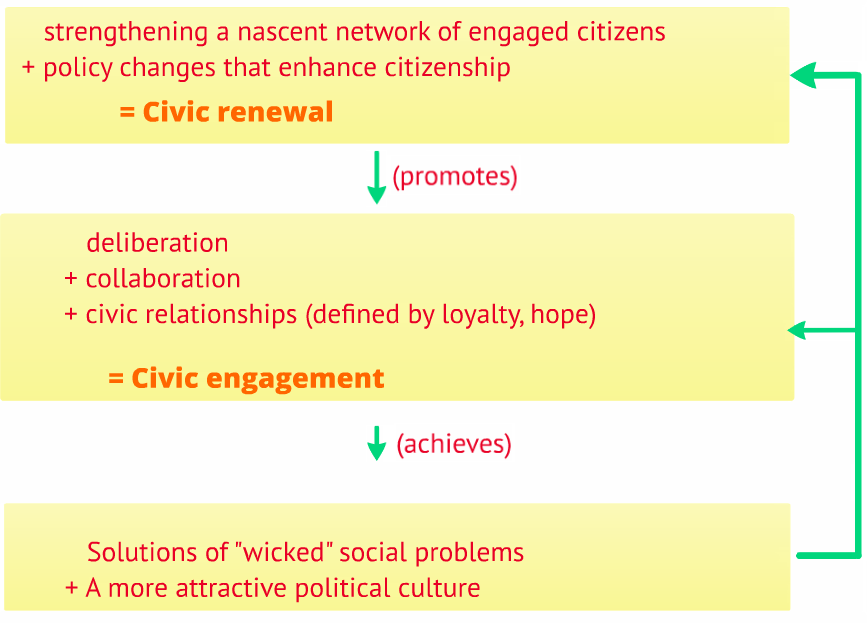
In part, this model is empirical. The arrows are causal, so they depend on data about society as a whole and evidence about the performance of particular programs and initiatives. If a given effort works, that strengthens the case for doing more of it. (“Can implies ought.”)
But the model is also openly moral (or “normative,” in the sense that philosophers use that word). I favor the elements of the model for moral reasons, and the programs whose success I cite were built by people who had moral motivations for their work. For instance, educators don’t randomly decide to enlist teenagers in community service projects and observe what happens. They choose this strategy for principled reasons, and when it does not work as they hope, they improve their programs and try again. So their loyalty and hope are partial explanations of the empirical results on which my model is built.
In most comparable models (e.g., Positive Youth Development or Asset Based Community Development), the moral aspect is undeveloped–or so I argue. That is because social science teaches us that values are simply facts about people. A person just happens to believe X instead of Y. For a scholar, believing X is a limitation or bias to be disclosed and minimized.
I argue, instead, that an essential task is to get the values right. This is not just a matter of avoiding evil, but of fine-tuning one’s principles until they are fully satisfactory. That process is as difficult–and as important–as fine-tuning one’s statistical model. When people think generically about “getting the principles right,” they start worrying about moral skepticism and relativism. How can we know if our principles are right? Once we put such abstract worries aside, we can get down to business. We articulate our principles and the reasons for them in public forums in which other people may ask critical questions: Does your moral theory actually align with your practice? Does your moral theory account for another principle that is important in my moral theory? If not, why not? The result is a more robust moral view, analogous (and closely related to) a more robust empirical theory.
I would like to think that my model rests on moral deliberation as well as extensive empirical evidence. It also has a third basis: strategic analysis. I hope that by introducing and defending this model to actual readers, I will help them to modify their actions so that the world changes (at least modestly) in the direction the model suggests. I know that my readers will not be very numerous or powerful, and that fact informs the model. If the Supreme Court asked my opinion, I might make different suggestions, but this is an intervention meant for realistic numbers of my fellow citizens, situated more or less as I am.
In brief, the criteria for a good social model are:
Empirical validity
Moral rightness
Strategic impact
I am not certain that the model in We are the Ones … is correct, but these are the standards by which I would like it to be judged.
(This is the fifth in a series of blog posts by CIRCLE, which evaluated several initiatives funded by the Democracy Fund to inform and engage voters during the 2012 election. These posts discuss issues of general interest that emerged from specific evaluations. This item is cross-posted from The Democracy Fund.)
Although low trust for Congress is widely known, it may be just as significant that “a dwindling majority (57%) [of Americans] say they have a good deal of confidence in the wisdom of the American people when it comes to making political decisions” (Pew Research Center, 2007). That trend is consistent with a long and steady decline in generalized social trust, or trust in fellow citizens.
If most people trust their fellow citizens but not the government, they are open to populist forms of political reform, such as referenda, recall, and transparency laws. If most people trust the government but not the people, they may want to consolidate power in the hands of political leaders. But if they trust neither, any reform agenda has a difficult path, and restoring trust in fellow citizens emerges as an important precondition of reform.
When we asked a representative sample to make open-ended comments about today’s political advertising, many respondents blamed voters for deceptive rhetoric, often describing their fellow Americans in scathing terms. They said, for example:
“Most people are sheep, the politicians know this and use propaganda to further [their] own ends. But not all of us are sheep, I try not to play into [their] bullshit.”
“Allowing sheeple [people who act like sheep] to vote reduces elections to pure pandering.”
“Deceptive advertising is reprehensible and ugly, and its popularity today reflects the American public’s inability or unwillingness to think critically and objectively.”
“Most American people believe everything they see on TV and do not take the initiative to research what they are hearing to ensure its validity. This results in the wrong people being elected to offices- people who make our situation a lot worse instead of improving it.”
“It’s a sad state of affairs that the political advertising used today is effective because of a largely ignorant electorate.”
“The general public doesnt know the difference between propaganda and rhetoric and I find most people too lazy to to research topics that they dont understand or dont know what a law is, they just blindly trust the person to be telling the truth.”
“The political ads are of low quality because their target audience is of low quality ….”
“There will always be deception in Politics. How else are you going to get a mass amount of ignorant and uneducated people to follow you?”
We coded only 7 percent of all the open-ended responses as critiques of the American people, so we cannot conclude that this was a majority opinion. On the other hand, our question was very broad—about political advertising in general—and it is notable that 42 people took the opportunity to denounce their fellow citizens.
Similarly, in evaluating Face the Facts USA, John Gastil and Dave Brinker asked representative Americans to watch videos of online conversations, and asked “After watching [the video], do you feel that you would be more able to participate in a political conversation?” Most responses were favorable, but some expressed critical views of the people featured in the videos:
“NO, it made me quite upset and I lost a little faith in humanity listening to all the right wingers”
“I don’t think this will help any political discussions because as was evident in observing some of the chat, liberals and democrats are incapable of remaining calm and decent 100% of the time and right wingers are incapable 90% of the time. Check that fact!! 🙂 People are dug into their positions and there is a war coming, it’s just a matter of when, not if.”
In conjunction with survey data about declining social trust, these responses indicate a challenging situation.
However, as part of the same Face the Facts initiative, AmericaSPEAKS also convened citizens to deliberate in Google Hangouts. Compared to a control group—and compared to people who simply received one-way informative materials—citizens who were randomly chosen to deliberate were more likely to express faith in their fellow citizens as deliberators. Their attitude was measured by their agreement with these statements:
“The first step in solving our common problems is to discuss them together.”
“Even people who strongly disagree can make sound decisions if they sit down and talk.”
“Everyday people from different parties can have civil, respectful conversations about politics.”
So it would appear that actually engaging other people in discussion makes people more favorable to deliberation. Most citizens do not have such experiences. Expanding the scale and prevalence of discussion would have benefits for nonpartisan political reform.
The previous entries in the series can be found below: