the Nehemiah story: on the pros and cons of walls

In writing yesterday about the Palestinian city, Rawabi, that is rising not far from Jerusalem, I thought of the Book of Nehemiah in the Bible. It tells a good and relevant story–but also a problematic one. It is a step-by-step primer in how to build a community, but also an illustration of how communities shut people out. It is about a wall–and walls can be both good and bad.

At the beginning of the chapter, the Jews are subjects of Persia; their own former capital lies in ruins. “The remnant that are left of the captivity there in the province are in great affliction and reproach: the wall of Jerusalem also is broken down, and the gates thereof are burned with fire” (1:1).

Nehemiah interprets this situation as a just punishment for the Jews’ sins. He is a Jew himself, but he has found a role as a cup-bearer or eunuch to the Persian King Artaxerxes. He recalls:

I took up the wine, and gave it unto the king. Now I had not been beforetime sad in his presence.

Wherefore the king said unto me, Why is thy countenance sad, seeing thou art not sick? this is nothing else but sorrow of heart. Then I was very sore afraid,

And said unto the king, Let the king live for ever: why should not my countenance be sad, when the city, the place of my fathers’ sepulchres, lieth waste, and the gates thereof are consumed with fire? (2:1-3)

Moved by Nehemiah’s plea, the king and queen allow and assist him to rebuild Jerusalem. Nehemiah organizes each of the clans and guilds to work on a section of the wall. The people labor for 52 days until the whole ring is complete. Much of the Book of Nehemiah records and honors the names of the builders and the sections of the wall they worked on.

While the work proceeds, divisions arise among the Jews, some of whom get rich at the expense of others. This makes Nehemiah “very angry,” and he institutes social reforms, including a ban on usury. Importantly, he personally eschews special treatment, “not eat[ing] the bread of the governor” (5:14), but working with his bare hands.

A wall benefits everyone inside it once it is whole and complete. The Jews sanctify this common good and the space it encloses. The sanctified and complete wall then becomes a framework within which individuals can construct private property. “Now the city was large and great: but the people were few therein, and the houses were not builded.” (7:4).  The people come with their servants and personal property (horses, mules, camels, asses), and some give gold and silver to the city for common purposes.

The community needs not only a framework and a mix of common and collective goods, but also rules to guide the interactions of its members. So the people gather and listen to the Law as narrated by Ezra. “The ears of all the people were attentive unto the book of the law” (8:3). Finally, they celebrate a common ritual that consists of each household’s building its own small booth of “live branches, and pine branches, and myrtle branches, and palm branches” (8:15) until the whole city is a place of “mirth” (8:12) and “solemn assembly” (8:18).

All of this is exemplary of civic work:

  1. Nehemiah’s interactions with Persia and the local peoples are “political,” in the narrow sense of that word. He negotiates an arrangement favorable to his people. The deal may also benefit Artaxerxes by creating a loyal subject city near the frontier with Egypt. (Nehemiah’s enemies accuse him of plotting to rebel against Babylon, but he insists they are lying: “There are no such things done as thou sayest, but thou feignest them out of thine own heart.” [6:8])
  2. Next, Nehemiah concentrates on building an essential common resource, in this case, a wall.
  3. He is attentive to questions of justice within the group.
  4. He applies all restraints and restrictions to himself as well as others.
  5. He creates a space for individual initiative and freedom; but at the same time …
  6. He leads the people in shared rituals that reinforce their commonality.

But a wall also has another aspect. It shuts some people out even as it protects those within. The desire to distinguish between the Jews and their “heathen” enemies is a consistent theme throughout the book of Nehemiah. From the first time that the neighbors “Sanballat the Horonite, and Tobiah the servant, the Ammonite, and Geshem the Arabian, heard [about the plan to rebuild Jerusalem], they laughed us to scorn, and despised us, and said, What is this thing that ye do? will ye rebel against the king? / Then answered I them, and said unto them, The God of heaven, he will prosper us; therefore we his servants will arise and build: but ye have no portion, nor right, nor memorial, in Jerusalem” (2:19-20).

Note that Geshem is an Arab/Arabian, which makes the story particularly problematic for the case of Rawabi. Later, the same people mentioned as scoffing at Nehemiah’s project become serious about it. They “conspired all of them together to come and to fight against Jerusalem, and to hinder it. /Nevertheless we made our prayer unto our God, and set a watch against them day and night, because of them. (3:9)” Indeed, the Jews must work with spears at the ready and on 24-hour guard. They are successful, nevertheless, in finishing the wall. “And it came to pass, that when all our enemies heard thereof, and all the heathen that were about us saw these things, they were much cast down in their own eyes: for they perceived that this work was wrought of our God” (6:16).

Then, once the wall is complete and the “heathen” are shut out, Nehemiah institutes legal reforms that separate Jews from gentiles. “And the seed of Israel separated themselves from all strangers, and stood and confessed their sins, and the iniquities of their fathers.” (9:2) The people also tell a story of their own past that emphasizes their conquests. They recall that they “subduedst … the inhabitants of the land, the Canaanites” and took “their hands, with their kings, and the people of the land, that they might do with them as they would. And they took strong cities, and a fat land, and possessed houses full of all goods, wells digged, vineyards, and oliveyards, and fruit trees in abundance: so they did eat, and were filled, and became fat, and delighted themselves in thy great goodness”(9:24).

Here we see the two aspects of citizenship neatly combined. It is about building a safe and supportive common framework for a whole people–and about shutting other people out. It is about celebrating common bonds–and memorializing the enemies’ defeat.

But I would resist the idea that citizenship must always have losers as well as winners. Citizens can build bridges as well as walls, and even when they concentrate on walls, they can benefit the people who live on both sides. Although some read the poem differently, I take Robert Frost and his neighbor to be constructing a common good when they silently stack New Hampshire granite along their shared dividing line:

I let my neighbor know beyond the hill;
And on a day we meet to walk the line
And set the wall between us once again.
We keep the wall between us as we go.
To each the boulders that have fallen to each. …

And he likes having thought of it so well
He says again, “Good fences make good neighbors.”
Rawabi, the planned Palestinian city

In yesterday’s New York Times, Isabel Kirshner reports from Rawabi, the planned city that’s rising on a hill between Jerusalem and Nablus. She describes Rawabi’s struggles with the Israelis over permits and water, limited support from the Palestinian Authority, and criticism from the “Palestinian Boycott, Divestment and Sanctions National Committee, which opposes any normal ties with Israel. The committee has accused Mr. [Bashar] Masri [Rawabi’s developer] of promoting his private interests at the expense of Palestinian rights and of whitewashing the Israeli occupation.”
DSC00146

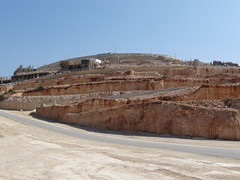
I am not sure what to conclude about the politics. But I have been to Rawabi, where I received the official promotional tour, designed mainly for prospective investors and residents. One of my colleagues took this snapshot as we approached.

Rawabi is an impressive place from the perspective of planning and development. It is environmentally friendly, aligned with the new urbanism, and yet–at least to my naive eyes–also consistent with the traditions of the region. Terraces of stone houses will line the hill, creating streets and squares for pedestrian traffic and shopping. Many residents are likely to commute, and their cars will be accommodated in underground garages. Ample attention is being paid to common or public amenities, including the central mosque and a church.

The politics are complicated because this is a Palestinian project that does not challenge the Israeli occupation. Indeed, I think Rawabi is good for Israel, creating a nice new Palestinian town on land that Israel does not officially contest, and thus potentially relieving pressure on the Jerusalem area. The kind of state that it invokes–orderly, prosperous, high-tech–would be easy for Israelis to live next to. Rawabi also brings business to Israel, which provides the town’s only port and airport and supplies many of its materials.

The fact that Rawabi is good for Israel does not make it bad for Palestinian aspirations. I am confident that the motivations for building it are nationalistic. It is about creating autonomy and prosperity within the Palestinian territory. Bashar Masri is an international businessperson who could make more money in other countries, including the US, where he lived for 25 years. He sees himself as investing in the Palestinian nation.

But this a classic situation in which choosing a win/win strategy could possibly undermine your side’s bargaining position in the inevitable zero-sum struggle for finite resources (land and water). That is essentially what the Palestinian Boycott, Divestment and Sanctions National Committee seems to be saying–and I am not surprised by their view.

Meanwhile, the Israelis show only grudging tolerance for Rawabi. When we were there, the developers were struggling to get permits for an access road. Apparently, not all Israelis see this development as good for their side. I do not know whether that is because they hold a purely zero-sum view of the geopolitical conflict (anything good for the Palestinians must be bad for Israel), because some influential Israelis actually want the land on which Rawabi is built, or because red tape is just pervasive. In any event, the obstacles seem foolish to me.

Again, I do not know enough to make an overall judgment of Rawabi from a Palestinian perspective. But I have a bias in its favor, based on the general premise that building things confers power. I am fully aware of the radical disparities in the situation. The Israelis possess the main cities, all the ports, the contiguous population centers, access to water–and jets, tanks, and the bomb. The Palestinians do not. I would favor substantial changes in that balance. But the question is how to get a just outcome while also developing Palestinian nationhood.

On the same day that we visited Rawabi, we had met with representatives of the Palestinian Authority, who emphasized the many ways in which they were being victimized by Israel and misunderstood by Americans. I did not disagree with their position, but it was hard to be impressed or to see a path to success. It was very easy to be impressed by Bashar Masri in Rawabi. Maybe he is impressive because he is an international businessperson, hence a representative of the ascendent “neoliberal” order, whereas the Palestinian Authority is a Third World bureaucracy running on borrowed cash. In that case, ideologically, I should be more sympathetic to the PA than to Masri. But another interpretation is that Masri is creating a reality while the PA is asking for something akin to pity. Also, Masri has a strategy (offering a win/win opportunity for his side and the side that has the tanks), whereas I couldn’t detect a strategy in the PA office in Ramallah. Rawabi represents productive, constructive power that can only help the Palestinian cause.

young people on guns and gun control

A Black Youth project study entitled “Gun Violence and Public Opinion on Gun Control among America’s Young People” presents data that should be basic to the national debate, along with some relatively surprising findings. First, almost half of White youth (18-29) recently carried a gun or know someone who did. Less than one in four Black and Latino youth report that experience. Yet Black and Latino youth are much more supportive of gun control. Given a choice between protecting the rights of gun owners versus controlling gun ownership, Black youth favor control by a three-to-one margin, but a majority of White youth prefer gun owners’ rights. Two-thirds of Black and Latino youth would ban assault weapons, versus just over half of White youth. Perhaps more interesting is the finding that two thirds of Black youth support having “More police/armed guards in public places like schools and malls.” Considering the frequent tensions and complaints involving those guards, that is interesting. It may reflect something of a Hobson’s choice: more guns or more armed guards. After all, almost one quarter of Black youth say that they or someone they know “experienced gun violence in the last year,” versus just 8.3% of White youth.


having one conversation for 26 years

(Salem, MA) I am here for a retreat of the Jonathan M. Tisch College of Citizenship and Public Service, where I work. In the summer of 1987, I came here for a retreat of the Charles M. Kettering Foundation, where I served as an intern between my sophomore and junior years in college. I’ve been back to Salem since then–we don’t live very far away now–but I recollect the first retreat forcefully. Early impressions bite deeply; later experiences just leave surface scratches.

The 1987 retreat was my first business trip: we could charge meals and get reimbursed for them. It was one of my first times sitting around open tables with water pitchers and notepads, talking about what an organization should do. (How many hundreds of such meetings have I attended since?) It was not my first time in an old city, because I had been privileged to spend years of my childhood in Europe, but it was my first time in an old American town. I remember thinking that Salem’s crooked, narrow streets and houses with historic placards were exotic. And it was one of my first discussions about civic engagement: why do Americans not participate as much as we would like in civil society and politics, and what should we do about that?

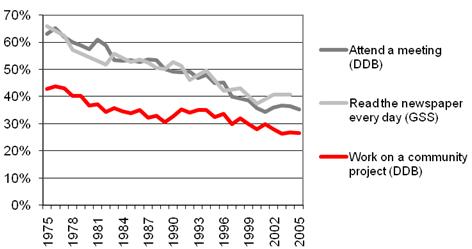
Now I am grey and “experienced,” a board member of the Kettering Foundation instead of an intern. We’ve seen Prague Spring, Bowling Alone, Points of Light and AmeriCorps, the Tea Party, Occupy. I can’t remember the conversation in 1987 well enough to be sure, but I would bet our analysis is more sophisticated now. People at the 1987 retreat–and many of their colleagues–have done important and valuable things in the past quarter-century. The large-scale trends, however, have mostly been for the worse.

indicators of civic engagement (DDB = DDB Needham Life Styles Survey. GSS = General Social Survey)

If I’m fortunate still to be having these conversations in 2039, I hope we will be able to point to upward trends, not necessarily in the measures depicted above (for instance, newspapers will probably be defunct), but in their functional equivalents.

keeping the state close or at a distance

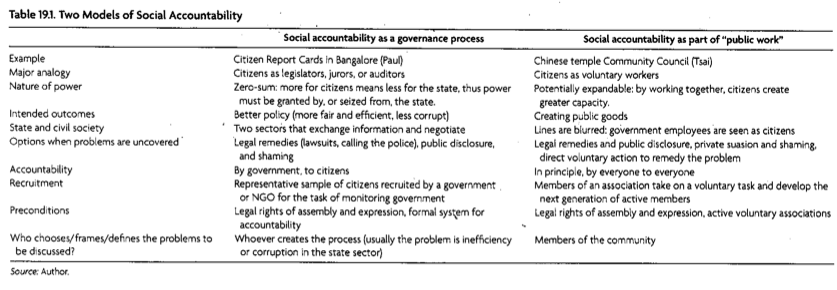
(Salem, MA) This is a table from a chapter of mine entitled “Social Accountability as Public Work.”* (You can click to expand it.)

Screen Shot 2013-08-04 at 4.01.10 PM

The table refers to two examples from the same volume. In his chapter, Samuel Paul describes how nongovernmental organizations in Bangalore surveyed representative citizens to develop “report cards” for municipal agencies. When the press publicized the results of the surveys, government officials took action to remedy the problems that the citizens had identified. Sometimes, processes like these are actually launched by governments to fight corruption. The Obama Administration’s transparency initiatives (now forgotten because of the NSA surveillance story, but actually quite significant in their own way) reflect a similar model–information is supposed to activate and inform citizens to improve government.

In her chapter, Lily Tsai describes Chinese village temple community councils that organize religious and communal activities. Members directly produce public goods through their own hands-on work. Local governmental officials are discouraged from leading the councils, which are religious bodies, “but as ordinary members of the temple group, they diligently fulfill their obligations to contribute to the good of the group.” Tsai also describes government officials involved in a similar group who “used their personal connections with higher level officials to secure a bank loan” for the organization.

In both stories, citizens influence the state. But the relationship is very different: detached in one case, highly cooperative in the other. I think persuasive arguments can be made for both kinds of relationship, and both have perils (alienation on one hand, corruption and bias on the other). The two stories also represent divergent models of citizens, who are seen as monitors in the Bangalore case and as producers of public goods in the Chinese temples. Ultimately, I think we need a bit of both; I doubt that transparency measures will make much difference  unless people are also organized and active in groups that provide direct services.

*in Sina Odugbemi and Taeku Lee, eds, Accountability through Public Opinion: From Inertia to Public Action (Washington, DC: The World Bank, 2011), pp. 291-306