versions of Han Shan

From Robert G. Hendricks, The Poetry of Han-Shan: A Complete, Annotated Translation of Cold Mountain:
Screen Shot 2013-08-25 at 5.08.57 PM
From J. P. Seaton, Cold Mountain Poems: Zen Poems of Han Shan, Shih Te, and Wang Fan-chih:

Screen Shot 2013-08-25 at 5.10.41 PM

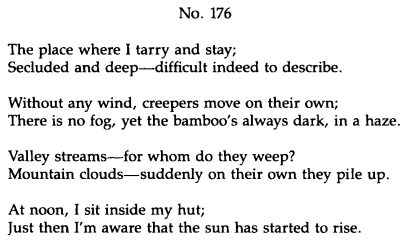
And me, using their versions to attempt a third:

Murky places here, dim shapes.
No cause of that motion;
Blurry for no reason.
Whose name do the streams sob?
What agitates the clouds?
Staring until noon,
I realize the day’s dawned.

a debate about the President’s higher ed proposals

The National Journal’s Fawn Johnson writes, “President Obama landed on some sweet talking points in his recent, somewhat rehashed, proposals to make colleges more affordable and more targeted on graduation and employment. “Higher education should not be a luxury,” Obama said in Syracuse, N.Y. “If a higher education is still the best ticket to upward mobility in America–and it is–then we’ve got to make sure it’s within reach.”

Johnson asks, “What’s not to like?”

I begin my invited response:

We in higher education deserve criticism for high costs and low graduation rates. But I have grave doubts about the goals and the solutions that President Obama proposes.

Consider two colleges. The first, which I will call “Harvard” (because that’s its real name), places almost all of its graduates in jobs or graduate schools. … The second college, which I will call “Local State,” enrolls students who live at home or off campus.  …. Completing a degree typically takes many years, if one manages to graduate at all. … Local State is the college we should subsidize and support.

The rest is on the National Journal’s Education Insider’s blog.

my remarks introducing Civic Studies at the American Political Science Association

(Chicago) According to the official definition of the American Political Science Association, “Political science is the study of governments, public policies and political processes, systems, and political behavior.” In other words, it is a generally impersonal and positivistic investigation into how certain kinds of processes (labeled “politics”) actually work. It is not a discussion of what you and I should do to make the world better.

This modern definition may seem obvious but it reflects a shift. In 1901, President Arthur Hadley of Yale had argued for “political education” that would enhance the motivations, virtues, skills, and knowledge that people needed to be good citizens. He wrote, “A man may possess a vast knowledge with regard to the workings of our social and political machinery, and yet be absolutely untrained in those things which make a good citizen.” But by 1933, University of Chicago President Robert Hutchins announced, “‘education for citizenship’ has no place in the university.”

This shift at the university level also had implications for how we teach children and adolescents. From the 1920s through the 1960s, most high school students took courses entitled “civics” or “problems of democracy” that investigated the students’ role in community life and how they could address public problems together. The assigned textbooks tended to address the students as “you” and invited consideration of what you, the citizen, should do. Both courses have now almost vanished from the curriculum, but a third class, “American government,” remains highly prevalent, reaching nearly 90 percent of all high school graduates. This course mimics college-level political science in its impersonal treatment of institutions and processes.

At times, the APSA has actually been hostile to forms of civic education that are normative and concerned with the role of citizens. A 1971 report by argued that the job of political education was to provide “knowledge about the ‘realities’ of political life.” According to this report, most high school civics teachers imparted “a naïve, unrealistic, and romanticized image of political life which confuses the ideals of democracy with the realities of politics.” Understanding and teaching the realities of politics would be another apt definition of mainstream political science.

I think the impact on k-12 civic education has been harmful. And the APSA’s definition implies a misguided view of politics that distorts even the most advanced scholarship in the discipline. My colleagues and I are using the phrase “Civic Studies” to describe a nascent discipline that would put citizens back at the center and combine empirical, normative, and strategic analysis. The flourishing of Civic Studies would have consequences for civic education at the k-12 level. It would reorient political science and the other social sciences. And it would connect academic work to global movements for civic renewal. Continue reading

top ten signs you are an academic careerist

In The New Republic, Russell Jacoby names Stanley Fish as the academic who “raised careerism to a worldview.” “His writings incarnate the cheerful, expedient self-involvement that is part and parcel of contemporary life: everyone is out for himself. Fish has burnished this credo for the professoriate.”

I do not know if that is fair to Fish, but I do observe plenty of academic careerism. Here are ten signs of it:

  1. You want famous academics to know what you’ve done, but you don’t know or care what laypeople think about the topics you study.
  2. You can recite the professional achievements and setbacks of colleagues but don’t quite remember their arguments and findings.
  3. If you could continue to accumulate praise and rewards without learning anything new, you would stop learning.
  4. If you had a choice between a job where you could do better work and a job that had higher prestige, you would pick the latter.
  5. You are primarily interested in who holds each theory, not whether it is right. And you mainly select topics to study because prominent scholars are currently interested in them.
  6. You are most impressed by scholarly work that requires especially difficult techniques. You do not consider impact when you assess scholarship.
  7. You can explain what you know and how you know it, but not why it’s worth knowing.
  8. For you, a “good” university is one that attracts students and faculty who are already accomplished before they arrive.
  9. You think that fully successful students are those who become professors in your field.
  10. Like Fish, you don’t think taxpayers, students, and other laypeople have any right to judge your work.

It is a privilege to be paid to read, talk, and write. Many talented young people strive for a chance to join the academy but can’t find jobs. If you hold an academic position and have turned into a careerist, I believe you should quit and get out of the way.

an argument against intervening in Syria

The Syrian government appears to have violated the Geneva Protocol to the Hague Convention (1925). The Protocol, which Syria signed in 1968, begins: “the use in war of asphyxiating, poisonous or other gases, and of all analogous liquids, materials or devices, has been justly condemned by the general opinion of the civilised world.” And so it should be.

Citing this rule as a justification for a bombing campaign would be a classic example of legalistic reasoning. I do not mean “legalistic” in a pejorative sense. The best argument for intervening in Syria is to enforce the Geneva Protocol, and it is an example of legalistic reasoning for three reasons:

1. It draws a bright line in one particular place. Conventional bombs or even machetes could kill more innocent people than poison gas did in this case. Likewise, you may hurt someone worse by insulting him than by robbing his store. But a law establishes very general prohibitions in order to control evils, to prevent wrongs from escalating, to allow people the freedom to do things not expressly forbidden, and to create a structure of predictable norms and consequences. Robbery is forbidden; so is the use of chemical weapons. Neither rule guarantees justice or peace, but they do create a worthwhile structure.

2. Deciding whether the rule was violated is different from evaluating how much damage was done or how much good would be achieved by punishing the violator. Legal reasoning puts consequences and persons largely aside. The rule of law is honored when no one violates the law or when all violations are predictably punished.

3. The expressive aspect is important. Law is not just about making things better; it is about expressing norms. A jury exists in part to represent the community and express the community’s view in the form of a verdict stated in open court. Likewise, the Geneva Convention speaks of “the general opinion of the civilised world.”

I think the agreement to ban chemical weapons was an achievement, even though it did not prevent many other (or even worse) evils. Violating that agreement should bring condemnation and punishment. If Bashar Assad can use chemical weapons with impunity, that is a sad day. I don’t think a meaningful punishment would have to end Assad’s regime, any more than a punishment for robbery must so bad that no one ever robs again.

Nevertheless, a legalistic framework does not support the US and allies bombing Syrian military installations. That is because:

1. The punishment would not fall on the perpetrators. We talk about “bombing Syria” or even “bombing Assad.” We would actually kill individual human beings who were present in Syria when the bombs dropped. Bashar Assad is very unlikely to be one of those individuals, and “Syria” is not something that can suffer. Using these proper names is a disingenuous form of synecdoche. The more accurate sentence would be: “Assad ordered chemical weapons to be used, so we must kill some other people.” Put that way, it is a clear injustice.

2. The punishers would not have standing to judge. It is deeply unfortunate that the UN won’t decide to punish Bashar Assad for using chemical weapons. But it won’t, and unilateral action by the US would not restore the principle of rule of law. It is as if A robbed B’s store, the police did nothing, and so C beat up A. That is not an advance for justice. C’s beating up A could have positive consequences. For instance, it might cause A to cease robbing people. But once we are in the realm of weighing consequences, the calculus probably does not favor a US bombing campaign in Syria.

3. The expressive aspect of the case would be ambiguous. What norms would a US-led bombing campaign express? Never use poison gas? (Maybe.) Go ahead and use poison gas because the cost is not very high? (Perhaps.) The US and European countries that previously ruled the Middle East can bomb anyone they like? (Maybe.) The expressive function of the law requires very carefully designed expressive institutions, such as public jury trials in courts of law. Otherwise, the act of A punishing B just looks like violence.

In short, the best argument for a bombing campaign in Syria is legalistic, but it fails.