talking about the Pledge of Allegiance on “Tell Me More”

On NPR’s “Tell Me More” recently, I discussed the Pledge of Allegiance with host Michel Martin and reporter Mary Plummer from KPCC in Pasadena. At one point, Martin asked me whether I would replace the Pledge with something “better.” I replied that I am not necessarily against it, “but I do think there is something more important, which is actually to have a conversation, an appreciative conversation but a thoughtful conversation, about what ‘liberty and justice for all’ means–to actually take some of those words like ‘liberty’ and ‘justice,’ which are very complicated and controversial, and talk about them and understand them.”

Albert Dzur and democracy inside institutions

Albert Dzur, author of Democratic Professionalism and Punishment, Participatory Democracy, and the Jury, is writing a series in the Boston Review entitled “Trench Democracy: Participatory Innovation in Unlikely Places.”

When we think of democratic reform, our minds usually turn to explicitly political upheavals: the Civil Rights Movement, the Arab Spring. In such cases, masses of people put aside their ordinary lives of family and work to press for a new government–or at least for new laws.

That definition of reform hides a different kind of democratic politics that is more sustained, less state-centric, and less obvious to reporters and average citizens. It is what Dzur calls “the public work of self-directing community groups that band together to secure affordable housing, welcome new immigrant groups, and repair common areas like parks and playgrounds.”

I am aware of this kind of public work and have put it at the center of my book We Are the Ones We Have Been Waiting For. I argue that about one million Americans are engaged in “self-directing community groups” in particular places and issue areas. But they do not yet see themselves as part of a civic movement that is larger than their particular projects and causes. So we must organize them to advocate in their common interest–for funds to support civic processes, rights to public participation, education policies that support high-quality civic education, and news coverage of citizens’ work.

In developing this strategy and counting my one million civic activists, I did not pay sufficient attention to the layer of politics and reform that Dzur investigates. I describe leaders and members of civic groups, but his main topic is the everyday pro-democratic work of professionals within mainstream organizations:

[T]hey take their public responsibilities seriously and listen carefully to those outside their walls and those at all levels of their internal hierarchy in order to foster physical proximity between formerly separated individuals, encourage co-ownership of problems previously seen as beyond laypeople’s ability or realm of responsibility, and seek out opportunities for collaborative work between laypeople and professionals.We fail to see these activities as politically significant because they do not fit our conventional picture of democratic change. As if to repay the compliment, the democratic professionals I have interviewed in fields such as criminal justice, public administration, and K-12 education rarely use the concepts employed by social scientists and political theorists. Lacking an overarching ideology, they make it up as they go along, developing roles, attitudes, habits, and practices that open calcified structures up to greater participation. Their democratic action is thus endogenous to their occupational routine, often involving those who would not consider themselves activists or even engaged citizens.

Though they belong to practitioner networks and engage in ongoing streams of print, online, and face-to-face dialogue, the democratic professionals I have met do not form a typical social movement. Rather than mobilizing fellow travelers and putting pressure on government office holders to make new laws or rules, or convening temporary participatory processes such as citizens’ juries, deliberative polls, and citizens’ assemblies, democratic professionals are making real-world changes in their domains piece by piece, practice by practice. In the trenches all around us they are renovating and reconstructing schools, clinics, prisons, and other seemingly inert bodies.

The rest of Dzur’s series will explore examples of this work, using his own interviews with committed democratic professionals. These professionals must be part of a movement for civic reform. The first step is to learn who they are and what they are striving for. Dzur’s work is indispensable for that purpose.

six types of freedom

(Ft. Lauderdale, FL, en route to Austin, TX) Here are six types of freedom. Isaiah Berlin cited the first two as part of his argument for pluralism. He believed that genuine goods were distinct and incommensurable. For instance, a reasonable person could value two types of freedom, but no social order could maximize both simultaneously. We would have to choose, not only between the two types of freedom that he described, but also among freedom, happiness, equality, and other worthy goods.

Much in the spirit of his work, I extend the list of freedoms to six:

1. Negative liberty: freedom from constraint in the form of tangible action against the person or her property or (much more commonly) the threat or fear of such. Because fellow human beings can threaten violence, anarchy poses dangers to negative liberty. (Think of failed states flooded with AK-47s.) Although parents must constrain the negative liberty of their children, they can abuse that power. To combat anarchy, intra-family abuse, and other forms of violence among citizens, states are probably necessary. Yet in most of the world, it is the state that can threaten violence most effectively and pervasively. It must be curtailed in the interest of negative liberty.

2. Positive liberty: the freedom to do something. You are not free to travel, for example, unless you can afford a fare. Positive liberty is a matter of degree, since human beings are simply not able to do everything we want. But there may be a list of fundamental capabilities that everyone should be able to exhibit, and they require external support. You can’t learn to read unless someone teaches you. If one has a meaningful right to a positive liberty (e.g., the right to read), then some other person or community has a duty to provide it; and the state may be the best means to enforce that duty. But if I must pay taxes for your kid’s education or face imprisonment, then my negative liberty has been curbed in the interest of her positive liberty.

3. Individuality: the freedom to develop and express a unique personality and life-story in both the public and private spheres. Individuality may require a degree of negative and positive liberty, but it also faces threats not yet mentioned. The social norms that are strongest in tight, traditional communities and the mass culture that dominates today’s global society both inhibit individuality. Mass culture already worried de Tocqueville, but it has been hypercharged by advertising and technology. The global mass exercises its power less through majority rule at the ballot box than through search algorithms, trendy catchphrases, and addictive tunes.

4. Freedom from manipulation: I am treated as a means to someone else’s ends when the other person sways, threatens, or pays me to do what he wants. I am treated as an end when the other person tries to decide with me what we should do. States and markets arrange people as means to each others’ ends, perhaps unavoidably. Freedom (in this fourth sense) exists in ethical communities whose members treat each other as ends in themselves. Neither positive nor negative liberty guarantees such communities.

5. Freedom to make the world (or to live in a world that we make). Society is an artifact. We are born into the society of our ancestors, with all its flaws. But we are not compelled to replicate it. We become freer in this fifth sense the more that we design and fashion the world that we inhabit. That is a collaborative task, so it requires some limitations on negative liberty. But it is also not the positive liberty of being given an education or an airplane ticket. It is a matter of active co-creation.

6. Equanimity: freedom from the dread, doubt, disquiet, and sorrow that are consequences of being vulnerable and mortal creatures who care about other fragile living things. Although it is harder to achieve equanimity under conditions of extreme duress (e.g., given a complete lack of negative or positive liberty), and although mass culture threatens equanimity, inner peace seems to have different conditions. Indeed, when positive liberty means incessantly choosing consumer goods, it is incompatible with equanimity, as is individuality when it turns into narcissism, or co-creation when it becomes a vain yearning to build wholly new and permanent things.

All Together Now: Collaboration and Innovation for Youth Engagement

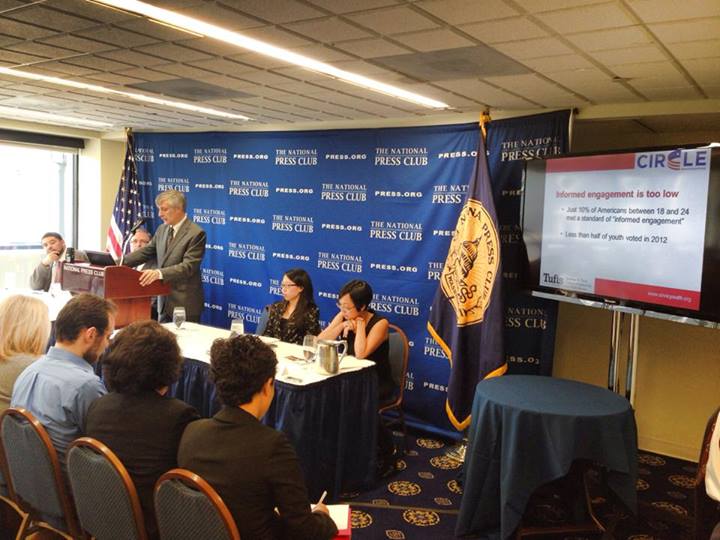
1377110_10151727004580748_1674310912_n(Washington, DC) Here I am at the National Press Club, releasing the report of the Commission on Youth Voting and Civic Knowledge, entitled “All Together Now: Collaboration and Innovation for Youth Engagement.”

Here is the text of our press release:

While the federal government is shut down, young people across America are required to study our system of government and how a bill becomes a law. Successful civic education is both more difficult and more important when Congress and other elected officials set such poor examples. Today, the Center for Information and Research on Civic Learning & Engagement (CIRCLE)—the nationally recognized research center based at Tufts University’s Tisch College of Citizenship and Public Service—released a groundbreaking report on how to educate young Americans for political participation in a time of deep polarization.

The new report, released this morning at a Newsmaker event hosted by the National Press Club in Washington, D.C., was written by the Commission on Youth Voting and Civic Knowledge and is entitled, “All Together Now: Collaboration and Innovation for Youth Engagement.” The report provides recommendations for educators, parents, and national, state and local policymakers on how to engage American youth.

The Commission on Youth Voting and Civic Knowledge is a distinguished, bipartisan group of scholars convened by CIRCLE to investigate exclusive data collected during and after the 2012 elections on issues such as civic knowledge, voting behavior, and the educational experiences of Americans ages 25 and under—a crucial constituency in electoral politics. The report is based, in part, on data collected for the Commission from more than 6,000 young adults and 720 high school civics or government teachers, and an analysis of all states’ voting and education laws. The research was funded by the S.D. Bechtel, Jr. Foundation, Robert R. McCormick Foundation, W.T. Grant Foundation, Spencer Foundation, and Youth Engagement Fund.

“Teachers face an inhospitable climate for civics: tests and standards that do not reward discussing current events, considerable resistance from parents to anything touching politics, and a national political climate that alienates young people from public life,” said Peter Levine, director of CIRCLE. “The research for this new report demonstrates the urgency of better civic education in schools and community-based organizations that include youth.”

Some highlights of the report’s findings released today include:

  •     Current levels of knowledgeable engagement by America’s youth remain too low. Less than half of young Americans vote, even in presidential elections, and just 10 percent of Americans between 18 and 24 met a standard of “informed engagement” in the 2012 presidential election cycle.
  •     Opportunities for civic learning and engagement are highly unequal. White, wealthy students are four to six times as likely as Hispanic or Black students from low-income households to exceed the “proficient” level on the National Assessment of Educational Progress (NAEP) in civics. Only 7 percent of students whose parents didn’t graduate from high school and who are eligible for free or reduced-price lunch reached “proficient.”
  •     Civic education is increasingly viewed as controversial by the public. A quarter (24.8 percent) of the teachers surveyed by the Commission thought that parents or other adults in their community would object if politics was discussed in their course—even though they were asked about a course on government or civics taught during a presidential election year.
  •     Although highly controversial, voting laws have only small effects. Photo ID laws seemed to lower voting for young people who have not attended college. Same Day Voter Registration modestly, but reliably, boosts youth turnout. The overall effects of these laws are small compared to the larger challenges to engaging youth in democracy.

“Research shows that civics education works. Discussing controversial issues, engaging in service learning if it involves discussion of “root causes,” being contacted by parties and campaigns, and participating in extracurricular groups all predict good civic outcomes for students,” said Trey Grayson, former Kentucky Secretary of State (R-KY), Director of the Harvard Institute of Politics and member of CIRCLE’s Commission on Youth Voting and Civic Knowledge. “As a teacher we surveyed stated, civic education ‘is essential if we are to continue as a free democratic society’.”

“All young Americans should be informed and responsibly involved in politics and civic life. And engaging the next generation is the best long-term solution to problems of polarization, incivility, and dysfunction in national politics,” said Levine.

To break current patterns, the report recommends policymakers must embrace innovative and collaborative approaches to civic education. Examples of recommendations from the report include:

  •     Lowering the voting age to 17 in municipal or state elections so that students can be encouraged to vote while they are taking a required civics class.
  •     Policies that support teachers’ obligation to include discussions of current, controversial political issues in the curriculum. Assigning students to read and debate news in class and encouraging them to discuss with their parents and other adults who are important in their lives.
  •     State standards for civics that focus on developing advanced civic skills, such as deliberation and collaboration, rather than memorizing facts.
  •     Badges for excellence in civics. These portable, online certificates would demonstrate advanced civic skills, knowledge, and actual contributions.

Both a full list of the commission’s members and additional, detailed information about the commission, its mission and focus can be found here.

###

CIRCLE (http://www.civicyouth.org) is a nonpartisan, independent, academic research center that studies young people in politics and presents detailed data on young voters in all 50 states. CIRCLE is part of the Jonathan M. Tisch College of Citizenship and Public Service at Tufts University.

The Jonathan M. Tisch College of Citizenship and Public Service (http://activecitizen.tufts.edu/) is a national leader whose model and research are setting the standard for higher education’s role in civic engagement education. Serving every school of Tufts University, Tisch College creates an enduring culture that prepares students to be lifelong active citizens.

Tufts University (http://www.tufts.edu/), located on three Massachusetts campuses in Boston, Medford/Somerville and Grafton, and in Talloires, France, is recognized as one of the premier research universities in the United States. Tufts enjoys a global reputation for academic excellence and for the preparation of students as leaders in a wide range of professions. A growing number of innovative teaching and research initiatives span all Tufts campuses, and collaboration among the faculty and students in the undergraduate, graduate, and professional programs across the university’s schools is widely encouraged.