CIRCLE press release on youth turnout in Virginia and New Jersey

(cross-posted from the CIRCLE website) If the Virginia and New Jersey exit polls captured precise and accurate estimates of the proportion of voters who were young, then youth turnout was 26% in Virginia and 18% in New Jersey, according to CIRCLE’s calculations.* In recent elections, exit polls have not always captured accurate age demographics. Also, the preliminary exit poll results reported on Election Day are subject to revision. However, CIRCLE’s turnout estimates are based on the best available data.

Using the same methods, we calculated that youth turnout in Virginia was 17% in 2009 and 18% in 1997, and in New Jersey 26% in 1997 and 19% in 2009.  That suggests a significant rise in Virginia this year.

Table 1: Turnout in Gubernatorial Elections, ages 18-29*

1997 2009 2013
New Jersey 26% 19% 18%
Virginia 18% 17% 26%

These turnout estimates would translate to roughly  288,000 young voters who cast a ballot yesterday in Virginia, out of the estimated 1.1 million 18-29 year-old citizens who live in that state.  In New Jersey, roughly 206,000 young voters cast a ballot out of the estimated 1.2 million 18-29 year old citizens.

According to the exit poll, 45% of young people voted for Democratic candidate Terry McAuliffe yesterday in Virginia, 40% for Republican candidate Ken Cuccinelli and 15% for Libertarian Robert Sarvis. In New Jersey, a small majority of young people (51%) voted for Democratic Candidate Barbara Buono but 49% supported incumbent Governor Chris Christie.

As a proportion of all the people who voted, in 2013, under-30s represented 13% in Virginia, which reflects a modest increase from 2009, when they made up 10% of all voters. In New Jersey, under-30s represented 10% of voters, which is very similar to the youth share of 9% in 2009. (The share of voters is not an accurate measure of youth turnout. “Turnout” is the proportion of all young citizens who voted, shown above.)

“Although 18% and 26% percent are far from satisfactory, these statistics should be put in context,” said CIRCLE Director Peter Levine. “Turnout is always much lower in off-year gubernatorial elections than in presidential years. The best available evidence on Virginia’s youth turnout suggests an increase compared to the two most recent gubernatorial races there. Virginia is also interesting in that Barack Obama won the state’s youth vote easily, but Democrat Terry McAuliffe got less than half of youth, and Libertarian Robert Sarvis ran relatively strong at 15%.”

* The estimated numbers of young people who voted in the 1997 and 2009 governors’ races were calculated using: (1) the number of ballots cast in each race according to the media, (2) the youth share of those who voted, based on the exit polls conducted by Edison Research for the National Election Pool, and (3) the estimated number of 18-29 year old citizens taken from the Census Current Population Survey, March Demographic File of that year.  Edison Research estimates that its exit polls have a margin of error rate of plus or minus three percentage points.
do companies control governments?

Consider that:

  • The same US government that can apparently tap almost any telephone in the world cannot harvest information that people voluntarily provide on the government’s own website regarding their eligibility for insurance.
  • A private firm, CGI Federal, botches healthcare.gov. A private firm, Dell, employs the analyst, Edward Snowden, who leaks the NSA’s secrets.
  • Snowden reveals (inter alia) that the NSA has been spying on Angela Merkel, whose main impact has been holding down government spending and debt throughout Europe, in keeping with neoliberal economic doctrine.
  • Companies like Google and Facebook possess unprecedented knowledge of the private behavior and beliefs of citizens. They profess “outrage” at the government’s collection of private information. They call it “outright theft.” Apart from their annoyance at losing their data to the state, they fear that consumers will now be reluctant to share information on US-based networks–information that is currently worth about $1,200/person to firms like Google and Facebook.
  • The Tea Party is a loose movement that professes support for free markets and resistance to government. Its power has presumably kept corporate taxes and regulations lower than they would be otherwise. Yet the US Chamber of Commerce and individual companies like AT&T and Caterpillar are so angry about the recent federal shutdown that they are spending significant money to defeat Tea Party-backed candidates in Republican primaries.
  • Facebook founder Mark Zuckerberg creates FWD.us to promote immigration reform. Through a subsidiary called Americans for a Conservative Direction, FWD.us funds conservative candidates who support reducing certain barriers to immigration. Through a different subsidiary called the Council for American Job Growth, it “reach[es] out to progressive and independent voters.”

One way to put these scattered points together is to talk about “the neoliberal state.” Big businesses basically get the policies they want, whether in the US, Germany, Russia, or in (nominally communist) China. Far from constraining them, the state is their assistant. The news consists of little skirmishes between particular businesses and forces not completely under their control: Tea Partiers, the national security apparatus, the US Attorney in Manhattan, and the Democratic Party. Business wins virtually all the skirmishes, and the underlying reality is even more favorable to its interests than the scattered conflicts suggest.

I mention the idea of the neoliberal state because I see that it contains a lot of truth. But I dissent in part on theoretical, moral, and strategic grounds:

Theoretically: we have to remember the problem of collective action. Each business gains from laissez-faire policies–but only a bit, and the competition gains as well. It is not in each firm’s self-interest to be too politically active. Eruptions like the Chamber versus the Tea Party, the Koch Brothers versus Obama, or Google versus the NSA show that it is genuinely difficult for a whole array of competing businesses to coordinate their efforts to achieve the ends they want. Clearly, ordinary people face even more daunting collective-action problems, but that is what political organizing is for.

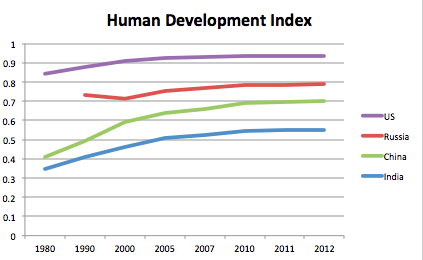
Morally: the critique of the neoliberal state ignores the benefits of global markets. The Human Development Index is a pretty good measure of actual well-being, incorporating not just per capita wealth, but also outcomes like health, education, safety, and women’s empowerment. This graph shows the trends in HDI since China and India opened their economies to direct foreign investment and became sensitive to global markets. The upward trends represent substantial net improvements in the lives of billions of human beings.

Screen Shot 2013-11-03 at 8.33.29 PM

Strategically: the theory of the neoliberal state gives the impression that ordinary people have no power. That impression is itself disempowering. Elections in the US are influenced by cash, but no one literally has more than one vote. If we choose not to do what big businesses tell us to do, we win. A defeatist theory makes that less likely.

I am not saying that the governments of the US, the EU’s members, China, India, and Russia are independent of big business or that corporate pressure is benign. I am claiming that the situation is somewhat complicated and unpredictable, and there is room for strategic action. Each of the bullet points with which I began this post is a pressure point.

(See also “two doses of realism about democracy,” “what is corruption?,” and “putting facts, values, and strategies together: the case of the Human Development Index.”)

strange lives

I surf Wikipedia looking for interesting stories, so you don’t have to. For instance:

Charles deRudio/Carlo di Rudio is born an Italian aristocrat in 1832. After fighting for Italian unification, he flees the country and is shipwrecked off Spain. We next meet him living in East London with his Cockney wife Eliza. In 1858, he is one of several men who throw innovative, mercury-based bombs at the Emperor Napoleon III, killing eight people but not harming the monarch. DiRudio is sentenced to be guillotined but spared and sent instead to the notorious Devil’s Island, off today’s Suriname. He escapes from there and immigrates to the US. During the Civil War, he serves as a Second Lieutenant, commanding Black troops. He stays in the US Army after the war and fights in the Battle of Little Binghorn, at which George Custer and most of his men are killed. DeRudio and one other man survive by hiding in a copse for 36 hours while Lakota women attack the bodies of the US Cavalry. DeRudio dies in Pasadena in 1910.

An anonymous Irish monk works at Reichenau Abbey, now in Alpine Germany, during the 9th century. He writes a poem in Old Irish about his companionable cat, Pangur Bán, which is translated by W.H. Auden and Seamus Heaney, among others, and set to music by Samuel Barber.

In 1943, Hans Robert Lichtenberg is born to the chief of police of wartime Frankfurt. In 1980, at age 36, he is adopted by Princess Marie-Auguste of Anhalt, daughter-in-law of the late and deposed German Emperor Wilhelm II. There are allegations that the adoption, which makes him “Prinz von Anhalt,” is arranged for cash. At age 43, he marries the 69-year old Zsa Zsa Gabor. They adopt three grown men, who inherit various titles. In 2007, three women allegedly approach “Prinz von Anhalt,” ask to pose in a picture with him, pull out guns, and steal his Rolls-Royce, jewelry, wallet, and all his clothes, leaving him naked when the police arrive. In 2010, he runs for Governor of California.

The king of India learns that his son Josaphat is planning to become a Christian. He isolates him from the world, but a Christian hermit saint named Barlaam gets access to Josaphat and converts him. The king relents and abdicates in favor of Josaphat who, after reigning for some time, leaves with Barlaam to become a wandering saint. In all probability, this is actually the foundational Buddhist story of Siddhartha Gautama, translated from Sanskrit into Persian (by Manicheans), which is then translated into Arabic as the “Book of Bilawhar and Yudasaf,” which influences the Georgian Orthodox and Catholic churches to recognize a pair of saints. The Sanskrit title bodhisattva (saint) probably becomes the name Josaphat by way of “bodisav” in Persian, Budhasaf or Yudasaf in Arabic, Iodasaph in Georgian, Iodasaph in Greek, and lastly Josaphat in Latin.

free expression in our schools

(Washington, DC) This is an audio podcast of me talking with Frank LoMonte, Executive Director of The Student Press Law Center, who defends free expression in schools. Frank and I discussed the Commission on Youth Voting and Civic Knowledge and its recent report “All Together Now: Collaboration and Innovation for Youth Engagement.” The report is relevant to the First Amendment concerns of the Student Press Law Center because it emphasizes “free expression and civil deliberation” (p. 24-25) as essential aspects of civic education:

Young people need the space and encouragement to form and refine their own positions on political issues, even if their views happen to be controversial. Adults, schools, political officials, and youth themselves must adopt a generally tolerant and welcoming attitude toward this process of developing and expressing a political identity.

In the National Youth Survey, discussions of current issues predicted greater electoral engagement. We also find that when parents encouraged their adolescent children to express opinions and disagreements, these young people had higher electoral engagement, political knowledge, and informed voting in 2012. Teachers in our Teacher Survey put a high priority on civic discussion.

Just as young people must be free to adopt and express their own views, they must also be taught and expected to interact with peers and older citizens in ways that involve genuinely understanding alternative views, learning from these discussions, and collaborating on common goals.

In the podcast, Frank and I discuss the serious obstacles to this kind of education–unhelpful tests and standards, parental resistance, a caustic media environment–and how to overcome them.

music and civic engagement (an analysis of private and public goods with intrinsic value)

A colleague recently suggested an analogy between music and civic engagement, emphasizing that both have been transformed by technological/economic changes, and there is no going back to the old days. We used to get music from recording companies and participate in public life thanks to daily newspapers, unions, grassroots political parties, and durable civic associations. The traditional institutions for both music and citizenship have been replaced by loose networks and individual choice.

We could extend the analogy by noting that civic engagement, like music, can bring satisfaction to the participants. Neither activity is a mere chore to be done to achieve an outcome. In both cases, people may be enthusiastic to participate (or not–their interest varies). Both activities are heavily collaborative. And in both cases, we should welcome a wide range of excellence. The one-in-a-million talent is admirable in politics, as in music, but we also need average people to sing and to express their political views. In both cases, people appreciate excellence better if they also contribute at their own level.

The differences are also worth noting. For one thing, civic engagement has a strong ethical aspect. Mussolini was active and skillful, but he made the world worse. We must able to evaluate civic engagement ethically with attention to means and ends. I would, for example, build into the definition of good engagement a strong desire to understand alternative views. The most ethically demanding aspects of citizenship do not come naturally. Neither does good musicianship, but I think that the ethical demands of citizenship are more onerous than the preconditions of making music.

Also, certain forms of civic engagement are rivalrous or competitive. More engagement by Tea Partiers means less success for liberals, and vice-versa.

Everyone has a right to be heard in the political domain. Although no one is obligated to listen to me sing (an unpleasant experience), my fellow citizens must give me equal time in a public meeting, just because I am a member of their community.

Finally, it is healthy in both civic life and music for people to form smaller communities of interest with diverse styles. However, as long as important decisions are made by governments, the people of each political jurisdiction must sometimes form a single political community to discuss and act on their common fate. In contrast, we never have to bring all the choirs, bands, and orchestras together to make one stream of music.

The differences between music and citizenship mostly point to the need for intervention in the civic domain. I think music will thrive in a world of digital files, free choice, and loose voluntary networks. Civic engagement needs help.