putting action in the state standards

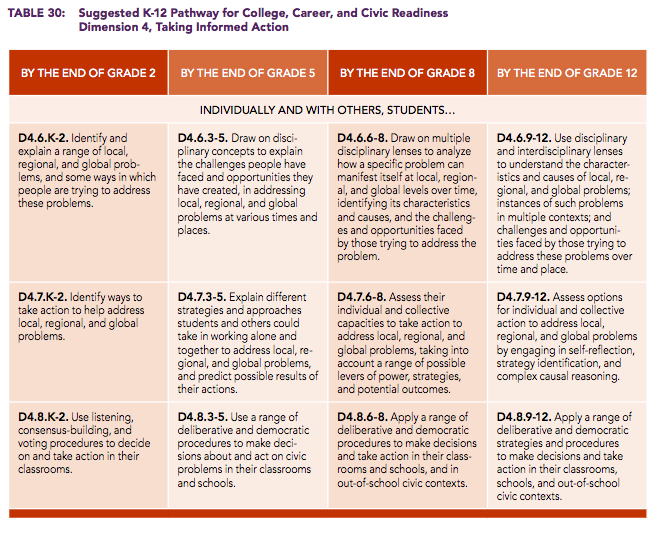
I am in St. Louis for the big annual gathering of social studies teachers, the National Council for the Social Studies conference. Last fall, the NCSS released a new voluntary framework for state standards entitled College, Career, and Civic Life (C3). For full disclosure, I helped write it. One part that seems especially important to me is the section near the end about “taking informed action” (shown below). I will be discussing why this is important and what it means in classrooms.
Screen Shot 2013-11-21 at 4.19.50 PM

At each level, we ask students to analyze a problem, then consider options for addressing the problem, and then make deliberative decisions about what they will do. The scope of action expands from the classroom in grades k-2 to beyond the school by 12th grade.

These standards were written by a large group, but they are consistent with my personal view that good citizens deliberate. By talking and listening to people who are different from ourselves, we learn and enlarge our understanding. We check our values, strategies, and facts with other people. We form ideas about topics that we didn’t even consider before we talked and listened. We also make ourselves accountable to our fellow citizens.

But (I argue) deliberation is not enough. Talking without ever acting is pretty empty. You can say most anything without learning from the results or affecting the world. Deliberation is most valuable when it is connected to work or action. At least sometimes, we should be part of groups that talk about what we should do, then actually do what we have talked about doing, and then reflect on the experience, holding themselves ourselves for the results. This is both the best way to improve the world and the best way to learn to be a good citizen.

Concretely, “taking action” can mean many things: not just community service, and definitely not just political activism (which is hard for a public school to recognize), but also managing and leading student groups, organizing public events, and creating and sharing knowledge.

As Meira Levinson and I argue in the new issue of the NCSS journal, taking action is nothing new.* There is a great old tradition of American students being asked to deliberate and then act as part of their social studies classes. If anything, I suspect the prevalence of action has declined because high schools now mimic colleges (which makes social studies into History or Poli Sci 101 for teenagers) and because conventional standardized tests cannot measure students’ facility at deliberation and action. The new framework, if taken seriously, would require a whole new approach to assessing students’ work.

*Meira Levinson and Peter Levine, “Taking Informed Action to Engage Students in Civic Life,” Social Education, vol. 77, no. 6 (Nov/Dec, 2013) pp. 337-9

the new information technologies empower whom?

(Frederick, MD) Within the past week, I have read two good manuscript chapters about the Dreamers and how they have used social media to change the public debate about naturalization and citizenship rights–even though they are young, not rich, and not even legally citizens. That kind of example suggests that the Internet strengthens the disadvantaged.

On the other hand, we have all read about the NSA’s monitoring of electronic communications, domestic and foreign. One of the most telling episodes in that story was Google’s outraged discovery that the NSA taps its data. Google has–and the NSA wants–a detailed profile of almost every Internet user in the world, valuable for marketers and spooks. This kind of example suggests that the Internet strengthens the strong.

It could do both, depending on context; and the balance may shift over time. To what extent various parties are empowered is an ongoing empirical question. But I would suggest a conceptual distinction to help guide the inquiry.

Part of politics is authoritative decision-making about rules or goods. That makes it substantially zero-sum. For instance, a win for the pro-choice side is a loss for the pro-life side. (However, everyone may gain from having a peaceful and efficient process for deciding contentious issues.) Insofar as politics is zero-sum, all parties will use the new technologies to try to win. It is an open question who will gain, relative to the others. Those who increase their share of power could be the traditionally weak, the traditionally strong, or both at the expense of the middle.

Some authoritative decision-making is not zero-sum. For example, the passage of same-sex marriage legislation is a loss for its opponents, but not if they decide that they like same-sex marriage (as millions have done). A shift in actual beliefs can enable a win-win outcome. The new electronic media are certainly changing the ways that public opinions shift. Again, it is an open empirical question whether this is a good thing. We have recently seen a rapid change in opinion favorable to gay rights but also a substantial erosion of belief in climate change.

Some politics is win-win or constructive interaction. For instance, when people collectively create Wikipedia, they are producing a public asset, and that is a political outcome. Yet, leaving aside some very hot struggles about particular Wikipedia pages, this effort is not adversarial.

When politics is collaborative, some may gain more than others. For instance, Wikipedia doesn’t do you much good if you can’t read. But it needn’t actually hurt anyone, and it may confer its benefits broadly. It enriches the commonwealth.

The Internet clearly has constructive outcomes like this. On the other hand, even Wikipedia uses carbon to run. That is a negative externality, and it is only an example of such. If Craigslist killed the daily newspaper, that was another casualty.

I have deliberately reached no conclusions here but have simply suggested that if we want to think about who is empowered by the new electronic media, it is worth dividing the topic into three parts: rivalrous politics, persuasive politics, and collaborative politics.

who is oppressed? a question for researchers

Let’s say you want to conduct research in a way that is “anti-oppressive.” Certain techniques and emphases will seem valuable. But a preliminary question arises: Who is oppressed? And that raises the deeper question: What is oppression?

In an article entitled “Anti-Oppressive Research in Social Work: A Preliminary Definition,” Roni Streier, an Israeli academic, offers a helpful summary of Anti-Oppressive Social Work Research (AOSWR), which turns out to be a well-established movement.* AOSWR emphasizes “the systemic study of oppression and the development of knowledge that supports people’s actions to achieve freedom from oppression.” It selects for investigation “the most oppressed populations that are largely excluded from main spheres of public and economic life and disconnected from social services.” It “reject[s] the dominant traditions of social science research” in favor of “more qualitative, ‘bottom-up’, interpretive methods.” It demands safe, reciprocal, mutually respectful partnerships between the researchers and the participants, working together to produce knowledge. And it yields research that will be owned by the communities being studied and that will lead to action.

I read all of this happily enough. Although I don’t want all research to be “community based” and participatory, I like the kind of work that Streier describes. But then she offers a case study: research on and with low-income Jewish women in Jerusalem.

I do not know this community. In fact, one limitation of my study trip to Israel and the West Bank last year is that I met secular middle-class Jewish Israelis, Arab Israelis, and West Bank Palestinians, but no ultra-orthodox. Thus I cannot be sure that poor Jewish women in Jerusalem are ultra-orthodox–although I suspect most are–nor do I understand their daily lives, values, and aspirations.

But I would not start by defining them as “the most oppressed population” in their geographical area. Perhaps biased by secular Israeli and Palestinian perspectives, I would view them as a community complicit in oppressing Arabs and strongly favored by Israeli state policies regarding welfare, education, and the draft. My instinct, if I were an anti-oppression scholar with an interest in this community, would be to stand apart from them and critically assess their privileges. To be sure, they are poor and they are women, but what jumps out at me is their political power.

On the other hand: I may be wrong in my diagnosis. And even if I am right, understanding how and why they think as they do might be helpful. Just because they have power, one should understand how to influence them and negotiate with them. That is a case for investigating this population with an open mind. But it doesn’t sound like “anti-oppression research.”

So the unavoidable question is: who’s oppressed? That breaks down into many subsidiary questions, of which a few are:

  • What is the relevant community? If one defines the community as Israel, then perhaps poor Jewish women are oppressed. If one defines it as Israel plus the Occupied Territories, then these women move far up the scale. Which geographical scope to use is highly controversial (but that does not mean that judgments of the matter are arbitrary opinions).
  • In what ways can people be oppressed? Individuals were chosen for this example on the basis of income or wealth and gender. But if they are really ultra-orthodox, then their families are foregoing income in favor of religious study and intense communalism. Are they “poor”? Does that matter?
  • What do they want? Self-interest is not self-evident; human beings want all kinds of things, including subservient positions within their own communities and limited freedoms. If a group of highly-religious women favor traditional gender roles, does that make their circumstances OK? Should our research about them be “bottom-up” and driven by their values? Or would anti-oppression research aim to broaden their options?

*British Journal of Social Work (2007) 37, 857–871

upcoming public talks

  • 11/20, 4pm, Hood College in Frederick, MD: book talk on We Are the Ones We Have Been Waiting For
  • 11/21, 9:30-10:45 am, Washington, DC: panel at the National Communication Association Conference on “Rethinking Foundations of Youth Engagement: Challenges and Possibilities of Young Citizen Engagement in Research and Practice”
  • 11/22, 9:00–9:55 am, St. Louis, MO, panel on “New and Exciting Research to Inform Civic Learning Classroom Practices” at the National Council for the Social Studies annual conference (with Diana Hess and Walter Parker)
  • 11/23, 10:30-11:30, St. Louis, MO, National Council for the Social Studies solo session on “Civics in the C3 Framework”
  • 12/4, 12:45-2:00pm, Boston, panel on “Measuring Civic Engagement,” at NEASC, the New England Association of Schools and Colleges.
  • 1/10, all day, New Orleans, mini-conference on civic studies, including an author-meets-critics session on my book.
  • 1/22, 6-30-8:30 pm, Washington, DC, Busboys & Poets book talk on We Are the Ones We Have Been Waiting For

what are the humanities? (basic points for non-humanists)

(Indianapolis) I am here for a meeting about the public purposes and social impact of the humanities. All the participants will be sophisticated about the humanities as practiced inside and beyond universities. But often I participate in conversations about the social purposes of academia in which I am the only humanist. I find that many professors in the social sciences, natural sciences, and professional disciplines fundamentally mistake what the humanities are about and cannot imagine a plausible public role for humanists. They may suggest, for example, that humanists should write stories that convey the importance of social issues. That is not what humanists do. Here are some very basic points about the humanities that I would want to convey:

First, the humanities are not aesthetic disciplines. Academics who create works of art and literature are not humanists. (Sometimes, creative writers are assigned to teach in English departments, but they are still not humanities professors unless they are also literary critics.) Humanists who study objects of high aesthetic value do not spend their time appreciating or teaching others to appreciate these things. They seek to understand how and why the objects or texts were made and used. A fuller understanding of a work of art can contribute to its enjoyment, but it can also undermine our pleasure by revealing its unsavory origins or purposes. Raising or lowering our appraisal of the object is not the point, except for the rare art historian who crosses over into attribution and connoisseurship.

By the same token, humanists do not write beautifully. Some write better than others, but very little credit is given for the style. I see both good and awful prose in the social sciences and the humanities alike.

It may be true that people tend to enter fields like literary criticism and art history because they enjoy works of beauty. But it is equally likely that people become biologists and mathematicians because they find nature and numbers beautiful. Neither scientists nor humanists get tenure for explaining why they admire the objects they study.

In any case, most humanists do not concern themselves with works that were meant to be beautiful. The humanities include social and political history, the philosophy of mind, religious studies, legal theory, and lots of other disciplines and sub-disciplines not related to the arts.

A great deal of humanistic scholarship is political. Humanists are not unconscious of political themes like power and oppression. Their views and interests vary widely, but if anything, they tend to adopt strongly critical political stances. I think one of the reasons that many humanists are disconnected from American public debates and institutions is that they are so critical they do not know how to engage fruitfully. That attitude may disempower them, but not because they are oblivious to politics.

Nevertheless, some humanists are deeply engaged with laypeople or in public debates. Imagining America is a network for engaged humanists. At Tufts, one of my favorite examples is Project Perseus, the vast compendium of free online classical texts in the original languages and translations. It is public scholarship not only because it serves the public but also because the founder, Gregory Crane, enlists laypeople from all over the world (for instance, Islamic clerical students from the Middle East) to contribute knowledge to the archive.

Humanists need certain kinds of support, but not the kinds familiar to scientists and engineers. In many parts of a university, grant money provides a pretty accurate proxy measure of excellence. For instance, you can’t do most kinds of biology without expensive equipment and staff, so good biologists win grants. But a humanist could produce stellar work for an entire career without getting a single cash award. Still, small amounts of money for travel or release time can buy excellent and influential humanistic work. Libraries and collections still have high value for humanists. And they need to be able to convene.

As a humanist and someone who has written three books in defense of the humanities, I worry that they have become marginal in public life. I could cite many reasons, but an important cause would be the profound positivism of our era. If you strictly separate facts from values and presume that values are matters of opinion, then (1) the disciplines directly concerned with moral argumentation—ethics, theology, jurisprudence—seem senseless, and (2) the best way to understand human beings seems to be to generalize about them statistically. But if you believe that value judgments can be defended rationally, then not only do the explicitly moral disciplines (such as ethics) seem essential, but so do history and literary criticism, because they often analyze cases selected for their unusual political, moral, intellectual, spiritual, or aesthetic importance.