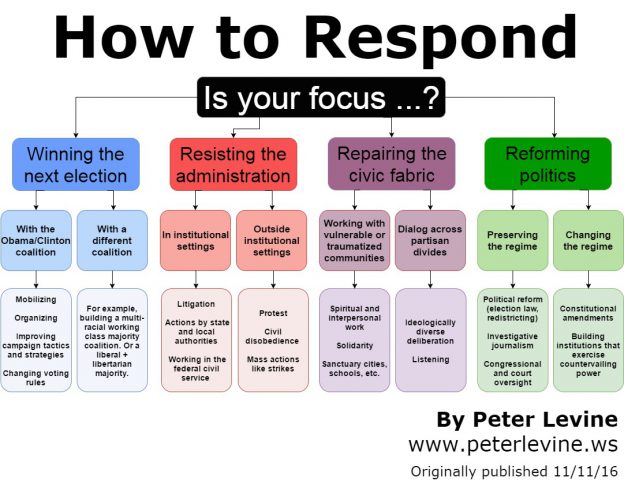
Options for responding to a Trump Administration

strategizing for civil resistance in defense of democracy

In July, Heritage Foundation President Kevin Roberts said, “We are in the process of the second American Revolution, which will remain bloodless, if the left allows it to be.” His statement reflected some bluster and hype, and Trump distanced himself from Heritage. Nevertheless, Roberts expressed a mood that will be shared by many–perhaps more than 1,000–new White House staff, senior federal appointees, allied members of Congress and staff, and ideological lobbyists. They will all be thinking hard about what to do to advance their “revolution.”

To plan a response, we should imagine what such people will do. Here is a SWOT (Strengths, Weaknesses, Opportunities, and Threats) assessment of the situation from the perspective of the second Trump Administration:

  • Strengths: Ability to make appointments, issue executive orders, negotiate with foreign governments, and command attention. Immunity from prosecution for all official acts and the power to pardon people who follow illegal orders. A compliant congressional GOP, a friendly Supreme Court, and some fawning media platforms. A claimed mandate from the election, and tens of millions of actual supporters.
  • Weaknesses: At this moment, the House remains in play. Democratic control would mean no laws or budgets without Democratic support. Even if Democrats lose the House, they will be able to filibuster legislation in the Senate. The economy looks healthy right now, but Trump’s tariffs and other economic proposals would cause inflation and/or contraction. MAGA true-believers will be tempted to introduce bills that are clearly unpopular.
  • Opportunities: Picking fights to establish dominance, discourage opposition, motivate supporters, and dare opponents to promote positions that many voters consider radical. If the opposition looks radical, many voters will perceive that politics is polarized, not that the president is extreme, and they may accept authoritarianism to “restore order.”
  • Threats: Trump voters include substantial subgroups who don’t really share his ideology but who believe that he is competent to deliver prosperity and order. (According to the exit polls, 31% of voters chose the economy as their top issue, and of those, 78% voted for Trump.) If he causes chaos and controversy, and many voters abandon him, he will become toxic for GOP candidates looking toward 2026. If a small group of GOP defectors in Congress join the Democrats, they can block Trump. If he loses the appearance of influence and momentum, he could quickly become a lame-duck (especially if he continues to display cognitive decline). If momentum swings strongly to the opposition, there will be opportunities to make the Supreme Court and other institutions more democratic, rather than less so.

Next, we might brainstorm specific moves that Trump may make in the early stages of his administration and think about counter-moves.

Their most pragmatic option would be to avoid prominent controversies while turning the quieter processes of the executive branch against immigrants and environmental programs. If Trump took that path, he might be able to avoid an energetic resistance and claim credit for the positive economy that he will inherit. He could play golf and retire in four years. But he and his people will be tempted to take riskier actions:

  1. Appoint numerous radical supporters to senior positions. Perhaps give them all “acting” titles and not even request Senate confirmation, thus defeating the norm that political appointees require approval. They will cancel grants and contracts, slow-walk appropriations, fire civil servants, and direct funds to friendly groups and legislative districts. Much of this activity will be unreported, since the executive branch gets little coverage.
  2. Negotiate privately with Putin, without a readout or meaningful public declaration. Offer Russia free scope in Ukraine and promise to block or sabotage US aid. Likewise, communicate privately with Netanyahu and encourage Israel to operate without limits in both the West Bank and Gaza.
  3. Pardon all the January 6th insurrectionists. Convene them on the White House lawn. Possibly deputize them as federal agents or at least encourage them to organize as a private militia. If any of them commit violent crimes against protesters, journalists, or residents, immediately pardon them again. Deploy them to break up marches and demonstrations and to patrol the capital.
  4. Order federal law enforcement and perhaps state national guards to detain immigrants in large numbers, hold them, and physically move them across the southern border.

Some counter-moves:

  • Large, regular, orderly marches that, as Bayard Rustin would recommend, are aimed at winning mass public support. At first, the main message should not be that Trump is illegitimate, since he won the election. Nor is this an opportunity to advance progressive policies, including those that I passionately support. Rather, the message should be opposition to specific things that Trump does that are both unpopular and illegal. The aim is to establish a legitimate counter-force in support of the Constitution and the rule-of-law. The priority is to preserve a system within which progressives (and others) are able to advocate their goals, not to accomplish those goals immediately. The larger and more diverse the protests, the better.
  • A mass walkout like the one that defeated the Kapp Putsch in Berlin in 1920 and preserved German democracy for more than a decade. That story makes important reading right now. I could envision Trump provoking a self-coup, much like the Kapp Putsch, even if he doesn’t really plan to do so. This could begin to happen if armed MAGA supporters exercise violent control in DC, perhaps in reaction to peaceful marches. However, a similar attempt failed in 1920 when Berliners refused to work in the face of a coup, the city shut down, and civilian resistance spread to regular military units. The Berlin work-stoppage did not begin with a formal strike but happened organically when frightened Berliners just stayed home.
  • Building organizations that allow many Americans to take concrete steps to protect democracy in a coordinated fashion.

Finally, some points about the movements that should form:

There should be no expectation that the opposition will coalesce into one big organization. For one thing, the Democratic Party will constitute part of the opposition, but not everyone will want to–or be able to–coordinate with any party. Besides, diversity and choice are valuable. We should expect opponents of Trump to hold diverse beliefs, from radical leftist ideals to genuinely conservative or libertarian values. It is important for people to be able to find groups in which they can feel reasonably comfortable.

On the other hand, the opposition will be weak if it consists of lots of evanescent, hyper-local, voluntary groups that have loose and shifting memberships. Such groups simply cannot accomplish much. In turn, a grassroots opposition will quickly lose momentum and confidence unless it enlists many Americans in tangible work that accomplishes victories.

The middle ground between one big organization and lots of ad hoc meetings is a widespread commitment to organize at medium scales. People need templates for forming small organizations that function and survive, including processes for selecting accountable leaders, making concrete decisions, and recruiting new members. Leaders of small groups should then seek each other out and form coalitions that, in turn, make decisions and elect accountable leaders for larger scales.

A healthy, broad-based nonviolent resistance movement will have leaders, but not just one or a few. It will be “leaderful,” and its best-known representatives will demonstrate some diversity.

I am in the camp that says that Kamala Harris ran a nearly flawless campaign, and she will make a plausible case to be renominated in 2028. But she cannot be the leader of a whole broad-based movement, if only because she is a potential presidential candidate. I would not be surprised to see a range of people from various sectors and walks of life gain prominence as part of a civil resistance. There is no need for them to agree in detail, but we will benefit if they communicate and come together at key moments.

As I have argued, successful movements need scale (lots of people), unity (the ability to coalesce), depth (some activists who develop impressive skills and networks), and pluralism (disagreement and dissent about many issues).

SPUD is hard to attain because combining unity with pluralism requires tolerance and patience within the movement; and combining scale with depth means finding ways for committed activists and peripheral supporters to collaborate. Nevertheless, good movements build SPUD.

One pitfall to avoid right now is debating whether Kamala Harris lost because she didn’t stand for what you believe–whatever that may be. Maybe you’re right (although it is always hard to prove such counterfactuals). If you’re planning a partisan political campaign for 2026 and 2028, you should think about why Trump won this time. But retrospective arguments will not help to build a citizens’ pro-democracy movement that includes people who both agreed and disagreed with Harris on key points.

To put it more bluntly: it’s alienating to be told that Trump won because Harris took a stance that one agrees with, and why alienate people whom we need? This was an election season of shifting “vibes,” and now we need the vibe to shift to unified resistance.

When brainstorming concrete actions for people to take, one option that is always worth considering is to send everyone out to conduct one-to-one meetings. In the tradition of relational organizing, these are not mainly about persuading individuals to endorse, support, or join the group. They are about genuine listening: learning what a range of people believe, experience, and care about. That said, whenever anyone demonstrates enthusiasm for the organization’s current vision, that person should be recruited to join.

I posted the graphic that accompanies this post immediately after the 2016 election, and it went a bit viral. (Thanks to my colleague Alberto Medina for improving its appearance.) Although the name “Obama” should be changed to “Biden,” and some other minor tweaks might apply, I think the diagram remains pertinent and is perhaps even more urgent today.

See also: learning from Robert’s Rules?; a flowchart for collective decision-making in democratic small groupstools for the #resistance; preparing for a possible Trump victory (Nov. 15 2023); and Maria Avila et al., Building Collective Leadership for Culture Change: Stories of Relational Organizing on Campus and Beyond

Tomashi Jackson Time and Space (1948 End of Voter Registration Line)(1965 LBJ Signs the Voting Rights Act), 2020

Tomashi Jackson, Time and Space

Last week, my 50 undergraduate students and I visited the exhibition “Tomashi Jackson: Across the Universe” at the Tufts University Art Gallery. They looked carefully and derived many insights from the work of this important artist. I highly recommend the show, which is open until Dec. 8 and free.

I illustrate this post with a photograph of Jackson’ 2020 work entitled “Time and Space (1948 End of Voter Registration Line)(1965 LBJ Signs the Voting Rights Act).” The photo does little justice to the original object, which is monumental (more than seven feet high) and structural, a multi-media painting mounted on a tilted wooden frame. In the photo with this post, you can see the shadows that the object casts on the gallery wall.

The materials listed on the gallery’s label are: “Acrylic, Pentelic marble, Ohio Underground Railroad site soil, American electoral ephemera, and paper bags on canvas and fabric.” Jackson collected the marble dust near the Acropolis in Athens, birthplace of democracy. The whole work is overlaid with red-white-and-blue stripes that are slightly askew.

We discussed the composition: Black citizens waiting to register to vote in Atlanta in the 1940s (at the top); recent election flyers (at the bottom); and in the middle, LBJ signing the Voting Rights Act. The President is larger than anyone else. Does that mean that he played a pivotal role? Or that his importance is overplayed in conventional accounts of American history? Is he responsible for the law, or was that really an outcome of a process that began with the people at the top of the picture?

a constitutional crisis is not the end of history

In Forbes yesterday, Meg Little Reilly paraphrases and quotes me:

American students are generally taught that the U.S. Constitution is unbreakable — which has been true, thus far—but this narrative reinforces the notion that if the Constitution were to fall, so too would the nation. For many Americans, everything that comes after political unrest is a “blank page,” according to [Peter] Levine. It’s a paradoxically fragile characterization of a country.

But this isn’t how civilizations or humans respond to political chaos. In reality, an existential challenge to the U.S. Constitution would trigger the next chapter, not the end. Preparing students with this more comprehensive understanding of human history could be constructive in November and long into the future.

Reilly also quotes my friend Emma Humphries from iCivics, who says, “Teachers are going to be a safe and steady presence for their students” in the aftermath of next week’s election, regardless of who wins and whether the outcome is resolved immediately.

I’d elaborate my comment as follows: Love it or hate it, the US Constitution is the oldest in the world. It suffered a catastrophic crisis in 1860, but the people who sought to preserve it won the ensuing Civil War. Although explicit amendments and subtler reinterpretations have changed the Constitution significantly, its stability has been evident. As a result, Americans are taught to assume that the document will always govern us–for the rest of our lives. We learn to equate the Constitution with the nation, as if it had constituted us as a people. Given this civic religion, a constitutional rupture sounds like the end of our history.

The prospect of a possible second Trump administration (which is, of course, very far from guaranteed) is causing people to mutter phrases like “Game over,” as if there would be no future for the republic if Trump wins and overrides constitutional limits.

I do fear a constitutional rupture or a period of deep constitutional instability, especially if the cause is an authoritarian presidency (no matter how competent). We could be much worse off than we are now, and the rest of the world is at risk as well. I do not want our system to break down.

However, it is an idiosyncratic US trait to view the Constitution as both fixed and fragile and to equate that document with the people and the nation. France has had five republics, two monarchies, two empires, a nascent commune, and a Quisling dictatorship during the period that our Constitution has stood.

French history is not enviable. More people were executed during the suppression of the Commune in 1871 than during the Terror of 1793-4, to name just two cruel episodes. Yet the French nation and people have demonstrated deep continuities, even when their formal system has changed.

Between the Second and Third Republics, Napoleon III ruled as a quasi-dictator. This was a betrayal of democratic rights and values, yet the republic in a deeper sense persisted. French history continued, and the French continued to influence their own state–as well, tragically, as the subjected peoples of their colonies. When Napoleon III won his rigged 1851 referendum, I doubt that many French people thought that the game was over. In fact, there were three more republics to come. And their history is far more typical than ours.

We Americans must be ready in case we have to use vocabulary and concepts that are familiar around the world: coups and auto-coups, oligarchs and juntas, Bonapartism, unrest and disorder, state media and oppositional media, states of emergency, security forces (and security-force defections), popular fronts, civil service strikes, general strikes, electoral boycotts, mass civil resistance, and constitutional restorations and re-foundings.

I devoutly that hope we experience none of these things, but if we do, it will be up to us to determine how they turn out. In that sense, the republic will still be ours, whether we can keep it consistently or not.

See also: the relevance of American civil religion to K-12 education; constitutional pietyhow to respond, revisited.

what voters are hearing about in the 2024 election

It’s easy to imagine that our fellow citizens see the same political news that we do, and yet many of them draw the opposite conclusions about the candidates. But this impression is only partly true. To a significant extent, prospective voters are seeing and hearing different things, depending on their parties and demographic groups. Specifically, the most inflammatory comments often reverberate most widely among a candidate’s opponents and hardly reach his supporters at all.

This point is well known, but it would be informative to quantify it for the 2024 campaign. CNN and several partners have been asking an online panel an open-ended question about what news they have heard lately. The results are published after a significant delay (presumably due to the work involved in the analysis), and the only reports that I have found are rather cursory so far. They leave me with a methodological concern: individuals’ reports of what they hear may not match what they were actually exposed to, because their attentions and memories may be selective. Still, these simple reports offer insights.

The graphic with this post shows the main topics that a sample of Americans say they heard regarding Donald Trump during several days in September. At that time, some of us were hearing his lies about Haitian immigrants in Springfield, OH–which echoed the inflammatory and hateful slanders that have preceded massacres of vulnerable minority groups here and around the world–and we wondered how anyone could consider voting for this man. But the people who heard about Trump and pets and immigrants had something in common: they were generally Democrats.

Republican and Independent voters remembered hearing one main news item about Donald Trump in late September: he had survived a second assassination attempt, this one on his own golf course. For them, Trump was a victim of crime, and the main events of this campaign were attacks on him. In general, many Americans get a diet of news about crime and unrest. According to Pew, crime is usually the second-most common news topic, after weather, and 77 percent of people see crime news. That is the context in which Republican and Independent voters processed the news that Trump was a crime-victim.

A more recent article about news consumption from Oct 11-14 doesn’t divide the data according to the respondents’ choice of candidates, which makes it less relevant for my purposes. But it is interesting that the word “assassination” continued to be prominent in news about Trump in mid-October.

It’s worth asking whether “the media” is responsible for our balkanized news environment. There are many competing news sources, and people can choose among them, so it’s possible that balkanization is inevitable.

It’s also worth asking whether individuals are responsible for choosing to follow–and remember–high-quality news, and if so, what that is. (I am far from perfect in that respect, spending too much time on polls and horserace news and not enough on troubling issues.)

In any case, it is an analytic mistake to assume that many people support the most awful things that one observes. To understand is not to forgive, but I can at least understand why people would feel differently about Trump if they didn’t hear what I hear about him.

a garbage-can model of political ideologies

Summary: This short essay explores four models for understanding political parties and ideologies:

  1. Each party has an ideology that represents positions that fall somewhere on the left-right spectrum;
  2. Each party represents a temperament or underlying principle, such as traditionalism or progress;
  3. Each party represents an interest-group coalition, such as the workers or business;
  4. Each ideology represents whatever its major associated political party stands for at the moment. In turn, per Cohen, March and Olsen (1972), any political party is a “collection of choices looking for problems, issues and feelings looking for decision situations in which they might be aired, solutions looking for issues to which they might be the answer, and decision makers looking for work.”

I argue that the first three models don’t fit US politics by themselves, and the last one (a “garbage-can” model) has some validity.

We are familiar with a model in which each political party promotes an ideology, and we can place the various parties’ ideologies on a spectrum to tell how far apart they are, where the median lies, and whether the right or left is more influential. When this model is applied to US politics empirically, the typical finding is that our parties have moved apart or “polarized.”

Verlan Lewis (2021) has argued that most empirical measures of polarization do not inquire into the content of the left or right positions. They identify statistical clusters that they label as ideologies, but they do not tell us what the ideologies stand for. Closer inspection reveals that the meaning of the ideological labels has changed drastically over time.

As Lewis notes, “in the 1960s, liberal MCs [Members of Congress] tended to vote against tax increases and in favor of tax cuts, while conservative MCs tended to vote just the opposite.” This statistical relationship was very strong. The words “liberal” and “conservative” later changed their meanings so that conservatives are now the tax-cutters.

Lewis also illustrates his critique of the standard “static” model with the examples of three 20th-century senators: “‘Cotton’ Ed Smith (D-SC, 1909–1944), Henry ‘Scoop’ Jackson (D-WA, 1953–1983), and Ron Wyden (D-OR, 1996–present).” All three have the same ideological score–left of the median–on the influential DW-NOMINATE scale, yet “Smith was a racist demagogue who opposed the New Deal, Jackson was a ‘neoconservative’ who supported both the Great Society and the Vietnam War, and Wyden is a ‘progressive liberal’ who opposes racism, has sought to reform entitlement spending, and opposes militarism.”

Lewis concludes, “As we can see, what it meant to be a ‘liberal’ MC in the 1930s was very different from what it meant to be a ‘liberal’ MC in the 1970s, and both are very different from what it means to be a ‘liberal’ MC today.” 

We might try to detect some underlying values or dispositions that define ideologies over time. One candidate: conservatives want to preserve something or return to the past, whereas progressives want to move forward.

I think that American progressives from 1932 until 1970 were, indeed, temperamentally oriented to change, while conservatives during that period wanted to hold onto traditions. Since then, however, I observe that progressives often want to preserve and conserve institutions that have become traditional (neighborhood public schools. welfare programs, unions) whereas conservatives from Reagan and Gingrich to G.W. Bush (not to mention Trump) embrace radical change. The temperamental orientation of the ideologies has switched.

A third possible model assumes that parties change their positions–and even their temperaments–but they retain the same core interest groups over time. We might expect a given country to have a party for the workers and one for the bourgeoisie, with potentially a third for the peasants. Perhaps the US has only bourgeois parties, but Republicans rely on business-owners and professionals from suburbs and small towns in the North, while Democrats depend on farmers plus urban industrial workers.

The problem with this third model is that the parties prove surprisingly likely to change their interest groups. Indeed, upscale professionals in northern suburbs are now at the heart of the Democratic coalition, while rural people in the South are core Republicans; and Northern industrial workers tilt to the GOP. Each of these groups has switched sides.

Nor is this pattern unique to the USA. The UK Labour Party, formed to represent industrial workers, drew 38 percent of the most advantaged social stratum in the 2024 General Election, compared to the Tory’s 18 percent. Labour performed a little worse among semi-skilled and skilled laborers than among managerial and professional employees. In France, the supposedly left-wing New Popular Front performed worst among workers (ouvriers), and was the top choice of the managerial class (cadres). The German Social Democratic Party, formed in 1875 to represent workers, now performs better among white-collar workers with high education.

if these models based on issues, temperaments, or interest groups fail, what model could work? I’d turn to Cohen, March and Olsen (1972), who posited that any “organization is a collection of choices looking for problems, issues and feelings looking for decision situations in which they might be aired, solutions looking for issues to which they might be the answer, and decision makers looking for work. … To understand processes within organizations, one can view a choice opportunity as a garbage can into which various kinds of problems and solutions are dumped by participants as they are generated” (Cohen, March & Olsen 1972).

If this model applies to politics, then a given party is not a manifestation of any specific principles, nor an agent for a given demographic coalition. It is a space within which various actors can participate, yielding various outcomes over time. In turn, an ideology–at least in a regime like the USA–is mainly the name for that set of views that is currently held by one of the parties.

In that case, it is not illogical if the word “liberal” comes to mean entirely different policy positions over time; that is the outcome of people dumping “various kinds of problems and solutions” into the garbage can of the Democratic Party, which then represents “liberalism.” (And the same for the GOP and conservatism.)

In fact, I don’t think the garbage-can model quite works for US parties. They do retain some philosophical premises and portions of their coalitions over substantial periods, and to some extent, their changes in positions reflect changes in the external world. For example, the parties may have switched their positions on isolationism versus interventionism because the main perceived adversary was communism for 45 years–but not before or after that.

Still, the first three models don’t fit by themselves, and the garbage-can model has some validity.


Sources: Lewis, V. (2021). The problem of Donald Trump and the Static Spectrum Fallacy. Party Politics27(4), 605-618; Cohen, M. D., March, J. G., & Olsen, J. P. (1972). A garbage can model of organizational choice. Administrative science quarterly, 1-25. See also: Mapping Ideologies as Networks of Ideas; in defense of institutions as “garbage cans”; what if political parties structure our thinking for us?; UK election results by social classsocial class inversion in the 2022 US elections;  class inversion as an alternative to the polarization thesisclass inversion in France and what does the European Green surge mean?