Since the 1950s, pollsters have been asking Americans whether they “trust the government in Washington to do the right thing most of the time?” The proportion who say yes has plummeted. Here I show that trend along with data on horizontal trust (i.e., citizens trusting and working with one another).
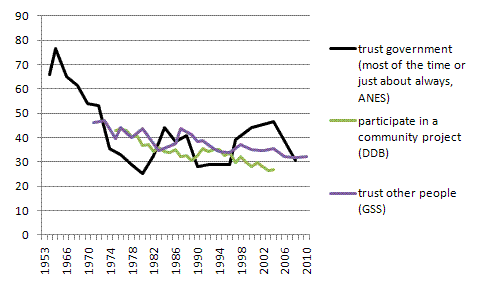
I worry about the trust-in-government decline for three reasons. First, the government can be a valuable tool for public purposes, and when it’s deeply distrusted, voters won’t allow it to be used. In other words, distrust will prevent ambitious government. But–second–distrust will not necessarily curb or limit government. When the state is widely distrusted, interests still use it for private gain and don’t have to worry about a mass public that has higher expectations. So a distrusted government can be intrusive and expensive without doing much good. And, third, the trend line of distrust may–in part–reflect declining trustworthiness. Alexander Hamilton proposed as a “general rule” that people’s “confidence in and obedience to a government will commonly be proportioned to the goodness or badness of its administration.”
But I bring all of this up because I recently read Matthew G. Specter’s Habermas: An Intellectual Biography (Cambridge, 2010) and kept track of Habermas’ thoughts on the importance of mistrust in government. For instance, in 1985, he wrote, “The legitimacy of rechtsstaatlichen [rule-of-law] institutions rests in the end on the non-institutionalizable mistrust of the citizens.” Separately, he argued that the legitimate state depends on a “non-institutionalized mistrust of itself,” which roughly translates into checks and balances. Habermas is an influence on theorists like Jean Cohen, who has written:
It makes little sense to use the category of generalized trust to describe one’s attitude toward law or government. One can only trust people, because only people can fulfill obligations. But institutions (legal and other) can provide functional equivalents for interpersonal trust in impersonal settings involving interactions with strangers, because they, as it were, institutionalize action-orienting norms and the expectation that these will be honored.*
If you asked Habermas whether he had confidence in the German state, he would probably say yes (at least “some confidence”–depending on the policies of the ruling coalition), but if you asked him whether he trusted it, he would say no. For him, trust in the state is a great evil that underlay German statism, from Frederick the Great to Hitler. Habermas is primarily concerned with preventing totalitarianism, something that he can personally remember.
Yet the aggregate survey results would be very similar if one replaced the word “trust” with “confidence,” because most people don’t make that subtle distinction. So, from a Habermasian perspective, what level of trust/confidence should we consider optimal? Too high means we have turned into state-worshipers, and totalitarianism is a threat. But too low means we no longer believe that we can use the state as our tool, and the national deliberation will suffer as a result. We could slide into some kind of dictatorship here, but since the American left is generally concerned with civil liberties and the right has a powerful strain of libertarianism, I think our more serious threat is the abandonment of government rather than too much of it.
In any case, this whole debate often focuses on the proportion of people who do not trust the government. But the desirable answer to this question is probably a subtle one, lying somewhere between trust and mistrust. We don’t want the proportion of people who trust the government implicitly to rise; we want everyone to give it partial trust (and to hold themselves responsible for improving government when it fails). I am not actually sure that the median American is so far from the optimal position if you take their ambivalence into account.
*Jean L. Cohen, “American Civil Society Talk,” in Robert K. Fullinwider, ed., Civil Society, Democracy, and Civic Renewal, p. 66. See also where do you turn if you mistrust the government and the people? and If You Want Citizens to Trust Government, Empower Them to Govern