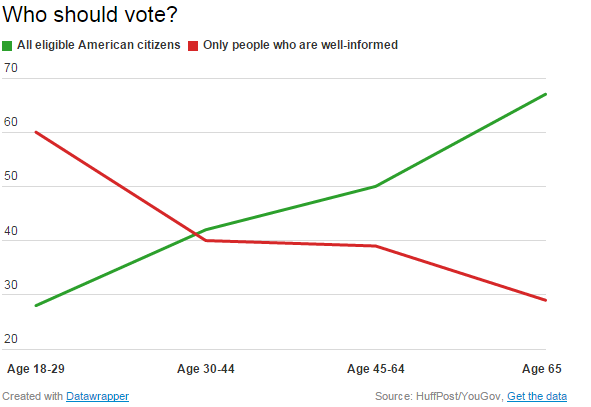
do younger Americans think they lack the knowledge to vote responsibly?

voting_duty

According to a HuffPost/YouGov survey reported by Ariel Edwards-Levy, younger Americans are the most likely to believe that you should only vote if you are well-informed. According to the same poll, younger Americans guess that a majority of their fellow citizens vote in midterm years. They overestimate national turnout far more than older people do. Yet many of these younger respondents do not vote themselves. (We know that actual youth turnout is only about 20-25% in midterm elections). They must see themselves as outliers–in a bad way. They are critical of their own political knowledge and believe that other people know more than they do.

The ones who do vote are quite well informed. According to the exit polls, 77% of 18-29s who voted this November claimed to have followed the midterm election at least “somewhat closely.” But many others may have told themselves that they don’t know enough to vote. As I said to Edwards-Levy, “If anything, they might be putting themselves through too stringent a test.”

Of course, you should inform yourself before you vote. But I don’t think our main problem is uninformed people casting ballots; it’s people staying home because they are actually uninformed or think they are. It is hard to collect political information all on your own just so that you can vote. The traditional solution is to enroll people in multi-purpose organizations that are also conduits for political information. But those organizations are shrinking. As I said in the article, “Twenty or thirty years ago, there were devices for getting information to working-class young people like labor unions, which they belonged to still, and also churches. … Those things have really weakened, so they’re kind of on their own. If you’re a high school dropout and you’re working at Walmart, there’s no way for you to get information except for you to actively seek it.”

viewing concessions dampens rancor

In the Atlantic, Robert Wright describes research that my team at Tufts University conducted in partnership with him. He summarizes the research question:

Suppose you’re a conservative or a liberal, and you’re watching a debate, and the debater you consider your ideological opponent throws in a “to be sure” sentence—a sentence that qualifies his or her basic policy position, underscoring some point of agreement with your ideological ally. Will that make you more favorably disposed to the person—more likely to take their views seriously, less likely to demonize them?

This was the method:

The study involved some 1,600 people, about half of whom identified themselves as liberal and half as conservative. Everyone watched an excerpt from one of two debates: one between Tim Noah and Glenn Loury on whether the minimum wage should increase, and one between Sarah Posner and Michael Dougherty on whether the government should be able to mandate that employer-provided health insurance cover contraceptives.

The excerpt shown to each viewer was short, but it clearly conveyed which person supported which position—in other words, who was the conservative and who was the liberal (on the issue in question, at least). For half of the viewers, the clip also included, at the end, a segment in which the speaker on the other side of the ideological fence from them added a to-be-sure.

Our conclusions:

The researchers at Tufts found that “viewing a concession created a more positive reaction to the ideological opponent.” Viewers who saw their ideological opponent make a concession were less likely than viewers who saw no concession to call their ideological ally the more credible of the two or the more knowledgeable of the two. And they were less likely to say they liked the ally more than the opponent.

Finally, Wright draws out two implications:

First, a message to people on the left and right who opine in public: Don’t forget to throw in a to-be-sure sentence; it may sound like a “concession,” but it could wind up helping your cause, especially if your cause includes not seeing America consumed by bitter acrimony. And it’s especially advisable to do this when you’re in “enemy territory”—when liberals are on Fox News, when conservatives are on MSNBC.

Second, it would be nice if the formats that mediate our discourse made it practical to add a to-be-sure sentence. For example, a pet crusade of mine is to change the structure of Twitter in a way that, while maintaining the 140-character limit on tweets, would nonetheless make it easier to add a short elaboration.

the cultural change we would need for climate justice

One way to think about climate change is that “we” (however you define that) have the wrong relationship to nature. We are exploitative and wasteful. We must change our basic orientation to save the world and ourselves: “The survival of the globe is dependent on a fundamental, philosophical shift in the way we relate to nature.”

I have three concerns about this approach. First, I don’t believe a fundamental philosophical shift is coming. If we need it but it’s implausible, then resignation ensues. Second, this stance seems inappropriately moralistic, based on beliefs about the superiority of unadulterated creation and the fallenness of humankind that I don’t share. It is not intrinsically bad for people to change the world. The question is whether we are improving it or making it worse. Third, even if the philosophical position implied in this view is correct, a lot of people won’t share it for principled reasons of their own–thus it is politically divisive.

A different way to think about climate change is that putting carbon into the atmosphere is an externality (a way of changing the world for the worse) that is free right now. If we taxed emissions at a rate equal to the public cost, people would cut back–a lot. If the biggest economies of the world imposed a carbon tax on their own economies, they could bend the curve. The tax would cost money, but it would generate revenue that could cover a big cut in current taxes. My Tufts colleague Gilbert Metcalfe testified to the US Senate that if we taxed carbon at $20 per ton, we could cut payroll taxes by about 1.5 percent and come out even. I don’t know if a tax of that size, enacted simultaneously in the US, EU, China, and Japan, would do the trick. In a different paper, Metcalfe notes that we cannot be sure how much tax is necessary to stabilize the climate (pp. 512-13). But if we need more than $20/ton, then we can also cut payroll taxes more deeply. William Nordhaus recommends a tax equal to 1 percent of GDP.

Why don’t we do this? Because of interest group pressure by carbon producers and a global prisoner’s dilemma. If the US enacts a tax but no one else does, the results are insufficient, and that gives us a reason not to enact the tax. Industry opponents make this point explicitly.

Note that we can explain our failure to act without blaming ourselves for having the wrong fundamental orientation to nature. The overuse of carbon is a classic collective action problem of the type that inevitably arises when goods are public. Such problems can be solved by appropriate policies, such as taxing the externalities. To get decent policies requires a political struggle and the application of countervailing power against carbon producers. In turn, building an effective political movement requires confidence in rather conventional tools: elections, laws, and treaties. In the face of organized opposition, this is a hard enough task. If we believe that we first need a fundamental change in our culture and souls, I fear we will overestimate the magnitude of the task and thus decrease the odds of success.

There is, however, a more modest cultural shift that we do need: we must reinvigorate our engagement with public life. There is little question that citizens of the major democracies are dispirited about government and about the potential of their own political action. The climate change movement is wonderfully diverse and heterogeneous, but Harry Boyte argues that it still fails to offer a model of broad-based, effective, and authentic political action. Any viable model would have to appeal across a wide spectrum to be effective. We have seen such models before, and they have achieved more difficult reforms than a tax equal to one percent of GDP. But people do need confidence in their ability to change systems.

See also: Sen on Climate Change.

why do the disadvantaged not participate?

In last week’s election, 51% of the voters said they were college graduates. Among adult Americans (by my calculation), 34% have associates’ degrees or higher and 29% have a bachelor’s or more. If a college degree is a mark of middle-class status, then the 2014 electorate was far more middle class–and less working class–than the population as a whole.

Many explanations can be given, and they are cumulative. Voting is harder for people who have less pertinent information ready at hand: for instance, those who do not already read political news. They may also face higher burdens in taking time off work or getting to the polls. Their confidence in their own opinions may be lower. They may see themselves and their concerns less reflected in politics. They hear fewer plausible messages about how the political system will address their needs. They are certainly less likely to be contacted and encouraged to participate–not only in the election of the moment, but in all forms of politics.

We can address these problems. Gaps are smaller in some other countries and used to be smaller in the US when turnout was higher here. In India, the lowest castes have higher turnout than the Brahmins.

But it is also striking how old and persistent are the patterns of unequal participation. In Beyond Adversary Democracy (1980), Jane Mansbridge found unequal levels of voice and influence in both a current Vermont town meeting and a radical commune, the two settings she studied. For comparison, she looked back at the earliest town meetings of colonial America. For instance, Dedham, MA (founded 1636) expected and required that everyone attend its meetings. The stakes were high, as the town set taxes and owned much common property of essential value to the residents. It was more like a commune than a modern municipality. But Mansbridge remarks (p. 131):

Even though no more than fifty-eight men were eligible to come to the Dedham town meeting and to make decisions for the town, even though the decisions to which they addressed themselves were vital to their existence, even though every inhabitant was required to live within one mile of the meeting place, even though each absence from the meeting brought a fine, and even though a town crier personally visited the house of each latecomer half an hour after the meeting had begun, only 74 percent of those eligible actually showed up at the typical town meeting between 1636 and 1644.

I don’t think we have evidence about how the participants differed from the nonparticipants in Dedham; but in nearby Sudbury, when a “crucial meeting” was held to decide whether common land would be apportioned equally or given in larger amounts to the wealthier landowners, the poor stayed home even though by attending they could have changed the outcome in their favor (p. 133).

Opportunities for political participation, such as votes, should be made convenient and actively encouraged. The recently enacted barriers, such as restrictive photo ID laws, may worsen inequality and also send a discouraging message. On the other hand, we have seen dramatic efforts to encourage participation, such as vote-by-mail, Motor Voter, and early voting. Those have done little good. And 17th century Dedham shows that even rules and processes highly favorable to participation are not sufficient.

Ultimately, there is no substitute for effective bottom-up political movements that drive agendas favorable to working people. The ideology of consensus and common interest in colonial Massachusetts may have discouraged participation by suggesting that there was no place for interest-based criticism and advocacy. If every good Christian agreed, then the town gentry might as well make all the decisions. In a somewhat parallel situation today, working class Americans lack a vital social movement that can make a real pitch for their votes.

six varieties of politics

If “politics” means all interactions on public or common matters, here are six varieties of it. They overlap, yet no category is coterminous with any of the others:

1. Adversarial politics: The parties hold incompatible interests or goals, but some resolution must be reached. We can divide this category into three subtypes:

1a. Negotiation: the parties reach a satisfactory conclusion that partly meets each one’s interests.

1b. Authoritative decisions, which may be made by a ruler or ruling body, by an outside mediator, or by the group as a whole using an authoritative process, such as majority rule.

1c. Doing without agreement by protecting individual liberty and letting the aggregate outcome be a function of private decisions.

2. Unitary politics: The parties either have or are able to create a genuine consensus of interests. As Jane Mansbridge argues in Beyond Adversary Democracy, this can happen if their interests happen to coincide from the beginning, if they persuade one another to agree (see variety 3, below), or if they all take the interest of the group as paramount.

3. Deliberative politics: The parties exchange reasons and attempt to persuade others to change their authentic goals and interests. Deliberative politics differs from Negotiation (1a) in that deliberators hope to make interests coincide rather than treat them as fixed and try to maximize everyone’s satisfaction. It differs from Unitary politics (2) because it may not generate anything close to a consensus and may, indeed, be rather contentious.

4. Co-creative politics (“public work” in Harry Boyte’s phrase): The parties create or build something together, whether the object is open-source software, a physical playground, or the norms and traditions of a community. Public work differs from Deliberative politics (3) because it may not be very discursive; and if the participants do talk, they may not need to address conflicting interests and values. They may share goals and only discuss means and techniques.

5. Relational politics: interactions among people who make decisions or take collective actions knowing something about one another’s ideas, preferences, and interests. Each participant has at least the potential to influence and be influenced by each of the others; thus relational politics is interactive. It need not be face-to-face if available technologies (letters in 1776, the Internet today) allow sufficient interaction at a distance. Nor does relational politics depend on or produce unity; people can have close political interactions with their opponents and critics. The defining feature of relational politics is mutual knowledge and influence.

6. Impersonal politics: yields decisions and actions without the participants having to know one another. Examples of impersonal politics include populations that vote by secret ballot, consumers who determine prices by the aggregate of their purchasing decisions, and rulers who issue laws, orders, or edicts that apply to unknown individuals. Each of these is an act of leverage in the Archimedean sense. As actors in impersonal politics, we can move distant objects, even if our impact is minuscule or outweighed by others’.

My own view is that we need all of these varieties. Relational politics, in particular, is by no means ideal or sufficient. The phrase “office politics” has a negative ring because so many interactions in a workplace where colleagues know one another are manipulative, unfair, exclusive, or just tedious. The extreme case is torture, which is as relational an interaction as we can conceive. David Luban observes:

The torturer inflicts pain one-on-one, deliberately, up close and personal, in order to break the spirit of the victim–in other words, to tyrannize and dominate the victim. The relationship between them becomes a perverse parody of friendship and intimacy: intimacy transformed into its inverse image, where the torturer focuses on the victim’s body with the intensity of a lover, except that every bit of that focus is bent to causing pain and tyrannizing the victim’s spirit. (David Luban,“Liberalism, Torture, and the Ticking Bomb,” Virginia Law Review, vol. 91 (Oct. 2005), p. 1430)

Office politics and (much more so) torture are marked by inequality, yet even under conditions of rough equality, relational politics can be inefficient or unproductive.

Yet I would argue that relational politics fills an important need in a society dominated by impersonal and adversarial institutions. It is best when it is also deliberative (3) and co-creative (4). That combination deserves active support. Further, since powerful institutions have no incentives to promote such politics and may have reasons to subvert, coopt, or repress it, someone must fight on behalf of productive relational politics. That requires some use of adversarial and impersonal tools (votes, lawsuits, mass communications) in the defense of relational interactions. How to accomplish that seems to me one of the hardest problems for anyone concerned about civic renewal.