three ways of thinking about social reform

A group has been discussing how to improve upward economic mobility in the Boston metro area, which is booming but leaving a lot of people behind. I do not know much about economic mobility, nor do I lead an antipoverty organization, so I have found it a privilege to be in the room with people who have real knowledge and clout.

In the discussions so far, I detect three theses. When I mentioned this list, some people felt that they are all true. Indeed, the ideas may fit together in various combinations, but I see tensions among them.

1. We know how to improve the prospects of low-income people; we just don’t have the will to do it. Innovation should be at the political level, changing the balance of power or the messages that resonate.

Probably the strongest evidence for that thesis is international. This OECD publication is one of many that shows poor intergenerational mobility in the US compared to countries like Denmark, Australia, and Norway. The same study finds that public investment in early childhood correlates with better mobility. We don’t invest much in preschool in the US. The reason is arguably that affluent suburbanites don’t vote for it because they don’t need it, while poor people don’t vote for it because they are generally disenfranchised and dispirited. So we need political strategies to change voters’ preferences to shift government.
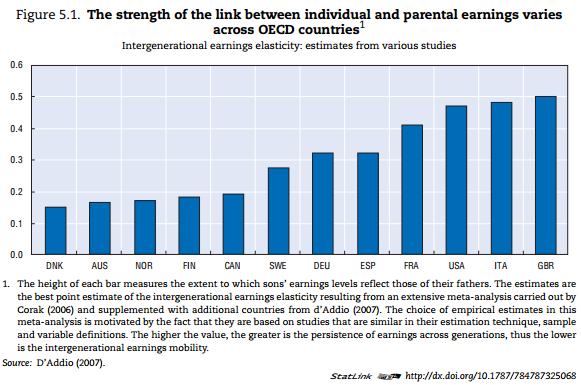
intergenerational
2. We don’t know how to help people move up the mobility ladder in a post-industrial, knowledge-based, global economy. We need innovative programs and R&D.

Ron Haskins recently wrote, “Despite decades of efforts and trillions of dollars in spending, rigorous evaluations typically find that around 75 percent of programs or practices that are intended to help people do better at school or at work have little or no effect.” That’s a controversial claim; I have previously addressed the complex question of whether to rely on randomized studies. But it is a plausible claim, especially if we restrict it to hands-on service programs (in contrast to entitlement transfers). To be sure, we see more intergenerational mobility in Denmark than in the US, and Denmark has large-scale policies that probably work–but I’ll bet they work less well than they used to, and they may not apply in situations like our massively deindustrialized cities. So there is a case for finding new strategies that really work instead of spending tons of money on things that don’t.

3. People in poor communities should determine their own futures.

Both #1 and #2 can be read as “We should do various things for–or to–people in poor communities.” Clearly, they need resources. But perhaps “we” should show a little more modesty. People in poor communities should not only decide how to use resources but also do the (paid) work of community development, creating their own solutions.

Again, I think these theses can fit together in various ways; many individuals see merit in two or even three of them. But they do pull you in different directions.
the Civic Studies Institute spreads to Ukraine

Thanks to our colleague Dr. Tetyana Kloubert of the University of Augsburg and a grant from the German Academic Exchange Service (Deutscher Akademischer Austauschdienst), the Summer Institute of Civic Studies that we hold annually at Tufts is adding a parallel institute in Ukraine, which I will help to teach in 2015. Ukrainian scholars and practitioners are strongly encouraged to apply. We will also consider applications
from Germany, Belarus and Poland. Please feel free to circulate this announcement.

Summer Institute of Civic Studies and Civic Education
Call for Applications

We are happy to invite you to participate in the Summer Institute of Civic Studies and
Civic Education that will take place in Ukraine from 3-16 August 2015 (at the Chernivitsi National Yuriy Fedkovych University).

The Summer Institute of Civic Studies and Civic Education is organized by a team from Tufts University (Prof. Peter Levine), the University of Maryland (Prof. Karol Soltan) and the University of Augsburg (Dr. Tetyana Kloubert).

Objectives and topics

The Summer Institute of Civic Studies and Civic Education is an intensive, two-week, interdisciplinary seminar bringing together advanced graduate students, faculty, and practitioners from diverse fields of study.

The Summer Institute of Civic Studies and Civic Education deals with issues of development of civil society, the role of an individual/citizen in society, the role of education in promoting democracy, the role of institutions in the development of a civil society and questions related to the ethical foundation of civic issues in a (democratic)
society. These topics will be examined in international and comparative perspectives, considering European (especially German) and US-American civic traditions. International examples will be discussed in the context of consolidation of democracy in
Eastern Europe, particularly in Ukraine.

The Summer Institute of Civic Studies and Civic Education engages participants in challenging discussions such as:

  • What kinds of citizens (if any) do good regimes need?
  • What should such citizens know, believe, and do?
  • What practices and institutional structures promote the right kinds of citizenship?
  • What ought to be the relationships among empirical evidence, ethics, and strategy?

Summer Institutes of Civic Studies have been annually organized by Peter Levine and Karol Soltan at Tufts University since 2009.

How to apply

Continue reading

two perspectives on our political paralysis

Let’s define “governing” in a democracy (and I mean really governing, as opposed to administering or muddling through) as putting an agenda before the people, achieving a mandate, and enacting the agenda before the next election offers a verdict.

No one has governed the United States, in this sense, for at least a quarter century, except for transient and incomplete moments: Reagan cutting taxes in 1980-82, Clinton raising taxes to balance the budget in 1992-4, G.W. Bush cutting taxes and passing the Patriot Act after 9/11, and Obama passing the Affordable Care Act (ACA) in 2010. But those names also remind us of abandoned agendas. Under Reagan, taxes and spending rose as a percentage of GDP and the federal service added a net 230,000 jobs. In retrospect, it’s hard to say what the domestic policy agendas of Clinton or the two Bushes were. Obama stopped governing (in the sense I mean here) when he lost his House majority in 2010. No one expects anything except paralysis through at least 2016. Gallup reports that “2014 was … the first year since 2007 that the economy was not the top ranking issue, and it was the first year ever in Gallup records that dissatisfaction with government topped the list.”

Here are two ways of interpreting this situation.

First, political scientist Juan Linz would note that every presidential system other than the US has collapsed. Individual legislators are not held accountable for the performance of the country but do get credit for criticizing the president. Thus a legislature has every incentive to undermine the executive branch. When the two branches are separately elected, you are bound to see legislative obstructionism (on one side) and executive unilateralism (on the other) whenever power is split.

That is just what we have seen in the US since ca. 1986. Why not before? Because until the 1980s, Congress always had at least three effective political parties, the Democrats being composed of two radically different wings (the Southern conservatives and Northern liberals). Thus a president could normally put two of the three congressional blocs together to obtain a majority. He was basically in the position of a Prime Minister, assembling a majority in the legislature. That opportunity vanished when the parties sorted neatly into left and right, so now we face the Linzian nightmare. Presidents will rule by executive order and congresses will obstruct until the system fails.

Alternatively, political scientist James A. Morone has argued that the US system was designed to avoid governing (in the sense of this post.) That is not only true of the federal constitution, with its famous checks and balances, but also of new institutions that we have developed subsequently, such as the New Deal regulatory agencies and the ACA. They always incorporate numerous veto points because they cannot come into being unless their opponents are mollified by such barriers–and because Americans profoundly fear governing as a form of tyranny.

Morone argues that at several points in American history, the federal government (blocked by design from changing its policies) has become manifestly out of step with a changing country. To name one example, Washington could not recognize unions but was faced with a militant labor movement ca. 1932. In such cases, Americans typically denounce their hobbled government as corrupt and elitist and demand that power shift to “the people.” They are invoking a myth, because the population is not unified; in fact, one of the reasons that government is paralyzed is that it reflects citizens’ conflicting interests. Nevertheless, by invoking “the people,” the reformers win new political rights or procedures (white male suffrage in the Jacksonian Era, regulatory agencies in the Progressive Era, collective bargaining under the New Deal, community action agencies in the 1960s). These new rights and procedures change who is effectively enfranchised and thus shift policy outcomes. Once a new equilibrium is reached, the system returns to paralysis, but in better alignment with the underlying social/economic situation.

If Linz is right, our challenge is largely unprecedented, and we are in big trouble. If Morone is right, we have faced the same circumstance at least five times before and the time now looks ripe for a new set of populist institutional innovations. Based on the past waves of reform, we should expect “an exuberant mix of democratic images and contemporary organizational methods: open meetings, civic education, broad opportunities to participate, professional staff support” (The Democratic Myth, 1990, p. 28). Today that might mean Participatory Budgeting, online games for city planning, and service corps, among other examples. These reforms will adjust the political balance and policy outcomes before they ultimately disappoint by puncturing the myth of a unified people.

Neither argument is exactly rosy, but both should be taken seriously if we hope to find better ways forward.

author’s colloquium on We are the Ones We Have Been Waiting For

Screen Shot 2014-12-19 at 6.29.14 PM

As I prepare to take a 2-week winter break from blogging, I’ll post the video of me, Jane Mansbridge and Marshall Ganz of the Harvard Kennedy School, and Jenny Sazama, Director & Co-Founder of Youth on Board, talking about my book We Are the Ones We Have Been Waiting For in a discussion moderated by Meira Levinson (Harvard Grad School of Ed). The event was a CMEI Colloquium/Gutman Library Distinguished Author Event last October 21.

questions about “collective impact”

The concept of “Collective Impact” suddenly seems to be everywhere. No meeting is complete without it. FSG defines it as “the commitment of a group of actors from different sectors to a common agenda for solving a complex social problem.” And they propose five conditions:

Common Agenda: All participants share a vision for change that includes a common understanding of the problem and a joint approach to solving the problem through agreed-upon actions.

Shared Measurement: All participating organizations agree on the ways success will be measured and reported, with a short list of common indicators identified and used for learning and improvement.

Mutually Reinforcing Activities: A diverse set of stakeholders, typically across sectors, coordinate a set of differentiated activities through a mutually reinforcing plan of action.

Continuous Communication: All players engage in frequent and structured open communication to build trust, assure mutual objectives, and create common motivation.

Backbone Support: An independent, funded staff dedicated to the initiative provides ongoing support by guiding the initiative’s vision and strategy, supporting aligned activities, establishing shared measurement practices, building public will, advancing policy, and mobilizing resources.

I definitely see the purpose and value of such efforts, but I would pose these questions for critical reflection whenever the framework is being used:

  1. When is a group with a shared agenda and “backbone” organization a “collaboration” or a “community of practice,” and when is it a cartel or a clique?
  2. When is reducing competition among NGOs a valuable a way of reducing waste and allowing them to work toward a broader goal, and when is reducing competition a way of protecting incumbent organizations from challenges by newcomers? (In short, when is a cooperating group a monopoly?)
  3. Who gets to decide on the common agenda, and to whom are they accountable?
  4. What makes you eligible to join the “diverse set of stakeholders”

(A civics textbook would say that the people should ultimately decide on the agenda for their community, mainly by choosing elected representatives who deliberate and vote–all subject to judicial review. We already have a smooth tessellation of political jurisdictions across America, each with its own elected leaders. But in the Collective Impact model, governmental agencies are just some of the “participating organizations.” )