Korsgaard on animals and ethics

(Northern Virginia) I made some comments about animal rights and welfare at one of the Tisch Talks in the Humanities last week. I have contributed no original scholarship on this topic, nor even followed the vast literature closely. But in the course of a quick lit. review, I came across the line of argument that Christine Korsgaard has developed, and it struck me as persuasive. I’d put a central point like this:

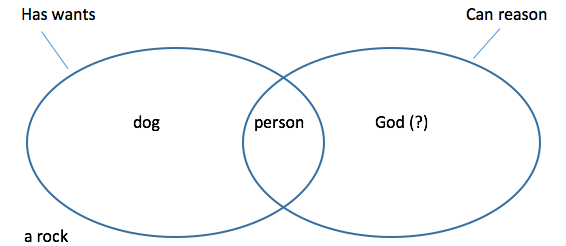
  1. There are two kinds of beings, those that have wants and those that don’t.
  2. There are two kinds of beings, those that can “reason” and those that cannot (where to reason is to have reflexive thoughts, or the ability to assess wants, desires, etc. critically).

Screen Shot 2016-02-11 at 1.23.50 PM

Inert objects like rocks and stars neither have wants nor can they reason. It follows that nothing is good or bad for them. All members of the animal kingdom, including human beings, have wants. That implies that some things are good and bad for each of them. Perhaps we alone are rational, in the Kantian sense. In that case, we and not animals have moral duties. But our moral duties are not only to those who are rational, but to those who have wants, which includes animals.

(I put God in the space for “can reason,” but “has [no] wants,” because I’ve been reading Spinoza this winter, and that’s his view. It’s theologically plausible that if there’s a God, God has wants. In that case, God would be in the same zone with us.)

Kant wrote:

If a man shoots his dog because the animal is no longer capable of service, he does not fail in his duty to the dog, for the dog cannot judge, but his act is inhuman and damages in himself that humanity which it is his duty to show towards mankind. If he is not to stifle his human feelings, he must practice kindness towards animals, for he who is cruel to animals becomes hard also in his dealings with men.

Korsgaard is a major Kantian, but in her Tanner Lectures on “Fellow Creatures: Kantian Ethics and Our Duties to Animals” (2004) and subsequent work, she disagrees with Kant’s reasoning here. What is wrong with shooting the dog is not that the man somehow neglects his duties to other humans. He has done wrong by mistreating the dog. Just like the man, the dog has desires, and there are things that are good for the dog. The man has negated the dog’s good in his own interest.

It is likely that dogs do not have the capacity to reflect on or change what they want. Therefore a dog does not have the right or obligation to participate in creating moral norms that are binding on itself or the man. It “cannot judge” in the way that a person can. We don’t blame it (or genuinely esteem it) for acting like a dog; that is simply its nature. But the man’s duty to reflect on his own desires is precisely the duty to take others’ desires into account. It doesn’t matter whether the others can judge; it matters whether they have desires and goods. Likewise, our duties to other human beings are not contingent on their acting like Kantian rational subjects.

See also: latest thoughts on animal rights and welfare and my evolving thoughts on animal rights and welfare.

what the Sanders youth phenomenon means for the future

(En route from NYC to DC) Early reports from the New Hampshire exit polls suggest that Sen. Sanders won about 8 in 10 voters under 30. Follow CIRCLE tomorrow for exclusive estimates of the size of the youth turnout. That will be important for helping to sort out whether Sen. Sanders’ dominance so far is a sign of his appeal–or of Hillary Clinton’s weakness.

I drew the latter conclusion while talking about Iowa last week on WGBH’s Greater Boston show with Jim Braude. Here’s the video clip. He and the other guests were very excited about Sen. Sanders’ large lead among young voters, both in the Iowa results and the Nrw Hampshire polls. Although I should try to avoid the role of the graying curmudgeon, I drew attention to Hillary Clinton’s poor showing in Iowa. Less than 5,000 young people caucused for her in the whole state, which seems to me an alarming sign both for Democrats in November and for anyone who cares about youth participation.

Just to put my comments in a broader context, I do think that Sanders’ youthful following is important. True, only about 35,000 youth voted for Sanders in Iowa. That is about one percent of the state’s population, and it was favorable terrain for him. Still, thousands of young people are having formative experiences as activists on the American left through his campaign (even as others come up through Black Lives Matter or the Dreamers’ or Marriage Equality campaigns). We know from extensive research that such experiences leave lasting imprints. A classic work is Doug McAdam’s Freedom Summer. It’s amazing how many leading figures of the left went to Mississippi in 1964, and McAdam shows how that summer shaped them for decades to come. I suspect when we read the biographies of leading progressive activists in 2030, many will say they worked for the Vermont senator in the winter and spring of 2016.

In the short term, the American left will struggle if Hillary Clinton is elected president (as I expect her to, unless a Republican beats her in November). While a centrist Democrat holds the ramparts against a Republican House, Republican statehouses, and a conservative judiciary, people to the president’s left will face constant pressure to pipe down. Concretely, the organized left may face a shortage of money, paid positions, media attention, technological innovation, and other forms of capacity–much as I recall from the Bill Clinton years, when I myself was young.

This is not ground for despair. Young activists can find solutions. For some of them, experiences with the Sanders Campaign will prepare them for the next four or eight years. Their activism will help President Hillary Clinton to do a good job, because (as FDR said) leadership is deciding who to cave to. She’ll need some pressure from that side.

All of which is to say that the youth support for Sanders is a real phenomenon that is worth following and caring about. But if one is interested in who will win the 2016 presidential election, I am afraid the Sanders phenomenon is likely to be something of a footnote as the primary campaign moves to larger and more diverse states. In that context, the important question is whether Senator Clinton can improve her showing with youth, whom she will absolutely need to win in November.

Selim Berker on moral coherence

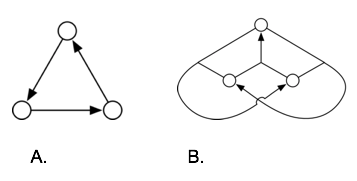
In “Coherentism via Graphs,”[i] Selim Berker begins to work out a theory of the coherence of a person’s beliefs in terms of its network properties. Consider these two diagrams (A and B) borrowed from his article, both of which depict the beliefs that an individual holds at a given time. If one beliefs supports another, they are linked with an arrow.
Screen Shot 2016-02-07 at 12.47.04 PM

Both diagrams show an individual holding three connected and mutually consistent beliefs. Thus traditional methods of measuring coherence can’t differentiate between these two structures. However, Graph A is pretty obviously problematic. It involves an infinite regress—or what has been called, since ancient times, “circular reasoning.” Graph B is far more persuasive. If someone holds beliefs that are connected as in B, the result looks like a meaningfully coherent view. If you find coherence relevant to justification, then you will have a reason to think that the beliefs in B are justified—a reason that is absent in A.

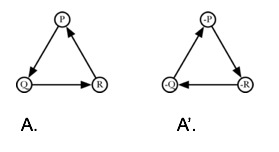
Berker also proposes a subtler but more decisive reason that B is better than A. Below I show A again, now with the component beliefs labeled as P, Q, and R. If the law of contraposition holds, than A implies another graph, A’, that is its exact opposite. A’  includes beliefs -P, -Q, and -R, and the arrows point in the reverse direction.
Screen Shot 2016-02-07 at 12.48.37 PM

But that means that if belief P is justified because it is part of a coherent system of beliefs, then the same must be true of -P, which is absurd.[ii]

The overall point is that coherence is a property of the network structure of beliefs. That should be interesting to coherentists, who argue that what justifies any given belief just is its place in a coherent system. But it should also be interesting to foundationalists, who believe that some beliefs are justified independently of their relations to other ideas. Foundationalists still recognize that many, if not most, of our beliefs are justified by how they are connected to other beliefs. Thus, even though they believe in foundations, they still need an account of what makes a worldview coherent.

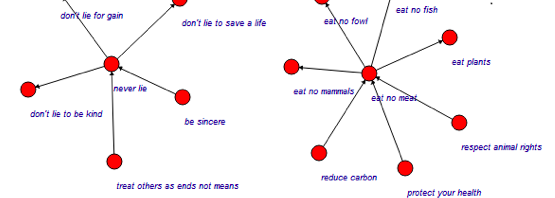
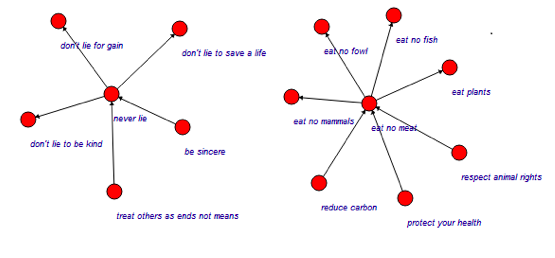
I have been developing a similar view, with a narrower application to moral thought (and without Berker’s deep grasp of current epistemology). I am motivated, first, by the sense that what makes a moral worldview impressively coherent cannot be seen without diagramming its whole structure. Imagine, for instance, a person who holds two major moral beliefs: “Never lie” and “Do not eat meat.” Assume that this person has not found or seen any particular connection between these two main ideas.
Screen Shot 2016-02-07 at 12.50.10 PM

His or her set of maxims is perfectly consistent: there is no contradiction between any two nodes. And every idea has a connection to another. But if we wanted to judge the coherence of this worldview, we would not be satisfied with knowing the proportion of the components that were consistent and directly connected. It would matter that the person holds two separate clusters of ideas—two hubs with spokes. This person’s network is fairly coherent insofar as it is organized into clusters rather than being completely scattered; but it would be more coherent if the two clusters interconnected via large integrating ideas. You can’t see the problem without diagramming the structure.

I also have another motivation for wanting to explore moral worldviews and political ideologies as networks of beliefs. In moral philosophy and political theory, constructed systems are very prominent. Although diverse in many respects, such systems share the feature that they could be diagrammed neatly and parsimoniously. In utilitarianism, the principle of utility is the hub, and every valid moral judgment is a spoke. That theory is so simple that to diagram it would be trivial. Kantianism centers on several connected principles, and Aristotelian, Thomist, and Marxist views are perhaps more complicated still. But in every case, a network diagram of the theory would be organized and regular enough that the whole could be conveyed concisely in words.

In contrast, my own moral worldview has accumulated over nearly half century as I have taken aboard various moral ideas that I’ve found intuitive (or even compelling) and have noticed connections among them. My network is now very large and not terribly well organized. A narrative description of it would have to be lengthy and rambling. Many of my moral beliefs are nowhere near each other in a network that sprawls widely and clusters around many centers.

I suspect this condition is fairly typical. No doubt, individuals differ in how large, how complex, and how organized their moral worldviews have become, but a truly organized structure is rare. (I have asked a total of about 60 students and colleagues to diagram their own views, and only one of the 60 gave me a network that could be concisely summarized.) That means that such constructed systems as Kantianism and utilitarianism are remote from most people’s moral psychology.

Further, I think that having a loosely organized but large and connected network is a sign of moral maturity. It is a Good Thing. That is obviously a substantive moral judgment, not a self-evident proposition. It arises from a certain view of liberalism that would take me more than a blog post to elucidate. But the essential principle is that we ought to be responsive to other people’s moral experiences.

Berker includes experiences as well as beliefs in his network-diagrams of people’s worldviews.[iii] In science, it should not matter who has the experience. An experience of a natural phenomenon is supposed to be replicable; you, too, can climb the Leaning Tower and repeat Galileo’s experiment. But in the moral domain, experience is not replicable or subject-neutral in the same way. Since I am a man, I cannot experience having been a woman my whole life so far. Thus vicarious experiences are essential to moral development.

If we are responsive, we will accumulate sprawling and random-looking networks of moral beliefs as we interact with diverse other people. These networks can be usefully analyzed with the techniques developed for analyzing large biological and social networks. It will be illuminating to look for clusters and gaps and for nodes that are more central than average in the structure as a whole. The coherence of such a network is not a matter of the proportion of the beliefs that are consistent with each other. Its coherence can better be evaluated with the kinds of metrics we use to assess the size, connectedness, density, centralization, and clustering of the complex networks that accumulate in nature.

On the other hand, if someone adopts a moral view that could be diagrammed as a simple, organized structure, he has not been responsive to others so far and he will be hard pressed to incorporate their experiences in the future. At the extreme, his simple graph is a sign of fanaticism.

See also: envisioning morality as a network; it’s not just what you think, but how your thoughts are organized; Stanley Cavell: morality as one way of living well; and ethical reasoning as a scale-free network (my first thoughts along these lines, from 2009).

Notes

[i] Berker, S. (2015), Coherentism via Graphs. Philosophical Issues, 25: 322–352. doi: 10.1111/phis.12052

[ii] “Coherence, we have been assuming, is a matter of the structure of support among a subject’s beliefs, experiences, and other justificatorily-relevant mental states at a given time.” But we can use directed hypergraphs (in mathematics, networks in which any of the nodes can be connected to any number of the other nodes by means of arrows) to represent all of those support relations. That is, we use directed hypergraphs to represent all of the relations that have a bearing on coherence. It follows that coherence is itself expressible as a graph-theoretic property of our directed hypergraphs (p. 339).

[iii] “Many theorists hold that a subject’s perceptual experiences are justificatorily relevant (in these sense that they either partially or entirely make it the case that the subject is justified in believing something).”

you have a right and a responsibility to attend to your own happiness

Two theses for today: 1) You have a right (and even an obligation) to be concerned about your own inner wellbeing–call it happiness, peace, lack of suffering, equanimity, satisfaction, or mental health. And 2) Inner wellbeing is a complex issue, not just a matter of maximizing a simple mental state, such as pleasure. Continue reading

the library of Edward R. Murrow

MurrowLast week I reported from the AFT building in Washington, where I’d attended a meeting in a room lined with the personal library of Albert Shanker, the late and very controversial leader of the teachers’ union. Earlier this week, I got to hear my excellent Tufts colleague Kelly Greenhill present on “The Security-Related Effects of Rumors” in a Tufts room that is furnished with the books of the late broadcast journalist Edward R. Murrow (1908–1965).

The arrangement of the two rooms is similar: the books fully surround a long wooden table, leaving just enough space for chairs.

Murrow was best known for his courageous WWII broadcasting and then his postwar opposition to Sen. McCarthy. He was perhaps a more consistently admirable person than Shanker, although opinions on that would vary. His books, however, were much more middle-brow. Shanker owned ponderous tomes of 20th century Continental philosophy. Murrow had more volumes like The Lady and the Vote (1956) by Marion K. Sanders. Then again, Sanders turns out to have been a crusading feminist journalist, a psychological warfare operative in WWII, an interviewer of Saul Alinksy, and a one-time congressional candidate. I’d guess that Murrow knew her professionally, which is reason enough to display her book and many like it.