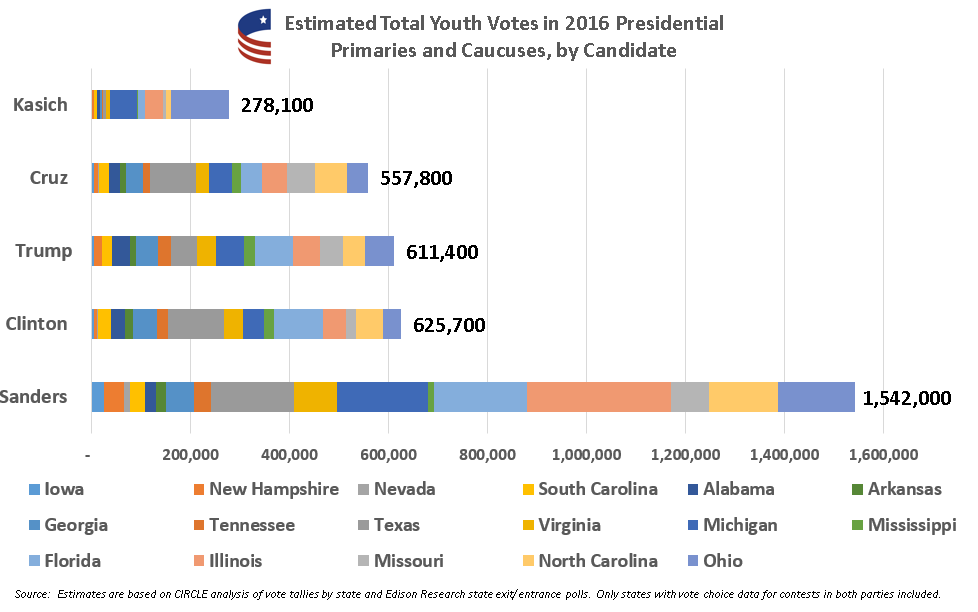
Sanders’ youth votes > Clinton + Trump

This graphic is the focus of Aaron Blake’s Washington Post article entitled “74-year-old Bernie Sanders’s remarkable dominance among young voters, in 1 chart.” As Blake writes, “Hillary Clinton and Donald Trump are well on their way to becoming their parties’ 2016 nominees for president. Among young voters, though, Bernie Sanders has more votes than both of them — combined.” The source is CIRCLE’s analysis released today.

Cumulative-Graph-March15

is the Sanders campaign a movement?

My friend Micah Sifry has a must-read article in The Nation entitled “How the Sanders Campaign Is Reinventing the Use of Tech in Politics.” He interviews two key staffers, Zack Exley and Becky Bond, who reveal a lot about the way their campaign has engaged its supporters.

I’ve written before about an oscillation: campaigns go back and forth between using technology to empower volunteers and accumulating Big Data to make their centralized outreach efforts more precise. Bond is explicit about which direction the Sanders campaign wants to move:

We’re shifting the focus away from a small number of sophisticated data and technologists engaged in a kind of Election Day arbitrage that ekes out incremental advantages by using micro-targeting algorithms to identify and turn out voters based on a model. Instead, we’re putting hundreds of thousands of volunteers to work, and in some states have literally called every single voter who will pick up the phone to identify everyone who supports Bernie or is undecided. Then we have other volunteers persuade the undecideds and turn out those who indicated support.

The article repeatedly describes the campaign as a “movement.” For instance, Exley says, “When Claire and I first arrived at the campaign, we knew that a movement was already way out ahead of the campaign. We believed it was our job to set up structures and tools to … help grow the movement.” A campaign fueled by volunteer hours and small donations that encourages its activists to recruit and lead certainly has a movement “feel.” But what would qualify the Sanders campaign as an actual movement–or as part of one?

Some would say that it’s already a movement because it has engaged a lot of fired-up people in unpaid political activity. Exley describes “a massive volunteer organization that’s making more than 1 million calls every day right now, knocking on countless doors and doing so much more.” Those accomplishments are typical of big, grassroots-based campaigns–not only partisan electoral campaigns but also bursts of grassroots energy in civil society. According to the late Charles Tilly and his colleagues, such campaigns are components or activities of social movements. But one campaign–even a large one–does not itself constitute a social movement.

Others would say that Sanders is part of a movement because he belongs to a loose, evolving, open network of academics, cultural figures, union leaders, organizers, and a few politicians that originated in the New Left and that supports democratic socialism in the United States. Not only is that network called a movement, but it is sometimes called The Movement–as in, “I grew up in the movement, you know,” or “I got to know Bernie through the movement back in the ’70s.”

I personally do not identify with this network, in part because I haven’t done anything worthy of admission to it and in part because my actual political beliefs are too eclectic. (I am not sure you can love Hayek and be in The Movement.) But I’ve known and admired bono fide participants all my adult life. The questions are … Does this strain of political thought and activism really qualify as a movement, even as it has spanned multiple decades? Has it shown enough signs of motion to be a movement? And how much of a movement activist is Senator Sanders? My sense is that he has been a solo voice on important issues, but not much of a movement-builder. He is not known for training organizers or leading organizations. As a voice and a vote in the Senate, he may be an asset to the movement–much like a noted author or musician who supports the cause–but I’m not sure he’s a movement person.

His campaign could nevertheless be an important episode in a movement that spans a longer time horizon and that has many more leaders than Bernie Sanders. It’s too early to say whether that’s the case, because everything depends on what happens after the 2016 election.

Another question is what movement his campaign is part of, if it turns out to be part of a movement at all. Sanders’ own roots are in ’60s-style US-based democratic socialism (see the Port Huron Statement), but other currents are feeding his campaign. Bond says, “First of all, I want to take this opportunity to say that the movement to defend black lives is fundamentally changing the terrain of social-change organizing. After recognizing that, yes, the young people and working-class folks, many of whom are from communities of color, who are leading the movement behind Bernie Sanders as volunteers on the ground are changing American politics.” That comment sounds somewhat aspirational to me–Sanders would be closer to the nomination if he had engaged the Black Lives Matter movement more effectively. But a large coalition could still form after his campaign concludes. Influenced in part by Tilly, I’d look for these features as evidence that a movement is afoot:

  • A set of campaigns–such as the Sanders presidential run and the civil disobedience in cities like Ferguson–that gain rather than lose momentum over a span of years and that look increasingly interrelated.
  • A characteristic repertoire of political acts, which might encompass everything from viral “memes” on social media to people shutting down highways.
  • A diverse, not completely consonant, yet overlapping and interacting set of prominent leaders, some involved in politics and some outside of it.
  • Cultural manifestations, such as very popular music in support of the cause.
  • A set of increasingly specific demands that begin to be implemented by major institutions.

See also: questions for the social movement post Ferguson.

game theory, naval warfare, and Derek Walcott

I am in Washington, DC but remembering our winter vacation in Les Saintes, near Guadeloupe, because I am reading Derek Walcott’s astoundingly good epic, Omeros.

In the channel with three islets christened “Les Saintes”
in a mild sunrise the ninth ship of the French line
flashed fire at The Marlborough, but swift pennants

from Rodney’s flagship resignalled his set design
to break from the classic pattern … (XV)

Walcott is referring here to a major naval battle in 1782. When we saw the dioramas of the battle in the local history museum, I wondered why the “classic pattern” was for enemy fleets to form neat parallel lines and blast away at each other.

BattleOfVirginiaCapes

Was this some kind of courtly custom of the Baroque era? (Walcott writes, “the young midshipman … thought there was no war  /as courtly as a sea-battle.”) I think game theory offers a better explanation. The opposing players chose the best available strategies, each on the assumption that his opponent would make the best choice for him–which is what game theorists call a Nash Equilibrium.

Recall that sailing vessels cannot maneuver with perfect control because they are driven by the wind. Most of their lethal fire is directed from their sides. If they independently choose their own courses during a battle, they can easily get in each others’ way. In principle, each could be given complex directions from some central point, but inter-ship communication was badly limited before radio. It therefore made the most sense to set one simple rule that would guarantee coordination. The inflexible rule of the Royal Navy was to form a line of evenly spaced vessels.

Lord Howe’s Explanatory Instructions (1799) explained, “The chief purposes for which a fleet is formed in line of battle are: that the ships may be able to assist and support each other in action; that they may not be exposed to the fire of the enemy’s ships greater in number than themselves; and that every ship may be able to fire on the enemy without risk of firing into the ships of her own fleet.”

If one fleet had a good reason to form a line of evenly spaced ships, so did its opponent. Both wanted to sail in front of the other’s line, or “cross the T,” so as to be able to rake the enemy’s ships without receiving fire in return. But if two fleets are both trying to cross in front of each other, what you get is a pair of parallel lines.

The result of such a battle was pretty predictable, a function of the number of guns on each side. That meant that a clearly smaller fleet had a strong incentive to avoid battle or, if forced into it, to break the line and take a chance at prevailing in a chaotic melee. A melee could also develop by accident as a result of weather conditions, geographical obstacles, or sheer chaos. At the Battle of the Saintes (1782), the lines got mixed up. Walcott says this was Admiral Rodney’s plan, his “set design.” Wikipedia says the reason was a gusty wind that broke up the lines. Whether by chance or design, the Royal Navy ended up killing 8,000 French to their own losses of just 243 men.

Trafalgar (1805) was another famous counterexample. Nelson deliberately swooped in to break the enemy line, despite the grave risk of being raked by their broadsides, because he had a much greater incentive than the Franco-Spanish fleet to achieve a decisive result that day and was willing to take his chances. Nelson played the chicken game and didn’t swerve, for which he paid with his life but gets to stand on top of a huge column in central London to this day.

In 1913, when he was First Lord of the Admiralty, Winston Churchill faced the accusation that he had impugned the traditions of the Royal Navy. He replied: “And what are they? Rum, sodomy and the lash.” Maybe he should have said, ” … and the Nash.”

See also the gift economy of Beowulf and some thoughts about game theory.
Where we vote affects how we vote. So where should we vote?

According to a summary article by Ben Pryor in The Conversation/Scientific American, people’s votes are affected by the voting location. Voting in a church “prime[s] significantly higher conservative attitudes—and negative attitudes toward gay men and lesbians.” On the other hand, “individuals voting in Arizona schools were more likely to support a ballot measure that increased the state’s sale tax to finance education.”

Pryor draws the conclusion that we should vote by mail–which, for most people, would mean voting at home. One objection is that home isn’t a neutral place. It will bring its own biases. I don’t know whether voting at home has been experimentally compared to voting at (say) a school, but let’s imagine that being home makes people more resistant to taxes. Why is that the most authentic, or most rational, or most autonomous perspective? To prefer the home seems to assume a rather contentious view of the relation between the public and private sphere. In political theorists’ terms, it’s a hyper-liberal view as opposed to a republican or communitarian one. Arguably, you should vote where you are primed to think about other people.

But isn’t it problematic that a church, for instance–with all the deliberate persuasive power of its iconography and architecture–should be the required context for voting in a secular republic? Well, maybe. But I don’t accept the view that citizens can be or should be disembodied and culture-free. The Progressive movement that achieved the secret ballot envisioned the ideal voter as a rational calculator of best interests (either his own interests or the nation’s). Progressive voting reforms were probably helpful, on the whole, but the guiding ideal seems both naive and a little unattractive. What, after all, is in our interests once we strip away values and group-memberships?

The opposite view–just for the sake of argument–is that we construct communities that are redolent of values. That’s why they are full of religious buildings, public structures with inscriptions and allusive architectural styles, businesses that promise various versions of the good life, and even natural spaces that we interpret as having moral significance. Communities govern themselves by making decisions, and a vote is one important moment for decision-making. Each person’s vote is profoundly influenced by the community context. Yet individuals push back. While the average voter may be influenced in a conservative direction by voting in a church, some are probably alienated by the context and pushed in the opposite way.

On every day, not just on Election Day, the community changes as people build, alter, and decorate its physical spaces and communicate in more ephemeral ways. For instance, the church in which a polling place may be located was built by people who wanted to change  local values and commitments. They were not satisfied with whatever religious structures and institutions already existed, but chose to make a new one. That was part of an endless process of community-formation. The material with which we reason and choose is given to us by the community so far, but we can change it one piece at a time. The real me doesn’t emerge when I am inside the home that my family has privately decorated. I am really “me” everywhere I go, and that means that I am always being shaped by my context and often pushing back.

See also: on voting by mail and voting and punishment: Foucault, biopower, and modern elections.

the question each citizen must ask

(New York City) “The Question Each Citizen Must Ask” is my new piece in Educational Leadership, the magazine for k-12 school administrators (vol. 73, no. 6, March 2016, pp. 30-34. It begins:

When universal public education was invented in the United States, visionary proponents like Horace Mann believed they were building the first large-scale democracy in the history of the world. They realized that citizens would have to be educated to play their parts in a system that depended on millions of wise and active participants. They made a courageous bet that children could be taught to make democracy work.

I argue that civic education must equip students to ask the citizen’s core question, and I explain what that is and what pedagogies are most promising. (The article is also available via academia.edu).