why Donald Trump is anti-conservative

Although not a conservative, I have sincere respect for conservative thought, because I think its core insight is human limitation. We human beings are too frail cognitively and morally to change societies wholesale without bad consequences.

You can come to that insight from a religious background, thinking that human beings are sinful but that we receive invaluable guidance from the divine. You can be completely secular, like Friedrich von Hayek, and argue that people lack the cognitive capacity to understand or manipulate something as complicated as a modern society, so we shouldn’t try to manage it centrally. Or you can be a cultural traditionalist, like Edmund Burke, and presume that much trial-and-error is embedded in all local traditions, whereas novel ideas are likely to go wrong, especially when imposed from without or above.

Regardless of your entry point, the conservative premise of human limitation leads to certain biases or tendencies: against central governments, against radical reforms, and in favor of durable constitutions, markets, and common law.

Of course, there is another side to each of those arguments, and I often land on the progressive rather than conservative side. (Just for instance, I don’t think that modern capitalist economies are really distributed systems that avoid top-down control; I think they are disruptive forces run by a few arrogant people.) But the conservative perspective is always worth serious consideration.

By this light, Donald Trump is not only the least conservative candidate in the current field, but the most anti-conservative candidate I can think of in modern American history. His whole argument is against human limitation. He promises that he can make everything radically better by applying his own amazing brainpower. He acknowledges none of the constraints prized by conservatives: religious revelations, cultural norms, constitutional checks, limited government in a mixed economy, or common law. I think his strong support in the primaries underlines the fact that the Republican electorate had become anti-conservative in basic ways, although a genuinely conservative GOP core is horrified by his campaign. As they should be, because he is the diametrical opposite of what is most valuable in conservatism.

See also: What defines conservatismEdmund Burke would vote Democratic; and the left has become Burkean.
why we need theory for social change

Margaret A. Post, Elaine Ward, Nicholas V. Longo, and John Saltmarsh have edited the new volume, Publicly Engaged Scholars: Next-Generation Engagement and the Future of Higher Education. It’s a great anthology that describes 30 years of work reconnecting higher education to communities and proposes exciting futures for that movement. It highlights the work of a new generation of engaged scholars who are more diverse and in many ways more sophisticated and effective than their predecessors.

I wrote an Afterword entitled “Practice & Theory in the Service of Social Change.” Since many of the chapters by younger scholars are autobiographical, I allowed myself to reflect on my own experience as well.

When I was an undergraduate, I chanced upon a set of early discussions and experiments that helped create the current movement for engaged scholarship. I got to join a Wingspread meeting about national and community service that helped build momentum for George H.W. Bush’s Points of Light initiative and then AmeriCorps under Bill Clinton.

Meanwhile, back on campus, my student colleagues and I started a program that provided paid summer service internships for students who agreed to present their work to the local alumni clubs. …

Thanks to my role in student government, the clerical and technical workers’ union asked me to sit at the table in a series of round-the-clock negotiations with the university that narrowly averted a strike. The university’s lawyers studiously ignored my presence because they took the position that there were just two parties in a contractual dispute; questions of public impact and justification were irrelevant, and therefore no representatives of the community had a right to attend. …

Also during my undergraduate years, I encountered deliberative democracy in a seminar on Habermas and during an internship at the Kettering Foundation in Dayton, OH, which was then experimenting with practical deliberative democracy in the form of National Issues Forums.

That was 25-30 years ago, and in many ways, I am still in the same milieu–now a Trustee of Kettering and an Associate Dean of a college that promotes and studies service and civic engagement.

In the “Afterword,” I argue that the movement began as a result of deep and searching questions about the democracy and society as a whole. Some participants were motivated by the Habermasian argument that civil society is a space for the reasonable discourse that should generate public opinion, but it was being “colonized” by the market and bureaucratic states. Some thought more in the spirit of Habits of the Heart (1985) and believed that US society was becoming too atomized. Still others were involved in the debate about neoliberalism and the declining welfare state, either welcoming volunteerism as an alternative or seeing students’ civic engagement as a form of resistance to the market.

So the movement began with a rich and vital discussion of how to change America, which turned into concrete activities like service-learning and deliberative democracy as potential tools or tactics. The subsequent decades have brought much experimentation with those activities, as well as burgeoning research about them: do they work, why, and for whom? But I don’t think we are any clearer about how to change America–and the strategies that seemed to make sense in 1985 may now be obsolete.

In the “Afterword,” I acknowledge the value of the “emotions,” “embodied experiences,” and “personal narratives.” Yet, I argue,

we do face problems that can be posed in abstract and general terms. And I believe that to some degree, our experiences from service-learning, community-based participatory research, and campus/community partnerships have outrun our theories. Put more forcefully: we will be unable to address profound social problems until we strengthen our theoretical understanding of society, and that will come from books, data, and seminar rooms as well as from action in communities. …

This book has a generational focus and looks to younger scholars for new models and solutions. Those scholars will (and should) base many of their ideas on personal experience and identity. Their relatively diverse backgrounds and their relatively deep experience with engagement are assets. Yet I would also look to the next generation for groundbreaking theory, some of it highly abstract and challenging. The theories that are already embedded in their narratives must emerge; they may also need to develop new theoretical insights. We need theories not only about civic engagement, but also about how society works and what causes it to change for the better. Almost every successful social movement I can think of from the past has developed new bodies of such theory. The theories of gender that accompanied Second Wave Feminism or the range of theological and political philosophies that emerged because of the Civil Rights Movement are essential historical examples. I would expect nothing less from The Next Generation of Engagement.

popular theories of political psychology, challenged by data

(Washington, DC) I’ve raised doubts about Moral Foundations Theory, which offers valuable insights but classifies individuals too crudely, overlooks the importance of deliberation and narrative in the construction of our moral ideas, and fails to explain historical change in moral opinions. I’ve also complained about research that classifies conservatives as having negative character traits. And I’ve argued that Amy Chua and Jed Rubenfeld’s bestseller that purports to explain economic success is unscientific.

Research reported in the press during this week has reinforced my skepticism:

First, Kevin B. Smith and colleagues, writing in the American Journal of Political Science, cast doubts on three strong claims of the Moral Foundations Theory: that the dispositions labeled “foundations” are stable for individuals over time, that these foundations predict and explain political ideology (and hence explain ideological differences), and that the foundations are inherited–as they must be if they result from Darwinian selection. Surveying twins along with other family members, Smith et al. find that “moral foundations are not particularly stable within individuals across time, at least compared to ideology.” At a given point, individuals’ answers to Moral Foundations questions do relate to their ideologies, but their views change over time. The causal arrow seems to point from ideology to moral foundations, as much as the reverse. Presumably, people are influenced by events, experiences, and discussions to revise their political views, thereby changing their Moral Foundations (which are not actually foundational). Thus the stream of research exemplified in Moral Foundations Theory has been “overly dismissive of the role of conscious deliberation.”

Second, Steven G. Ludeke & Stig Hebbelstrup Rye Rasmussen use a large survey to dispute previous work that had associated conservative ideology with “psychoticism,” which means being “cold, impersonal, lacking in sympathy, unfriendly, untrustful, odd, unemotional, unhelpful, antisocial, lacking in insight, strange, with paranoid ideas that people were against him.” Quite to the contrary, they find a negative association between psychoticism and conservatism.

These authors still find that conservatives tend to be more authoritarian than liberals are. My complaint about that kind of finding is that it’s ahistorical. At various historical moments, the right or left may be more favorable to authority or to disruption and change. The current association between conservatism and authoritarianism in the US tells us more about the political situation today than it does about fundamental political psychology. But in any case, we can drop the association between psychoticism and conservatism, since it’s false.

Third (in the same journal), Joshua Hart and Christopher F. Chabris tested whether the Chua & Rubenfeld “Triple Package” of “impulse control, personal insecurity, and a belief in the superiority of one’s cultural or ethnic group” predict economic achievement in modern America. It does not. Parental education (a proxy for social class) does, as does the individual’s own cognitive ability and self-control. As one might expect, having rich parents, doing well on tests, and behaving yourself lead to prosperity in the USA. Believing in the superiority of your cultural or ethnic group is no help at all. (This is political psychology only in the sense that a view about ethnic groups has political implications.)

Sources: Smith, K. B., Alford, J. R., Hibbing, J. R., Martin, N. G. and Hatemi, P. K. (2016), Intuitive Ethics and Political Orientations: Testing Moral Foundations as a Theory of Political Ideology, American Journal of Political Science (doi: 10.1111/ajps.12255);  Steven G. Ludeke & Stig Hebbelstrup Rye Rasmussen, “Personality correlates of sociopolitical attitudes in the Big Five and Eysenckian models,” Personality and Individual Differences, vol. 98, August 2016, pp. 30–36; Joshua Hart & Christopher F. Chabris, “Does a ‘Triple Package’ of traits predict success?,” Personality and Individual Differences, vol 94, May 2016, pp. 216–222.

the last qualified president was Zachary Taylor

There has been lots of debate this week about whether various people are qualified to be president. Peter Shane once observed that the US Constitution, Art. II, § 1, ¶ 5, renders all the current candidates ineligible:

No person except a natural born citizen, or a citizen of the United States, at the time of the adoption of this Constitution, shall be eligible to the office of President; neither shall any person be eligible to that office who shall not have attained to the age of thirty five years, and been fourteen Years a resident within the United States.

It seems that to be president, you have to have been either a natural-born citizen or a citizen of the US on June 21, 1788, the date when the Constitution was ratified. Zachary Taylor was three-and-a-half years old at the time, so eligible. Millard Fillmore was born in 1800, so unqualified–along with all of his successors. It’s that second comma that makes it so. And we know that every jot and tittle of the Constitution is perfect.

(Those wacky Framers.)

the advantages and drawbacks of precision in ethics

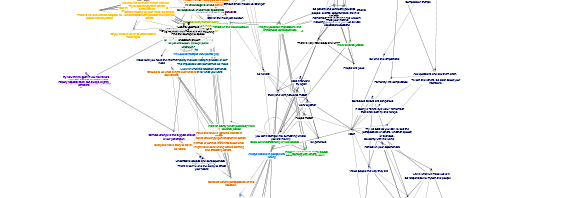
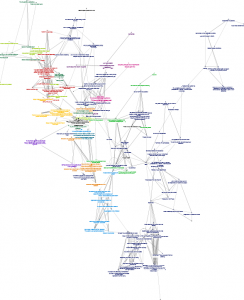
subject3I like to ask people to state their own beliefs that are relevant to ethics and then draw connections among those ideas to create networks that represent their moral worldviews. I put people (students and others) in dialogue with each other, invite them to explain their networks to peers, and watch connections form.

Usually the ideas that people propose are not precise. In explaining what we believe, we don’t employ many terms that we could define with necessary and sufficient conditions, nor do we often use quantifiers like “all” or “exactly one.” The connections we detect among our ideas are rarely logical inferences. They are looser links: resemblances, rough implications, empirical generalizations.

One impulse is to strive for as much precision as possible. That is a fundamental goal of analytic moral philosophy and it has significant merit. If someone proposed, “We should strive to improve everyone’s lives,” I would join mainstream analytic philosophers in requesting more clarity. Does that mean maximizing net human welfare? Does “welfare” mean happiness, satisfaction, or objective well-being? Does it trade off against freedom and autonomy? Does “everyone” mean all currently living human beings? (What about future generations?) Does “strive” mean actually maximize net welfare, or have a generally beneficent attitude toward others? These are valid and hard questions.

On the other hand, if the goal is descriptive moral psychology, it is a mistake to ask for that level of precision. We all hold–and are motivated by–rougher moral ideas and looser connections than could pass muster with an analytical philosopher. If you want to know what people believe, you must model those ideas and relationships as well as the clear ones. If you encourage people to map out many of their ideas and relationships, they will produce complex and elaborate networks that are useful for representing their mentalities and for provoking reflection.

That still leaves the normative question: how much precision should each of us strive for? I would say some but not too much. One of my favorite quotes is from Bernard Williams, in Ethics and the Limits of Philosophy (1985, p. 117):Theory typically uses the assumption that we probably have too many ethical ideas, some of which may well turn out to be mere prejudices. Our major problem now is actually that we have not too many but too few, and we need to cherish as many as we can.”

I’d expand that remark as follows: Through direct and vicarious experience, we build up collections of moral ideas that give our lives meaning and restrain our basest instincts. We also connect our ideas; we say that we believe A because it seems somehow related to B. If we must pass all these ideas and connections through a screen for clarity, precision, and inferential rigor, most will have to go. That will leave us with less meaning and less constraint against mere inclination and will.

Seeking clarity can illuminate. It can, for instance, force us to disaggregate a vague idea into a set of related ideas that are worth seeing on their own. Or it can reveal gaps and tradeoffs that deserve consideration. Formal philosophy is also useful for developing specific ideas that are clear and precise and that relate to one another logically.

However, it is a false dream that we can convert our entire networks of moral ideas into structures of clearly defined concepts and implications. Even the best moral arguments carry just a short distance–from a premise to a conclusion, or maybe as far as another conclusion or two, but not all the way across the domain of the moral. It is good to have a dense, complex, and expansive network of ideas that draws on experience and demands constant reflection and reevaluation, even if its components are a bit vague and the links are hard to articulate. Better that than a crystalline chain of reasons that connects just a few ideas and leaves us otherwise free to be selfish or fanatical.