CIRCLE analysis of Clinton and the youth vote

From today’s CIRCLE release:

Young voters overwhelmingly favored Sanders in Democratic primary, but the general electorate offers more potential upside to Clinton than Trump; young women, black youth more likely to support Clinton

The Center for Information and Research on Civic Learning & Engagement (CIRCLE) – the preeminent, non-partisan research center on youth engagement at Tufts University’s Jonathan M. Tisch College of Civic Life – today released an analysis of young people’s support and views of Secretary Clinton during this primary election cycle, exploring trends and implications for the general election.

How did Hillary Clinton perform among young people who voted in the primaries? And how did her youth support compare to that of previous Democratic nominees?

  • Secretary Clinton won 20 of the 27 state primaries for which exit poll data are available, but won the youth vote (ages 17-29) in just two of those states—Alabama and Mississippi.  
  • In these 27 states, she averaged only 28% of young voters, lagging far behind recent Democratic presidential nominees.
  • Secretary Clinton performed relatively better with young African Americans and she did better with slightly older youth (ages 25-29).
  • Data from Super Tuesday primaries indicate that young women were more likely to support Secretary Clinton than young men; but young women still supported her at lower levels than did older women.

How do young people overall view Hillary Clinton? And which groups of young people are most likely to vote for her?

  • At least half of young people have negative views of Secretary Clinton, and similar numbers do not find her honest and trustworthy.
  • However, more youth report that they intend to vote for Secretary Clinton than for Donald Trump, who has even lower favorability numbers.
  • Secretary Clinton may enjoy higher support from constituencies who have been especially supportive of other recent Democratic presidential nominees, such as young single women, young Black women, and young Latinas.

Is the general youth electorate more or less favorable to Hillary Clinton than the Democratic primary electorate?

  • The youth electorate in recent general elections has been more diverse than this year’s Democratic primary, which may benefit Secretary Clinton given her relative strength over Mr. Trump with young women and youth of color.
  • Together, young people of color and young women comprise roughly 70% of youth eligible to vote, and young women have historically turned out at higher rates than young men.
  • Voter outreach, always important, is especially critical with youth; our research has shown that young people who are contacted about voting are more likely to cast a ballot on Election Day. 


white working class alienation from government

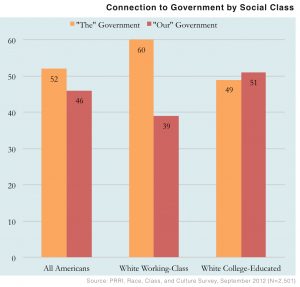
In aPRRI-2012-White-Working-Class_connection-to-govt-by-social-class recent long post, I argued that one reason white working class Americans are alienated from government is that they lack the productive political power that comes from organizations, such as political parties that rely on ordinary members, and unions. Moreover, because of the weakness of such organizations, white working class people are simply not visible in positions of power. A few leaders can rightly say that they started life in the working class, but almost by definition, they are now all well-paid and highly educated professionals.

As a supportive data point, here is a graph from a 2012 PRRI survey. Respondents are asked: “When you think and talk about government, do you tend to think of it more as ‘the government’ or more as ‘our government?'” The adult population is fairly evenly split, with almost half of Americans opting for “our government.” More than half of white college-educated people see things that way. But six-in-ten working class whites perceive it as “the government.” Among seniors who are working-class whites, a majority still see it as “their” government. That could be because they are invested in certain government policies (such as Social Security and Medicare), but it’s also true that they came of age at a time when working-class people exercised political power. Among young working-class whites, 70% see it as “the government.”

I don’t think they’re wrong. It is “the” government rather than “their” government in a meaningful sense. But as long as they feel this way, and no one offers actual empowerment, they are going to be ripe targets for demagogues who want to blow the whole thing up.

against root cause analysis

I am skeptical of the idea of “root causes” and the assumption that progress comes from addressing the roots of problems. The following points draw from discussions in our annual Summer Institutes of Civic Studies and are indebted to my co-teacher, Karol Soltan.

  1. The metaphor of a “root” seems misplaced. Social issues are not like plants that have one root system at the bottom and branches and leaves at the top, so that if you cut or move the root, you kill or move the whole plant with a single action. Very often, social phenomena are connected in systems that incorporate feedback loops and cycles, whether virtuous or vicious. It’s possible for one thing (A) to affect another thing (B) and for B also to affect A. Very often, outcomes are not the result of one ultimate cause but of the interaction of many causes. And causes can be viewed as outcomes, because there’s lots of reciprocal causation.
  2. Often, successful social action occurs even though the activists don’t know the root cause of a problem or they disagree about what it is. An example is the global movement to end slavery. Religious abolitionists argued that the root cause of slavery was sin, going back to the Fall of Man. “Free labor” abolitionists, like Abraham Lincoln, said that slavery was a plot to undermine a competitive market of labor in which the individual worker could profit. In contrast, Karl Marx wrote in 1847 that slavery was a lynchpin of global capitalism: “Direct slavery is just as much the pivot of bourgeois industry as machinery, credits, etc. Without slavery you have no cotton; without cotton you have no modern industry. It is slavery that has given the colonies their value; it is the colonies that have created world trade, and it is world trade that is the pre-condition of large-scale industry.” Frederick Douglass saw racism (“the wolfish hate and snobbish pride of race”) as a–or perhaps the–root cause of slavery. I suppose that all of them pointed to genuine causal factors, but the main point is that they formed a coalition that targeted the actual problem, not its underlying causes, and they won.
  3. Trying to identify root causes can delay or even block effective action. My friends Joel Westheimer and Joe Kahne wrote a very influential and valuable paper in 2004 entitled “Educating the ‘Good’ Citizen: Political Choices and Pedagogical Goals.”* They found that civic education programs in the US tended to fall into three categories, defined by their objectives for the students. An example illustrates the differences. In a program that aims to produce “personally responsible citizens,” a student will “contribute food to a food drive.” In a program whose ideal is to develop “participatory citizens,” a student will “help to organize a food drive.” In a program that emphasizes “justice-oriented citizens,” the student will “explore why people are hungry and act to solve root causes.” As Karol notes, the first two begin with an action, but the third begins with “exploring,” which doesn’t actually do any good in the world. Now, to be sure, one can also explore a diagram of a complex, interconnected system for a long time before doing anything, so it’s not only root-cause analysis that can fatally delay action. But I think that root-cause analysis is particularly likely to frustrate action because it sends us in search of the biggest, hardest, deepest aspect of a problem, which is exactly where the odds of success may be lowest. And that’s a mistake if problems do not actually have roots.

*Political Science and Politics, April 2004, pp 241-24.

See also Roberto Unger against root causes and roots of crime.

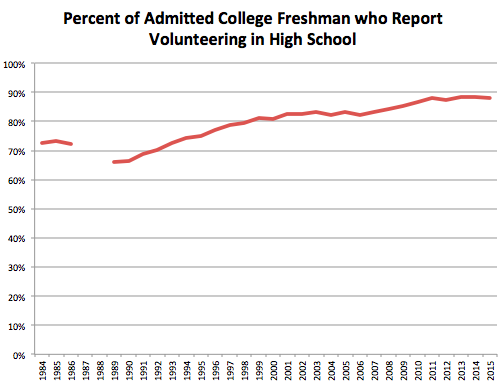
rate of first year college students who performed volunteer service

Screen Shot 2016-06-16 at 8.11.27 PM

This graph is based on data from the Higher Education Research Institute (HERI) American Freshman survey. I don’t think I have seen the trend presented in one place and continuing until 2015, so I offer the graph for public consumption. The trend is consistent with what we know about high school civics. Service programs became much more popular after the 1980s, as new initiatives, such as the federal Learn & Serve America grants, came online. Rates of volunteering have plateaued since ca. 2010, but at high levels. Service is pretty much expected of today’s prospective college students. However, volunteering is strongly correlated with socioeconomic advantage. People of the same age as these admitted freshman who are not going to college volunteer at much lower rates.

Mischa Berlinski, Fieldwork

This is an unsolicited advertisement for Mischa Berlinksi’s first novel, Fieldwork. It’s a compelling mystery, fluently and charmingly told. Without being at all pretentious, it’s also a challenging novel of ideas. Berlinski juxtaposes an imaginary Southeast Asian hill people who have remarkable religious rites of their own, a three-generation family of American evangelical missionaries who are thoroughly acclimatized and believe in the local gods (albeit as devils), a Dutch-American ethnologist who also happens to be a politically conservative woman, and a contemporary slacker dude. He describes everyone with respect and empathy. I can’t think of a way to discuss the issues Berlinski raises without spoiling the plot, so I will just say: read it.