building grassroots power in and beyond the election

14650129_10208031620332641_5797710429391184777_nI’m speaking today at a Wellesley College event entitled “The People Take Over the Election: Building Grassroots Power in and Beyond the Election.” I think this will be my thesis: We must be organized to have power and to exercise it productively.

Only when you are organized can you seriously ask the question, “What should we do?” Without an organization, you can still ask, “What should I do?” but none of us can do all that much alone. We end up combatting climate change by changing our own lightbulbs, or addressing racism by trying to improve our private thoughts. These are not pointless strategies, but they are badly insufficient.

Without an organization, you can ask, “What should be done?” or “How should things be?” or “What should somebody else–often the government–do?” Those questions are too easy. (Carbon should be taxed; police should be overseen.) The hard part is figuring out how we can make those things happen. A habit of thinking only about what should be done encourages a spectator attitude toward politics.

People without organizations end up being represented by famous individuals–celebrities–who claim to speak for them and who claim mandates on the basis of their popularity. Celebrities have no incentives to address social problems; they gain their fame from their purely critical stance. And they owe no actual accountability to their fans, since no one (not even a passionate fan) expects a celebrity to deliver anything concrete. Donald Trump is unusual in that he has moved from a literal celebrity to a presidential nominee; but he still acts like a celebrity, and presumably he will return to being a pure mouthpiece once the election is over. Meanwhile, back at the grassroots level, a person who feels represented by celebrities is unlikely to talk productively with fellow citizens who disagree.

I mention Trump here because one important fact about his core constituency, White men without college degrees, is that they used to be organized, but that is no longer true. For instance, less than 6 percent of them are in unions. That’s an 80- or 90-percent decline* since the 1950s, and they are now less unionized than college grads are.

If you have no organizations behind you, you’ll typically feel powerless. If that’s how you feel, you are unlikely to want to participate in a difficult conversation, make sacrifices and tradeoffs, acknowledge any unfair advantages, or negotiate. Again, to use Trump voters as an example: they are overwhelmingly White, and it would be appropriate for them to acknowledge White privilege when issues of racial injustice arise. But I think they are very unlikely to acknowledge their own privilege, let alone agree to concessions, as long as their overwhelming experience is one of powerlessness. And I think they are powerless if they are unorganized and represented only by unaccountable celebrities. This implies, by the way, that one of the most important tasks confronting us today is organizing the White working class.

Organizations build what Charles Tilly named WUNC: worthiness, unity, numbers, and commitment. For instance, the protesters now holding ground at Standing Rock are demonstrating that they have a right to be there (worthiness), that they stand together (unity), that there are a lot of them, with a lot of supporters around the world (numbers), and that they are willing to face violence (commitment). WUNC is a scarce but renewable asset for social movements. Poor and marginalized people all over the world have build WUNC and used it to change the world.

It may be that we can do without older forms of organizations, such as unions, grassroots-based political parties, and religious congregations, now that we have digital networks. I think the jury is still out on that question. Loose, voluntary networks of activists brought down the Egyptian government, but once those networked activists confronted the organized Muslim Brotherhood, they lost the election, and once the Muslim Brotherhood confronted the even better organized Army, they lost a bloody struggle for survival.

We need organizations during an election. It might appear that when it’s time to vote, each person can exercise power individually and privately. But that power is actually pretty trivial. Nate Silver currently gives Hillary Clinton a 99.8% chance of winning Massachusetts, which means that each vote here is close to irrelevant. What matters in an election is not your individual vote but your participation in organized efforts to change the whole discussion, the balance of power, and the outcome.

Campaigns are such efforts. The Clinton campaign will spend more than half a billion dollars to build and run an organization. But modern presidential campaigns are problematic organizations because they rely so much on wealthy donors, they spend their cash so heavily on propaganda, and they establish short-lived transactional relationships with their own voters. But they are still organizations, and their power reinforces the importance of building other kinds of organizations as well.

*not percentage-point, by the way.
the ethics of vote swaps

David Iaconangelo writes, “this year is seeing a resurgence of vote-swap websites and apps that pair voters for a major-party candidate – in most cases, Democrats in blue states – with a third-party supporter living in a swing state. … Some find the tactic a little unsettling, even if it isn’t illegal or clearly unethical. ‘I’m a little conflicted,’ says Peter Levine, a political philosopher and associate dean at Tufts University’s College of Civic Life.”

As I say in the article, you’re not supposed to do anything as a quid pro quo for your vote. Swapping would seem to violate that principle. “On the other hand, the president is a national political figure, meaning the allocation of one’s vote across state lines might be considered a matter of personal choice. And if there’s no enforcement involved …, the deal might be little more than two people talking about how they’re going to vote, since the ballot is secret, anyway.”

I also note in the piece that we may have two different theories of what a vote is. On one view, it’s an instrument for getting the outcome you want. The point of our voting laws should be to ensure that everyone has the same influence. The Electoral College introduces inequality because only some states are competitive. If you can coordinate with someone in a different state to remove that obstacle, you are using your instrument more effectively.

On a different view, voting is partly an expressive civic act. Your vote won’t make a tangible difference in a presidential election anyway (with or without the Electoral College). But your vote is one way for you to belong to a community that governs itself–and not only by voting. You should vote in the community that you belong to.

I have a expressed a similarly nuanced opinion about where you should vote if you have a legal right to choose. For example, I support the right of college students to decide whether their residence is their college or their family’s home for the purpose of voting. However, it’s not obvious to me that they should (ethically) make that choice by deciding where their vote will count the most. Quite honestly, the differential impact of where you cast your single vote in a presidential race is microscopic. I think you should decide where you are a citizen in the full sense, and vote there.

evolution, game theory, and the morality of modern human beings

It’s valuable to model the development of phenomena like altruism and spite (harming someone else at a cost to oneself) by combining game theory with evolutionary theory. The results should be seen as predictions to be tested against empirical evidence about actual organisms. My question is what this combination tells us about our situation as human beings in historical time.

The basic assumptions are:

  1. Organisms interact with each other so that each one can win or lose. For instance, a parent feeds its child, a predator eats its prey, a mite hitches a ride on an insect. These interactions can be modeled as games in which each player makes a choice (e.g., kill or don’t kill), and positive or negative outcomes result for each as a joint result of their decisions. (“Choice” is a metaphor, because completely non-sentient organisms can be modeled as players in a game. For instance, a plant can release a chemical or not.)
  2. Changes in how organisms interact in game-like situations arise more or less randomly. As a result of a genetic mutation, an organism may begin to mimic another species. Or, as a result of a change in climate, an organism’s prey may become scarce.
  3. If playing a game in a particular way increases the odds that a species will reproduce, that behavior will become more common. For instance, if mimicking works, it will spread.
  4. This means that the payoffs that matter from game-like interactions among organisms are best measured in terms of evolutionary fitness. Whatever an organism may want or think or feel, what matters is whether its chances of reproducing increase or decrease.
  5. Given the first four assumptions, under certain conditions, behaviors that we might consider proto-moral, such as helping offspring, helping others outside the family lineage, or even sacrificing oneself to punish another for violating a norm, predictably arise. By being altruistic (or punitive) in game-like interactions, an organism may gain evolutionary fitness.
  6. Thus we can explain proto-moral behavior through a combination of game theory and evolutionary theory. The behavior is a consequence of background conditions. This form of explanation applies to homo sapiens, who have cognitive capacities and instinctive drives for things like fairness and punishment because of the conditions that pertained before historical time when we evolved into our current form.

Game theory is part of my own toolkit. I believe it clarifies many situations that confront human beings as we interact with each other and helps us to devise solutions to collective problems. I also acknowledge that we are a biological species that evolved with certain capacities and drives, and that inheritance must be taken into consideration as we diagnose and try to address our problems as a species. However, I tend to believe that Darwinian evolution gave us certain capacities that now fundamentally change the premises described above (points 1-6):

  1. We can design games. The original Prisoner’s Dilemma, for example, is a situation intentionally created by a prosecutor within a legal system. The prosecutor could change the game, or he could be required to change it by a legal reform. A shared pasture is a very different game from a Prisoner’s Dilemma, but it’s also intentionally designed.
  2. We can choose goals. If natural selection determines change in a whole population, then it doesn’t matter what each organism wants; it matters what promotes survival and reproduction. But human beings can choose what we want in specific interactions. Sometimes we want things that reduce our chances to survive and reproduce, but we compensate with other strategies.
  3. We can change our identities. If a person’s main identity is a parent, his impact on his own offspring is central. But he could instead choose to identify primarily with a church, a community, a nation, or other grouping.
  4. We can design and change the groups within which our interactions occur. As an example, the size of a group influences how organisms interact. But we human beings can merge small groups to form vast nations, decentralize governance to small groups, nest communities within states, or place people in multiple overlapping groups. We can intentionally vary not only the size of groups but also their internal diversity, spatial extension, equality of influence, and cost of entry and exit.
  5. We can influence individuals’ predilections to play games in various ways, e.g., to be altruistic, trusting, selfish, spiteful, or punitive. We can influence children in lasting ways by raising and educating them to have certain character traits. We can also influence behavior in local and temporary ways by changing messages and contexts to encourage desired behaviors.
  6. We are influenced in all the above choices by norms, but we disagree about the best ones, and the available norms are the results of deliberate human creativity. In short, we invent and choose norms.

Game theory remains relevant–in fact, it is an especially useful toolkit for a creature that is capable of designing and redesigning its own interactions. I am less sure that evolutionary theory is relevant, except insofar as it explains certain proto-moral tendencies and limitations that now contribute to our challenges.

Notes: Points 1-6 are guided by my Tufts colleague Patrick Farber and specifically his excellent paper “Reciprocal Spite” (with Rory Smead). Points 7-12 are heavily influenced by Elinor Ostrom, who emphasized the diverse outcomes that result when people face collective action problems and the importance of their intentional choices about groups, rules, and norms.

John Stuart Mill, Stoic

I sometimes envy my fellow academics in the humanities who regularly renew their acquaintance with fundamental works that have slipped pretty deep into the well of my own memory because my job is to conduct and administer empirical research about current politics. For just that reason, I am thoroughly enjoying reencountering some major works as I teach first-year undergraduates this semester.

For instance, I now see Mill’s Utilitarianism in an entirely new way thanks to re-reading it with students after our extensive discussions of authors like Epicurus, Buddha, and Emerson. It seems much less an explanation of the utilitarian principle of justice (maximize everyone’s happiness) than I had remembered, and more an exploration of how an individual should pursue happiness. It thus belongs to a genre that Mill knew very well, the tradition of therapeutic philosophy inaugurated by the Hellenistic schools and revived by Montaigne.

In the text of Utiliarianism, Mill refers several times to Epicureanism and Stoicism. For instance: “I do not, indeed, consider the Epicureans to have been by any means faultless in drawing out their scheme of consequences from the utilitarian principle. To do this in any sufficient manner, many Stoic, as well as Christian elements require to be included.” This passage suggests that Mill is interested in constructing the kind of “eclectic” view (drawing from multiple Hellenistic schools) that was popular from the time of Cicero and continued in early Christianity. Continue reading

CIRCLE breaks down the youth vote

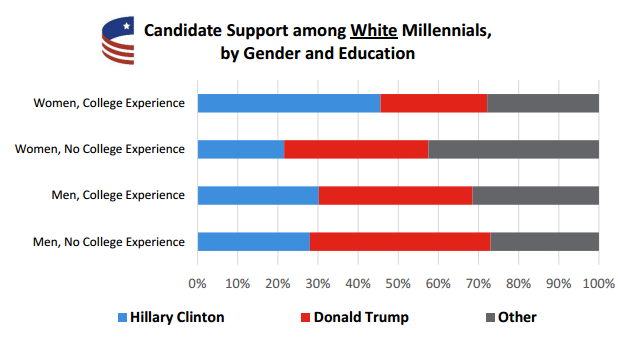
When CIRCLE’s Millennial survey was conducted (9/21-10/3), Clinton was beating Trump by 21 points (49% vs. 28%). Clinton may do better when the actual votes are cast, because there seems to be a trend in her favor among youth. That said, the CIRCLE poll allows detailed comparisons between young Americans who were favoring the two candidates at a moment when Trump was drawing one in four.

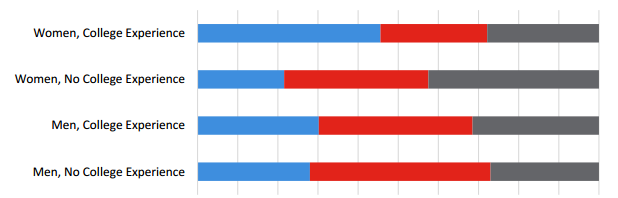
Young Trump and Clinton voters were starkly different people, and today CIRCLE has published an analysis that compares them by demographics and by opinions. For example, this graph shows Trump winning a plurality of non-college-educated men under 30 even as he was losing college-educated young women by almost 2-to-1.

circletrump

A couple of other illustrative findings from the report, which deserves to be read in full:

  • 85% of young Trump voters are dissatisfied with the way things are going for the country, and they are far more likely than Clinton supporters to believe that the country’s best days are behind us.
  • Trump supporters are less experienced with various types of political engagement, and more likely than Clinton supporters to say that they would “never, under any circumstances” do things like volunteer for a campaign or attend a political rally, suggesting that Trump supporters are overall less likely to be politically engaged.