why Trump fans aren’t holding him accountable (yet)

(Washington DC) Kevin Drum imagines how a Trump fan receives the president’s tweets:

You’re at home, watching the Factor, and O’Reilly is going on about the crime problem in Chicago. It’s outrageous! The place is a war zone! Somebody should do something!

Then, a few minutes later, you see Trump’s tweet. “If Chicago doesn’t fix the horrible “carnage” going on, 228 shootings in 2017 with 42 killings (up 24% from 2016), I will send in the Feds!” Damn straight, you think. They need the National Guard to set things straight there. Way to go, President Trump.

This exchange is good enough for you–on its own. You don’t really want Trump to send the feds into Chicago, whatever that might mean. If it would cost money or create a precedent for federal intervention in your town, or anything like that, you might actually be against it. But your media stream will never give you an update on whether Trump sent in the feds or what happened to the murder rate in Chicago. You are immersed in media that consists largely of bad news about places you don’t like. You are satisfied that the guy in charge shares your opinion and has announced he’s on it. He even quotes verbatim the same stats you just saw on O’Reilly. It’s a magic solution–at last.

I think more or less the same will happen as a result of Trump’s announcement today that Mexico will pay for the border wall via a 20% import tax. That is highly unlikely to occur, because Congress would have to enact the tax, and I’m guessing the economic effects would be awful if it did; but Trump’s fans will probably never get an update. They may hear about battles between the president and Congress over taxes, but those will take the form of specific insults flung from his end of Pennsylvania Ave. up to the Hill, which they will endorse. Each exchange will be an event unto itself.

I happen to think that this kind of politics has yuge political limitations for Trump. Most people already disapprove of him, and his welcome is going to wear even thinner when people’s actual lives fail to improve. In turn, massive disapproval will weaken his already shaky position. But it’s still a very dangerous situation, at best, and is very far from any reasonable model of a democracy.

My explanation is that millions of Americans have lost all expectation that leaders will be accountable to them. At the national level, they are not getting very good results from the government that purports to represent them. At the local level, they have lost the kinds of institutions that used to depend on people like them. To reprise a graph from a recent post, here is the trend in the proportion of people who belong to a church and/or a union:
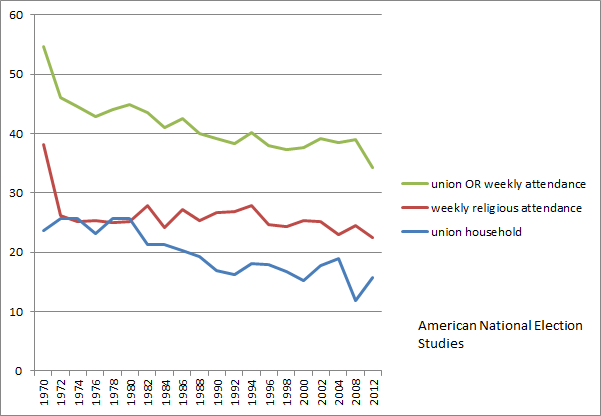
For all their flaws, these are the kinds of institutions that make promises and then have to deliver. If they fail, their members know about it and complain, act up, or walk out. A union or a church has a real covenant with its members. When people have no such expectations of accountability, they are much more likely to be satisfied because the boss just tweeted something they agreed with. Again, I think Trump’s own appeal will wear even thinner than it is now, but the underlying problem is a lack of accountable organizations in many communities.
assessing the charge of respectability politics

“Respectability politics” is a valuable term of criticism. Apparently, Evelyn Brooks Higginbotham coined it in 1993. It refers to a strategy of trying to look “better” in the eyes of the dominant group in order to be accepted and make progress. Since respectability politics puts unjust and impossible burdens on the marginalized, we should diagnose and try to avoid it.

At the same time, successful social movements do try to look better. An appearance of moral or spiritual discipline and excellence–“Worthiness” –is an asset that social movements can build and use for political purposes, along with “Unity,” “Numbers,” and “Commitment” (WUNC, for short). They claim higher ground because that’s a powerful strategy.

Also, democratic social movements demand that their own members–previously excluded from civic life–be treated as full citizens. True citizens display values and commitments that are not very common in any population: for example, they are actively engaged with public issues and concerned for the common good. Therefore, in asserting a right to be full citizens, social movements often try to embody values that are better than what they see around them; they try to “Be the change.”

My friend Harry Boyte has saved the Program Notes from the 1963 March on Washington, which says, among other things: “In a neighborhood dispute there may be stunts, rough words, and even hot insults. But when a whole people speaks to its government, the dialogue and the action must be on a level reflecting the worth of that people and the responsibility of that government.”

I don’t think that message should be labeled “respectability politics.” The point of the Program Notes was not to look better to White people. The point was to live up to high expectations chosen and embraced by the Black leaders of the March. The movement redefined respectability–indeed, excellence–on its own terms.

For example, it’s traditional for a crowd at a march or rally to hear a famous and excellent singer. That is one way to display both worthiness and unity. At the 1963 March, Mahalia Jackson filled this traditional role when she sang, “I’ve Been ‘Buked, and I’ve Been Scorned.” The difference was that she sang an old gospel song about her own people. This was a performance designed to move and inspire Whites (and others) as well as African Americans, yet she didn’t sing a “White” song to obtain their support.

Likewise, Dr. King’s speech was aimed at a majority-White and overwhelmingly Christian nation, but his specific style of prophetic oratory was uniquely African American. One of the achievements of an effective social movement is an expansion or redefinition of respectability–but not an abandonment of respectability as an ideal.

It’s hard to redefine and consistently demonstrate respectability within a mass movement that is voluntary and democratic. People will join with all kinds of agendas and styles, and they have a right to that diversity. Some will make choices that look bad to others. Enemies of the movement will emphasize the outliers: for example, FoxNews showed footage of last Friday’s anarchists to illustrate Saturday’s vast and peaceful women’s marches. Still, I think the women’s marches represented “worthiness” to an extraordinary degree, and that is a basis for optimism about the next few years.

Opinions about any specific case will differ, but we can look at a sign, slogan, or statement; at a whole episode, like Saturday’s marches; or at a movement composed of many such episodes, and assign it to a category:

  1. Problematic respectability politics, when the movement adopts norms that exclude some people in order to gain support.
  2. Neutral respectability, when the movement just happens to be respectable in many people’s eyes, without adjusting its rhetoric or strategies or excluding anyone.
  3. Pursuit of excellence: whether by displaying self-sacrifice or by singing as well as Mahalia Jackson (or in many other ways), a movement presents itself as more than respectable. Most people cannot meet this ideal, but it becomes a resource for the whole movement. Maybe only Gandhi is starving himself, but we are all satyagrahis if we support him.
  4. Shifting the border of respectability in productive ways. For example, wearing a pink pussy hat on Saturday was a way of rebuking the utterly disreputable new president with a sly and kid-friendly answer. In my view, the hats were fully respectable, but in a way that shifted respectability slightly.
  5. Unhelpfully un-respectable politics, such as the anarchists’ window-breaking on Friday or (arguably) Madonna’s speech at the March.

My main point is that the choices are not just 1 or 5. Some movements fill the other categories, and all are options.

fighting Trump’s populism with pluralist populism

In lieu of a substantive new post here today, I’ll link to an essay of mine on the Oxford University Press blog, “Fighting Trump’s populism with pluralist populism.” It concludes, “We need a dose of populism that neither delivers power to a leader nor merely promises fair economic outcomes to citizens as beneficiaries. In this form of populism, diverse people create actual power that they use to change the world together.”

Saturday’s democratic vistas

The ideal of democracy gets weak support today.

Republican presidents from T.R. to George W. Bush presented the United States as a champion of democracy. But a current conservative talking point holds that the US is meant to be a republic, not a democracy, and only the opposition party favors democratic forms of government.

It’s my anecdotal impression that not many Democratic voters are all that enthusiastic about democracy, either; they see a population that likes Donald Trump enough to give him a near-majority, and they are not sure they want that majority to rule.

Overseas, the suppression of the Arab Spring, the frailties of the EU, the rise of popular ethno-nationalists in many countries, and the strong performance of  China’s authoritarian regime have left small-d democrats with a hangover. Julia Ioffe is just one of many well-informed commentators who recalled recent failed democratic uprisings when she observed this weekend’s marches. “Talking to the protesters in Washington today, it was hard not to hear the echoes of the weakness of the Moscow protests five years ago: a vague, unstructured cause; too much diversity of purpose; no real political path forward; and the real potential for the meaning of the day to melt into self-congratulatory complacency.”

Meanwhile, impressive scholarly evidence continues to build that people make political choices on the basis of social identities, not by forming independent opinions of issues; that our conflicting moral views have unconscious bases that are “nearly impregnable to arguments from outsiders“; and that voters are badly uninformed. Walter Lippmann (1925) and Joseph Schumpeter (1942) already held this general view, but the accumulating evidence must be taken seriously.

Many thoughtful people have accepted the diagnosis in full. They are aware of democracy’s real maladies. Unfortunately, their commitment to finding cures is much weaker.

After all, any political system is only as good as we make it. There are generic arguments in favor of core principles of democracy, such as “voting equality at the decisive stage” (Dahl 1989), but there are also generic problems with it, such as majority-tyranny, propaganda, free-riding, motivated reasoning, the “iron law of oligarchy,” and polarization. An actual system based on voting equality will work well only to the degree that we build institutions and norms that can counter its weaknesses. For instance, a city newspaper can address low information and polarization in a metro area–as long as it finds a market and uses its revenues to inform the public. A grassroots political party can overcome free-riding problems by getting citizens involved–but only if it engages citizens.

If we want to build the new institutions and norms that can make democracy work in the 21st century, we need a lot of people to see its potential. We must be hard-headed designers and reformers of institutions, our eyes open to human limitations; but we must also hear old Walt Whitman’s music:

The purpose of democracy … is, through many transmigrations, and amid endless ridicules, arguments, and ostensible failures, to illustrate, at all hazards, this doctrine or theory that man, properly train’d in sanest, highest freedom, may and must become a law, and series of laws, unto himself. …

Did you, too, O friend, suppose democracy was only for elections, for politics, and for a party name? I say democracy is only of use there that it may pass on and come to its flower and fruits in manners, in the highest forms of interaction between men, and their beliefs — in religion, literature, colleges, and schools — democracy in all public and private life, and in the army and navy. I have intimated that, as a paramount scheme, it has yet few or no full realizers and believers. I do not see, either, that it owes any serious thanks to noted propagandists or champions, or has been essentially help’d, though often harm’d, by them. …

I submit, therefore, that the fruition of democracy, on aught like a grand scale, resides altogether in the future.

Whitman saw glimpses of that future in his own time, and I think hundreds of thousands of people–including me–scanned new democratic vistas on Saturday. That was the first essential step toward actually repairing our democracy together.

a plea to conservatives

The new president derides almost everything you claim to defend. You say you are for limited government and the rule of law over men; he denies all limitations. You say you are patriots; he praises a foreign kleptocrat while abusing his domestic critics and public servants. You speak of an independent free market; he intervenes daily with threats and blandishments. You remind us of the importance of norms and moral constraints, grounded in traditions. He seeks public attention by violating interpersonal, institutional, even sexual norms. You honor faith; he demonstrates ignorance of his own religion and contempt for others. You stand for cultural excellence and depth–he is a shallow vulgarian.

It will be tempting, nevertheless, to embrace this man because he aligns with you on certain matters that you are entitled to hold dear: taxes, Supreme Court nominations. Besides, liberals and progressives with whom you have a long and bitter feud hate him, and that inclines you to sympathy. His critics sometimes go beyond principled judgment to demonstrate bias against him. That makes you want to take his side. Your fellow travelers who have never struggled to understand or honor the hard principles of your movement–opportunistic politicians and performers who don’t know Hamilton from Madison or Burke from Hayek–are already jumping aboard. They have cast their lots and sold themselves that they might drink.

Liberalism will be fine. Liberals will lose favored policies, and as a result people will suffer, even die. But as a movement, liberalism will emerge unscathed, indeed, more unified, determined, and popular. It is conservatism that it’s at risk. And that is a problem for the country, which needs a conservative counterweight.

If you don’t stand explicitly against him, he will define what you stand for. Conservatism will mean Trumpism for generations to come. If you are very lucky, his administration will perform well enough that you will survive to continue your battle with the left and center-left. But if he leads the nation into a crisis or ruin, you will own that, too. And deservedly, because his mistakes will flow from his arrogant abuse of state power, which you, as champions of limited government, should have blocked.

“For the day of the Lord is near in the valley of decision” (Joel 3:14). Even in a century or more, it will be remembered where you chose to stand. Blow ye the trumpet, sound the alarm.