The Anachronist

In the year 1596, Anna is about to be burned at the stake. As the constable prepares to light the fire below her, she can do nothing but seek a solution in her own memory and imagination.

The Anachronist is a game in which you make choices that determine the outcome. By increasing Anna’s knowledge, you can create opportunities for her to act. By decreasing the entropy or disorder of the whole situation, you can raise the odds that the ending will be a happy one for all of the characters. If you try to conclude the story while knowledge is too low or entropy is too high, Anna will burn.

At the same time, The Anachronist is literary fiction. With as many words as a novel, it’s indebted to authors like Joyce, Borges, Calvino, and Pamuk. It uses modernist and post-modernist literary techniques–as well as an interactive format–to explore questions of perspective, historical change, and truth.

Emily Short writes:

The Anachronist is a Twine piece by Peter Levine. It’s long, and paced like a novel rather than like a short story or a poem; it very much belongs to the category of readerly IF [Interactive Fiction]. …

As for what it’s about, that is a little more difficult to describe. The protagonist is being burned at the stake in 1598 (perhaps), but in the moment that she stands in the flame, her mind wanders. She imagines her surroundings in Oxford, or possibly a painting of her surroundings; she thinks about alchemy, the art of memory, the intellectual commitments of a former teacher.

Your task is an abstract one, to do things that globally increase knowledge or decrease entropy. Part of the gameplay involves recognizing and selecting anachronistic references; those links aren’t highlighted for you, but if you succeed in finding something, that counts against entropy.

The knowledge aspect is a little trickier. Most of the choices at least in the early stages of the story are choices either to look more closely at some aspect of the world or else to move onward. My impression was that looking more closely would often increase knowledge, but I’m not certain how consistently that was applied. Some choices overtly claim to have changed your knowledge/entropy status, but I’m not sure that there aren’t other, covert alterations.

I have not yet had the time to read the whole thing. One of the themes so far is a meditation on cultural contact, on how people portray and understand those from other cultures. But that is definitely not the only thing going on, and I’d need to finish the piece in order to say much more.

It’s been online for about three weeks. Some other early readers’ responses are here. Or click to enter the world of The Anachronist.

mixed feelings on the DeVos nomination battle

I opposed Betsy DeVos’s nomination, I’m grateful to the people who protested it, and I’m sorry she won confirmation. But I’m not sure it’s a good sign that she attracted more effective opposition than the other nominees have. (That is, unless the grassroots opposition to Jeff Sessions has been relatively underreported.) The purpose of this post is not to check the momentum of the anti-DeVos efforts but to ponder today’s ideological spectrum and how we should identify and counter the worst threats to democracy.

Why did DeVos get more effective criticism than the other nominees? It can’t be because she poses a graver danger. The Every Child Succeeds Act of 2015, which had bipartisan support, determines federal k-12 education policy. Congress won’t reopen that legislative compromise. Moreover, education is predominantly a state responsibility, and the 2015 Act gave the states more discretion. The Higher Education Act is due for renewal, but I doubt Congress will muster a majority for a major change. DeVos will have to operate within the parameters of two demanding statutes. In contrast, the cabinet secretaries in charge of foreign policy, justice, financial regulation, and environmental issues have much more freedom of action.

Nor do DeVos’ radical views explain why she attracted more effective opposition than Trump’s other nominees. She is a very strong proponent of school choice, to such an extent that some mainstream proponents consider her support a liability. But the idea of introducing market mechanisms into education has been dominant for 25 years, and both the Clinton and Obama administrations endorsed versions of that theory. Democratic Sen. Cory Booker has worked with DeVos on school choice initiatives. To be sure, she acknowledges that she favors school choice so that religious schools can expand, whereas some other pro-market reformers just expect better performance to result from competition. But that difference of motivation may not make much difference for actual policy.

It’s true that DeVos performed poorly in her hearings, but was she really less qualified than Rick Perry or Ben Carson? If the Senate has been assessing competence and qualifications, then you’d have to consider sexism to explain why Senators seem to prefer those two men to DeVos. After all, DeVos has worked on education issues, albeit narrowly defined.

It’s not hard to find other explanations for DeVos’ harder path to confirmation. More people care about education than about other issues. Vouchers are unpopular or irrelevant in suburban and rural communities. Also, there is just one cabinet secretary for education, so she attracted all the attention, whereas the nominees concerned with other topics split up the opposition. Here, for example, is a rally against the environmental nominees, but it targets three of them, it’s not very big compared to the anti-DeVos events, and it’s in Democratic controlled Newark, NJ.

Above all, the teachers unions are organized nationally and still have the capacity to prompt grassroots action.

I’m all for that, since I think democracy requires organization. But is it good that mobilization has been most effective against DeVos? We’re used to a linear ideological spectrum, with pro-market/anti-state views on the right and New Deal/Great Society government activism on the left. In that framework, DeVos stands far to the right. Trump is also some kind of right-wing radical. Therefore, DeVos must be like Trump, and blocking her would mean blocking Trumpism. Unions are organized for that purpose, since they exist to counter market rule.

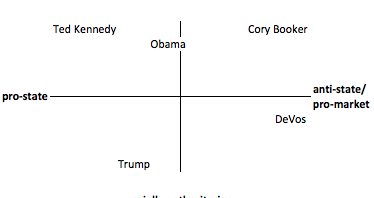
I think this framework is obsolete. We should array political leaders on two continua, from pro- to anti-state and from liberal to authoritarian on social issues. Donald Trump does not stand to the right on the spectrum from pro- to anti-state. He is all for using the massive power of the federal government. He just wants to use it for an ethnonationalist, reactionary program.

This is the taxonomy I have in mind for the issue of education:

I code Ted Kennedy as pro-state and socially-liberal, although he was a major architect of No Child Left Behind, which introduced market mechanisms. I still think he was more pro- than anti-state, because NCLB also dramatically increased federal spending on education and introduced some new command-and-control regulations. I code Cory Booker as socially liberal and pro-market on education, because he (and not he alone among Democrats) has strongly advocated school choice. I put DeVos just a touch to Booker’s right on the pro/anti-state axis, but also well to his south on the authoritarian scale, because she clearly wants to use education policy to change the whole culture in conservative directions. Still, she chooses to do that by reducing the power of the state, not by expanding it, which makes her not very authoritarian. Finally, Donald Trump stands down there in the bottom-left quadrant, eager to use the state to enforce reactionary norms.

I’m left-of-center on this diagram, but I’m willing to have an ongoing debate with market advocates in which the size of government rises and falls and voters make judgments based on results. It’s the bottom-left that frightens me.

If pro-state authoritarianism is the greatest threat to democracy today, then we must rally all its opponents. They will include pro-government liberals who detest the content of Trump’s policies along with anti-government libertarians who fear the expansion of the state. I would not advocate trying to enlist Betsy DeVos herself in the movement against Trump, although she did oppose him explicitly on ideological grounds in March, saying, “I don’t think Donald Trump represents the Republican Party. I continue to be very optimistic that as we get further along into the process, the more voters know about him, and the more informed they are, the more they’re going to continue to break away.” But even if you don’t want to share a movement with DeVos herself, we need people from her general camp.

As Jon Valant writes, Donald Trump is driving Democrats away from school choice. They used to be divided on that issue, and some, like Sen. Booker, saw choice as means to improve poor systems. Now Trump has endorsed school choice on the stump and has chosen a market zealot for his education secretary, and Democrats are rightly against Trump. Therefore, Democrats are turning against school choice. Valant says, “Trump and DeVos, divisive figures enormously unpopular among Democrats, could become the public faces of charter schools and school choice.”

If you oppose market mechanisms in education (and I’m moderately skeptical of them), then this is a Good Thing. It disrupts the bipartisan support for school choice and turns it into yet another policy proposal that will require single-party control to enact. Down go the odds that we will expand school choice. But if you’re hoping for a leftist plus liberal plus libertarian coalition against Trump, then the shift against school choice could make things harder.

None of that implies that DeVos will be a good Secretary of Education or that it was a mistake to oppose her. I just think we need a coalition against authoritarianism that is equally effective against the true Trumpists and that makes common cause with libertarians until the present danger passes.

Brecht, To Future Generations

Bertolt Brecht, An die Nachgeborenen (1939), in my translation from the very simple and direct German.

I

Truly I live in dark times!
A sincere word is folly. A smooth forehead
Indicates insensitivity. If you’re laughing,
You haven’t heard
The bad news yet.

What are these times, when
A conversation about trees is almost a crime
Because it implies silence about so many misdeeds,
When, if you’re calmly crossing the street,
It means your friends can’t reach you
Who are in need?

It’s true: I earn a living.
But believe me, that’s just a coincidence. Nothing
of what I do entitles me to eat my fill.
It’s a coincidence that I am spared. (If my luck stops, I’m lost.)

They tell me: eat and drink! Be glad that you did!
But how can I eat and drink if
What I eat is snatched from the hungry,
My glass of water from someone dying of thirst?
And yet I eat and drink.

I would like to be wise.
The old books say what wisdom is:
To shun the strife of the world and spend the short time
You’ve got without fear.
Do without violence.
Return good for evil.
Not fulfilling desires but forgetting
Counts as wisdom.
I can’t do any of that:
Truly I live in dark times!

II

I came to the cities in a time of disorder.
When famine ruled.
I came among the people in a time of turmoil
And I rebelled with them.
So the time passed
That was given me on earth.

I ate my food between slaughters.
Murder lay over my sleep.
I loved carelessly
And I looked upon nature with impatience.
So the time passed
That was given me on earth.

In my time, roads led into the swamp.
Speech betrayed me to the slaughterer.
I could do very little. But without me,
Rulers would have sat more securely, or so I hoped.
So the time passed
That was given me on earth.

Energies were low. The goal
Was far in the distance,
Clearly visible, though for me
Hard to reach.
So the time passed
That was given me on earth.

III

You who you will emerge from the flood
In which we have sunk,
Think
When you speak of our weaknesses
And of the dark time
That you have escaped.

For we went, changing countries more often than shoes,
In class warsdesperate
When there was only injustice and no outrage.

This we knew:
Even hatred of humiliation
Distorts the features.
Even anger against injustice
Makes the voice hoarse. Oh, we
Who wanted to prepare the ground for friendliness
Could not ourselves be kind.

But you, when
one can help another,
Think of us
Forgivingly.

(Originally posted in 2014.)

trends in egalitarianism

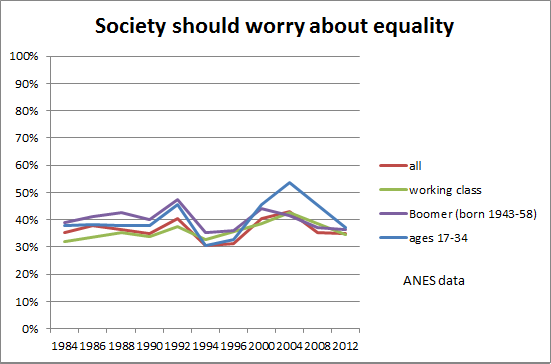
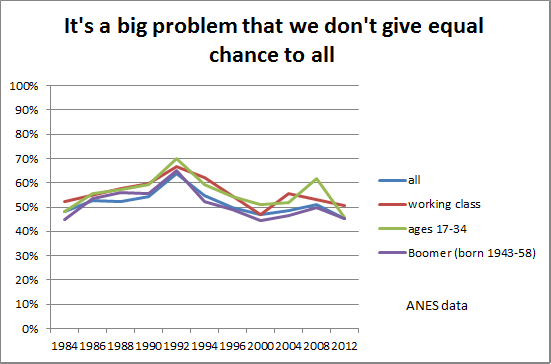
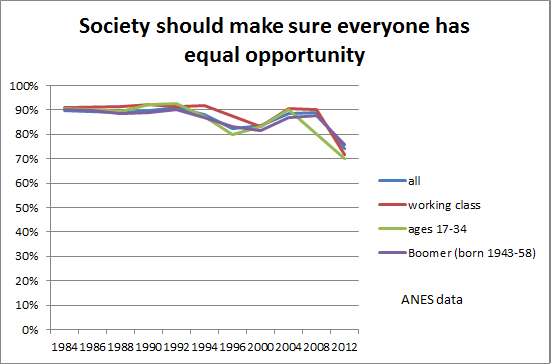
Here are some graphs that show Americans’ changing views of equality. You can click them to expand them. In each case, I’ve graphed the opinion of the whole population, of people who identify as working class (a measure more of self-image than objective resources), of younger people, and of one pivotal generation, the Boomers, as they’ve moved through time. Each point represents at least 100 respondents, usually many more.

Some observations:

Most Americans believe in equal opportunity. Not nearly as many believe that we should worry about equality or that a lack of opportunity is a big problem. (The former question asks whether “We should care less about equality,” and I show the percentage who disagree.) One interpretation is that Americans believe in equality of opportunity but not in equal outcomes, and many perceive that opportunities are pretty equal.

Differences by class, age, and generation are not striking. Younger people have been somewhat more likely to think that we should worry about equality, but they’ve actually been a bit less likely to see unequal life chances as a big problem. Boomers have tracked the national mean during this period, as have working-class people.

The consensus in favor of equality of opportunity fell off substantially during the Obama years. That is not entirely an effect of partisanship, since even in 2012, 83.5% of Republicans favored equality of opportunity, just five points below Democrats.

The other equality measures rose during the Reagan and Bush I administrations, fell under Clinton, rose during Bush II, and fell under Obama. Any of these explanations might hold: people react negatively to the perceived priorities of incumbent politicians; or Americans view equality as taken care of under Democrats and unaddressed under Republicans; or Democrats win elections when the economy is bad, and that’s when Americans grow concerned about equality.

Finally, I really don’t see a secular trend here–i.e., a trend that would reflect long-term changes in the economy or the demographics of the country.  Two of the measures stand roughly where they did in 1984, and the shifts appear to be short-term reactions to presidential administrations or the business cycle. There’s possibly a long-term trend in the general belief that “society” should ensure everyone equal opportunity. One could perceive a decline in that measure since 1992, although if 2016 or 2018 registers a rise, that decline will look illusory.

See also: the most educated Americans are liberal but not egalitarianthe most educated Americans are liberal but not egalitarian (2); a new chapter on generational trends in US politics; and how public opinion on social spending has changed: a generational approach.