Josh Patten’s satire

I’m very amused by Josh Patten’s project: replying to President Trump’s tweets as if they were texts for him personally:


Imagine going back to 1990 and trying to explain the humor here. “We have a president, you see, who makes a fool of himself daily by tweeting inane remarks to about 34 million followers. Yes, the President of the United States. A tweet? Well, it’s a short message that you type and anyone who wants to read all your ad hoc thoughts can subscribe. Yes, lots and lots of people do this all the time. OK, so a comedian imagines that the president’s tweets are messages just for him. (We all get these ‘texts’ on fancy phones that we carry everywhere.) The comedian responds in the banal way you might answer a friend’s texts, imagining that he’s part of the president’s private circle instead of a mass audience. And this is funny because … I guess you’d have to live in 2017.”

A serious point is buried in Patten’s humor. Companies and governments have long sought to infiltrate private spaces in order to increase their influence. FDR arrived in Americans’ living rooms during “fireside chats.” The TV screen brought “Friends” into your house. To various degrees, most people have protected their real lives from these infiltrations by drawing distinctions between actual and fake friends, authentic and artificial messages. Now that we lead a lot of our private life online, where anyone can “follow” it, and now that almost all leaders (popes and Dalai Lamas as well as heads of state) broadcast messages through the same media that we employ for social purposes, the borders are harder to police. Donald Trump is intruding–often counterproductively, but still pervasively. Patten’s satire pushes back.

See also: protecting authentic human interactionDoes Twitter “smoosh” the public and private?Habermas illustrated by Twitter.

deliberation depends on social movements

Why would people deliberate? Here I’ll argue that citizens will only come together to exchange reasons if they are empowered to make decisions. In turn, it often takes a social movement to  change institutions so that any particular group of citizens has power. And social movements cannot be (fully) deliberative.

In an important passage in Talking to Strangers, Danielle Allen argues that it’s an error to assume that speakers “enter [any] deliberative forum already mutually well-minded toward one another.” She writes, “If they do so enter, the battle to achieve a reasonable policy outcome is already 75 percent won. The hard part is getting citizens to that point of being mutually well-intentioned.”

Allen proposes rhetorical solutions to this problem: ways of communicating that encourage other people want to hear your reasons and respond with good arguments, rather than walk out or shout you down. For example, you can begin a conversation by making an unsolicited sacrifice, which is “the most powerful tool for generating trust.” You can also “aim to convince 100 percent” of the audience instead of trying to build a mere majority, and you can look for ways to “ameliorate the remaining disagreement and distrust” after a decision has been reached. These are techniques for creating the conditions under which people will exchange reasons about what is right to do.

The rhetorical techniques that Allen suggests manifest political friendship, in Aristotle’s sense. First you act like a friend; then people will trust you enough to deliberate with you. The good news is that many people exhibit a desire for such friendship that makes deliberation possible. In 1982, my friend James Youniss, a developmental psychologist who had studied with Habermas, wrote:

Persons enter discussion, debate, negotiation, and so on … to clarify uncertainties, check doubts, receive criticism, justify views, gain different opinions, or explore novel ideas. But that is not all. Persons who respect one another seek to maintain their relation, and they communicate voluntarily for this purpose. They want to understand and to be understood. They want to show that they care and want to be cared for in return. In the reciprocal cooperation epitomized in friendship, each retains freedom of thought by acknowledging freedom in the other and, thus, communication is essential so that the respective parties do not lose the opportunity for truth seeking in common. [“Why Persons Communicate on Moral Matters: A Response to Shweder,” Merrill-Palmer Quarterly, vol. 28, no. 1, 1982]

These relational motives make deliberation seem plausible. Talking can be its own reward, if and when people value friendship. However, the mode of discussion may have to be emotional and personal and may have to involve speech-acts like making sacrifices. Abstract arguments will fall on deaf ears unless trust has been built.

Allen’s rhetorical suggestions are valuable as long as relevant citizens have chosen to gather together at one time and place in order to communicate. But most people allocate their time and energy to purposes other than meetings. Those who stay away may be foolishly renouncing their influence, or selfishly free-riding on others’ efforts–but both behaviors are predictable.

If group exists, we can try to invite, entice, cajole, or reward people to participate. But we cannot just assume that a group exists that has the capacity to make decisions. To be sure, once a group forms, then (almost regardless of its assets) it can empower itself by creating goods that it allocates. A Parent-Teacher Association (PTA) raises money at a bake-sale, which gives it a budget to deliberate about. In such cases, the deliberation depends on a prior solution to a collective-action problem: getting parents to contribute goods for the sale.

In many circumstances, the problem is more difficult than that. It’s not just a matter of generating a resource that can be discussed, but of capturing it from someone else. For instance, if the municipal government sets the city budget, then a public meeting about priorities is not really a deliberation; it is just a forum for talking to power. Forcing or persuading the city to share ts power would require an organized political effort that would precede a citizen deliberation about taxing and spending. But how to get people involved in that political effort is again a problem of motivation and coordination.

The broader point is that any reasonably decent conversation depends on rules, which must not only cover the speech itself (e.g., by giving everyone an equal chance to talk) but must also create groups that have the power to make decisions that are worth talking about. Since power rarely yields voluntarily, the main way to change unacceptable rules is to organize social movements. Such movements may harbor some internal deliberations, but they cannot be deliberative fora. They must aim for specific reforms that then create groups that are worth deliberating in.

This is why I think that “Ostrom, Habermas, and Gandhi are all we need.” See also: Habermas, Ostrom, Gandhi (II) and how to get a deliberative democracy.

varieties of neoliberalism

Jonathan Chait laments the use of the word “neoliberalism” to denounce Democratic Party leaders like President Obama and Hillary Clinton–even Elizabeth Warren–from the left. Chait tells a story that begins in the 1980s, when the word “neoliberalism” was “the chosen label of a handful of moderately liberal opinion journalists, centered around Charles Peters, then-editor of the Washington Monthly.” Chait began his own career with Peters and shares at least some of this group’s views. He feels attacked by those who call neoliberalism “the source of all the ills suffered by the Democratic Party and progressive politics over four decades, up to and (especially) including the rise of Donald Trump.”

The word “neoliberalism” was virtually unused before 1950 and has rapidly become popular of late. But what does it mean?
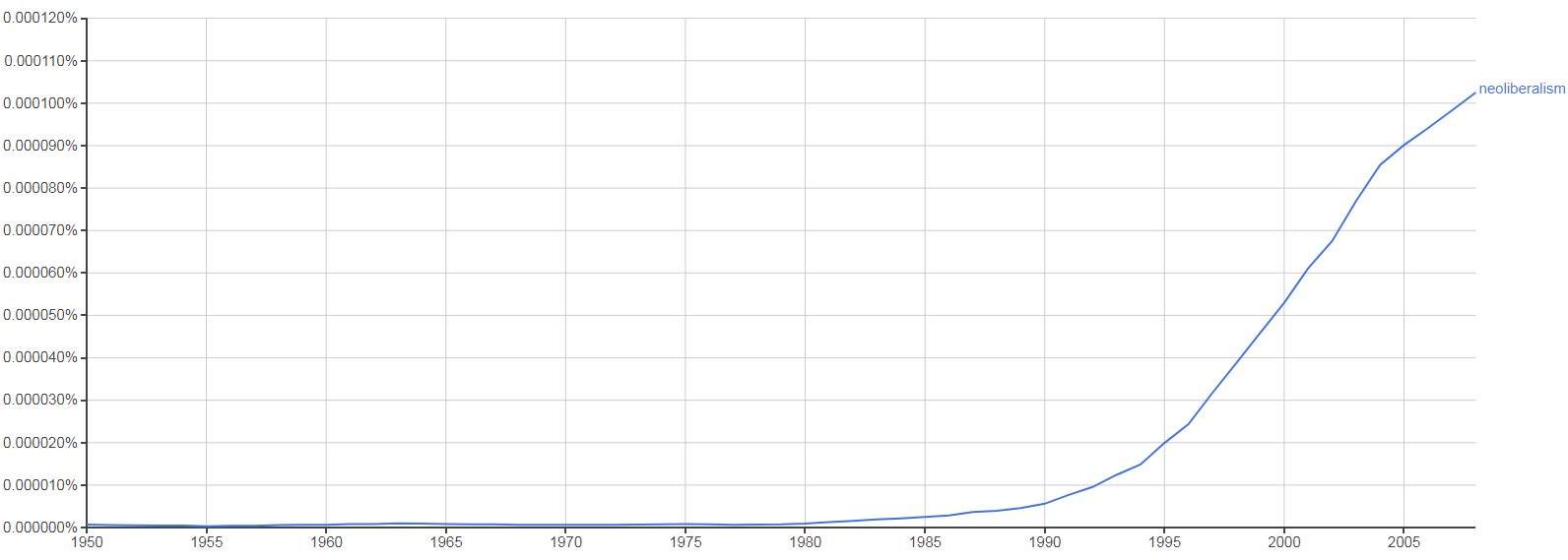
“Neoliberalism” as a percentage of all the words in all English-language published books, 1950-2016, from NGram

In a reply to Chait, Mike Konczal distinguishes three kinds of neoliberalism, of which Chait’s is the first. Konczal argues that the left critique–a valid one–is against the second and third versions. All three have developed since 1980, probably contributing to the trend shown here.

Konczal’s three-fold distinction is better than the two-fold one I was going to propose before I read his piece, so I’ll follow his scheme.  This is how I would define the three versions:

Neoliberalism I

In the 1980s, certain leaders of the Democratic Party (Charles Peters, Bill Galston, Bill Clinton, and others) argued that if you seriously evaluated social programs, you’d find that many didn’t work. Spending scarce resources ineffectively did the recipients no good and reinforced the voters’ sense that Democrats just threw money at problems. Some of these people were centrists, arguing with their party’s left. They called themselves “neoliberals” to assert a break with the positions of people like Walter Mondale, the supposed “paleoliberals.” However, in principle, their argument could appeal to leftists, who would reallocate funds from poorly performing programs to better ones. I can easily imagine a version of this agenda flourishing within a socialist system. It’s about measurement, accountability, managerial expertise, and innovation, which are features of modernity that have been quite influential on the left. If you “see like a state,” you will be interested in measuring impact and allocating resources to the most effective uses. The reallocations will be made by state agencies, which actually centralizes power.

Neoliberalism II

In the 1950s and 1960s, Keynsian economics reigned pretty much supreme on both sides of the Atlantic. Then stagflation delivered an intellectual blow, and soon Chicago School economists were making increasingly influential proposals for tax cuts, deregulation, and monetary responses to recessions. Their arguments were welcome to political and economic interests that never liked the taxes and regulations of the New Deal. The economists didn’t call themselves neoliberals, but that label made some sense in a global context, where “liberalism” typically means laissez-faire–what Americans call economic conservatism. Reagan and Thatcher were neoliberals in this sense, many continental European countries also moved in that direction, and the shift was dramatic in the Global South, partly because of pressure from the IMF and World Bank. The arguments tended to be utilitarian: if you cut taxes, then you will see more total wealth for the whole population. An authoritarian state, such as Pinochet’s Chile, could endorse these policies, in which case there would be a dramatic gap between political liberties and neoliberal economics. Indeed, some critics hold that this form of neoliberalism is mostly about using militarized state power to promote corporate economic interests.

Neoliberalism III

Since Victorian times, a social philosophy has been available that says market exchange is natural, whereas states are artificial; that exchanges of goods or labor for money manifest freedom; that success in a market reflects virtues (thrift, industry, creativity) rather than vices like greed; that governments are coercive, whereas market exchanges are voluntary; that people should be individually responsible for the consequences of their actions; that markets embody collective wisdom, whereas centralized planning is subject to massive error, etc. That philosophy was called “liberalism” ca. 1850. It gained momentum and picked up the name “neoliberalism” in the 1980s, although most actual proponents called themselves “libertarians,” “classical liberals” or (in America) “conservatives” rather than “neoliberals.” I have mentioned a lot of different ideas in this paragraph, and proponents need not endorse them all. However, the thrust here is neither pragmatic experimentation (as in Neoliberalism I), nor utilitarianism (Neoliberalism II), but a set of normative views about society and character. One of the greatest thinkers of the left, Michel Foucault, expressed some support for neoliberalism in this form, seeing it as potentially emancipatory. Foucault certainly wouldn’t have appreciated Neoliberalism I or II.

Put together, these three movements invoke a long list of ideas, and most people would refuse to endorse them all. Hardly anyone calls himself a “neoliberal”; it’s an epithet coming from further left on the political spectrum.

It’s not clear that we’ve really moved in a Neoliberal II direction. The federal government spends about 3 percentage points more of GDP today than it did in the 1960s, when the Great Society (and the War in Vietnam) were in full force.
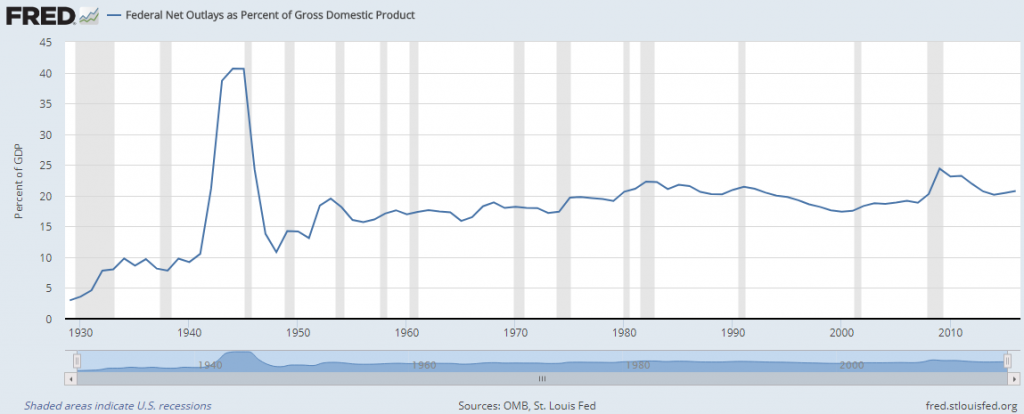
However, there has definitely been a shift of rhetorical emphasis. The 1948 Democratic Party platform on which Harry Truman ran was unabashedly pro-government and critical of business. No modern Democrat would sound like that. They all order some of their dishes from column I, II, or III of neoliberalism’s menu.

Specifically, the Obama Administration loved concrete new policy interventions that could be rigorously evaluated. In 2o13, for instance, the administration proposed $200 million in a competitive pool for state governments that cut energy use and expanded HOPE (Hawaii’s Opportunity Probation and Enforcement scheme), which had performed well in evaluations. But they proposed to cut Social Security by $130 billion and Medicare by $380 billion. They didn’t like these cuts; they felt forced to offer them in a budget battle with Congress. But the result of expanding evaluated social programs while cutting entitlements would be Neoliberalism I.

Similarly, when modern Democratic leaders tout their superior economic management–Look at the GDP growth and stock market increases when we’re in charge!–they are making a utilitarian case for voting Democratic. It’s not exactly Neoliberalism II, because it doesn’t say: “Less government produces more net wealth.” Instead, it says: “A combination of competent management, fiscal prudence, targeted investments, and free trade produces more net wealth.” That claim may be true and reasonably popular, but it leaves a lot of space to its left, particularly when it carries a whiff of Neoliberalism III in the form of admiration for business leaders. It isn’t surprising, then, that a substantial number of people would want to criticize mainstream Democratic policy, and the word “neoliberalism” works pretty well for their purpose.

See also:  Foucault and neoliberalismEdmund Burke would vote Democraticthe core of liberalism, and what defines conservatism?

Anachronist review

The Anachronist is my interactive novel. Several readers have posted reviews of it on the Interactive Fiction Database. (If I may say so, the one person who gave it a low quantitative rating had a complaint about a technical issue that I’ve fixed since then.) A reviewer called CMG makes some helpful and valid critical points, but in the interest of blatant self-promotion, I’ll quote from the good parts of the review, which nicely summarize my intent:

You play as a woman about to be burned at the stake for witchcraft. She is lashed to it when the story starts. It is being lit. But she doesn’t burn just yet. She has been apprenticed to an alchemist, and has gleaned the art of memory. This allows her to retreat into her own mind and escape the fire — temporarily.

A single moment expands to encompass days, weeks, years, lifetimes as she plunges deeper and deeper into her memories. …

Time obviously goes out the window. Anachronism isn’t a mistake: it is the truth. The more time decomposes, the more we understand as we come to learn the circumstances surrounding the present moment. It’s a complex little plot, with conspiracies and double-crosses. Bit players enlarge to take central roles as our protagonist’s focus sharpens. Structurally, this means that the story is based around increasingly dense telescopic descriptions. We have a scene, we concentrate on a detail, that detail becomes another scene, we concentrate on another detail in that scene…

More than any other interactive fiction I’ve played, this feels like a novel. …

I faced the hardest decision I’ve had to make in a choice-based game in this story. At multiple points, you can break your concentration and return to focusing on the stake, the rising fire. I didn’t do that. I stayed in the protagonist’s head (or maybe the protagonists’ heads). And finally I reached a point where I had been reading for hours, for days, while the stake was still burning, and the game confronted me: what was I accomplishing by living in my memories? Shouldn’t I focus on the fire, what’s actually happening?

I didn’t know what to do. After playing for so long, I really felt as though I was avoiding the story’s reality. I had stretched out my time on the stake in real time by reading the text. It was absurd. I should’ve been burnt to a crisp. Here was the story’s most glaring anachronism, and I was the anachronist enabling it.

What I chose to do next doesn’t matter as much as the fact that the game created this situation in the first place. This isn’t a story whose strength rests on making the “right” choices. Its strength comes from how its themes are reflected in the reader’s own experience, which can only happen because it’s interactive.

In this sense, it’s some of the strongest interactive work I’ve seen.

the laughter of the gods

The laughter of the gods is asbestos:
Unquenchable. It’s genuine, hearty,
Unselfconscious. Wet eyes shut to slits; lungs
Heave the mountain air. A shaky finger points
To the god who started it off: Nice one.
He’d mentioned some mortals’ pratfall end:
Sinkhole swallowed family car, gas main blew,
Drunken, laid-off father shot wife, kids, dog, self.
Mirth subsiding to satisfied chuckles,
They take sweet foamy sips from the nectar’d bowl.
Then someone starts it up again. What about
Heart attacks, yes, or slow wasting sicknesses?
The joke is contagious; they’re all chiming in.
Plagues, famines, lonely singles quietly
Ending it. Civil wars! Firing squads!
They keep it going to maintain the mirth,
Each relishing the others’ pleasure:
No pretense, no competition, no critique,
Just a nice way to pass the endless time.

(see also a poem should and voices)