learning from the Florentine republic

(Florence): En route to Kyiv, I am in Florence for a conference of Americans who work on civic and democratic reform in the USA. It happens that I studied in Florence many decades ago–an experience that helped form my lifelong commitment to republican self-government. I am not truly an expert on the Florentine republic, but I can venture some thoughts about its relevance to our time:

  1. For renaissance Florentines, civility (civiltá) meant the kinds of discourse and behavior that benefited self-governance. To determine what counted as civility, one first asked what the republic needed. Their answer was discourse that was frank, plain-spoken, and direct, in contrast to the talk of courtiers, which was deferential and artificial. For the Renaissance historian Giovanni Cambi, a true citizen was a man who refused to doff his hat or call any one “padrone” (boss), and Cambi named that virtue civiltá. Today, we can also ask which kinds of discourse benefit or harm our republic, and it’s unlikely that “civility” (in this sense) should mean politeness.
  2. The Florentines invented many mechanisms to avoid domination. For instance, they tended to elect slates of potential leaders, and then select the actual officer-holders by lot. To prevent military coups, they hired mercenaries as their generals and banned them from entering the city. Most importantly, the city consisted of hundreds of guilds, enterprises, and vigorously competitive religious orders, making its public sphere vastly “polycentric.”
  3. Republican values inspired one of the world’s greatest cultural movements. The Renaissance means the “rebirth” of classical culture, and Florentines recovered Greco-Roman culture because they saw themselves as republicans in the tradition of their early Roman forebears. In short, they created renaissance art to celebrate self-rule. However, the same cultural innovations that they launched for that purpose could also promote Caesarsism. My group stopped to admire the facade of Santa Maria Novella, which Leon Batista Alberti designed on behalf of his city. But, as Ingrid Rowland notes in a review of a new book by Indra Kagis McEwen, Alberti spent most of his career serving dictators in “Italy’s hothouse courts” outside Florence. These patrons also purported to embody “ancient Roman virtues” — but “no longer the republican virtues heralded by Cicero but virtues adapted to the conditions of empire.” Later, when the Medici smashed the republic and installed themselves as rulers, they continued the fluorescence of renaissance art, but in the interest of monarchy. In short, the republic’s cultural legacy was subject to capture.
  4. The leader of the Medici bank and family for most of the 15th century, Cosimo the Elder, cannily avoided holding any official offices in order to preserve the rules of the republic that benefited him. He ran the city as a political machine. His descendants acted more like rulers, and they provoked a republican movement that was also an anti-Medicean faction. The downfall of the republic was simply its military destruction at the hands of the Medici, who had transmuted economic power into monarchical power. Their wealth was the root cause of the republic’s defeat.

See also: civility as equalitycivic republicanism in medieval Italy: the Lucignano council frescoeswhat does the word civic mean?; the coincidences in Romola
Hannah Arendt: I’m Nothing but a Little Dot

(Cincinnati) In 1947, Hannah Arendt wrote a short poem, “Ich bin ja nur ein kleiner Punkt,” which Samantha Rose Hill accurately and ably translates as “I am just a little point / no more than a spot. …”

I took more liberty to make this translation, imitating Arendt’s strong rhyme-scheme:

I’m nothing but a little dot
No bigger than that black spot,
The beginning of a square.

When I want to expand from there
I start to daub spots everywhere.
My pencil lead (or ink is worse)
Casts on everything my curse.

But--I am nothing but a dot,
Not even a very well-made spot,
Radiant as the start of squares.

I think this is a poem about writing. The middle verse describes someone like Hannah Arendt in the midst of a project, spreading argumentative words in every direction, cursing (or perhaps bewitching) her surroundings with her ideas. But she had started with a single mark. Sometimes she identifies more with that humble first dot than with her whole, ambitious project.

The third stanza almost repeats the first, with the crucial difference that a single geometrical square has become plural, and her little dot (Punkt) “shines” or is “resplendent” (prunkt). It may be humble, but it has potential.

In the original:

Ich bin ja nur ein kleiner Punkt 
nicht grösser als der schwarze 
der dort auf dem Papiere 
als Anfang zum Quadrate.

Wenn ich mich sehr erweitern will,
beginn ich sehr zu klecksen, 
mit Stift und Feder, Blei und Tint 
die Umwelt zu behexen.

Doch bin ich nur ein kleiner Punkt 
nicht einmal gut geraten, 
der auf den Papieren prunkt 
als Anfang zu Quadraten.

German text from What Remains: The Collected Poems of Hannah Arendt (Liveright, 2024), translated by Samantha Rose Hill with Genese Grill. See also: “Complaint,” by Hannah Arendt

Frontiers of Democracy conference 2025

Frontiers of Democracy 2025:  Listening and Leading
June 19 – 21 | Tufts University, Medford, MA

It’s time to register and purchase tickets for Frontiers of Democracy 2025!
 
This summer’s conference will take place June 19 (5:30 pm) to June 21 (12:30 pm), at Tufts University’s campus in Medford, MA.
 
This year’s special theme is “Listening and Leading.” We recognize that crises of democracy can be caused and fueled by division and polarization,and that listening and dialogue may be part of the solution. We thus anticipate rich discussions and constructive disagreements about how we navigate these frontiers of democracy. There will be sessions on other topics also related to Tisch College’s “North Star”: building robust, inclusive democracy for an increasingly multiracial society.
 
This year’s plenary speakers will include Deb RoyRhonda FitzgeraldRita Kiki EdozieJake FayTahira Amatul-WadudJohn SarroufFreddy MutanguhaBeth-Sarah Wright, and several more.
 
Also to look forward to on the agenda:

  • 20 concurrent sessions including panels, workshops, and film screenings.
  • 4 plenary panels.
  • A plenary “hackathon” activity (which will inform a request for funding proposals!).

happiness lecture in Kyiv

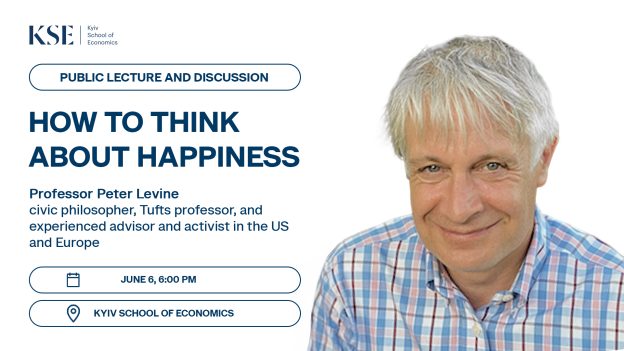
I will visit the Kyiv School of Economics (KSE) in early June primarily to offer a course on civic engagement that will be a short version of the Summer Institute of Civic Studies that colleagues and I have presented regularly since 2009. While I am in Kyiv, I will also offer a public lecture and discussion on the topic: “How to Think About Happiness.”

This is the blurb from my hosts at KSE:


What is happiness, really? And how should we live a good inner life?

This public lecture will explore how major philosophical traditions have approached the question of happiness — from Aristotle’s idea of purpose, to the Buddha’s path of detachment, to the Skeptical embrace of uncertainty and compassion.

Whether you’re curious about ancient wisdom or modern meaning-making, this event will help you rethink how happiness fits into your own life and civic identity.

After a 30-minute lecture, the audience will be invited to take part in an open discussion.

Why you should attend:

  • Explore timeless and contrasting views on happiness
  • Rethink your inner life through a philosophical lens
  • Engage in a meaningful discussion with a world-class thinker
  • Join either in person or online, wherever you are

Speaker: Professor Peter Levine

  • Senior Professor at Tufts University, currently visiting at Stanford University
  • Former fellow at Harvard and Johns Hopkins Universities
  • Described as “among the leading philosophers of civic life of his generation” (Robert D. Putnam)
  • Civic activist and advisor with experience across the US and Europe

Date: June 6, 6:00 pm
Location: KSE, Rooms 1.08.1 & 1.08.2 and online via Zoom
Register here

Contact person:  Mariia Yurina, myurina@kse.org.ua
Come for the philosophy — leave with a new way to think about happiness.

Civic Engagement course in Kyiv on June 3-5

Thanks to the Kyiv School of Economics (KSE), I have the opportunity to offer a short version of our Summer Institute of Civic Studies in-person in Kyiv on June 3-5. It is open to people in the vicinity as well as KSE students. I will also offer a public talk on the theme of happiness and will post more about that once the promotional materials are ready. Meanwhile, courtesy of KSE, here is information about the civic engagement course:


Do you want to understand how societies can change for the better—and how you can help lead that change?

This exciting, hands-on course is designed for:

  • Civil society leaders and activists – current and aspiring
  • Students with a passion for politics, ethics, and making a difference

Why attend?

You’ll dive into real-world examples of civic action and gain practical tools to:

  • Organize people around a shared goal
  • Communicate across political divides
  • Respond to exclusion and injustice
  • Learn from global success stories of activism and nonviolence

What’s inside the program?

  • Simulation games like the Prisoner’s Dilemma
  • Case studies of civic movements
  • Discussions on propaganda, polarization, and dialogue
  • Lessons in nonviolent and military resistance
  • Certificate option with short reading assignments

All participants will receive a certificate upon completing the course.

This is not just a lecture—it’s an invitation to think, act, and engage.

Led by one of the world’s most prominent thinkers in civic philosophy:

Professor Peter Levine – Senior Professor at Tufts University, visiting scholar at Stanford, former fellow at Harvard & Johns Hopkins, renowned expert in civic life and democratic engagement

Dates: June 3–5, 3:00–7:00 pm each day

Location: KSE, Room 4.07

Register here

Contact: Mariia Yurina — myurina@kse.org.ua