apply for the 2018 Summer Institute of Civic Studies

The eleventh annual Summer Institute of Civic Studies will take place from June 11 to June 21, 2018 at Tufts University. It will be an intensive, two-week, interdisciplinary seminar that brings together faculty, advanced graduate students, and practitioners from many countries and diverse fields of study. Please consider applying or forward to others who may be interested.

The Summer Institute was founded and co-taught from 2009-17 by Peter Levine, Associate Dean of Research at Tisch College, and Karol Soltan, Associate Professor in the Department of Government and Politics at the University of Maryland. In 2018, it will be taught by Peter Levine with Tufts colleagues. It features guest seminars by distinguished colleagues from various institutions and engages participants in challenging discussions such as:

  • How can people work together to improve the world?
  • How can people reason together about what is right to do?
  • What practices and institutional structures promote these kinds of citizenship?
  • How should empirical evidence, ethics, and strategy relate?

The daily sessions take place on the Tufts campus in Medford, MA. The seminar concludes with a public conference, Frontiers of Democracy, and participants in the Institute are expected to stay for the conference.

A draft syllabus for the 2018 summer institute (subject to change) is here. This is a 16-minute video introduction to Civic Studies. You can read more about the motivation for the Institute in the “Framing Statement” by Harry Boyte, University of Minnesota; Stephen Elkin, University of Maryland; Peter Levine, Tufts; Jane Mansbridge, Harvard; Elinor Ostrom, Indiana University; Karol Soltan, University of Maryland; and Rogers Smith, University of Pennsylvania.

To apply: please email your resume, an electronic copy of your graduate transcript (if applicable), and a cover email about your interests to Peter Levine at Peter.Levine@Tufts.edu.  For best consideration, apply no later than March 16, 2018.

You can also sign up here to receive occasional emails about the Summer Institute if you’re interested, but perhaps not for 2018.

European Institute: Applicants from Armenia, Azerbaijan, Belarus, Georgia, Germany, Kazakhstan, Kyrgyzstan, Moldova, Poland, the Russian Federation, Tajikistan, Turkmenistan, Ukraine and Uzbekistan are invited to apply to the European Institute of Civic Studies to be held in Herrsching, near Munich, Germany, from July 15 to July 28, 2018. Their costs are covered thanks to a grant from DAAD.

Practicalities 

Tuition for the Institute is free, but participants are responsible for their own housing and transportation. One option is a Tufts University dormitory room, which can be rented from $69/night for a single or $85/night for a double. Credit is not automatically offered, but special arrangements for graduate credit may be possible.

The seminar will be followed (from June 21, evening, until June 23) by a public conference–”Frontiers of Democracy 2018″–in downtown Boston. Participants in the institute are expected to stay for the public conference. See information on the conference here.

Why Civil Resistance Works

Here are some working notes on Erica Chenoweth and Maria J. Stephan, Why Civil Resistance Works: The Strategic Logic of Nonviolent Conflict (Columbia University Press, 2011)

This is their central finding: nonviolent campaigns are nearly twice as likely to win–meaning that they achieve their objectives–as violent campaigns are, and the gap is growing (citing the Kindle edition, locations 315, 337).

This pattern appears to be causal; staying nonviolent increases the odds of success when other factors are held constant. Moreover, countries that have experienced successful nonviolent campaigns are much more likely to achieve “durable and internally peaceful democracies” than those that have experienced violence (351, 1260).

Why would this be? Doesn’t violence help to win many struggles? Didn’t George Washington raise an army to get George III out of the colonies? Chenoweth and Stephan argue:

  1. Nonviolent campaigns are less costly and dangerous to join than violent struggles, so they draw many more people. Although a few participants typically take prominent and perilous roles in a nonviolent campaign, there is also plenty of room for modest acts of support that can preserve the participants’ anonymity and safety (839). Large campaigns sometimes achieve critical mass, when the sheer size of the protests makes it safe to join–and possibly dangerous not to (812). It’s a clear pattern that bigger movements are more likely to win (892). To be sure, some people are drawn by the political potential of violence, the romance of armed struggle, or the sense that being willing to fight confers solidarity and dignity (769, citing Frantz Fanon). But the people drawn to violence tend to be young and male, and a broader base is necessary for victory.
  2. Nonviolent campaigns draw “robust, diverse, and broad-based membership” (351). Diversity is an asset beyond sheer numbers.
    1. When protests are diverse, the authorities can’t “isolate the participants and adopt a repressive strategy short of maximal and indiscriminate repression” (892). In turn, cracking down violently on a broad segment of a population often backfires. Although violent crackdowns do reduce the chance of successful resistance, they also increase the gap in the success rate between nonviolent and violent campaigns (1098, 1421). In other words, if the state is going to attack its citizens, that’s bad news, but the citizens’ smartest move is to remain nonviolent.
    2. Diverse campaigns typically generate a whole range of messages, tactics, and strategies, and that “tactical diversity” allows some options to succeed even if others don’t. In contrast, violent campaigns tend to make irreversible strategic decisions that prove fatal if they fail.
    3. A movement with diverse members is more likely to include people who have personal ties to the security forces, the government, or the business class, so it is more likely to fracture the opposition. Sixty percent of the larger nonviolent campaigns achieve “security force defections (1040). “Fraternization” is an ingredient of many campaigns’ success (1995)
  3. Nonviolent campaigns are much more likely to draw international support (1129).
  4. Authorities have sincere reasons to fear giving up power. Many former rulers have ended their lives before firing squads. Campaigns that are able to maintain the discipline of nonviolence can credibly promise to honor agreements made at the negotiating table, and that increases incumbents’ willingness to yield or share power.

As a matter of definition, we are talking about durable campaigns that have names and goals, not just events, activities, or organizations (426). Nonviolent resistance campaigns employ extra-legal activity (387), not just regular elections or lawsuits. (But sometimes a stolen election is a catalyst for extra-legal protests). They are predominantly and distinctively nonviolent, even though some violence may occur around the margins.

Chenoweth and Stephan contribute to the perennial and basic debate about structure versus agency. A structural theory explains outcomes as a result of big, impersonal forces. For instance, American presidential candidates win if the economic conditions are favorable to them, and not otherwise. It hardly matters what they do or say. An agency theory suggests that it does matter how we choose to act. A structural theory of nonviolent campaigns would attribute their success to factors like fractures in the ruling regime. Chenoweth and Stephan instead “make the case that voluntaristic features of campaigns, notably those related to mechanisms put into place by resistors, are better predictors of success that structural determinants” (1347). As I argue in my Civic Studies video, there are several robust intellectual traditions that not only find agency important in history but also work to enhance agency. Nonviolent resistance is one of those traditions.

As shown on the graph above, many nonviolent resistance campaigns fail. Although they have a surprisingly high success rate, they can still end in tragedy. One challenge is combining unity with diversity. Incorporating many kinds of people in a movement is smart; it clearly increases the odds of success. Yet movements also need unity. It can be hard to convey a coherent message or to negotiate effectively if participants in a movement disagree among themselves.

It’s also easy to overlook–when reading detached cases from distant countries–the sheer emotional difficulty of struggling together within a diverse movement. It sounds like an obviously good thing for the hard-core radicals to join together with police officials who are feeling uneasy about the regime and business interests who see new opportunities. But that’s easier said than done. Even in the relatively tame circumstances of the US in 2018, one can sense deep tensions between people who have been confronting police brutality for decades and people who joined their first protest last January and want to go home safely after the march. Making a movement out of all of them is a spiritual as well as a practical challenge.

I’d interject my SPUD model here. Successful movements must combine unity with plurality, and size with depth, even though those are in tension.
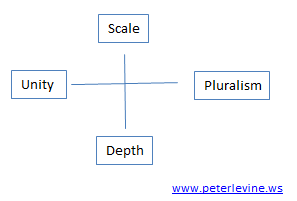
Another challenge is keeping authoritarians from dominating a plural movement. The Iranian Revolution of 1979 began as truly diverse, encompassing religious revolutionaries, secular Marxists, merchants hoping for economic liberalization, civil libertarians, and even a Hippie drug counterculture (2084-2111). To achieve Unity along with all that Pluralism, the movement settled on the Ayatollah Khomeini as a leader, not because they all agreed with his positions but because he seemed uniquely viable (2111). In fact, there wasn’t much discussion in the revolution itself about what Iran should look like after the Shah (2196).  This weakness became critical once the Shah was deposed, the Ayatollah gained power, and he and his allies ruthlessly destroyed all the internal opposition. The question is whether nonviolent social movements can be streams that carry authoritarians into power, and if so, what to do about it.

See also: a sketch of a theory of social movementswhat is a social movement?the kind of sacrifice required in nonviolence; and self-limiting popular politics.

where to invest to RAYSE youth civic engagement

CIRCLE has developed RAYSE (Reaching All Youth Strengthens Engagement) to help nonprofits, philanthropists, agencies, political campaigns, activists, and others decide where to invest in youth engagement or understand the strengths and weaknesses of the places where they are committed to work. It organizes data on all the counties in the US.  This new video explains how to use it and also presents a broad strategy for renewing democracy by investing in youth. Get started by looking up your own county!

new Tisch College summer program for high school students

Tufts Pre-College Intensive Program:
Leadership for Social Change
July 8th-July 20th 2018
Two weeks. Not for credit. Residential.

Join Tufts University’s Tisch College of Civic Life for an exciting, engaging, two-week summer program created for those who are passionate about making a difference in the world and having an impact on local and global issues. With a lens toward advancing equity, inclusion and participation in civic life, the program will equip students with the skills and knowledge to build connections, work collaboratively, and emerge as change agents who can inspire others. The students will also tour several college campuses in the area.

More information here.

how to tell if you’re doing good

If you have the capacity to affect other people, there seem to be three basic ways to decide what to do–and then to assess how much good you’ve done once you’ve acted.

  1. You can talk to the people affected. You can consult your fellow citizens or even convene them to deliberate and decide together. The advantages include sensitivity to a wide range of perspectives and considerations, from justice to practicality; nuance and complexity; and the chance for people to learn and enrich their individual views. Asking people to assess and influence the policy also honors their dignity and agency. On the other hand, actually asking very large numbers of people to deliberate and decide everything is prohibitively difficult and expensive. Consulting samples of people fails to enhance the agency of everyone else. Further, discussions are subject to serious and pervasive flaws, such as cognitive biases, inequalities of power and influence, tyranny of the majority, and vulnerability to manipulation and strategic action.
  2. You can predict and empirically assess the impact of what you do. You can use scientific methods to make predictions and test causal hypotheses. Science incorporates safeguards against biases, such as random sampling and blind review. It’s much more likely than deliberation to predict accurately what will happen if you do something. But it cannot determine whether your methods or your goals are good ones. And it confers power on experts (or employers of expertise) in ways that can be problematic.
  3. You can observe price signals. If milk is selling for more than the price of producing it, then people must want milk, and providing it meets a need. The feedback from prices is immediate; it reflects many people’s knowledge, choices, and agency; it’s hard to manipulate; and it allows comparisons. Since you are responsible for allocating finite resources among all possible purposes, prices give you a common metric. One evident drawback  is inequality. For example, market prices would suggest that there’s weak demand for clean water, even though 2.1 billion people lack access to it. They have too little money to affect prices. However, if you are concerned with justice, you can adjust price signals for equity. For instance, you can give poor people money and let them decide how to spend it, instead of dictating their choices. The other major problem with price signals is that they fail to make moral distinctions. Methamphetamine and antibiotics both have prices. It takes a combination of science (to assess affects) and deliberation (to discuss values) to determine that antibiotics are good while meth is bad.

All sectors of a modern society use all three methods. But I would argue that democratic governments are particularly obliged and well-suited to use deliberation. The fact that every citizen has a vote reflects: 1) the equal right of each person to affect outcomes, and 2) the obligation of every citizen to learn and discuss before making choices. For that reason, governments have formed parliamentary bodies and courts that are supposed to deliberate, they have safeguarded free speech, and they have built ways of consulting publics. Unlike a discretionary decision by a private entity, a government program must be subject to public deliberation because it is the people’s government.

Nonprofit associations and philanthropies use discussion and price-signals. But they are particularly well suited to use “science” (in its broadest form, including ad hoc experimentation and program evaluation). The fact that there are large numbers of modest-sized nonprofits and donors means that each one can try different things and observe the effects without accumulating dangerous amounts of power and influence. When their experiments work, others can pick them up. And unlike for-profit firms, they can ignore price signals in order to pursue goals that they believe in for moral reasons. This is why program evaluation is so common in the non-profit sector, whereas major governmental decisions–even massive tax cuts or wars–are hardly ever subject to formal evaluation.

Companies, obviously, use price-signals. If Toyota can’t sell enough Corollas at a profit, it will realize it must change its business. If it observes that Subaru is more profitable, it will consider copying Subaru. However, it’s worth noting that prices offer insufficient guidance even for profit-maximizing firms. Again, assume that Toyota suddenly cannot sell enough Corollas. It must find out why not, and that will probably require some combination of asking people what they value and studying causes and effects–the same techniques used by democratic governments and philanthropies.

Among people committed to democracy and/or philanthropy, prices provoke unease. When something previously offered free is charged for, critics will complain of “neoliberalism” and “marketization” or “commodification.” But if that good was scarce and provided to some group without a charge, then someone must have decided to allocate resources for that purpose and to that group (instead of to something and someone else). Those who make such decisions are morally responsible for exercising their power well. They should strive to determine whether their choices benefit the world. Consultation and science are two means for that purpose, but both have limitations. Prices are also very useful for determining demand and for making comparisons. Not only should responsible people notice prices, but they should worry about whether their actions (through governments and philanthropies) are distorting price signals in ways the deprive them of useful information about other people’s needs. For instance, if you offer free tuition, you can no longer tell whether schooling is what people want.

On the other hand, prices certainly do not offer all the necessary and relevant information, even for people and firms that want to make a profit–and still less for people who pursue justice.