two approaches to social capital: Bourdieu vs. the American literature

The phrase “social capital” is used in (at least) two very different senses and discussions.

One is an Anglophone discussion among social scientists who seem generally comfortable with a liberal market order. Important participants include James Coleman, Robert Putnam, Elinor Ostrom and (using the related phrase “collective efficacy”) Robert Sampson and Felton Earls. These social scientists understand social capital as the value that derives from collaborating and solving collective-action problems together. It’s measured by rates of joining, socializing, participating in the institutions of civil society, and trusting one’s peers. It can exist in any group, regardless of wealth and prestige. For instance, Sampson, Earls and their colleagues found that levels of collective efficacy varied greatly among Chicago neighborhoods, independent of race and class.

The central hypothesis in this literature is that higher social capital predicts better outcomes (safety, education, health, employment). This hypothesis is often proven in empirical studies. The deepest explanation is that these desirable outcomes are public goods, subject to problems of collective action, and social capital is the capacity—inherent in a group—to address problems of collective action successfully. For instance, safe streets represent a public good, and when people voluntarily maintain order, the streets are safer.

The other discourse is loosely Marxian and of Continental European origin; the most influential theorist is Pierre Bourdieu. For Bourdieu, social capital can only be understood in relation to economic capital and cultural capital. All three forms are the result of past labor, which accumulates or materializes in forms that can then be owned and by–and used to the advantage of–specific individuals or closed groups, such as firms.

Economic capital means ownership, or the ability to own, the means of production (factories, offices, farms, mines). Cultural capital means personal characteristics that you can learn in order to set yourself apart as a member of an advantaged group. For example, if you know how to dress for and behave at a corporate job interview, you have acquired cultural capital. And social capital means membership in any group that has value for those who belong.

Thus a paradigm case of social capital for Bourdieu is being connected to specific aristocrats in a way that puts you within the group known as “the nobility.” You might be a poor and boorish noble: then you would have social capital without much economic or cultural capital. Still, each of the three pays off in ways that are fundamentally economic.

For Coleman et al., the effort required to build social capital is at least partly altruistic. When you try to help others around you, it turns out that you benefit as well from the public resource of social capital. Social capital is non-rivalrous or win/win. If poor people in Chicago build more social capital, that does no harm to Lake Shore millionaires. It might even reduce their tax burdens by boosting graduation rates and cutting crime in the city as a whole.

The Bourdieuian form of social capital is competitive and maybe even zero-sum. If you form a connection to an aristocrat that gives you a leg up in society, I am less advantaged. According to Bourdieu, people build social capital to advance their own interests, strategically targeting others who have various forms of capital to add to their networks:

The existence of a network of connections is not a natural given …  It is the product of an endless effort at institution. … In other words, the network of relationships is the product of investment strategies, individual or collective, consciously or unconsciously aimed at establishing or reproducing social relationships that are directly usable in the short or long term. …

The reproduction of social capital presupposes an unceasing effort of sociability, a continuous series of exchanges in which recognition is endlessly affirmed and reaffirmed. … This is one of the factors which explain why the profitability of this labor of accumulating and maintaining social capital rises in proportion to the size of the capital. Because the social capital accruing from a relationship is that much greater to the extent that the person who is the object of it is richly endowed with capital (mainly social, but also cultural and even economic capital), the possessors of an inherited social capital, symbolized by a great name, are able to transform all circumstantial relationships into lasting connections. They are sought after for their social capital and, because they are well known, are worthy of being known (‘I know him well’); they do not need to ‘make the acquaintance’ of all their ‘acquaintances’; they are known to more people than they know, and their work of sociability, when it is exerted, is highly productive.

Although these theories are different, they could both apply in a society as a whole. After a discussion with students last week, I am inclined to the following hypotheses:

  1. Access to the highest rungs of socioeconomic advantage requires (or at least benefits from) Bourdieu-style social capital. If you want to get a seat on the Supreme Court, it seems almost necessary to attend Harvard’s or Yale’s law school, partly because of who you know as a result. Social capital may also get you into those law schools in the first place. For instance, I can think of someone who attended Law School on his way to federal judicial appointments; his mother had also been a judge, and his grandfather had attended Yale.
  2. Well-being in the middle and lower rungs depends on social capital in the Coleman/Putnam sense. If you are trying to get through high school and obtain some post-secondary education, get a job, stay out of jail, and live to the median age, it’s very helpful to be embedded in networks of cooperation and mutual support. Those networks have value even if the other members are not rich and powerful.

See also: David Brooks/Pierre BourdieuBourdieu in the college admissions officeChua and Rubenfeld, The Triple Packagesocial capital and economic mobility“social capital”: political and apolitical and when social advantage persists for millennia.
curiosities from Wikipedia (an occasional series)

From the entry on Norfolk Island, pop. 1,748, which lies 877 miles from mainland Australia:

This common heritage has led to a limited number of surnames among the islanders – a limit constraining enough that the island’s telephone directory also includes nicknames for many subscribers, such as Cane Toad, Dar Bizziebee, Lettuce Leaf, Goof, Paw Paw, Diddles, Rubber Duck, Carrots, and Tarzan.

From the entry on the Scots Language:

The results from a 1996 trial before the Census, by the General Register Office for Scotland, suggested that there were around 1.5 million speakers of Scots, with 30% of Scots responding “Yes” to the question “Can you speak the Scots language?”, but only 17% responding “Aye” to the question “Can you speak Scots?”.

From the entry on Isaac Newton:

As Warden, and afterwards Master, of the Royal Mint, [Sir Isaac] Newton estimated that 20 percent of the coins taken in during the Great Recoinage of 1696 were counterfeit. … Convicting even the most flagrant criminals could be extremely difficult. However, Newton proved equal to the task. Disguised as a habitué of bars and taverns, he gathered much of that evidence himself. … Newton had himself made a justice of the peace in all the home counties. … Then he conducted more than 100 cross-examinations of witnesses, informers, and suspects between June 1698 and Christmas 1699. Newton successfully prosecuted 28 coiners.

See also: strange livesthe European country that spoke Esperanto; and Anson Burlingame and the duel that never happened.

new CIRCLE youth survey: high youth engagement in the 2018 election

From today’s CIRCLE release:

The 2018 midterms have the potential to be historic for youth political participation, with young people receiving campaign outreach, paying attention, and intending to vote at unusually high levels (34% “extremely likely” to vote) that come close to the levels of engagement seen in the 2016 presidential election. Young people who report being actively engaged with the post-Parkland movement for gun violence prevention are even more likely (50%) to say that they’re extremely likely to vote. Our poll reveals strong support overall for Democratic candidates in Congressional elections (45% plan to vote for Democrats, versus 26% for Republicans), but large disparities among different demographic groups of young people, with Black and Latino youth much more likely to support Democratic candidates, young white men actually favoring Republicans, and unaffiliated white youth spreading their support across various parties and ideologies. We also find that, for all the focus on young people’s engagement with political content online, family remains the most important way for youth to learn about the election and the most influential in their engagement and participation.

Much more is here, and this is just the first in a series of analytical posts drawn from a new survey of 2,087 people aged 18 to 24 in the United States, with representative over-samples of Black and Latino youth, and of 18 to 21-year-olds.

reforms for a broken Supreme Court

In the Republic of A, the highest appeals court may overturn legislation based on the text of an idealistic but short and vague constitution (without further appeal to the legislature), that court consists of just nine justices appointed for life, appointment requires an agreement between the president and the Senate, and those two bodies are separately elected and can belong to different parties. This sounds like … a royal mess.

You’d predict that Supreme Court appointments in this republic would be another form of regular legislative politics, but with higher stakes and less accountability. When one party controlled both the executive branch and the Senate, they would appoint a justice to promote their agenda for the rest of her or his life. When the branches were split, they would be unable to make appointments at all, unless as part of elaborate horse-trades. If the public did not accept these realities, then politicians would attempt to conceal the underlying situation by endorsing justices with appropriate judicial “temperaments” and sterling resumes, trying to avoid discussing the nominees’ positions on issues.

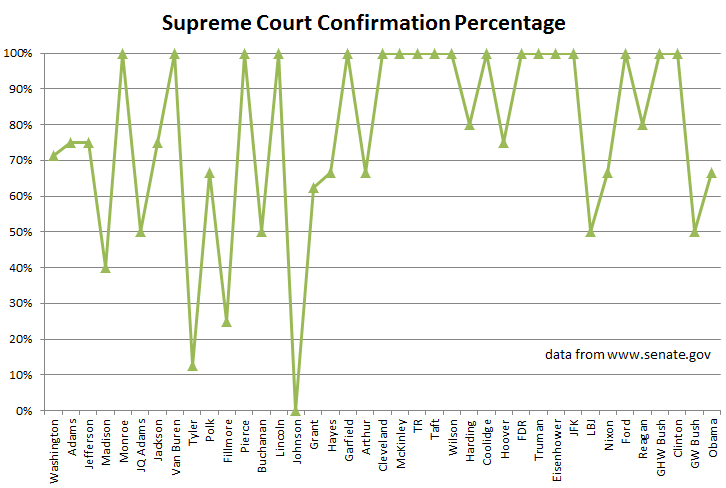
The actual record in the Republic of the USA is a bit more complicated. There have been long periods of rocky confirmations–especially 1800-1870–as well as lulls in that strife.

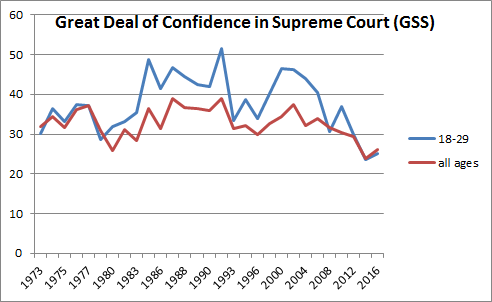
Note also the waning public confidence in the Supreme Court. Here I show the trend for younger adults separately, because early-adult experiences are formative, and youth have lost a lot of confidence since ca. 2000.

One explanation for the lulls could be a degree of consensus about the issues coming before the court, but that can’t explain why Taft could appoint five conservative justices, and FDR, eight liberals. Throughout that period, there was a bitter debate about the role of government, yet presidents were successful at appointing justices who shared their views.

A different explanation is that our two parties were divided internally on ideological lines from about 1890-1980. Thus any president could almost always assemble a majority by combining his whole party with the faction of the opposition that was aligned with him ideologically. That situation only ended ca. 1990, when the parties polarized in Congress. Note the resulting turbulence since then.

The Supreme Court is not simply a machine for implementing partisan policy preferences. Justices are also guided by legal principles, considerations that arise in the specific cases or controversies that come before them, constitutional texts and interpretations, precedents, deliberations among the Nine, and concern for the institution of the court. They may reach unexpected conclusions.

Yet we see generally different results from justices appointed by Democrats versus Republicans. That means that the Supreme Court represents at least a big dose of legislative politics by other means. The small number of justices, their life terms, and the randomness of who can appoint and confirm new members all raise the stakes and lower our confidence in the fairness of the process.

From this perspective, the familiar list of grievances (Bork, Thomas, Garland, Gorsuch, Kavanaugh) is predictable and only likely to worsen. If we are open to alternatives, we might begin to consider:

  1. Weakening judicial review so that the Court is less likely to be the final arbiter of deeply contested issues. That would be a democratic reform but not a liberal one, and it could be dangerous for minorities of all kinds.
  2. Strengthening advice and consent by developing a norm that the president should choose from a short list acceptable to members of both parties. That reform has a centrist bias that may not be desirable.
  3. Constitutional reform. For instance, imagine that justices hold rotating nine-year terms. Then every year at least one vacancy would arise (more if someone resigned or died). Debates over confirmation would be constant, but the stakes would fall. Each new president could count on four chances at appointments, followed by the referendum of a national reelection campaign. A two-term president with a Senate majority could entirely reshape the court, but her successor could change it back.

[Confirmation data from the Senate. See also: is our constitutional order doomed?are we seeing the fatal flaw of a presidential constitution?,  two perspectives on our political paralysis,  and the changing norms for Supreme Court nominations.]

the regime that may be crumbling

Margaret Thatcher and Ronald Reagan would be pleased that Trump has signed a massive tax cut, presided over deregulation, and saved NAFTA by essentially reenacting it after running for president against it. Nevertheless, his worldview and his coalition are inconsistent with their legacy.

The regime that they founded has had the following characteristics:

  1. Political elites widely agree that government programs, especially redistributive welfare programs, are inefficient and counterproductive. It was Bill Clinton who announced “the era of big government is over” and ended the federal welfare guarantee. It was the Socialist President François Mitterand who led France into austerity (“la rigeur“) in 1983. What characterizes this period is not the electoral victory of pro-market parties, but the fact that the opposition also criticizes the welfare state.
  2. Progressive movements channel most of their energy into opening capitalist institutions to women, people of color, and sexual minorities, rather than overturning capitalist institutions. Progress means being able to be who you are at work or in school. That is a broadly libertarian impulse.
  3. Many huge countries liberalize and deregulate their economies, fully entering the competitive global economy. Whether as a result or by coincidence, they see rapid and sustained improvements in human development (education, health, longevity). Of the 135 countries with data, 132 have seen improvements in the Human Development Index since 1970, many to a startling degree.
  4. International flows of capital rapidly increase. So do rates of economic migration, albeit at a slower rate than capital. Developed nations become more diverse as a result of immigration.
  5. Developed nations deindustrialize, with the losses of manufacturing jobs concentrated in certain cities. For example, Detroit’s population falls by more than 50%.
  6. Unions practically vanish. Union density falls from more than 30% of US workers in 1955 to 10% now (6.7% in the private sector).
  7. Many countries get “tough on crime,” expanding the use of prisons.
  8. Some nations that are capitalist and authoritarian become magnets for capital. Of the world’s nine Alpha+ and Alpha++ Global Cities, five are located in authoritarian states: Singapore, Hong Kong, Beijing, Dubai, and Shanghai.
  9. The US and NATO countries spend heavily on the military (with most of the money flowing to defense industries). They are especially prone to intervene in the Persian Gulf, where the oil comes from. We should also acknowledge that the chance of dying in a war during this period is the lowest in human history. One interpretation is that the US and its allies have locked things down in ways that really do reduce violence, albeit also to the advantage of multinational corporations. Terrorism is a feature of this period, but it kills an infinitesimal number of people compared to war.

I believe that most of the trends enumerated above were popular. I am familiar with the Martin Gilens/Benjamin Page argument that the US is an oligarchy–responsive to lobbies, not to ordinary voters. I think that explains why specific bills are blocked even though they are popular. It does not explain a much deeper and broader trend toward a certain kind of global corporate political-economy.

Reagan was elected in a country with a large White majority that was affluent by historical and global standards. A voting majority was suburban, Christian, and bourgeois. To a rough approximation, they got what they voted for. Every indication is that Chinese citizens appreciate the progress generated by their version of a neoliberal regime.

The questions now are: 1) Are people revolting against the current order? How many people? How effectively? 2) What is most likely to replace it? New versions of egalitarianism? Ethnonationalism and authoritarianism? Davos Man strikes back? And 3) How to move forward? It is generally a lot harder to build things up than tear them down, and we don’t just need new governmental policies; we also need new institutions in civil society.

(I see that I’ve addressed the same topic once before, offering a different list: what is the political economy that people are revolting against?)