was Lincoln trying to tell us something?

The penultimate paragraph of Lincoln’s “Lyceum Address” (Jan 27, 1838)

[Memories of the sacrifices of the American Revolution] were the pillars of the temple of liberty; and now, that they have crumbled away, that temple must fall, unless we, their descendants, supply their places with other pillars, hewn from the solid quarry of sober reason. Passion has helped us; but can do so no more. It will in future be our enemy. Reason, cold, calculating, unimpassioned reason, must furnish all the materials for our future support and defence.–Let those materials be moulded into general intelligence, sound morality, and in particular, a reverence for the constitution and laws: and, that we improved to the last; that we remained free to the last; that we revered his name to the last; that, during his long sleep, we permitted no hostile foot to pass over or desecrate his resting place; shall be that which to learn the last trump shall awaken our WASHINGTON.

“Trump” here means to summon loudly like a trumpet, as in John Keble’s Christian Year (1827): “Awake—again the Gospel-trump is blown.” It probably doesn’t mean “To give forth a trumpet-like sound; spec. to break wind audibly (slang or vulgar),” although the OED attests that sense from 1425 onward.

In all seriousness, Lincoln’s address is a timely reminder that high ambition may have motivated the founders to create a republic, but the ambitious gain no renown from keeping an existing republic going. The irony is that Lincoln ended up with a massive memorial on the National Mall because history gave him the opportunity to save and re-found a union imperiled by others.

See also: ambition: pro or con?  and hearing the faint music of democracy
the pivotal youth vote in Ayanna Pressley’s election

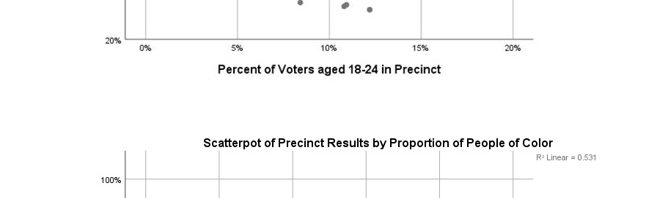
Early this month, Boston City Councilor Ayanna Pressley defeated incumbent Rep. Mike Capuano in the Democratic primary. CIRCLE’s analysis shows that Pressley performed best in precincts where young adults or people of color are most numerous. Those precincts also saw the biggest turnout increases compared to the most comparable recent election. “For example, Boston’s Ward 21, Precinct 2—home to Boston University’s Student Village—saw 400 percent more votes cast in this primary compared to four years ago, which dwarfed the median increase of 166 percent across all precincts.”

It’s true that precincts with lots of youth or people of color tend to be located in the City of Boston, where Pressley has been a councilor. So it could be that she performed best within her own jurisdiction. (She is a respected veteran elected official, even though she is sometimes portrayed simply as an insurgent.) However, she also won precincts outside of Boston that have favorable demographics.

I find it interesting that age and race/ethnicity separately predicted support for her. Or, to put it another way, she did well in student precincts that are predominantly white and upper-income as well as in low-income neighborhoods.

the Massachusetts Citizens’ Initiative Review

[Press Release] – A 20-person panel of voters convened by the Massachusetts Citizens’ Initiative Review (CIR) pilot project has released its Citizens’ Statement on Question 1, the ballot question on nurse staffing limits.

The Citizens’ Statement is intended to assist voters by providing them with the results of their fellow citizens’ four-day deliberation on the ballot question. It sets out the panel’s key findings as well as the strongest and most reliable reasons to support or oppose Question 1.The Citizens’ Statement is available online.

The Massachusetts Citizens’ Initiative Review deliberations were held from September 12-15 at the Watertown Free Public Library. The campaigns for and against Question 1 both appeared before the citizen panel three times to present their arguments and answer questions.

The citizen panelists also heard from seven neutral experts in fields relevant to nursing, patient safety, and healthcare. Trained facilitators guided the deliberations that resulted in the Citizens’ Statement.

The Massachusetts CIR pilot project was organized by State Representative Jonathan Hecht in partnership with Tufts University’s Jonathan M. Tisch College of Civic Life and Healthy Democracy, the organization that pioneered CIR in Oregon and others states. Experience in Oregon, where CIR has been part of the official election process since 2011, has shown it to be a highly effective and well-received way to inform voters about complicated ballot measures.

This is the second time Massachusetts Citizens’ Initiative Review has been used in Massachusetts.

In 2016, 77% of voters who saw the Citizens’ Statement on marijuana legalization (Question 4) said it was helpful in making their decision. On major factual issues, voters who read the Citizens’ Statement were better informed and more confident in their knowledge than those who only read the official voter guide. John Gastil, Professor of Communications at Penn State and one of the nation’s leading CIR researchers, will conduct surveys to determine how helpful the 2018 Citizens’ Statement proves for Massachusetts voters.

The 20-member citizen panel was selected from respondents to a mailer sent to 15,000 randomly-selected Massachusetts voters.

how Brexit is unlike Trump (and what to do about it)

When they think about Brexit, most of my American friends equate it with the election of Donald Trump. Both events are seen as manifestations of xenophobia, paranoia toward elites, and even Russian propaganda.

You can tell that this analogy is weak from the stance of Labour, which is meeting right now for its conference in Liverpool and debating a huge range of motions on Brexit. Yesterday, the Guardian reported:

Consensus appeared to break out as Jeremy Corbyn insisted he would follow the democratic will of his party if delegates voted for a second referendum on the final Brexit deal. But trouble could still be brewing. The Labour leader refused to say which way he would vote. The Unite chief, Len McCluskey, added his tuppence worth, suggesting it would be wrong for any new vote to include the option of staying in the EU. Remainers will be unimpressed.

Last night, after 5.5 hours of negotiation, party leaders emerged with a draft statement that criticizes “the Tories’ chaotic approach to the Brexit negotiations,” calls for a general election, and fudges everything else. Corbyn himself voted against Brexit, but he also voted against the key European treaties of 1975, 1992, and 2008; he has little positive to say about the current EU; and he has frequently pledged to “respect the referendum” that passed Brexit.

Imagine if Bernie Sanders won control of the Democratic Party and refused to say which way he would vote on Trump’s Wall or the refugee ban, while expressing respect for the policy implications of an election held several years ago. That would be plausible if Brexit were like Trump–but it isn’t.

I can’t overstate my own disappointment with the Brexit vote. My commitment to European integration goes back to the 1970s, when I was a child in a London primary school with a literal WWII bomb site next door. The European Economic Community was forming in those days, and we studied each member country in turn–in order to become peaceful, pluralist, democratic Europeans. (By the way, this was a Christian socialist state primary school run on progressive lines.) I’m proudly a citizen of the USA but have remained deeply invested in the ideal of European unity.

However, it is a matter for debate and reasonable disagreement whether the current form of the EU merits membership. One doesn’t have to be a bigot or a fool to want to leave. If you approach politics from the left, you will see both pros and cons to exit.

For Labour politicians, ambiguity is attractive, because they can hope to win votes from both sides on Brexit while blaming the inevitable fiasco on chaotic Tory management.

I happen to believe in what Bill Galston once called “the obligation to play hardball,” and I think a Labour policy of deferring on Brexit until the outcome crushes the Conservatives is possibly a good hardball play (to use a baseball metaphor for the land of cricket).

But it also has risks, even from a Labour perspective:

  1. Constitutional risks: there is now a widespread sentiment in Britain that respecting a referendum is the best way to honor democracy. (And holding a second referendum would somehow undermine the people’s will.) The traditional view was that the British people were best represented by Parliament, which they choose to exercise sovereignty between elections. That is a better political theory, because government should be deliberative and flexible. Parliamentary sovereignty would return if Labour took a clear position against Brexit. No one would doubt that Parliament could overrule the referendum once voters gave Labour a mandate to do so. It would then be equally clear that Britain is heading toward Brexit because the Tories are in the government. Hence there is only one reason that parliamentary sovereignty is at risk: the opposition refuses to take a position on the most pressing issue of the day.
  2. Risks to the European left: many have noted that if Labour takes over and Britain gains the same status as Norway (all the rules without a vote in Brussels), then Europe will lose the strongest potential voice of the left–Corbyn, as the leader of the second-biggest EU economy. The best way for a Labour voter to try to influence all of Europe is to stay in the EU.
  3. Risks to the United Kingdom: the most obvious danger is the collapse of Irish peace due to a hard border. But you can also see pro-European Scotland constantly looking to leave Britain if the UK leaves the EU. There are arguments for Scottish independence, but if you’re a Labour voter (either north or south of the border), you should definitely want to keep all those leftish Scots in the country.
  4. Risks to Labour: I can believe that Britain will sustain a terrible shock from Brexit and that voters will long blame the Tories for it. But will they respect Labour if Labour didn’t oppose Brexit while it had a chance? On the other hand, if the exit goes reasonably well, the Tories will benefit. Thus ambiguity presents electoral risks, not just as benefits, for Labour.

self help: a short story

Political prisoner K. was sentenced to solitary, with only cement walls, a cot, a stinking bucket, and a food slot for company.

One day, on his way back from interrogation, he saw a tattered paperback on the floor. The guard let him take it with him. It turned out to be Letting Your Inner Boss Shout by Dr. Bradford P. Bradley, PhD.

K. was enraged at first by its solecisms, trivialities, cliches and lexical trespasses. Anything would be better than this! After reading it several times without finding any value in its Six Winning Strategies for Asserting Your True Needs in an Office Context, he began selecting fragments from the pages. The rule was to leave chosen words in place but hide the rest. For instance:

Another game: rearranging all the words of a sentence to say something better:

The Six remember. Strategies, always.

True, winners: their real minds speak.

These activities engaged K’s. attention for several days, but something kept intruding. Or rather, someone. Dr Bradley, PhD.–Brad Bradley–just Brad. Was he raggedly bearded and balding, with spots on his head and long speeches to give? Or a young guy, bored out of his mind, looking for new life though writing? A pseudonymous woman, quiet observer of her office culture? An ironist, chuckling as he typed?

K. couldn’t quite tell. Alternatives multiplied into a whole community of Brads.

The real author, whoever it might be, seemed to deserve the respect of attention. Maybe Brad really had only five strategies in mind, but the book was too short and he’d wracked his poor brain until he came up with a sixth to pad the pages. Or maybe Brad knew that eleven strategies were necessary for achieving your life goals, but the cheapskate publisher forced him to cut five of them, and now he was worried to death about his misinformed readers.

It was good, in any case, to have a companion. The six strategies had been meant as gifts; perhaps it would be better to accept them as such. With thanks, even.

Prisoner K. and Dr. B. Just the two of them, in solitary but not solitary. Shouting their inner bosses. Hearing the other’s shouts. Having someone to walk with blindfolded to the final wall.

(Chicago, Sept. 20)