an expert class and the grassroots

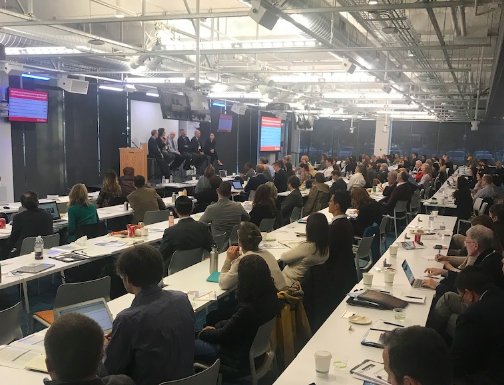
(Menlo Park, CA) Here I am at Facebook, posting on Facebook. I’m with about 160 other people, and we’re having a valuable conversation about how to measure and assess civic education. (The space is leant to us by Facebook, but the organizers, CivXNow, are fully independent from Facebook.)

The participants bring highly diverse expertise, professional backgrounds, and opinions of relevant topics–from the nature of a good citizen to the appropriate role of testing. They are somewhat diverse racially and culturally, but much less so than the nation or our nation’s students. They are the kinds of people who can get their flights to California reimbursed from an organization’s budget, who can put titles on their name tags, and who can be asked to address specific issues as experts. Even if they perfectly represented America’s students and parents in terms of race and ethnicity, they would be sociologically different. This is a slice of the professional class.

Speakers have named that problem, as they should. Any group concerned with enhancing democracy should ask whether it is operating democratically. Democratic values include representation, voice, and accountability. If a bunch of adults with titles on their name tags talk about kids, they do not represent youth, give youth voice, or make themselves accountable to youth.

But I think it’s important to be realistic about the challenge. A defining feature of modernity–possibly the defining feature–is specialization. In socialist and capitalist societies alike, roles are differentiated and assigned to people who demonstrate and build specialized experience and training over years. Per Wikipedia, Max Weber’s definition of a “bureaucracy” is:

  • hierarchical organization
  • formal lines of authority
  • a fixed area of activity
  • rigid division of labor
  • regular and continuous execution of assigned tasks
  • all decisions and powers specified and restricted by regulations
  • officials with expert training in their fields
  • career advancement dependent on technical qualifications
  • qualifications evaluated by organizational rules, not individuals

Some successful organizations avoid the narrowest versions of these characteristics. For instance, they don’t divide tasks too “rigidly.” But they all do some of the above, and for an important reason: it works. Specialization, formal lines of authority, expertise and training all improve efficiency.

Because bureaucracy (within appropriate limits) boosts efficiency, it also confers power. People in organizations are more powerful than amorphous masses of people. A conference of representatives of organizations has more influence than a gathering of representative citizens would have. Apart from anything else, it can interlock with other bureaucratic systems, from state agencies to Facebook. But it must be demographically unrepresentative of the people it intends to help, at least in terms of age, employment, and educational attainment. Maybe Robert Michels exaggerated when he observed an Iron Law of Oligarchy, but if it’s not a law, it’s a strong tendency.

There is also power in grassroots politics, social movements, mass meetings, viral media campaigns, and the like. In fact, the people can swamp a Weberian bureaucracy. But popular politics is very different from organizational networking.

At our best, I think we can blur some of these boundaries. (For instance, there are a few eloquent and impressive k-12 students at this meeting.) We can cross boundaries in our own lives and careers, spending some time in settings where we are not experts or leaders, even if we wear name tags with impressive titles in other settings. We can morph from organizations to movements and back. And we can develop new methods for engaging grassroots publics in our organizations’ work. (This survey is an example.) But we shouldn’t kid ourselves that social change occurs without organizations or that organizational leaders can be truly representative of the public.

See also: who must be included in which meetings, committees, and movements?; Nicole Doerr, Political Translation: How Social Movement Democracies Survive; the rise of an expert class and its implications for democracy; and what gives some research methods legitimacy?


was Aristotle right about what we must know to be good citizens?

Let’s posit that a good citizen should be able to a) form ideas about what would improve her community or society, b) understand how decisions about such matters are actually made and who has power to make each decision, c) persuade those people to think and act differently, and d) do all of the above ethically, which means reflecting on right and wrong.

A name for b) is “politics”; for c), “rhetoric”; and for d0, “ethics.” Aristotle wrote a book on each of those topics, and, although he didn’t give titles to any of his books, these are the names that we give them.

The Politics is about how city-states worked, about the pros and cons of various forms of government, and about the role of citizens in these states. The Rhetoric is about persuasion, but especially about “how to generate trust in ways that preserve an audience’s autonomy and accord with the norms of friendship” (Danielle Allen, Talking to Strangers, p. 141). In other words, it’s about persuading responsibly, to the benefit of the listener. And the Nicomachean Ethics is about how to live a good life.

As the founder of a school (the original “Lyceum”), Aristotle meant his works to frame a curriculum. The good citizen should study politics, rhetoric, and ethics.

Was he right? I think largely so, with two caveats.

First, Aristotle had little to say about the actual decisions that confront a community. Ancient Athenians had to decide whether to build a wall or more ships, to invade Sicily or pursue peace with Sparta, to rebuild the Parthenon or use the money for something else. In our day, we must decide what to do about climate change, policing, economic growth and equality, and myriad other issues. Aristotle didn’t address most of the policy questions of his day, let alone those of our time. And he didn’t make “policy analysis” a part of his civic curriculum.

I think one reason was that he didn’t believe that general, theoretical reasoning was helpful for policymaking. Wise collective action was a matter of phronesis, judgment, and it was highly concrete. Citizens should deliberate about whether to build more triremes and should learn from the results. No abstract theory would help them to decide.

The other reason may have been a kind of elitism. Expertise existed about military, architectural, economic, medical, and agricultural matters, but it belonged to tradesmen (broadly defined). Gentlemen-citizens were generalists who lacked such knowledge. Their role was to consult experts when necessary and then to make all-things-considered judgments. A curriculum for gentlemen-citizens was about politics, rhetoric, and ethics, not about policy.

In contrast, we have disciplines such as economics, medicine, law, education, social work, international relations (and many more) that confer the highest social status and that promise knowledge relevant to making decisions. They sometimes even promise to be able to determine the best policies. For instance, if economics works, it should generate answers about questions involving taxes and interest rates. Advanced education for leaders has turned into the study of public policy, largely to the exclusion of rhetoric, ethics, and even politics, in Aristotle’s sense.

We might think that the pendulum has swung too far, because we really do need phronesis to make decisions. There are few algorithms that can determine a better policy. And to exercise judgment, we need ethics, rhetoric, and politics. But we wouldn’t want the pendulum to swing all the way back to Aristotle’s view, which is too disparaging of the study of policy. We should add the social sciences to Aristotle’s curriculum.

The second caveat concerns how we interpret Aristotle’s project and continue it. One type of interpretation emphasizes the consistency of Aristotle’s whole philosophy. He perceives ethics as connected not only to rhetoric and politics but also to logic, metaphysics, and natural science. It’s all part of one coherent universe organized by a small number of principles. A major test of whether a view is right is whether it coheres with this whole system.

If you think of Aristotle’s system as an inspiration, but you want to update it for a new era, you may try to build a new system. You won’t derive your specific views from any social science but from the elaboration of an overall view of the world: a systematic philosophy.

Thomas Aquinas exemplifies this approach. He believes that Aristotle must be updated by adding Christianity, and he writes a new systematic philosophy to that end. He begins with the question of God’s existence and works from there toward all other questions. When Aquinas gets to politics in the second part of the second part, question 58, his topics are: (1) What is justice? (2) Whether justice is always towards another? (3) Whether it is a virtue? (4) Whether it is in the will as its subject? (5) Whether it is a general virtue?; (6) Whether, as a general virtue, it is essentially the same as every virtue? — and so on.

The ornate cathedral of Aquinas’ thought might seem like a mere curiosity, except that the urge to systematize has been common, and Aristotle has often served as a model.

The alternative is to emphasize the Aristotelian idea of phronesis, practical wisdom. What Aristotle offers are some very general guidelines about how to organize political communities in which individuals who strive for personal virtue can argue productively about what to do together. No theory settles how to structure political organizations, how to live, or what policy arguments are right, but Aristotle inaugurates a process of thinking about those three topics together. And they are still more or less the right topics for citizens.

See also against a cerebral view of citizenship; Bent Flyvbjerg’s radical alternative to applied social science; Bent Flyvbjerg and social science as phronesis; on philosophy as a way of life.

this blog turns 16

I posted a first blog on January 8, 2003. For more than a decade, I was an obsessive blogger, posting once every single work day. Sometimes, while traveling, I would go to serious lengths to get online in order to post just before midnight to avoid breaking my streak.

Lately, I have slacked off. I posted 163 times this year, or a little more than three times per week.

I blame Donald J. Trump. In 2018, I spent too much time following the latest outrages, about which I had nothing unusual or useful to add. Nowadays, I’m not reading as much serious stuff as I used to, unless it’s directly relevant to research or teaching. For several decades, I read almost every article in every issue of The New York Review of Books, but now I watch a growing stack of unopened issues. Instead, I’m pouring my time into checking whether the Post says something different from CNN about Trump’s latest tweet or what happened to the S&P and the presidential approval polling average as a result of the day’s news.

Then again, maybe this is not Trump’s fault. We’re each responsible for how we deploy our attention, and there is still plenty of excellent new work to read and reflect on. A New Year’s resolution, then, is not necessarily to blog more but to squander less time on ephemeral outrages in order to understand their deeper causes, or else to appreciate more of the things that are wonderful about our world.

architecture of the 2010s

These are brand-new or planned buildings within walking distance of our home in Cambridge, MA.

I see this kind of design all over Boston and have also noticed it as far away as Kyiv. The typical urban architecture of our decade seems as distinctive as that of the 1890s or the 1930s.

The facades are divided into rectilinear panels of various sizes, avoiding regular patterns and symmetry. To differentiate the panels, a range of materials is used–notably, exposed wood, painted wood, brushed steel, some concrete, and tinted or clear glass. Often the panels are set in different planes. The architectural elements use a modernist vocabulary (e.g., windows without moldings, flat roofs, no cornices), but the overall impression is anti-modernist because the patterns have decorative–not functional–purposes.

I don’t know what search terms to use to test this uninformed observation. If you search “architecture 2010s,” the results are all about marquee buildings by world-famous architects, and the trend is radical experimentation with materials and forms–usually organic rather than rectilinear. I’m not sure whether there is a name or a recognized handbook for the kinds of relatively routine (no offense) buildings shown above, but I think they all would have looked odd in 2000 and have become ubiquitous since 2010.

See also love what you see: Kogonada’s Columbus (2017); Boston, recovering city; a complaint about ceilings in modern architecture; and anxieties of influence (a poem about Cambridge MA).

a template for analyzing an institution

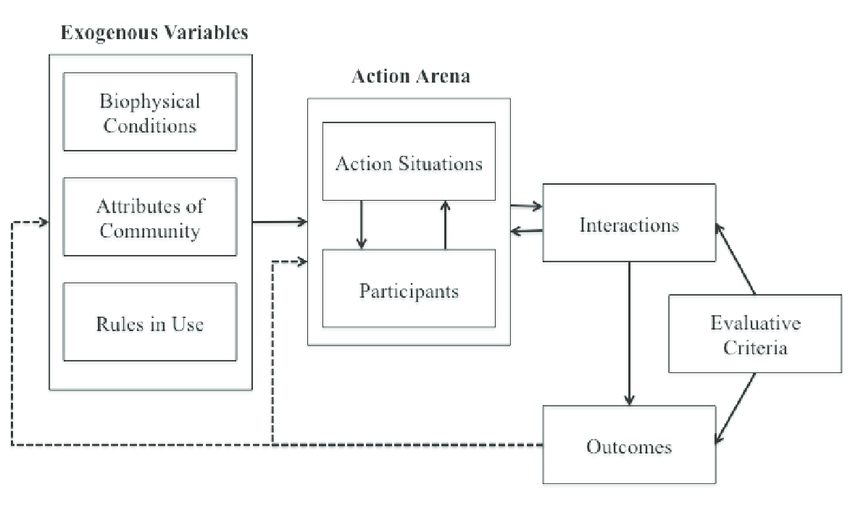
If you want to analyze an institution–whether it’s the local police department, marriage, or Facebook–an excellent guide is the Institutional Analysis and Development (IAD) Framework developed by Elinor Ostrom and colleagues, which is an encapsulation of the lifetime of work for which Ostrom won the Nobel Prize. It is shown below in a graphical form, and a very helpful, concise guide is McGinnis 2011.

The Institutional Analysis and Development (IAD) Framework (Schoon, 2015 after Ostrom et al., 1994, p. 37)

I would divide the analysis into the following 23 questions. These questions basically cover the same issues as in the diagram above, working from left to right, but they don’t match up precisely because I draw on my own idiosyncratic influences.

  1. What is the institution? What is its name? How would you define it uniquely, and which people, resources, locations, etc. does it involve?
  2. What problem or set of problems interests you about it? This problem may be a failure (the institution doesn’t yield the intended results) or an injustice (it has bad results), or it could be the intellectual problem posed by its success: why does this institution work and can we replicate it?
  3. What other institutions are closely related to it, and how?
  4. Which institutional form(s) does it reflect, e.g., a government, a firm, a market, a network, an association, a community?
  5. What are important relevant biophysical conditions? What natural resources does it use, and which natural processes come into play? What characteristics of these resources and processes are relevant to the institution: e.g., scarcity, fragility, adaptability, ability to reproduce and grow, interdependence, tendency to move?
  6. What are important technological conditions, where “technology” means the relevant affordances and limitations that have been created–or will predictably be created–by human beings?
  7. What cultural meanings (in the sense of Geertz 1973) are involved? Are these meanings shared or disputed?
  8. To what extent can we detect wholes, rhythms, hierarchies, and networks in the institution (C. Levine 2015)? How do these forms interrelate?
  9. What official, formal, usually written rules govern the institution? What are its rules-in-use? (These may diverge from the official rules.)
  10. Are the rules grounded in phenomena beyond the institution? For instance, an institution might use a currency whose value is determined by other institutions. Tufts runs on an academic calendar related to the solar calendar, which is grounded in the motion of the earth. (Grounding is different from causation.)
  11. What goods are relevant? Who has which kinds of ownership over which goods? Are the goods subtractable? Are they excludable?
  12. Who are the relevant actors?
  13. What choices confront each actor? What does each actor know about the available choices?
  14. What does each actor value, and why?
  15. Under what conditions do the actors choose (e.g., with or without discussion, once or repeatedly, simultaneously or in turn, with or without knowledge of what the others are choosing)?
  16. What are the consequences of the most important or most likely combinations of choices made by all the actors?
  17. Are these consequences desired by the actors?
  18. Are these outcomes desired by people who are not among the actors?
  19. Are the outcomes fair or just by various normative criteria?
  20. Are they sustainable–meaning a) literally repeatable many times, and/or b) good for nature?
  21. How do the outcomes affect the issues raised in questions 1-15? In other words, do the outcomes of the institution change the institution itself, in a feedback loop?
  22. What deliberate changes in institutional forms (4), technologies (6), meanings (7), rules (9-10), or values (13) would produce preferable outcomes according to the criteria raised in questions 17-19? (I focus on 4, 6, 9-10, and 13 on the ground that these are the factors we can most readily change. Factors like the biophysical conditions and the relevance of other institutions are harder to influence.)
  23. How can we go about altering the institution in the light of 21?

Geertz, Clifford (1973) Thick description: Toward an interpretive theory of culture. The interpretation of cultures: Selected essays (pp. 3-30). New York, NY: Basic

Levine, C. (2015). Forms: Whole, rhythm, hierarchy, network. Princeton University Press.

Mcginnis, Michael. (2011). An Introduction to IAD and the Language of the Ostrom Workshop: A Simple Guide to a Complex Framework. Policy Studies Journal. 39. 169 – 183. 10.1111/j.1541-0072.2010.00401.x.

See also: insights on police reform from Elinor Ostrom and social choice theory; Elinor Ostrom, 1933-2012; why I still believe in institutions; should all institutions be democratic?; what defines an organization?; and against methodological individualism.