the Historovox

Corey Robin’s essay, “Why Has It Taken Us So Long to See Trump’s Weakness?,” is mainly interesting as an argument about trends in reporting. Robin criticizes

a new genre of journalism that forgoes the pedestrian task of reporting the news in favor of explaining it through the lens of academic research. Ensconced at Vox, FiveThirtyEight, dedicated pages of the Washington Post and the New York Times, and across Twitter, the explainers place great stock in the authority of scholarship — and in journalists who know how to wield the authority of scholars

He argues, “There’s a bad synergy at work in the Historovox — as I call this complex of scholars and journalists — between the short-termism of the news cycle and the longue durée-ism of the academy. … When academic knowledge is on tap for the media, the result is not a fusion of the best of academia and the best of journalism but the worst of both worlds.”

An obvious objection is that there are more than just two genres of writing about politics (academic analysis and pedestrian journalism). I’d place Robin’s “Historovox” on a longer list.

  1. Old-school deadline-driven political reporting: The writer tells you what happened yesterday. The lede is an event: a speech, an endorsement, a vote, an indictment. Subsequent paragraphs tell (or remind) you what happened earlier, leading up to this new event. To the extent that the news is explained, the available explanations include: what the actors and their spokespeople say happened, how their critics reply, and the tactical advantages that will result for each. An imaginary example: “The Senator traveled to Wisconsin today to talk about jobs. This follows on the heels of her speech about the environment in Los Angeles last week. People involved in her campaign said that she is engaging two important constituencies. Her opponent charged that she wants ‘to rake in the dollars from spoiled Hollywood liberals.’ Of course, prospective presidential candidates always test their support in key states.”
  2. Positivist, mostly quantitative academic scholarship: The writer looks for statistically significant patterns in representative samples of data (rather than “anecdotes”). She poses and tests explicit hypotheses. She situates her original results in the context of peer-reviewed literature. For instance, “Some previous studies suggest that candidates mainly appeal to donors. Other studies suggest that they focus on ordinary voters. Our analysis of 256 campaign events finds that donor-appeal explains 11% more of the variance in decisions about candidate travel.”
  3. Ideological advocacy: The writer hopes to advance conservatism, or socialism, or environmentalism, or whatever, and uses recent political events as evidence and as a “hook” to persuade the unconvinced and mobilize the base. “The Senator made a great speech about jobs in Wisconsin but needs to remember why unions have declined. It’s no accident that wages have fallen as union membership has fallen: these are the results of neoliberal policy choices.” This style extends from opinion magazines and op-ed pieces deeply into academic journals.
  4. Theory-building: The writer is primarily interested in developing and defending general social theories, which may have both normative and explanatory components. She is trying to develop, for example, a new version of civic republicanism or intersectional feminism or social capital theory. As in #3, recent examples serve as illustrations and “hooks,” but the argument is less predictable, less topical, and may be considerably more complex.
  5. The “Historovox” is a fusion of #1 with #2 and/or #4. Its typical style is to “explain” a concrete recent event by summarizing some relevant positivist social science (#2) and adding an interesting social theory (#4). The very bright, broadly-educated reporter works by searching the scholarly literature and interviewing academics. This style claims to avoid #3, which is seen as politically biased, in favor of “research.”

Robin offers a subtle defense of #1–traditional deadline journalism–by way of quotations from political theorists who might be seen as “particularists”: highly skeptical of generalization and concerned with attending to details:

Everyone knows and cites Orwell’s famous adage: “To see what is front of one’s nose needs a constant struggle.” Less cited is what follows: “One thing that helps toward it is to keep a diary, or, at any rate, to keep some kind of record of one’s opinions about important events. Otherwise, when some particularly absurd belief is exploded by events, one may simply forget that one ever held it.”

and

the job of the scholar is to recall and retrieve what the Marxist critic Walter Benjamin described as “every image of the past that is not recognized by the present.” The task is not to provide useful knowledge to the present; it is to insist on, to keep a record of, the most seemingly useless counter-knowledge from the past — for the sake of an as-yet-to-be imagined future.

If I read him right, Robin is not saying that we need writers to express opinions about each event and record what they have opined. Rather, we–readers, citizens–should do that. Journalism gives us the raw material for our daily opinion-formation, and we should hold ourselves accountable by checking our views as new data arrive.

As a bit of a particularist myself, I find these quotes resonant, and I start with the premise that we badly need paid professional reporters to cover events. But the objection to #1 is that it was never theory-free, never just a record of what happened yesterday. Instead, it always embodied a problematic general theory, according to which history results from explicit decisions by self-interested professional politicians who compete with each other. Absent are deeper causes, issues ignored by the major parties, areas of agreement, and the work of citizens. Thus deadline journalism never served citizen-readers as well as it should have. It served up the wrong mix of “news events” for us to form opinions about.

#2 is valuable but has its limitations. As I argued right after the 2016 election, positivist social scientists mostly failed to predict Trump because their job is to detect trends in data collected already (i.e., the past). They can’t see that something is about to shift fundamentally, and when that happens, they retain a bias in favor of treating the new event as one outlying datapoint that doesn’t threaten the theory. A classic version of that critique is Robert C. Lieberman, “Ideas, Institutions, and Political Order: Explaining Political Change.” American Political Science Review 96.4 (2002): 697-712.

Another problem with #2 is tempo. The process of collecting representative data, analyzing it, and publishing it in peer-reviewed form takes many months or years, by which time events have moved on. Citizens cannot benefit from analysis unless they can use it in time.

Everyone criticizes #3–editorializing in support of an ideology–yet ideologies are indispensable heuristics, and each case of advocacy can contribute to a rich public sphere as long as you read it critically along with other views.

The advantage of #5 is translation. It connects social theory and empirical data to the news, allowing readers/citizens to learn from scholarly expertise. The big disadvantage is that there are theories for every fact. As Robin observes, when Trump looks strong, it’s time to cite the literature on authoritarianism. When he’s weak, we dust off the literature on the weak presidency. Historovox writers have a Malcolm-Gladwellish tendency to discover a new idea and find evidence of it everywhere for a while. Then events change, interests wander, and they find a new idea. As he argues, this is no way to learn.

But I think several commentators on Crooked Timber are right that explanatory journalism strives to address a real need. If we only had the first four categories listed above as separate streams, we’d be crying out for linkages. Sites like Vox and FiveThirtyEight (and The Conversation) don’t do this perfectly, but they seem fairly self-reflective and dedicated to self-improvement, and nobody could pull it off perfectly at first.

See also: why political science dismissed Trump and political theory predicted him; why political science dismissed Trump and political theory predicted him, revisited;
a civic approach to free speech

I argued in a recent post that libertarians, social democrats, American liberals, and most US Constitutional scholars share a sharp distinction between the state and the private sector–but this distinction does not reflect our actual experience of the social world.

One result is a certain way of thinking about freedoms of speech, the press, assembly, religion, and petition (the Five Freedoms of the First Amendment, which are also important rights in other democracies).

A typical first step is to identify which institutions are public or state bodies. They should be prevented from interfering with other people’s speech and assembly, and they should be constrained from expressing themselves in certain ways. For instance, the US government may not express support for any specific religion, although anyone else in the society may.

The next step is to safeguard the freedoms of non-public groups, including their freedom to discriminate and exclude. For instance, the Catholic Church is not required to ordain non-Catholics (or women) as priests. Such requirements would violate its freedom of assembly and religion.

Then we face two recurrent debates. One is whether various private associations (universities, web platforms) should act like states, even though perhaps they don’t have to under the Constitution. For instance, should a private university accord its students untrammeled freedom of speech? The other debate is whether hybrid institutions (state universities, political parties, public broadcasting services) are more state or private. Do they have First Amendment rights or must they safeguard others’ rights, or both?

The debate about the role of speech in our democracy thus centers on questions like comment-moderation, inviting or disinviting speakers, speech codes, hate speech–all of which have a legalistic flavor. The question is who has a right to say what, where.

If I actually had any influence, I would not seek to upset the apple cart of American constitutional thought. The categories that we have drawn (public/private, freedom/restriction) reflect some accumulated wisdom and offer some practical advantages. I would give a Burkean justification for how we employ the First Amendment: it is how we have learned to operate.

But the distinction between state and private sphere is at odds with the reality of how institutions work. They are almost all hybrids, partly public and partly private, exercising power but also allowing voice, including some and excluding others.

So what if we started instead with a population of people–individual human beings–who come together in a wide range of organizational forms to define, discuss, and address problems? I think these are the important points for them to consider in relation to freedom of speech:

  1. They need structured, reflective discussions that encompass a diversity of views and respond to good reasons or insights, not to power. They don’t need consensus, but they must continuously learn from others.
  2. Good discussions take institutional forms, from op-ed pages to seminars to town meetings. All institutions have rules, norms, resources, and incentives. Incentives are necessary because participation in a discussion has costs. It takes time and energy to discuss, and the conversation may cause discomfort. Individuals don’t have to participate. Successful institutions for communication or discussion find ways to lure people in. A classic example was the package of the local daily newspaper: comics and sports to encourage subscriptions, and a sober front page to direct your attention to serious matters. The demise of this business model is an important example of what we should worry about.
  3. Any good discussion is a common-pool resource. It requires voluntary contributions, it serves all who participate, but it is easy for individuals to ruin. There are principles for the management of fragile common-pool resources.
  4. On the list of principles you will not find a requirement to discuss all the rules and incentives all the time. On the contrary, groups must economize on disagreement. They can’t handle too much of it. And any discussion assumes a prior solution to a problem of collective action. People didn’t automatically want to show up and talk; they were drawn in. This means that discussions generally rely on founders, small groups of leaders, or past generations of participants. We don’t make our own discussions; we join them. The structure of the institution constrains the discussions that take place within it, but there is no such thing as an unstructured discussion.
  5. Given the fragility of institutions for discussion and the importance of building institutions that match various needs and interests, they must be plural. We need lots of overlapping but heterogeneous forums–face-to-face, online, big, intimate, ideologically coherent and ideologically diverse. Each one will set rules for what speech it allows, but the rules will also determine who participates, the costs and benefits of participation, the scale, and a range of other issues. No set of rules is ideal; it’s the whole ecosystem that matters.

None of this is original. It reflects well-developed lines of argument from the sociology of communication and other fields. But it is an alternative to the US discourse of free speech, which is all about rights and restrictions. It focuses instead on the design of multiple institutions for communication–their resources, boundaries, rules, and norms.

what is Civic Science?

At Tisch College, we have a Civic Science initiative, which has roots in an NSF-funded effort under the same name. Here is my own personal working definition of “Civic Science.”

The word “science” in this phrase is relatively clear, although there may be significant questions about whether Civic Science should extend to the social sciences (in which there are other movements for greater civic relevance) and whether Civic Science has different implications for science and mathematics as compared to technology and engineering—the four components of “STEM.”

The word “Civic” is more contested, having assumed many meanings since the Roman Republic. We find the following definition useful. To be civic means to ask the question: “What should we do?” (Shaffer 2013). (Apologies for some self-plagiarization in the next three paragraphs.)

This question ends with “do” because a civic life requires acting: changing or preserving things in the world, not just forming opinions about them. The word “should” in the question signifies that the civic perspective is an ethical one. Civic agents must identify right or good goals and decide which means are proper.

The subject of the question is “we”: a real, identifiable group to which one can belong. The subject is not “I,” because any individual lacks sufficient capacity to change the world and has too narrow a perspective to be wise. Although individual ethics is important, a civic perspective requires working in groups. Importantly, the subject is “we” rather than some entity outside the group. The civic question is not “What should be done?” or “What should the government do?” but “What should we do?” Sometimes other people bear the primary responsibility for addressing an injustice, but we must still clarify that obligation to them. Communicating a critique or a demand is an action that groups take. Because the question is about “we,” it reflects a fundamental “feeling of responsibility for the world” (Havel 1992) that is definitive of civic life.

People who ask the civic question face myriad concrete challenges (climate change, racial injustice, and many more). They will also confront three general questions just as a result of trying to take civic action:

  1. How to form groups that actually work? Specifically, what structures, incentives, and rules allow groups to accomplish their goals, sustain their activities, and coordinate the efforts of their individual members? Functioning groups include associations, organizations, institutions, firms, and networks, any of which can be designed well or badly.
  2. How to deliberate contested questions of value? Since the civic question is “What should we do?” civic actors necessarily confront matters of value. As human beings, our best method for addressing such matters is to discuss them with other people who hold different perspectives. (Here we use the term “discussion” very broadly, to include reading an ancient text or watching a film from a distant land to learn other perspectives). Discussions can promote learning, but they can also fail because of propaganda, ideology, group-think, motivated reasoning, and many other dysfunctions. So the question is: How to make discussions go relatively well?
  3. How to gain access for excluded groups? Even a well-functioning group with a good internal discussion may erect unjustifiable barriers to outsiders. A clear example would be a system of de jure racial segregation or apartheid, but there are many subtler cases, in which some people have official rights to participate but are placed at systematic disadvantage. Civic action is then about gaining inclusion on fair terms and without triggering a cycle of violence. (A related goal may be peaceful separation, as, for example, in a movement for national independence.)

Science is deeply involved with each of these three questions.

First, science is a set of functioning institutions. It consists of laboratories, training programs, credentials, titles, journals, societies, government agencies, grants, contracts, data, and intellectual property, among other components. Science employs distinctive organizational techniques, such as blind peer review and an obligation to cite previous work. These techniques may reflect high ideals, such as Robert Merton’s CUDOS norms (1942):

  • Communism: a scientific discovery is given away to all, as quickly as possible, along with all the necessary background information, procedures, data, etc.
  • Universalism: the quality of the work, not the nationality or race or gender of the researcher, counts
  • Disinterestedness: no pay for particular results; academic freedom. Blind reviewing keeps those under review from currying favor with the powerful
  • Organized Skepticism: every theory is taken to be falsifiable.

At the same time, science may be deeply influenced by indefensible norms, such as deference to authority within a lab or the motives of funders.

Science is not a democracy: there are no popular votes on what constitutes scientific knowledge. And science is not a market: basic knowledge is not for sale. However, both democratic governments and markets are thoroughly implicated with science. The question for Civic Science is whether the organizational forms that science takes today are satisfactory for a public that seeks to ask, “What should we do?”

Second, contested questions of value—which constantly arise for civic actors—often have scientific dimensions. There are no purely empirical answers to such questions as, “At one point do developing human beings gain intrinsic value?” or “How much pollution should we allow to enable economic growth?” Yet these questions do have complex empirical aspects that can be challenging for non-specialists to understand. The logical positivists of the early 1900s made a sharp fact/value distinction and held that science could—and should—be value-free. Values were opinions; scientists produced facts. Although many professionals in STEM disciplines still hold that view implicitly, it is not philosophically defensible. So the civic questions are: How can scientists be part of good conversations about contested values that involve science? And how can the broader public have good conversations about science?

Third, questions of exclusion constantly arise in science. For example, LGBTQ Americans were largely excluded from decision-making about research on AIDS when the epidemic began. Their highly effective organizing changed science—its priorities, its demographics, and even the details of how clinical trials were designed and interpreted. It is not an exaggeration to say that “a strong and internally differentiated activist movement along with various organs of alternative media, including activist publications and the gay press” actually created scientific knowledge about HIV/AIDS by interacting with “immunologists, virologists, molecular biologists, epidemiologists, physicians, and federal health authorities” (Epstein, 1995). ACTUP was a classic example of a contentious or adversarial social movement that made demands on target authorities (Tilly 2004), but in this case, one of its outcomes was new scientific knowledge and medical treatments. This is an example of how the third generic problem faced by civic groups (how to gain access) can play out in science.

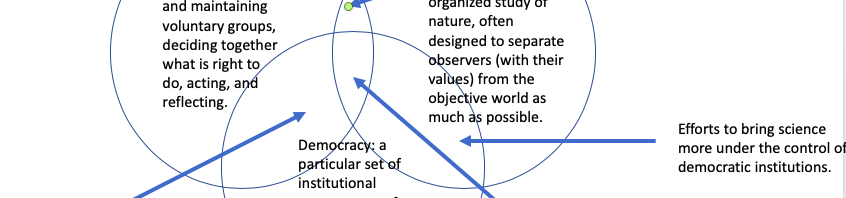
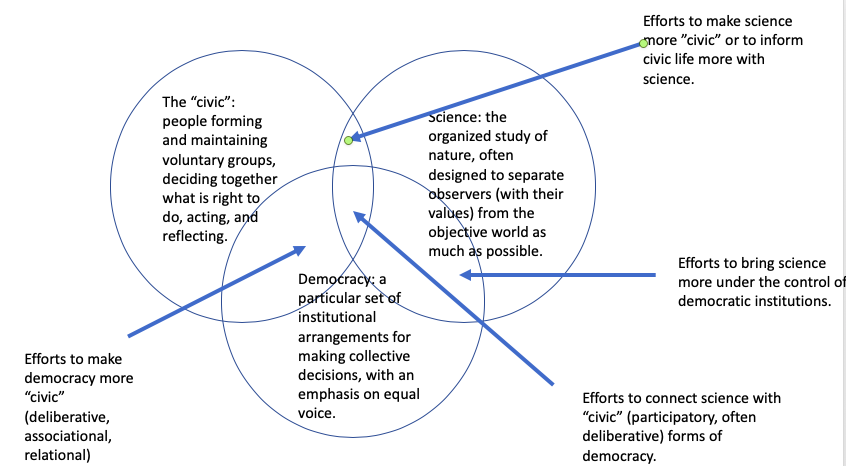
Civic Science works at the intersection of these three circles, and especially where “the civic” overlaps with science.

Civic Science in Relation to Other Movements

Given the definition developed in the previous section, it is clear that Civic Science does not stand alone but relates importantly to other fields and movements, both intellectual and practical.

Science, Technology and Society (STS): This is the interdisciplinary research field devoted to understanding science as a set of institutions in society and its relationship to other institutions, such as states and markets. It is ideologically pluralist and encompasses valuable disagreements, but the goal is not knowledge for its own sake. STS promotes understanding of science so that scientists and others can improve science. Feeding into STS are specific sub-disciplines such as the sociology of science and the philosophy of science.

Citizen Science: At its core, Citizen Science means enlisting laypeople to collect scientific data, such as environmental samples or observations of wildlife. Its goals can be to harvest more and better data or to give amateurs interesting tasks, but there is also sometimes an implicit reform agenda: to reduce status hierarchies that might otherwise keep laypeople out of science.

Community-Based Participatory Research: Particularly strong in the health sciences is the development of partnerships between credentialed scientists and community-based groups (usually nonprofits) that jointly shape research questions and methods and collect and interpret data together (Minkler 2002). Sometimes the goal is to generate better knowledge or to make sure that activists will be ready to use scientific findings, but (as with Citizen Science), there may also be an agenda of reducing status differentials between scientists and laypeople.

Civic renewal: Many organizations have arisen and come together in coalitions to advance “civic renewal” in the United States. This tends to mean efforts to strengthen deliberation, collaboration, and relationship-building in civil society (Levine, 2013). One signal moment was the National Commission on Civic Renewal in the late 1990s, but today such groups convene in the Bridge Alliance and other settings. Sirianni and Friedand (2005) map a Civic Renewal Movement.

Civic Studies: Launched with a manifesto by three past or future presidents of the American Political Science Association, a future Nobel Laureate in economics, and others (Boyte et al 2017), Civic Studies is a nascent field and intellectual movement that aims to study civic life with a combination of empirical, normative, and strategic methods (Levine 2014).

Dialogue and Deliberation: Such major political theorists as Jürgen Habermas (1987) and John Rawls (1997) have defended a role for public deliberation, meaning a relatively fair and reasonable discussion (the precise criteria vary) that influences government and public policy. Meanwhile, a large number of practical nonprofits actually organize dialogues or deliberations in various formats (Gastil & Levine 2005). There is a burgeoning literature on the impact of these efforts, creating a rich scholar/practitioner community.

Social movements that target science: In the tradition of ACTUP, citizens may come together to demand changes in the priorities, methods, and dominant paradigms of science. [Current examples? Gun violence? Climate?]

See also: Tisch College Postdoc in Civic Science; exemplary civic science: the CAFEH project; Civic Science; and science, democracy, and civic life

Citations

  • Boyte, H., Elkin, S., Levine, P., Mansbridge, J., Ostrom, E., Soltan, K., & Smith, R. (2007). Summer institute of civic studies—Framing statement. Tufts University Summer Institute of Civic Studies, 28.
  • Epstein, Stephen. 1995. the construction of lay expertise: AIDS activism and the forging of credibility in the reform of clinical trials. Science, Technology, & Human Values, 10/4 408-437
  • Gastil, John & and Peter Levine. 2005 (The Deliberative democracy handbook: strategies for effective civic engagement in the twenty-first century. San Francisco: Jossey-Bass
  • Habermas, Jürgen. 1987. The Theory of Communicative Action, translated by Thomas McCarthy Boston: Beacon Press.
  • Havel, Vaclav. 1992 Address at Wroclaw University, Wroclaw, Poland, December 21, http://old.hrad.cz/president/Havel/speeches/1992/2112_uk.html
  • Levine, Peter. 2015. We are the ones we have been waiting for: the promise of civic renewal in America. Oxford University Press
  • Levine, Peter 2014. The Case for civic studies. In Peter Levine and Karol Soltan, Civic studies (Washington, DC: AAC&U/Bringing Theory to Practice
  • Minkler, Meredith & Nina Wallerstein. 2002. “Introduction to community based participatory research.”  In Minkler & Wallerstein (eds.) Community based participatory research for health. San Francisco: Jossey-Bass, 3-26
  • Rawls, John. 1997. The idea of public reason revisited. University of Chicago Law Review. 64/3, 765-83.
  • Shaffer, Timothy J. 2013. What should you and I do? Lessons for civic studies from deliberative politics in the New Deal. The Good Society, 22(2), 137-150.
  • Sirianni, Carmen & Lewis A. Friedland. 2005. The civic renewal movement: community-building and democracy in the United States. Dayton, Ohio: Kettering Foundation Press, 2005
  • Tilly, Charles. 2004. Social movements: 1768-2004. Boulder/London: Paradigm

when the lotus bloomed

I was so distracted, tense, and busy
That I missed the lotus bloom.
Though preoccupied and hasty
I sensed something in the room—
Caught that subtle scent of longing,
That mute yearning to be still—
But I hadn’t yet an inkling
That the flower was my will.

(Answering Rabindranath Tagore, Gitanjali #20, “On the Day When the Lotus Bloomed,” which begins—in Tagore’s own English translation—“On the day when the lotus bloomed, alas, my mind was straying, and I knew it not. My basket was empty and the flower remained unheeded.”)

youth turnout rose more than others’ turnout in 2018

(UCLA) On Feb. 11, Martin Wattenberg posted a Washington Post Monkey Cage article that received the headline, “In 2018, the turnout gap between young and old people didn’t really shrink at all.” He wrote,

The Center for Information and Research on Civic Learning and Engagement (CIRCLE) at Tufts University produced a widely quoted reportestimating that young Americans’ turnout had risen to the highest level it had ever recorded. This study led to headlines such as, “Watch Out 2020: Young Voters on the Rise” and “Young Voters Turned Out in Historic Numbers.

No doubt this CIRCLE study is correct in asserting that the turnout rate of young Americans increased markedly in 2018, compared with recent midterm elections. But so did the turnout rate of all other age groups.

The crucial question, then, is this: Did 2018’s massive increase in turnout reduce the wide gap between the turnout rates of young and old Americans?

No. Official records of participation in three states between 2006 and 2018 show that this was not the case.

Wattenberg is not wrong that everyone’s turnout rose in 2018, presumably because Donald Trump raised the perceived stakes of politics and nationalized congressional elections. But it is noteworthy that young people at least kept pace with the average increase, because low youth turnout in midterm elections had hitherto been a very stable pattern.

Furthermore, if you look carefully at the graphs in Wattenberg’s article, the upward slope for youth turnout is actually steeper than that for other age groups. Not vastly steeper, but notably so.

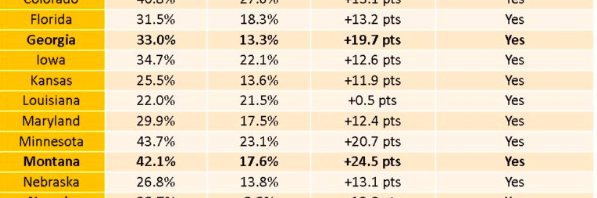
Now CIRCLE has used the voter files for the 17 states that have made them available so far to examine the relative gains in youth and older people’s turnout.

In 15 of the 17 states, youth turnout rose faster than older people’s turnout, meaning young voters expanded their share of the electorate. In certain closely contested races, the increase was dramatic–for instance, youth turnout more than doubled in Georgia and Montana.

In my view, a young-adult turnout rate of 31% is unacceptably low, but the only way to get to a reasonable level is by raising it one election at a time. A 10- or 11-point gain in one year is a very substantial step in the right direction, and it already made a difference to the results.