Participatory Action Research as Civic Studies

Thanks to the fabulous Tisch College postdoc Margaret McGladrey, we are holding a symposium on “Participatory Action Research as Civic Studies” today at Tufts, with 15 speakers.

I’m planning to make a few remarks revolving around three “ideal types” or imaginary characters.
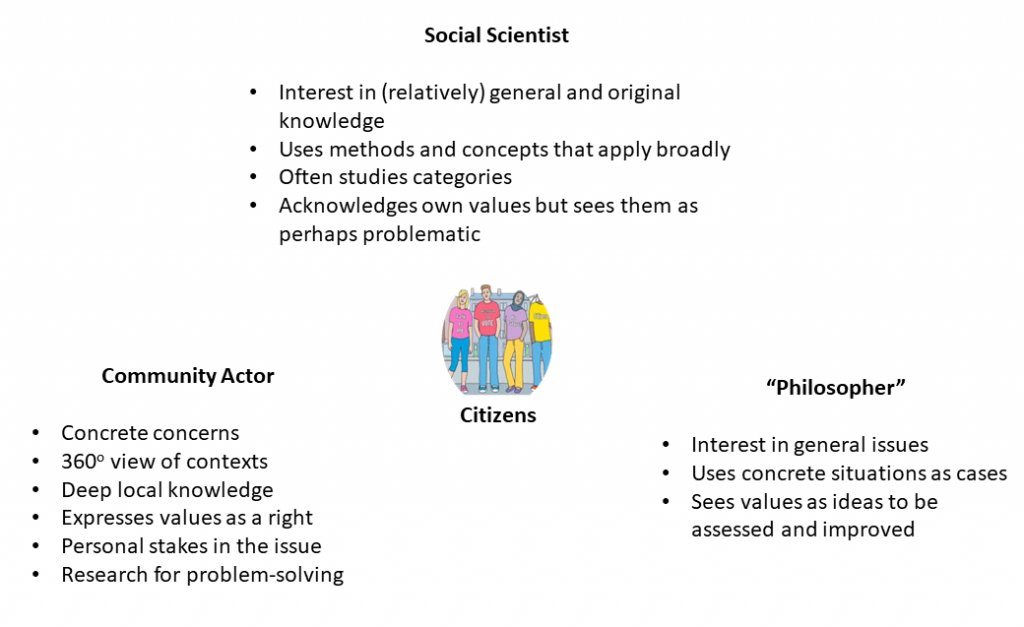
I won’t try to explain the whole chart here, but a few explanations might be useful.

The community actor could be a nonprofit leader, activist, or government official. The social scientist could be qualitative or quantitative, teaching in a university or working for an agency or even a research firm. And the “philosopher” need not be a professor of that academic discipline. She might be a scholar from a different field (e.g., theology, normative political theory, law, education) or someone working outside academia, for instance, as a writer or a clergyperson.

When I say that the social scientist “often studies categories,” I mean that her topic is often a set of examples that meet the same criteria: Dominican women, prenatal care programs, kids who are existing foster care. In contrast, a community actor is often concerned with a heterogeneous, multifaceted object like a school or a neighborhood.

When I say that the social scientist “acknowledges [her] own values but sees them as perhaps problematic,” I am thinking about the disclosures of bias and social position that are increasingly common in scholarly articles. Traditional conceptions of science understand it as a quest to understand the world independent of the observer. Social scientists know that observers have values, bias, and assumptions. That is because we are all human. But they regard those attributes of themselves as potential obstacles to understanding their objects of study. So they use techniques for reducing bias, and they disclose or acknowledge their values for the sake of the reader. In contrast, a civic actor typically asserts values as a matter of right, as things that she has. Often those assertions are tied to identities: “As a Pentecostal, I believe …” Finally, a philosopher is trained (if we are trained in anything), to ask whether any claim about values is the best one. We view values not as biases to disclose but as claims that require testing.

In the middle are some “citizens,” using that term in its moral (not legal) sense. They are people who feel responsible for their world: for changing it or preserving what is good about it. They need what each of the three ideal types offer, and they can’t distinguish sharply among these offerings. They need particular and general knowledge, information and good values.

I take it that movements like Participatory Action Research and Community Based Participatory Research attempt to bring together the Community Actor with the Social Scientist, either by reducing differences among these people or by making them into partners. Civic Studies, as we actually practice it so far, tends to combine the Social Scientist and the Philosopher, but really it should bring all three together.

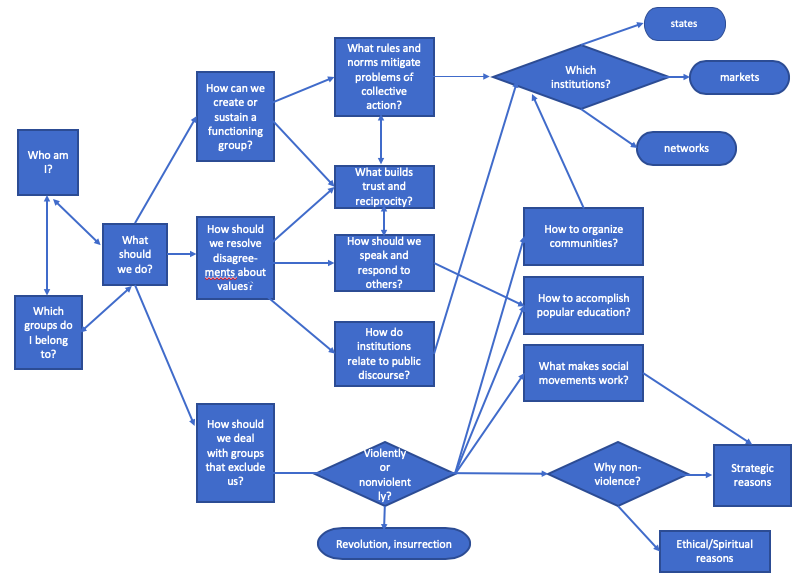
a Civic Studies flowchart

This is an agenda for research and education. It’s a way of organizing the major topics of our Introduction to Civic Studies course for undergraduates. It isn’t intended directly as a flowchart for civic actors (activists, leaders) because their problems are more concrete and more varied. But I hope that by addressing these topics in cumulative research, and by teaching the results (interactively), we can build a base of knowledge useful for activists. (See also the page about Civic Studies on the Tisch College website.)

should US kids learn they have a democracy?

The New York Times’ Dana Goldstein reports a “bruising political fight” over Michigan’s social studies standards, in which one of the questions was whether to describe our government as a democracy or a “constitutional republic,” as some conservatives prefer.

This is a familiar debate, previously held in states like Texas and Georgia. I’ve received messages and comments questioning my expertise on civic education on the ground that I sometimes ignorantly describe the US as a democracy, when it is actually a republic.

Goldstein offers what looks like a definitive, expert resolution:

mainstream historians, political scientists and legal scholars say that the United States is both a representative democracy and a republic — and that there is no contradiction between those terms.

A democracy is government by the people, who may rule either directly or indirectly, through elected representatives. A republic is a form of government in which the people’s elected representatives make decisions.

I think these definitions are fairly arbitrary. Both words have been used for more than 2,000 years in a dizzying variety of ways. The People’s Republic of China doesn’t select its representatives through contested elections. I suppose we might claim it isn’t a genuine republic, but the very first state to claim that title was Rome, whose legislature was hereditary. The first states to call themselves democracies (some of the Greek cities) used a wide variety of methods of governance, including awarding offices by lottery and consulting oracles.

“Republic” has Latin roots, and if you use etymology to determine meaning, then its core idea is the public good–an important domain (sometimes translated as “the commonwealth”) that is public rather than private property. This idea is incompatible with monarchy, which presumes that the state is one person’s property. Therefore, removing Elizabeth II as the titular monarch of Australia would convert it into a republic without really changing how Australia is governed. Developing the idea more fully, we might emphasize the importance and nobility of the public sphere and public life–republican virtues. Conservatives should be cautious about this direction since republicans, from renaissance Italy to Maoist China, have often been hostile to private wealth. The res publica and bonum commune are opposed to private interests.

As for “democracy,” it has Greek roots, and its etymology is power for the people. For some, that means one person/one vote, but that logic has been disputed. For Dewey, it meant active involvement in all sectors of life: science, art, the family, industry. For Soviet apologists, it meant the dictatorship of the proletariat (= the people) through a vanguard party until the state could be abolished entirely. For Bonapartists, it means that voters should anoint a unifying leader in a plebiscite to prevent domination by factions.

It’s true that the word “democracy” often had a pejorative ring until the later 19th century. For many authors, it meant something like mob rule. But they did not consistently equate it with direct, popular rule. In fact, Jefferson used the word “republic” precisely for that form of government:

Indeed, it must be acknowledged, that the term republic is of very vague application in every language. Witness the self-styled republics of Holland, Switzerland, Genoa, Venice, Poland. Were I to assign to this term a precise and definite idea, I would say, purely and simply, it means a government by its citizens in mass, acting directly and personally, according to rules established by the majority; and that every other government is more or less republican, in proportion as it has in its composition more or less of this ingredient of the direct action of the citizens.


— Jefferson to John Taylor, 1816, emphasis added

So when people tell you that the Founders created a republic because they feared “government by its citizens in mass,” they are certainly not remembering Jefferson.

“Ah,” you say, “but what about Madison? Jefferson didn’t write the Constitution or even like it very much. The authors of the Federalist Papers prevailed in its design, and they liked republics rather than democracies.”

Indeed, Madison defended checks on direct, popular rule to protect against factionalism, and his thought remains compelling. But look at what Madison wrote in 1834:

[1] no Government of human device, & human administration can be perfect; [2] that which is the least imperfect is therefore the best Govt. [3] the abuses of all other Govts. have led to the preference of Republican Govt. is the best of all governments because the least imperfect. [4] the vital principle of Repub: Govt. is the lex majoris partis, the will of the majority; [5] if the will of a majority can not be trusted where there are diversified conflicting interests, it can be trusted no where because such interests exist every where ..


— James Madison to Unknown, re majority governments
Dec. 1834 (emphasis added)

So there we see James Madison defending “the will of the majority” and the “law of the larger part,” and calling it republicanism.

For me, the bottom line is that we should stop treating this as some kind of fact that we should impart to youth. What is a democracy, what is a republic, what kind of government we have, and what kind of government we should have are live issues about which thoughtful and learned people disagree. Kids should be welcomed into the conversation.

See also:every Republican president since 1901 has insisted that the US is a democracy; do we live in a republic or a democracy?

pay attention to movements, not just activists and events

Let’s say you work in a school or college, a newsroom, a city government, or a firm. You may encounter a social movement when it makes demands on you. Regardless of your opinion of its demands, you probably see it as different in kind from the organization where you work. Your organization has a bank account, a board, and a mission statement. The social movement may appear to you mainly in the guise of individuals who participate in events or episodes—people you call protesters, boycotters, strikers, or voters. Or you may think of the movement as the name for people who share beliefs or goals. For instance, you could notice that many of your students have become environmentalists, or anti-racists, or neo-fascists. To you, they are a movement.

I want to encourage a different view. Any “movement” that is worthy of that name persists over multiple events and episodes (McAdam, Tarrow & Tilly 2001). It recruits active members and supporters and collects resources, which it uses in more or less strategic ways. Its members may not agree about anything in particular, not even about the marquee slogans of the movement. Ziad Munson has found that many anti-abortion protesters do not start with strong opinions about that issue but are recruited into activist networks from which they derive their anti-abortion views while they act (Munson 2010).

“Opponents of abortion” is the name for a segment of the population, who can be identified with a survey that asks opinion questions. The Pro-Life Movement, on the other hand, is a social entity that has resources and membership that persist over time; some of its members are not even against abortion. This is typical of movements in general.

Once you distinguish between individuals (activists, radicals, protesters) and a movement, you will notice that the movement resembles your own organization in some respects. It may encompass several autonomous components, but it still constitutes a larger whole with a real presence. For example, the American Civil Rights Movement encompassed many churches networked together in organizations like the Southern Christian Leadership Council, classic membership associations like the NAACP and the Urban League, a political party (the Mississippi Freedom Democratic Party) and a union (the Brotherhood of Sleeping Car Porters), among their entities, but we can still tell the movement’s history and describe its central tenets and tendencies at each point in the story

You should not only ask: What political opinions do I hold and which categories of citizens do I agree or disagree with? You should also ask: What do I think of the social movements of the day? Are they drawing diverse people together for generative conversations? Are they inventing new forms of political action that are valuable? Are they bringing out the best in their members? Do they create “Free Spaces,” forums in which their members discuss and learn (Evans & Boyte 1986)? Examples from the past include Grange Halls in Populism, Freedom Schools in the Civil Rights Movement, Talk-Ins against the Vietnam War, consciousness-raising circles in Second Wave Feminism, the “human microphones” of the Occupy Wall Street movement, and the uses of hashtags like #BlackLivesMatter and #MeToo to organize conversations online.

On the other hand, do the social movements of the day promote norms and habits that damage their members or other people? Do they tend toward extremism, nihilism, cynicism, a cult of personality, group-think, or other pathologies? How good are they at SPUD?

A movement can be worthy of support even if you disagree in part with its current agenda, if it provides a forum for learning, growth, and solidarity. We can’t accomplish much alone, so it can be your civic responsibility to participate in a movement that you don’t endorse 100% if you think it’s better than nothing and has the potential to improve. On the other hand, you may find that you agree with every demand of a social movement but choose to avoid it because of its internal dynamics. The point is to pay attention to the movement, not just the claims that it makes at the moment.

See also: a better approach to coalition politicsHabermas with a Whiff of Tear Gas: Nonviolent Campaigns and Deliberation in an Era of Authoritarianismthe value of diversity and discussion within social movementsa sketch of a theory of social movements; and against methodological individualism

Sources: Evans, Sara M & Boyte, Harry C., 1986. Free Spaces: The Sources of Democratic Change in America. New York : Harper & Row; McAdam, Doug, Tarrow, Sidney and Tilly, Charles, 2001. Dynamics of Contention (Cambridge: Cambridge University Press); Munson, Ziad W. 2010; The Making of Pro-Life Activists: How Social Movement Mobilization Works. Chicago: University of Chicago Press.

identities, interests, and opinions

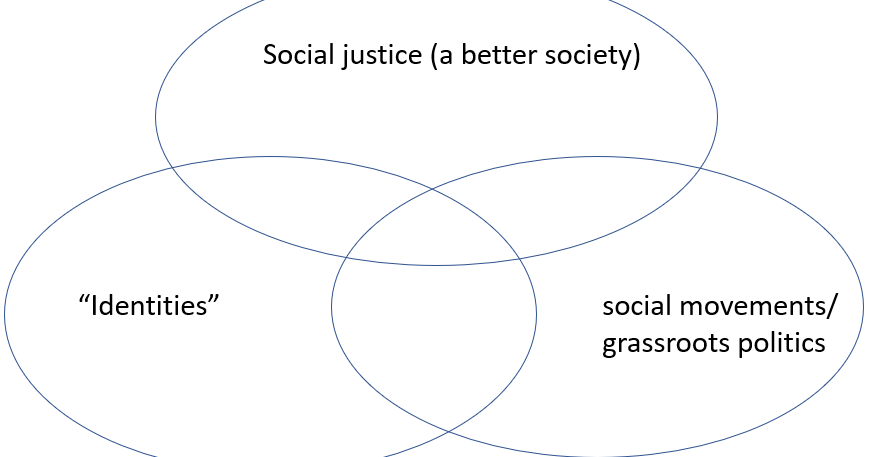
In our Introduction to Civic Studies course, this is the zone we’re currently in:

We all need some account of what would make a good–or at least a better–society. This idea can be provisional and open-ended; we still need something to orient us. If you think that it’s easy to define “social justice,” consider that it was the name of Father Coughlin’s antisemitic and pro-Nazimagazine in the 1930s.

We must consider the potential of bottom-up, participatory, social movements to promote justice, because the powerful won’t reliably offer justice. However, reasonable people disagree about how important bottom-up politics is. Maybe top-down leadership or impersonal forces are much more significant.

Finally, we must consider how identities (what we are, as opposed to what we think) fit in. Is all politics identity-politics? Or should we distinguish between “old” social movements, which made universalist claims, and “new” ones, which are identity-based? If the distinction holds, is the change good or bad? Also, does justice require fair treatment of identities? And what is an identity? For example, religion: an identity or a set of beliefs?

As always, it’s our students’ job to navigate their own way through these shoals; I don’t offer answers. But I do think it is interesting to distinguish:

  • An identity: “Speaking as a …”
  • An interest: “I want …”
  • An opinion: “We should …”

I’ll stipulate that we all use all of these forms of speech, and they are all protected under the First Amendment. Which ones are allowed is not a good question. But we might ask:

  • Which of these can be right or wrong?
  • Which can/should be subject to compromise?
  • Which does one have a moral right to? (Relatedly, which ones do other people have an obligation to honor in various ways?)
  • Which should we be open to changing, and why?

Here is an example of a view, although I am not wedded to it:

People have a right to their identities. Sometimes we should change our identities in response to new understandings. For instance, some people didn’t used to see sexual orientation as an identity, especially if they happened to be straight; now they should see heterosexuality as an identity. We should not, however, compromise our identities as part of a deal with others. We are usually right about our own identities, but not inevitably. We can lie or even lie to ourselves about who we are.

We should be open to compromising our interests in order to share the world with others. Whether to compromise depends in part on the moral standing of the other party. We should also be open to changing our interests in response to principled arguments, but that is a different process from compromise. We have a right to certain basic interests, but we can claim interests that we do not have a right to. You can disagree that something is my legitimate interest. I may even owe you an argument that it is.

Our opinions can be right or wrong. We should be open to changing them on the basis of evidence and arguments. We shouldn’t easily compromise them (in the sense of splitting the difference), although there are times when that is wise. Opinions should be sincere, so if you do compromise them, you should mean it.

See also: the New Social Movements of the seventies, eighties, and today; don’t confuse bias and judgment; and why study social justice?