on hedgehogs and foxes

“A fox knows many things, but a hedgehog knows one important thing” — Archilochus

This proverb is in the news lately because Philip Tetlock has shown that foxes (flexible and curious generalists) are much better at predicting events than hedgehogs (specialists who hold deep expertise). See David Epstein’s Atlantic article on Tetlock, and see Axios for a current competition funded by the US intelligence agencies to test his theories.

Tetlock draws from Isaiah Berlin’s 1953 essay, which is light but offers some insights, I think, about specific authors. Berlin argues that Tolstoy was psychologically a fox but believed–for theological/ideological reasons–that we should all be hedgehogs. Our one big idea should be the Imitation of Christ. This tension was at the heart of Tolstoy’s books and life. I also endorse Peter Hacker’s view that Wittgenstein was temperamentally a hedgehog who forced himself self-consciously to become foxlike in his late work.

If you take the proverb literally, it seems more impressive to be a fox. The fox uses its brain to hunt and escape, whereas the hedgehog just instinctively rolls up to take advantage of its best physical asset, its spines. But the metaphor is loose. Human hedgehogs are among our deepest, most original thinkers. They are the ones with the discipline to construct whole, coherent worldviews. They don’t merely employ a strategy but create it.

In contrast–and I write this as very much a fox–foxes can be ad hoc and derivative, eclectic in a bad way. A fox can employ the available ideas that seem to fit the situation without generating any new frameworks for others to use. A fox can be a jack of all trades, master of none. We foxes need hedgehogs to develop new ways of thinking, from which we borrow superficially and pragmatically.

But it is interesting that the hedgehogs are so consistently wrong about what will happen next. They are more likely to suffer from confirmation bias. They can make any data fit their theory. And they are worse than foxes at recognizing exceptions, tradeoffs, and zones of uncertainty. They lack phronesis, practical wisdom.

I therefore think it’s a problem that hedgehogs have an advantage in the competition for attention. If you are associated with one big idea and you keep hammering away at it, you have a “brand.” People turn to you to say that one thing, even if they don’t agree with it, and so your fame rises. You must compete with the other people who say the same thing, but if you’re first or more effective at communicating it, you can own the space.

So as not to offend anyone alive, I’ll use the case of my late colleague Ben Barber, who was early to revive the idea of “strong democracy.” (More democratic engagement is always better; the good life is lived in public; liberalism is too individualistic; etc.) He wrote several best-sellers, and I attribute his success in part to his capturing a particular brand. For courses, debates, conferences, etc., you may need someone to say, “More democracy!” Barber cornered that market.

Temperamentally, I am with the foxes. As soon as I write an argument for anything, I immediately become fascinated by the arguments against it. I have a limited attention span and jack-of-all-trades tendencies. I frequently disappoint practitioners and advocates, who know that I have written in favor of campaign finance reform, public deliberation, service, or civic education and want me to say it again to a new audience with more conviction. In fact, I am almost always on the verge of apostasy and retraction.

I really do admire the hedgehogs. But I’ll say a few things in favor of foxes.

First, the moral world is immensely complex, because it emerges from myriad human interactions and takes the form of communities, cultures, and institutions that overlap, interrelate, and become loaded with historical resonances. Thus an adequate moral theory is almost certainly partial, inconsistent, and ad hoc.

Second, acting like a fox keeps you mentally alive. It may be a self-indulgent concern, but I fear ceasing to think. Even the greatest hedgehogs, it seems to me, have stopped their quest for knowledge. They already know, and know that they know, and are done.

I’ll also say one thing against foxes. At least in folkore, a fox is a solitary hunter. What if you also like people and feel loyalty to groups of peers who share goals and missions? Then you cannot simply act like a fox.

To switch metaphors, Keats admired the “quality” that forms a “Man of Achievement especially in Literature and which Shakespeare possessed so enormously—I mean Negative Capability, that is when man is capable of being in uncertainties, Mysteries, doubts, without any irritable reaching after fact and reason.” I also admire Negative Capability, but it is a virtue of the poet, not the ally. Negative Capability is good for writing fiction that explores many different perspectives; it is not so helpful for co-writing a mission statement for an organization and then following through.

So I would like to be a fox who is helpful in a pack. The question is to what degree that’s possible.

See also: the politics of negative capability; loyalty in intellectual work; in defense of Isaiah Berlin; structured moral pluralism (a proposal); and Tolstoy, Shakespeare, Orwell
an expressivist critique of our criminal justice system

(Disclaimer: this post is the result of reading some work by Tommie Shelby and Erin Kelly but not yet wrestling with either author’s views sufficiently or examining the larger literature on expressivism in law. If you were a peer-reviewer, you should reject this post.)

A society has a right and an obligation to express what is just through the criminal law. One reason is that public statements about what is permitted and forbidden can influence behavior for the better. But sometimes laws are not effective means of shaping behavior. Even then, it is important for a community to express justice as accurately and completely as it can, and the criminal law is a valuable vehicle of expression.

Public expressions of justice must often be accompanied by penalties. Otherwise, laws can reasonably be interpreted as mere lip-service. If, for example, the law says that everyone must pay taxes, but oligarchs routinely get away with tax evasion, then the law is saying that oligarchs don’t have to pay taxes. The failure to punish them conveys a view of justice that is unfair.

Many things are wrong but should still be legal. Awful but constitutionally protected speech is an example. The scope of the law should be limited both because of the fallibility of any government and because individual liberty is a great value. (We’re not free if we’re only allowed to do good things.) Nevertheless, there remains a large domain of actions that are bad enough that the state should express their wrongness by prohibiting them and enforcing the prohibition with penalties.

Even a partially unjust regime can and must express justice through the criminal law. Its failures do not invalidate laws that it enacts and enforces, if those laws are just. An exception may be a pervasively evil regime. For instance, a Nazi law court could render the correct decision in a case of rape or murder, but the very existence of that court is so offensive as to render all of its verdict moot. The victims of even real crimes cannot get justice from Nazi judges. But that reasoning does not apply to courts in societies, like ours, that harbor a great deal of injustice.

Public statements about justice must be deliberated. This is not because deliberation equals justice (a proceduralist view). Justice is justice. Rather, we must deliberate because hearing and responding to alternative views is our best method of discovering what justice demands. Also, the legitimacy of a public (as opposed to an individual’s) statement of justice depends on whether each of us had a chance to influence it with our voice.

Our legal system violates the expressivist principles summarized so far. The features that violate this theory are: racialized mass incarceration, rampant plea-bargaining, degrading punishments (prison uniforms, refusal to provide education, tolerance for sexual violence, stripping prisoners of civil rights), frequent imprisonment of people with mental illness, and a tendency to hide the whole system away from public view.

Mass incarceration of people who are racial minorities and/or poor and/or mentally ill clearly expresses a view that is incompatible with justice–that those people are not equal. We wouldn’t have the same system if most of the prisoners were middle-class and white.

Racialized mass incarceration also blocks a satisfactory national discussion of justice. In some communities, incarceration is common, and in others, it is virtually absent; but since they are separated by race and class and have unequal amounts of political power, they are very unlikely to deliberate together.

Replacing jury trials with plea-bargains removes any public deliberation about particular cases and prevents each verdict from saying anything at all. The outcome of a case is a function of the perceived likelihood of conviction, the defendant’s tolerance of risk, the prosecutor’s interest in conviction, and the cost of a trial, not anyone’s view of what is deserved.

Hiding the whole system away excuses the public from deliberating about particular cases and about policy. You can easily turn a blind eye to the criminal justice system even though our prisons house a population as big as a state.

I would not go so far as to claim that an expressivist theory of criminal law is completely adequate. We can imagine a system that does a good job of expressing justice but fails other tests, such as the utilitarian criterion of doing the most good for the greatest number. For instance, maybe it would be better to cancel trials that don’t affect behavior and use the money saved for prevention. I’m sufficiently pluralist (or wishy-washy) to suspect that utilitarianism, contractarianism, classical liberalism, Foucault, and other views all offer valid insights.

But I would submit that an expressivist theory explains some of what is so badly wrong with our system.

See also: mass incarceration, the jury, and civic studies; why we are choosing to abolish the jury system; civic engagement and the incarceration crisis; if we are going to put millions in prison, WE should make millions of decisions

Frontiers of Democracy Conference 2019 Draft Agenda

This is a working draft (as of May 8, 2019), likely to change in detail. Tickets are still available but are running out.

Thursday, June 20

4:00-5:30 registration
Heavy hors d’oeuvres served

5:30 opening plenary

Welcoming comments by organizers.

“Short-takes” talks (10 minutes each, no Q&A)

  • Maya Pace, Lead for America, “Start Where You Live”
  • Jamila Michener, Cornell University, author of Fragmented Democracy: Medicaid, Federalism and Unequal Politics, on “Health Equity and Democracy”
  • Wendy Willis, Deliberative Democracy Consortium and author of These Are Strange Times, My Dear: Field Notes from the Republic
  • Andi Crawford, the Director of Empowerment and Citizen Engagement for the City of Lansing, MI, “Love Your Block in #LOVELansing”

Discussions at curated tables of eight

Friday, June 21

8:00-9:00 breakfast served

900-10:30 am: Plenary Session: “Working at the Frontiers of Democracy”

Questions:
1. What sense of duty, purpose or mission guides your life?
2. What issues at the “frontiers of democracy” interest and concern you most right now?
3. What do you not know enough about and hope to learn more about?
4. What issues and questions are you hoping that this conference will address?
5. What do you imagine that you will do after this conference if it goes well for you?

These questions will be discussed first by a panel at the head of the room and then by all participants, seated at assigned tables of eight. The panel:

  • Hajer al-Faham, a PhD candidate in political science at the University of Pennsylvania
  • Veronica del Carril, a youth program leader/arts educator from Argentina
  • Manuela Uribe Henao, Colombian working on public health interventions in El Salvador
  • Marianne Kwakwa, a PhD candidate in political science at Notre Dame
  • Jennet Kirkpatrick, political theorist at the University of Arizona, author of the books Uncivil Disobedience and The Virtue of Exit
  • Jamie Lee, Communication and Information Specialist, UNESCO/Cambodia, working on genocide memorials
  • Debilyn Molineaux, co-founder, The Bridge Alliance

10:30-10:45 break

10:45-12:15 concurrent sessions. Choose among:

  1. “Spectacle, Movement, Deliberation: Theoretical Perspectives on Democracy,” Samuel Schmitt, Aidan Kestigian, Vasiliki Rapti
  2. “Maintaining Meaningful Classroom Dialogue Even on Controversial Subjects,” Michael Fischer and Katina Fontes
  3. “BetaBlocks: Democratizing Manifestation of Technology in the Public Realm,” John Harlow and Eric Gordon
  4. “Renewing Democracy Through Renewal of Infrastructure,” Tom Flanagan, Craig Lindell, Wendi Goldsmith, Douglas Bruce, Carmen Sirianni
  5. “Love your Block,” Michael Hammett, Mary Bogle, Mauricio Garcia, and Andi Crawford
  6. “Fixing American Democracy from the Outside In – Storming the Hill,” with Represent.Us, American Promise, and Small Planet Institute, the Consensus Building Institute.

12:15-1:15 lunch
1:15-2:30 plenary activity: “How to be Helpful: Building Relationships for Social Impact” Led by Adam Seth Levine of research4impact. “How do you build successful working relationships with people who have diverse forms of expertise?”

2:30:2:45 break

2:45-4:15 Concurrent sessions. Choose among

1. “Amplify Impact, Build Bridges, and Connect Communities through Civil Discourse,” Cheryl Graeve, Robert Boatright, and Timothy J. Shaffer
2. “Democratizing Research for Environmental Justice and Health,” Chad Raphael, Doug Brugge, Amy Laura Cahn, Neenah Estella-Luna, Kenneth Geiser, and Charlotte Ryann
3. “How Interactive Simulations and Film Presentations Enhance Classroom Dialogue on Controversial Issues,” Joshua Littenberg-Tobias, GR. Marvez, and Jonathan Goodman Levitt
4. “Gaming and Civic Tech,” Libby Falck and Dmytro Potekhin
5. “Fixing American Democracy From the Inside Out – What’s Hot on the Hill!,” Jeff Edelstein and others
6. “Governance and Restorative Justice: The Role of Civic Groups in Problem-Solving in Schools and Drug Policy,” Nicole Kaufman, Sharyn Lowenstein, Dani O’Brien

4:15-4:30 break

4:30-6:00 Plenary Session led by Sam Novey and Clarissa Unger, “Recognizing Local Leadership to Build Better Strategies for Civic Renewal.”

(Time at tables for introductions and discussions)

Saturday, June 22

8-9 Breakfast

9 am-10:15: A choice between two sessions:

1. Panel: “Political Participation in the City and the Ballot Box.” with Tanya Gibbs, Benjamin Hernandez, Jonathan Collins, Tammy Esteves

Or

2. “The Social Contract of America” (Interactive workshop) planned by Debilyn Molineaux

10:15-11:30

Plenary Discussion

Questions:
1. What do you plan to do as a result of the conference?
2. Did your understanding of the frontiers of democracy shift?
3. What did you learn from someone in a different domain?
4. What are we committed to doing together?

These will be addressed first by a panel seated at the front of the room, and then by participants at assigned tables of eight. The panel is

  • Nakeefa Garay, urban studies PhD Student, Rutgers Newark
  •  Elizabeth Jabar, artist, Colby College
  • Liza Kostanyan, NGO leader, Armenia
  • Sterling Speirn, CEO, National Conference on Citizenship
  • Amber Wichowsky, political scientist, Marquette

11:30 What are we committed to doing together?

Report outs from tables, discussion.
Discussion of a follow up report

Rewiring Democracy

Matt Leighninger and Quixada Moore-Vissing have published “Rewiring Democracy: Subconscious Technologies, Conscious Engagement, and the Future of Politics” (Public Agenda 2018).

I would pick out this major contrast from the complex document of 68 pages.

  • On one hand, technologies are being used ubiquitously to influence individuals and the political world without our conscious awareness. Examples include tools that allow organizations to predict what individuals want without having to ask them, techniques for microtargeting messages, and methods of surveillance.
  • On the other hand, people are deliberately inventing and using new tools for civic purposes, i.e., for free and intentional self-governance. Examples include tools for collecting contributions of money or time and techniques for circulating information in geographical communities.

Much depends on which force prevails, and that depends on us.

The report ends with 3-page case studies of civic innovations. Public Agenda is also publishing those examples separately, starting with a nice piece on the changing role of tech on social movements. It explores how contemporary social movements share photos and collaboratively produce maps, among other developments.

See also: democracy in the digital age; the new manipulative politics: behavioral economics, microtargeting, and the choice confronting Organizing for Action; qualms about Behavioral Economics; when society becomes fully transparent to the state

college and mobility

Xiang Zhou has published “Equalization or Selection? Reassessing the ‘Meritocratic Power’ of a College Degree in Intergenerational Income Mobility” in the American Sociological Review–also available here. Like all multivariate statistical models, it’s subject to criticism and should be replicated using other datasets and specifications. But it’s certainly interesting and very well presented.

For background, here is Raj Chetty’s graph from a different source, showing the relationship between Americans’ family incomes when they were growing up and their incomes as adults, both expressed as percentiles.

If it showed a straight line from 0,0 to 100,100 with a slope of one, that would imply a perfect correlation between generations. It would imply zero mobility, although it would be consistent with some random movement up and down the income ladder that would be concealed by displaying averages. Instead, we see a basically straight line from 0,30 to 100,70 with a slope of about .4. People at the very bottom do tend to rise a bunch of ranks (if they survive to adulthood), and people at the very top do average below where their parents were. In short, there is a strong correlation across generations with some reversion to the mean.

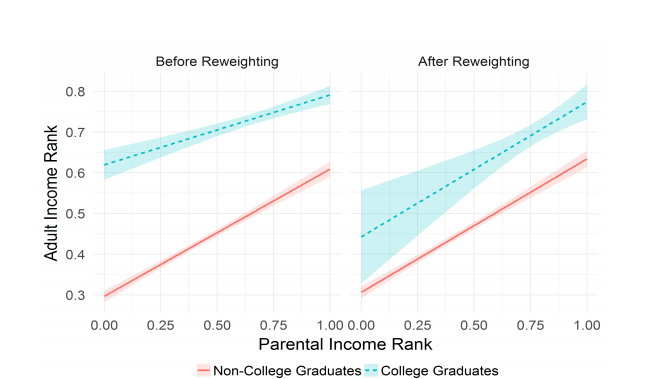
The graphs in Zhou’s article use a similar format but they show the data for young US adults depending on whether they graduated from college or not. Graduates are shown in blue, non-graduates in red.

In this first pair, the graphs show the raw data and then the same data reweighted for a bunch of variables that were measured while the subjects were still in high school: their “gender, race, Hispanic status, mother’s years of schooling, father’s presence, number of siblings, urban residence, educational expectation, the Armed Forces Qualification Test (AFQT) percentile score.”

It’s clear that you should go to college. A person whose parents were at the 25th income percentile ends up at the 30th percentile if she doesn’t graduate from college, and above the 60th if she does. But the slope is flatter for college students than non-college students without reweighting; and the lines are closer together and parallel when reweighted.

Zhou interprets this pattern to mean that people who are able to attend college (due to financial resources, a high school diploma, motivation, etc.) end up better off than those who are not able to attend, but college itself adds no noticeable benefit. To put it another way, if we used public policy to move everyone to the blue line by making them all college graduates, the slope of the blue line would remain fairly flat and it would cross the y-axis at a lower point, because it’s impossible that everyone in a society should rise to a higher income percentile than their parents.

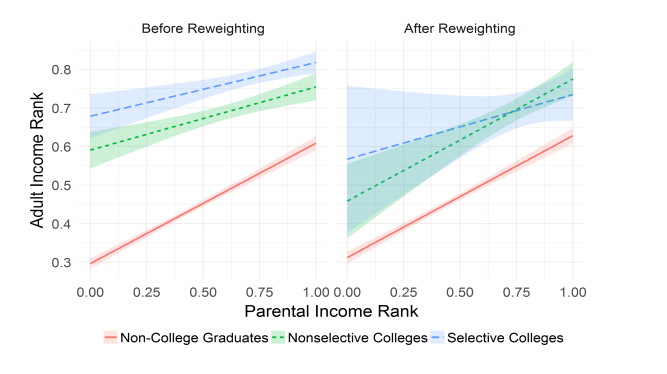
Here are the same patterns when Zhou distinguishes between selective and non-selective colleges. The slope for the non-selective colleges is steeper (which could imply that they are better at mobility), but the difference between the selective and non-selective colleges is not statistically significant after reweighting.

If Zhou is right, universal college would not improve economic mobility at all. The line would be fairly flat and lower than the current line for college grads. The economic advantages of college are due to stratification, not the experience of being in college.

See also: to what extent can colleges promote upward mobility?; sorting out human welfare, equity and mobility; social capital and economic mobility