Frontiers of Democracy and summer institutes: coming up

The more-or-less final agenda for Frontiers of Democracy 2019 is up. We are oversold. If you want to attend and don’t have a ticket, you can email me to get on the waiting list. The talks on June 20 will be video-recorded and archived later (but not live-streamed.)

Before Frontiers and feeding into it are three other meetings:

And following the Frontiers conference will be the 11th annual Summer Institute of Civic Studies, for about 20 selected professors, graduate students, and activists from Argentina, China, Iran, Mexico, Spain, and the USA.

Participants in these groups, plus about 16 alumni of past Summer Institutes, plus another 50 people who simply signed up to attend will all convene at Frontiers.

Since I am in charge of ICER, Frontiers, and the Summer Institute, blogging has been light for the past week or so, and the forecast is for continued sporadic posting here–although I traditionally blog about some of the themes that arise.

how a mixed economy shapes our mentalities

(On my way to London for a small conference on Friedrich Hayek and Elinor and Vincent Ostrom).

These are some of the activities that we undertake as we organize social activity in a mixed 21st century economy:

  1. Observing prices of inputs and outputs and identifying opportunities for profit (market);
  2. Discussing a collective choice and then voting according to our preferences (democracy);
  3. Taking direction from a supervisor and directing subordinates to help fulfill that order (bureaucracy);
  4. Framing a complaint against another party and bringing it before a neutral tribunal (law);
  5. Forming an intimate, loving relationship with a concrete other person and taking that person’s interests as one’s own (family, and related groups);
  6. Drawing people of like minds together into a voluntary grouping (network);
  7. Assembling evidence for a conclusion and submitting it for expert review and possible publication and citation (science);
  8. Constructing a creative work within the boundaries of a genre and seeking the approval of a knowledgeable aesthetic community (art);
  9. Professing articles of faith and participating in the rituals of fellow believers (religion).

Sometimes these ways of interacting come into conflict. A society can use one method or another to make a decision, but not both at the same time; and the consequences of such choices may be profound. For example, if you have no ability to produce goods that have market value, but social outcomes are determined entirely by #1, then you may starve. But if the majority hates people like you and laws are made solely by #2, you may die. In subtler everyday cases, the balance among state regulation, bureaucracy, scientific autonomy, etc. can have huge economic and sociological effects.

Still, I start with the presumption that we need all of these ways of interacting. Each reflects accumulated experience and partial but significant truths about the world. Each results from the cumulative thinking of countless people, who surpass the mental capacity of any individual or small group. Each has proven a degree of fitness in the competition for support. It’s a dangerous form of arrogance to minimize any of these logics a priori, even though we are entitled to argue for one over the others in particular cases.

Thus I dissent from Hayek-style classical liberals who would assign these eight logics to two boxes. For Hayek, #1, #4, #5, #6 and #8 are “emergent” or “spontaneous” forms of order that reflect lots of people making specific choices in their own circumstances. We are good at these ways of thinking. On the whole, using these methods should generate progress, as improvements survive and mistakes die off. These methods should yield enough stability and predictability that individuals can act intentionally.

In contrast, Hayek thinks that #2 and #3 are examples of deliberate social engineering, which exceeds our capacities and endangers others by allowing too much discretion.

I disagree with this categorization because all these logics are emergent. Their current states reflect the largely uncoordinated activity of countless predecessors, who have thought and interacted in eight different ways. Just for example, any democratic system (#2) is a highly complex combination of rules, norms, forums, and offices. It cannot simply be the rule: “50%+1 wins,” because that rule doesn’t stand on its own. Who gets to vote? Who sets the agenda? Who is influential? The current state of a democratic system probably reflects some successful adaptation to circumstances. See Ostrom, E. (1986). An Agenda for the Study of Institutions. Public Choice,48(1), 3-25.

I also dissent from strong democrats and social democrats who think that only #2 is ultimately just; therefore, a deliberative democracy should be sovereign and able to make all decisions unless it chooses to assign decisions to other institutions (including courts and markets). I think this approach privileges one form of interaction, which has distinctive limitations as well as advantages.

So far, this is a familiar argument for a mixed economy (or political pluralism in Galston’s sense). I’ve tried to defend this position before, for instance in “polycentricity: the case for a (very) mixed economy” and “should all institutions be democratic?” Here I would like to add a point about the impact of such pluralism on our mentalities.

Participating in any collective endeavor teaches skills and values. We learn and develop lasting habits of character from each of the activities listed above.

Every time we use one of these logics, we learn to see the world in a particular way–for example, as a set of goods that all have current prices, or as a commonwealth shaped by our collective decisions, or as set of natural processes that can be objectively understood. We are responsible for making specific decisions: what to buy or sell, which way to vote, whether to join a church. But we are also responsible for making the meta-decision about which decision-making processes to use. It is unlikely that we will make those meta-decisions wisely unless many of us have substantial experience with each logic.

If market logics are hegemonic, everything (and everyone) looks like a good with a price, and other ways of thinking atrophy. Therefore, classical liberals/libertarians are wrong to think that a market accommodates all values and mentalities that are compatible with other people’s freedom. A rampant market shapes the subjectivity of its participants and makes them less capable of other forms of interaction. This is the truth in the charge against “neoliberalism” (a social order that is heavily influenced by market logics.)

A related problem for libertarians is that they need people to be socialized to favor market values. Two centuries after classical liberal ideas emerged, great masses of people have not gravitated to them. And when people have the freedom to form groups, sometimes the groups they design–such as gated residential communities and disciplined corporate bureaucracies–probably teach the next generation to expect and value imposed social order. Should young people be raised to think in market terms? If so, what is a legitimate way to accomplish that?

But the same charge might be made against the other logics, too. There are subcultures in which almost everyone is allergic to market thinking and only learns to participate in voluntary networks or aesthetic communities. Yet these subcultures don’t spread to the whole population any more than libertarianism does.

I am hinting at two empirical claims: 1) Immersion in any social form shapes subjectivity, influencing how people interact and the forms of interaction that they value. And 2) People who work in multiple social forms are better at weighing their respective pros and cons.

I think there is a large but dispersed empirical literature on the first claim, but I have not explored it thoroughly. I doubt much is known about the second claim.

The underlying theory here is compatible with two famous thinkers, who make somewhat strange bedfellows. One is the author of Federalist #51 (probably Madison) who writes, “This policy of supplying, by opposite and rival interests, the defect of better motives, might be traced through the whole system of human affairs, private as well as public.” He is emphasizing one principle of good design (division of power) that might be used across different social forms, but we could generalize his point. People are embedded in many private and public arrangements, all of which need principles of design.

That bring me to John Dewey, who writes, “The forms to which we are accustomed in democratic governments represent the cumulative effect of a multitude of events, unpremeditated as far as political effects were concerned and having unpredictable consequences.” For Dewey, as we develop new forms of self-government in any domain (a state, an office, a family), we have an opportunity to learn what works better and test its logic elsewhere.

See also: against state-centric political theorythe right to strikeChina teaches the value of political pluralism; explaining Dewey’s pragmatism; the truth in Hayek; the legacy of Elinor Ostrom and the Bloomington School; and why the deliberative democracy framework doesn’t quite work for me.
“the body of us all”: Anne Carson’s “The Glass Essay”

Anne Carson’s long poem entitled “The Glass Essay” relates how the narrator, having been dumped by her romantic partner, goes home to Canada to visit her mother (a difficult-sounding person–prone to rehashing old criticisms) and her father, now suffering from Alzheimer’s. Being a scholar, this narrator takes with her

… lot of books—

some for my mother, some for me
including The Collected Works Of Emily Brontë.
This is my favourite author.

She thinks about Emily and Charlotte Brontë, about herself, about her father and her mother. She feels strong emotions. For example:

Anger travels through me, pushes aside everything else in my heart,
pouring up the vents.
Every night I wake to this anger,

the soaked bed,
the hot pain box slamming me each way I move.
I want justice. Slam.

I want an explanation. Slam.
I want to curse the false friend who said I love you forever. Slam.
I reach up and switch on the bedside lamp. 

But the poem moves toward something that I can only call transcendence. The narrator concludes with a perspective and a moral concern that goes infinitely beyond herself and her own circumstances.

But how can you transcend your circumstances if you are a modernist writer who favors concrete images and objective correlatives? How can you transcend earthly pain if you cannot invoke God? (“I am uneasy with the compensatory model of female religious experience and yet ….”) How can you transcend the injustices you have faced if you believe that your identity as a woman matters–that not everyone has the same problems, that differences are important?

One answer, Anne Carson suggests, is time. “Days passed, months passed and I saw nothing.” She finally attains insight, but only after a long wait. Another answer is hard thinking. The narrator probes herself, nature, and other people. She asks the hard questions and debunks her own answers.

Most importantly, you need the courage to believe and say things that are un-ironic, explicitly ethical, and close to cliché:

I saw a high hill and on it a form shaped against hard air.

It could have been just a pole with some old cloth attached,
but as I came closer
I saw it was a human body

trying to stand against winds so terrible that the flesh was blowing off the bones.
And there was no pain.
The wind

was cleansing the bones.
They stood forth silver and necessary.
It was not my body, not a woman’s body, it was the body of us all.
It walked out of the light.

This is moving because it is so hard-won.

See also: on the moral dangers of cliché and on the proper use of moral clichés.

asking the public to do the reading

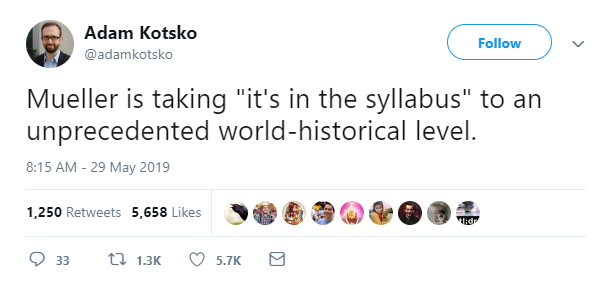
Buzzfeed’s Tanya Chen assembles lots of tweets and other quotes that analogize Bob Mueller to a frustrated college instructor. The American people are his students. Since we didn’t do the reading, we want him to explain it all in simple terms.

These are amusing responses, but they raise the question of what millions of Americans are really obligated to read. I once heard a Supreme Court justice say (to the approbation of the audience in the room) that citizens shouldn’t criticize judicial decisions unless they have read them, presumably in full. Some environmentalists despair that most people didn’t read the last big Intergovernmental Panel on Climate Change (IPCC) report for themselves. It seems outrageous that the President of the United States, who swore to uphold the Constitution, would fail a basic test of its contents. (For instance, he expects the judiciary to review an impeachment process.)

But once you put several of these assignments together, it makes for a daunting syllabus.

And it depends on what else you would do with your time. Instead of reading the Mueller Report, I have actually spent hours neurotically checking second-hand opinions about the report in order to root for the ones that say that Trump is in big trouble and boo the ones that say he’s been exonerated. That was a bad decision about how to allocate my attention. If I’d spent the same hours reading the report, I might have learned something. However, the text of the report would not change my opinions and behavior in a way that would matter for the country. So it would have been wiser still for me to spend my time not on the Mueller Report, nor on the endless second-hand commentary, but rather (for example) on the work of the astoundingly creative Anne Carson.

I start with faith that certain responsible summaries of the Mueller Report will give me what I need to know. I then waste time reading all the other commentary in the light of what I already believe. If I took Sean Hannity to be the responsible commentator instead of Lawfare or the New York Times, my behavior would be exactly the same but my conclusions would be the opposite. The problem is deciding who is the responsible intermediary, and you can’t do that with 100% certainty unless you read the original text for yourself. But again, it is not obvious that we are morally obliged to understand the Mueller Report with 100% certainty, when there are other things to do with our day.

The Great Professor in the Sky definitely expects us to do the reading. But I am not sure we are all obliged to take Professor Mueller’s class. We do face a mandatory exam called the 2020 election, but it will cover a whole lot of material, and you can do fine on it even if you didn’t take Mueller.

Your responsibility as a citizen–as distinct from your duty as a person–obliges you to collect information and insights about public affairs. (Your duty as a person is to read Anne Carson.) But there is an awful lot to learn about public affairs, of which the Mueller Report is only one sample. What bothers me is the implication that everyone should have mastered that particular body of material, when no one can understand everything that matters.

what does the European Green surge mean?

The Greens did very well in the EU elections. One interpretation is that a substantial minority of Europeans are now seriously focused on climate issues and voted Green to promote EU-wide climate policies.

But the Greens also stand for pan-Europeanism, multiculturalism, civil liberties, and the rule of law; and they have a specific demographic base. They are challenging or even replacing social democrats as a pillar of the center-left, without expanding the total center-left vote by much (if at all). It is not clear that they have a stronger policy platform on climate issues than the socialist parties in countries like Germany.

Therefore, a different interpretation is plausible. Perhaps the social democrats have fractured along class lines, and the Greens have taken away their college-educated vote, not because of climate but because of a whole basket of issues and values.

To explore that second hypothesis, I’ll focus on Germany–the birthplace of social democracy (in 1875) and the EU’s most important economy. There, the Social Democratic Party (SDP) came in third with less than 16%, surpassed by the Greens at 20.5%.

The SPD was traditionally a coalition of unionized industrial workers plus college-educated employees who were close to the welfare state (teachers, civil servants, and the like). These were the groups that stood to benefit most from an active state, and they were effectively organized in unions, professional associations, and the SDP itself. In other words, they didn’t just have votes but also organizational muscle. They played a major role in building the welfare state.

However, at least some of the party’s white-collar base has migrated to the Greens, who have become less environmentalist and more of a socially-liberal, cosmopolitan, center-left party. And some of the industrial workers have left the SPD for the right. The net result is a weakening of the organized center-left. Yes, the Greens are flourishing, but that is mostly at the expense of the SDP and reflects a fracturing of the social democratic coalition that helped to build the Federal Republic.

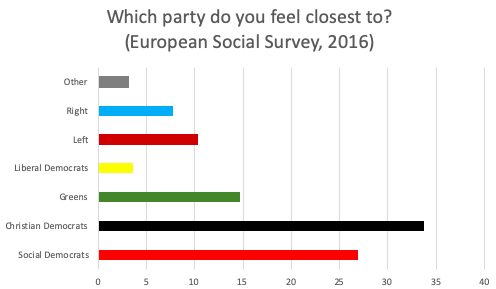
An EU election can be misleading if you want to understand the deeper state of a country’s politics. Only about 60% of eligible Germans voted this week, and they presumably focused more than usual on European issues. They certainly opted more than usual for small parties. Therefore, as second graph, I show how the whole German adult population responded when asked which party they felt closest to in 2016:

These data are now two years out of date but probably reflect the underlying conditions. The order is still the familiar one–Christian Democrats, Social Democrats, Greens, and then others–but the once-mighty SDP is already down to 26.2% in this survey. Left parties claim 58.7% of the total electorate but stand very far apart on issues. The traditional establishment parties (Christian Democrats, Social Democrats, and Liberal Democrats or FDP) claim just 64.2% of the vote in total. Both the left and the center are larger than the right, but the center-left is far from dominant.

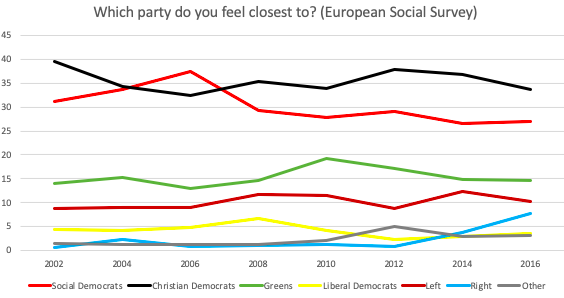
This third graph shows how this pattern had evolved since 2002:

The change in the position of the Christian Democrats has not actually been huge. They have certainly seen some erosion since the immigration crisis, but they are only six points less popular than they were in 2002. The Greens stand not far from where they were in 2002, but they temporarily improved their position while the Social Democrats were sustaining their largest decline (2006-10). The right also rose, but mostly after the SDP had seen its major losses (2012-16).

That graph is consistent with the theory of a fragmenting SDP. However, trends in party support do not tell you how individuals shifted. Maybe the Greens grew by attracting former SDP members, but maybe those two lines converged for other reasons. The Greens declined and the right-wing grew after 2010, but we don’t assume that Green Party members defected all the way to the right.

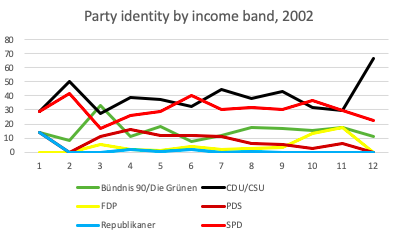
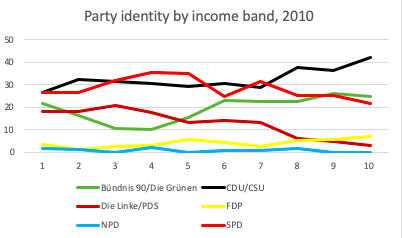
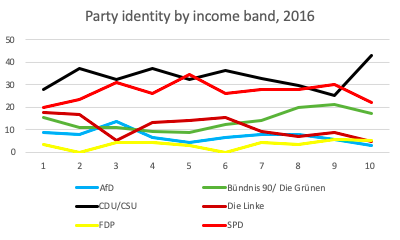
As an imperfect test of the thesis that the SDP has indeed lost members to the Greens and the right, I graphed party support by income band for three selected years. I am assuming that if the SDP falls and the Greens or the right-wing rises within a specific income stratum, then people are actually changing their party affiliations in that way.

In 2002, the SDP performed best at three levels: the poor (who might benefit most from welfare), the fourth and fifth deciles (which may reflect unionized industrial workers), and the 8th and 9th deciles (where people with a lot of education may land). The Christian Democrats dominated among the rich but drew votes from across the spectrum. The Greens could not yet be described as an affluent party. Also (not shown here) they performed worse than the SPD among students. The right drew strongest from the lower-middle class.

By 2010, the Greens were more affluent and the SPD had lost a substantial amount of support in the upper deciles. The Greens were now also running even with the SPD among current students. The far right was weaker than it was in 2002, but I think that reflected a temporary change in the array of parties. The left drew support almost entirely from the lower income bands.

And by 2016, the right was much stronger–in third place in some of the lower income bands, behind only the SDP and Christian Democrats. Meanwhile, the Greens had become distinctly affluent and (again not shown here) they dominated the current student vote. They lost support only in the top income range, where the Christian Democrats were still ahead (although less so than in 2002).

These patterns are not sharp and dramatic; there is actually a fair amount of stability despite tumultuous times. But it does look as if the SDP has lost members to the Greens over lifestyle issues, and to the right because of nationalism.

The SDP and the Greens can certainly come together again in parliamentary coalitions, but at the grassroots, the coalition that sustained the German welfare state looks weaker than it was for decades. Also, I am not sure the Greens have the organizational muscle that the SPD had in its heyday, which means that their capacity to implement policy may be weaker.

If you care about environmental policy and social justice, you have to welcome the Greens. But the question is whether the center-left as a whole has sufficient capacity to govern.