marginalizing odious views: a strategy

If you looked out at the National Mall on any Inauguration Day from 1944 to 2012, you might conclude that Nazism had been effectively marginalized in the USA. The president who was being sworn in might be leading a war against actual Nazis (Roosevelt) or might be a veteran of such a war. The growing array of monuments, memorials, and museums along the Mall included explicit repudiations of Nazism (the United States Holocaust Museum, the WWII Memorial), and lots of images and statements at odds with Nazi ideology. Even a white-supremacist like Jefferson was represented–selectively but not falsely–as a proponent of values antithetical to Nazism. And certainly no one would feel the need to explain why no Nazis were invited to this party.

As further evidence that Nazism was marginalized in the USA between 1941 and 2017, consider that:

  • No censorship was required to keep Nazi materials off respectable shelves, except sometimes as historical evidence of evil.
  • The word “Nazi” was an epithet, not requiring an explanation as to why it was bad.
  • People who shared a lot of beliefs with Nazis remained prevalent, but they denied that they were Nazis or resembled Nazis.
  • The word got misapplied as an insult to people who didn’t deserve it. The debate was not about whether it was OK to be a Nazi but whether it was OK to call someone that.
  • The word gained a penumbra of moral seriousness and shame. Joking about it was generally off-color, although it did produce some brilliant satire.
  • [We did still read Heidegger and Carl Schmitt, which shows either that the marginalization was incomplete or that it’s possible to make judicious exceptions.]

Marginalizing Nazism was an achievement. It was a form of self-governance, the imposition of values on a population by the population. Even if you’re not a purist about First Amendment principles, you might still agree that successful marginalization of an odious view is more effective than state censorship. It is also in some respects safer, because states that censor may easily abuse that power. (And censorship is ultimately backed by the gun.)

Although marginalization need not employ state censorship, it does make heavy use of authoritative rhetoric, rituals, social norms, selective invitations to speak, and refusals to listen. It is incompatible with engaging alternative views, listening to learn, being open to changing one’s mind, seeing the good in everyone, etc. It explicitly repudiates dialogue. We can either engage in dialogue or we can marginalize; we can’t do both to the same target.

As such, marginalization can be misused. For instance, socialism hasn’t been fully marginalized in the US since the Palmer Raids of ca. 1919–but close. Many people who share views with actual social democrats or democratic socialists deny that they do. In many circles, the term “socialist” suffices as a critique and doesn’t need an argument–it functions as an epithet.

Again, the marginalization of socialism has never been complete. There have always been socialists in the US with significant influence and secure positions. Just lately, we are seeing a real resurgence. Still, the degree of marginalization has been sufficient to distort the public debate. I happen to be mildly skeptical of socialism on several grounds, yet it seems obvious that the policies employed in thriving countries like Norway and Germany deserve consideration in the USA–and are, in fact, sometimes employed here. Marginalizing the word that best describes those policies prevents the public from considering them on their merits.

The temptation to marginalize is felt across the spectrum. For instance, neoliberalism is perhaps the reigning orthodoxy of our era. Yet no one calls himself a “neoliberal.” The word is almost always used in circles where people oppose market capitalism, as an epithet. It substitutes for an argument. It is hard to define “neoliberalism” in a way that (a) accurately describes the views of the alleged proponents, and (b) is actually bad. A commitment to personal freedom is something that alleged neoliberals would acknowledge but that also seems attractive. A preference for corporations over people is something that they would deny. Once you propose a precise and accurate definition of neoliberalism, you are engaged in an argument rather than marginalizing anyone–but you risk losing the argument. Now you are no longer just charging opponents with being neoliberals but considering whether choice and competition might be helpful under specific circumstances.

To the target, marginalization feels like censorship. When a university refuses to invite a certain kind of speaker to give a formal talk, or disinvites someone who was invited, that is not–in an important, technical sense–censorship. The university has a right and even a responsibility to invite selectively. However, when the university is part of a larger movement to marginalize a given view, then holders of that view face what feels like censorship when they are not invited. If those people are Nazis, then their marginalization is an achievement. But if they are merely out of step with dominant views on college campuses, then they may have a legitimate complaint.

In short: marginalization is a powerful and appropriate strategy when the target deserves it. The power to marginalize is a political resource. It is a form or aspect of governance. But its power is so tempting that we must be careful not to abuse it. One reason not to marginalize any given view is that we may then fail to learn from it.

See also responsiveness as a virtue; civility, humility, tolerance, empathy, or what?; civility: not too much, not too little; and (from 2009) a theory of free speech on campus.
views of abortion by gender

I didn’t know how women and men differ in their views of abortion or how opinions have changed over time. So I ran the numbers using American National Election Study data since 1980.

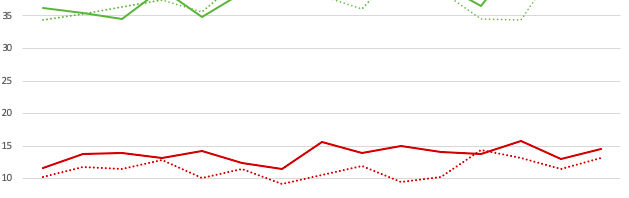
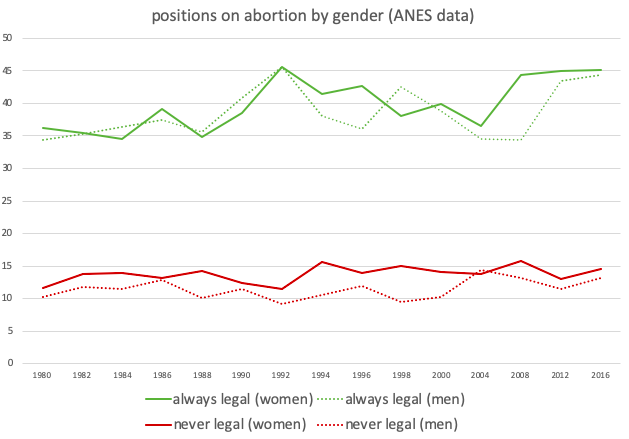
Here are the strong pro-choice and anti-abortion views by gender:

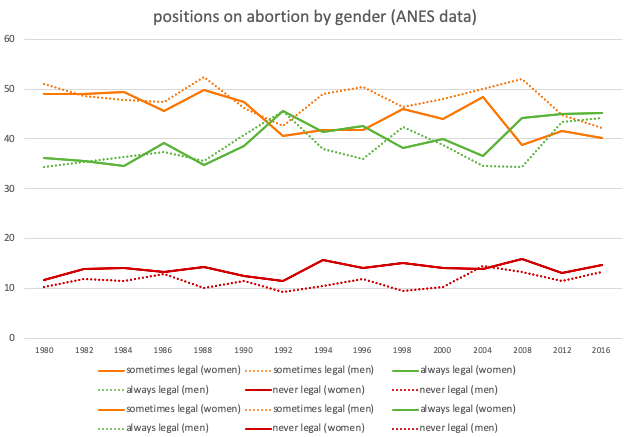
More people favor always allowing rather than never allowing abortion. Differences by gender are small and not significant, but women are currently just a bit more likely to take both the strongest pro- and anti- positions. The trend over time is slightly favorable to choice.

The graph is noisier if we add a middle view as defined by the ANES (abortion should be legal in cases of rape, incest, or medical risk to the mother):

Making abortion sometimes legal is the most popular position, and men are somewhat more likely than women to adopt it, but again, the gender difference is small.

some notes on receiving tenure

This week, the Tufts Trustees voted to grant me tenure and make me a full professor. I am very grateful to them, the Political Science Department (which is my tenure home), the Tisch College of Civic Life (which will remain my main base) and its dean, Alan Solomont, and the other people–known and anonymous to me–who were involved in advancing and reviewing my case.

I have been working full-time in universities (Maryland and then Tufts) since 1993. However, I don’t believe I should have held tenure until now. Tenure means job security for teaching. It’s a way of protecting instructors’ intellectual freedom. Until now, I have never held a teaching position. More years than not, I’ve taught at least one credit-bearing college course, but not as part of my paid employment. Instead, my salary has come from external sources (philanthropy, contracts, and–in the early years–a state appropriation). These funds have supported me and my colleagues to serve external constituencies with research and organizing. That kind of work must be contingent on funding and performance or it would turn into a sinecure.

So really the big change in my life is that I will be teaching virtually full time, starting in 2019-20. One motivation is our new Civic Studies major at Tufts, which is a major commitment of mine. This major is also part of a more general strategy of making the study of civic life a core academic focus at Tufts, which is another personal commitment for me and a key strategy for Tisch College. At the same time, I am looking forward to the role of a teacher/individual scholar, because that should allow me to explore certain topics more deeply than I have so far–mainly, topics in political theory.

My career is unfolding in backwards order. My degree is in a humanities field, philosophy. Humanists usually start by teaching alone and doing single-authored research: in short, reading, writing, and presenting. Some of them gradually begin leading departments, serving on committees, planning conferences, conducting collaborative and interdisciplinary research projects, and interacting with publics.

I started in an externally-funded center within a state school of public policy, where our work was applied, interdisciplinary, collaborative, and done in public. From an early age, I was heavily involved in working with other people. I was rarely in a classroom but almost constantly on the phone or email, communicating with peers. My most significant publications were co-authored; the Civic Mission of Schools report lists 60 authors.

I will not give up that kind of work but I do plan to spend more time teaching and conducting individual research. If this backwards order makes any sense intellectually, the advantages will be: 1) Breadth–I never sought tenure in a discipline that would have expected me to demonstrate deep specialization, but I had to learn a bit about a lot of things, and 2) Experience in how knowledge, power, money, networks, and organizations relate to each other in the 21st century. I’m hoping to make that second topic a focus of my research.

The immediate plan is to keep doing the collaborative work that I’m doing now (so don’t be alarmed if you are a collaborator) while developing several new courses in 2019-20. I have completed a book manuscript that is under review, so if that goes reasonably smoothly, I will feel free to focus a lot of attention on curriculum and pedagogy during the next academic year. I also have a sabbatical coming up, and I plan to spend that time learning network science and continuing to collect network data of different kinds, toward one or two books on networks and political/moral thinking.

It’s very rare for someone to switch to the tenure track after 26 years in the business. It’s like lifting a heavy locomotive and putting it down on different rails. Tufts has been tremendously supportive, flexible, welcoming, and creative in making this possible in my case. I feel a deep sense of gratitude and loyalty to this institution and my colleagues and students.

on hedgehogs and foxes

“A fox knows many things, but a hedgehog knows one important thing” — Archilochus

This proverb is in the news lately because Philip Tetlock has shown that foxes (flexible and curious generalists) are much better at predicting events than hedgehogs (specialists who hold deep expertise). See David Epstein’s Atlantic article on Tetlock, and see Axios for a current competition funded by the US intelligence agencies to test his theories.

Tetlock draws from Isaiah Berlin’s 1953 essay, which is light but offers some insights, I think, about specific authors. Berlin argues that Tolstoy was psychologically a fox but believed–for theological/ideological reasons–that we should all be hedgehogs. Our one big idea should be the Imitation of Christ. This tension was at the heart of Tolstoy’s books and life. I also endorse Peter Hacker’s view that Wittgenstein was temperamentally a hedgehog who forced himself self-consciously to become foxlike in his late work.

If you take the proverb literally, it seems more impressive to be a fox. The fox uses its brain to hunt and escape, whereas the hedgehog just instinctively rolls up to take advantage of its best physical asset, its spines. But the metaphor is loose. Human hedgehogs are among our deepest, most original thinkers. They are the ones with the discipline to construct whole, coherent worldviews. They don’t merely employ a strategy but create it.

In contrast–and I write this as very much a fox–foxes can be ad hoc and derivative, eclectic in a bad way. A fox can employ the available ideas that seem to fit the situation without generating any new frameworks for others to use. A fox can be a jack of all trades, master of none. We foxes need hedgehogs to develop new ways of thinking, from which we borrow superficially and pragmatically.

But it is interesting that the hedgehogs are so consistently wrong about what will happen next. They are more likely to suffer from confirmation bias. They can make any data fit their theory. And they are worse than foxes at recognizing exceptions, tradeoffs, and zones of uncertainty. They lack phronesis, practical wisdom.

I therefore think it’s a problem that hedgehogs have an advantage in the competition for attention. If you are associated with one big idea and you keep hammering away at it, you have a “brand.” People turn to you to say that one thing, even if they don’t agree with it, and so your fame rises. You must compete with the other people who say the same thing, but if you’re first or more effective at communicating it, you can own the space.

So as not to offend anyone alive, I’ll use the case of my late colleague Ben Barber, who was early to revive the idea of “strong democracy.” (More democratic engagement is always better; the good life is lived in public; liberalism is too individualistic; etc.) He wrote several best-sellers, and I attribute his success in part to his capturing a particular brand. For courses, debates, conferences, etc., you may need someone to say, “More democracy!” Barber cornered that market.

Temperamentally, I am with the foxes. As soon as I write an argument for anything, I immediately become fascinated by the arguments against it. I have a limited attention span and jack-of-all-trades tendencies. I frequently disappoint practitioners and advocates, who know that I have written in favor of campaign finance reform, public deliberation, service, or civic education and want me to say it again to a new audience with more conviction. In fact, I am almost always on the verge of apostasy and retraction.

I really do admire the hedgehogs. But I’ll say a few things in favor of foxes.

First, the moral world is immensely complex, because it emerges from myriad human interactions and takes the form of communities, cultures, and institutions that overlap, interrelate, and become loaded with historical resonances. Thus an adequate moral theory is almost certainly partial, inconsistent, and ad hoc.

Second, acting like a fox keeps you mentally alive. It may be a self-indulgent concern, but I fear ceasing to think. Even the greatest hedgehogs, it seems to me, have stopped their quest for knowledge. They already know, and know that they know, and are done.

I’ll also say one thing against foxes. At least in folkore, a fox is a solitary hunter. What if you also like people and feel loyalty to groups of peers who share goals and missions? Then you cannot simply act like a fox.

To switch metaphors, Keats admired the “quality” that forms a “Man of Achievement especially in Literature and which Shakespeare possessed so enormously—I mean Negative Capability, that is when man is capable of being in uncertainties, Mysteries, doubts, without any irritable reaching after fact and reason.” I also admire Negative Capability, but it is a virtue of the poet, not the ally. Negative Capability is good for writing fiction that explores many different perspectives; it is not so helpful for co-writing a mission statement for an organization and then following through.

So I would like to be a fox who is helpful in a pack. The question is to what degree that’s possible.

See also: the politics of negative capability; loyalty in intellectual work; in defense of Isaiah Berlin; structured moral pluralism (a proposal); and Tolstoy, Shakespeare, Orwell

an expressivist critique of our criminal justice system

(Disclaimer: this post is the result of reading some work by Tommie Shelby and Erin Kelly but not yet wrestling with either author’s views sufficiently or examining the larger literature on expressivism in law. If you were a peer-reviewer, you should reject this post.)

A society has a right and an obligation to express what is just through the criminal law. One reason is that public statements about what is permitted and forbidden can influence behavior for the better. But sometimes laws are not effective means of shaping behavior. Even then, it is important for a community to express justice as accurately and completely as it can, and the criminal law is a valuable vehicle of expression.

Public expressions of justice must often be accompanied by penalties. Otherwise, laws can reasonably be interpreted as mere lip-service. If, for example, the law says that everyone must pay taxes, but oligarchs routinely get away with tax evasion, then the law is saying that oligarchs don’t have to pay taxes. The failure to punish them conveys a view of justice that is unfair.

Many things are wrong but should still be legal. Awful but constitutionally protected speech is an example. The scope of the law should be limited both because of the fallibility of any government and because individual liberty is a great value. (We’re not free if we’re only allowed to do good things.) Nevertheless, there remains a large domain of actions that are bad enough that the state should express their wrongness by prohibiting them and enforcing the prohibition with penalties.

Even a partially unjust regime can and must express justice through the criminal law. Its failures do not invalidate laws that it enacts and enforces, if those laws are just. An exception may be a pervasively evil regime. For instance, a Nazi law court could render the correct decision in a case of rape or murder, but the very existence of that court is so offensive as to render all of its verdict moot. The victims of even real crimes cannot get justice from Nazi judges. But that reasoning does not apply to courts in societies, like ours, that harbor a great deal of injustice.

Public statements about justice must be deliberated. This is not because deliberation equals justice (a proceduralist view). Justice is justice. Rather, we must deliberate because hearing and responding to alternative views is our best method of discovering what justice demands. Also, the legitimacy of a public (as opposed to an individual’s) statement of justice depends on whether each of us had a chance to influence it with our voice.

Our legal system violates the expressivist principles summarized so far. The features that violate this theory are: racialized mass incarceration, rampant plea-bargaining, degrading punishments (prison uniforms, refusal to provide education, tolerance for sexual violence, stripping prisoners of civil rights), frequent imprisonment of people with mental illness, and a tendency to hide the whole system away from public view.

Mass incarceration of people who are racial minorities and/or poor and/or mentally ill clearly expresses a view that is incompatible with justice–that those people are not equal. We wouldn’t have the same system if most of the prisoners were middle-class and white.

Racialized mass incarceration also blocks a satisfactory national discussion of justice. In some communities, incarceration is common, and in others, it is virtually absent; but since they are separated by race and class and have unequal amounts of political power, they are very unlikely to deliberate together.

Replacing jury trials with plea-bargains removes any public deliberation about particular cases and prevents each verdict from saying anything at all. The outcome of a case is a function of the perceived likelihood of conviction, the defendant’s tolerance of risk, the prosecutor’s interest in conviction, and the cost of a trial, not anyone’s view of what is deserved.

Hiding the whole system away excuses the public from deliberating about particular cases and about policy. You can easily turn a blind eye to the criminal justice system even though our prisons house a population as big as a state.

I would not go so far as to claim that an expressivist theory of criminal law is completely adequate. We can imagine a system that does a good job of expressing justice but fails other tests, such as the utilitarian criterion of doing the most good for the greatest number. For instance, maybe it would be better to cancel trials that don’t affect behavior and use the money saved for prevention. I’m sufficiently pluralist (or wishy-washy) to suspect that utilitarianism, contractarianism, classical liberalism, Foucault, and other views all offer valid insights.

But I would submit that an expressivist theory explains some of what is so badly wrong with our system.

See also: mass incarceration, the jury, and civic studies; why we are choosing to abolish the jury system; civic engagement and the incarceration crisis; if we are going to put millions in prison, WE should make millions of decisions