The excellent other presenters mainly discussed projects that are based in their colleges and engage the communities around them: Ventura County, CA, San Diego, Newark, NJ, and Queens, NY. I thought they demonstrated that their institutions are components (or even “anchors”) of those communities. So instead of saying that their students “go into” communities, we might conclude that their students belong to communities and learn beyond the classroom.
Little Irina Antonovna, six,
Took it upon herself to write to her aunt,
Laboriously addressing it to:
"Region of Petrograd, Max Heltz factory."

Why did she write this letter? Well, her father:
Ten years in the camps for being a scholar,
Dead by now. Her mother: dead. Neighborhood:
Wall fragments, smoke, equipment shards, Nazi bombs.
Grandfather: died of rickets while walking
Irina to safety. Grandmother: same.

The letter worked; Irina lived. Married
Dmitri, who never asked her opinions,
But did write Number Nine for her and maybe
Heard her when he wrote the gentle cello drone
That supports the opening. Or the polka--
Why couldn't that frenzied part be Irina?
Why assume she was always soft, helpful?

A young, diverse American quartet
Exhumes Dmitri and Irina for us,
His black notes crisp on their iPads, their bows
Vibrating like cicadas, their eyes flashing
Recognition, assent: one to the other.

They are pillowed in layers of safety.
A clean, bright stage, a tidy concert hall,
An audience that has heard it before
And knows just when to leap up for applause:
White-haired burghers of this college and town.

Irina's professor father would have fit
Right in, if he hadn't been starved or shot.
Little Irina would have liked to hide
Beneath that concert grand, so solidly framed.
A campus cop waits, unworried, outside.

This place is not real. What's real is in the notes.
They know starvation, midnight knocks on doors,
Cities murdered from the sky, orphans' fears,
They know, too, the terrors of the audience,
Shrunken in their seats, nervous to drive home.

Phones still ring with sad news; death sentences
Come in biopsy results. And beyond this room
A billion new Irinas plead to be spared.
My colleagues at the Institute for Democracy and Higher Education here at Tisch College have released their national report on the 2018 election and sent detailed specific reports to each of the roughly 1,031 colleges and universities that participate in our National Study of Learning, Voting, and Engagement (NSLVE). This research is based not on surveys (which have errors in sampling and self-reporting), but on official voting records for about 20 million people.
As reported in today’s Washington Post, the headline is that college student turnout more than doubled between 2014 and 2018 (the last two midterm elections). It’s true that everyone’s turnout grew in 2018, but college students far surpassed the national trend. My favorite statistic is that turnout rose on 99% of all the NSLVE campuses. Now that is a significant pre-/post- change.
The full report has much more detail on demographic groups, profiles of selected colleges, and suggestions for maintaining the momentum. As always, the actual result (40% of college students voted in 2018) remains too low, but the only way forward is by raising engagement one step at a time, and doubling it is a good step.
A lively and valuable debate is underway about whether Senator Sanders or Warren should carry the flag of the left. Considering that Sanders calls himself a “socialist,” and Warren says she’s pro-“market,” it’s worth thinking about what each means by these words and how their words relate to their policies and their political strategies or theories-of-change. For instance, if both use the New Deal as a positive reference point–Sanders to illustrate socialism and Warren to show how capitalism can be saved–then maybe the difference is merely semantic. Or maybe not.
I would contribute one observation. Elizabeth Warren may belong in a specifically American tradition of progressive politics that is distinctive from socialism and that lacks a crisp name of its own, so far as I know. But it has these features:
Enthusiasm for truly competitive markets that are free of monopolies. Competition is supposed to lower profits to minimal levels and make companies accountable to consumers and prospective workers. For instance, Louis Brandeis argued in 1912 that “our people appreciate better than they did before, the great economic truth which was embodied in the Sherman Law”: “the value of competition.” “The Democratic position … is that private monopoly in industry is never permissible; it is never desirable, and is not inevitable; competition can be reserved, and where it is suppressed, can be restored.”
An understanding of the public as consumers. In 1912, the Progressive thinker Walter Weyl wrote that the office of “consumer is most universal, since even those who do not earn wages or pay direct taxes consume commodities. In America to-day, the unifying economic force, about which a majority, hostile to the plutocracy, is forming, is the common interest of the citizen as a consumer of wealth” (The New Democracy, New York, 1914, pp. 248-50)
Related to the last point, a preference for universal identities over special interests and particular identities.
An ideal of the government as the protector of consumers. Robert M. La Follette said in 1906: the “welfare of all the people as consumers should be the supreme consideration of the Government.” Often this is extended to workers as well.
Related to the last point, a defense of democracy (with reforms like referenda and publicly finance campaigns) as the system that makes government most accountable to all the people, not to special interests.
A theory that citizens should mainly monitor their own rights and choose leaders and officials to protect them. For their part, prospective leaders should offer detailed proposals for solving problems. “I have a plan for that” is exactly this approach.
A belief in transparency and access to information as tools of reform, captured in Brandeis’ famous line that “sunlight is the best disinfectant.” Brandeis also wrote that the Sherman Antitrust Act would remain inadequate without stronger enforcement, better “administrative machinery,”and “comprehensive, accurate, complete knowledge” of the behavior of businesses (mandatory transparency).
Note that this is not socialism. That word can be defined in many ways, but surely it would stretch the term to use it for a political philosophy that prizes competition and consumer identities.
But it can be radical, and it’s a deeply American tradition. Roger Taney, while Secretary of the Treasury under Andrew Jackson, said, “it is proper that [banking] should be open as far as practicable to the most free competition and its advantages shared by all classes of society.” A century-and-a-half later, Ralph Nader also championed deregulation of selected industries, consumer rights, transparency, and popular sovereignty.
To illustrate Senator Warren’s adherence to this tradition, I would cite (for example) her interview with Franklin Foer in The Atlantic:
I believe in markets and the benefits they can produce when they work. Markets with rules can produce enormous value. So much of the work I have done—the Consumer Financial Protection Bureau, my hearing-aid bill—are about making markets work for people, not making markets work for a handful of companies that scrape all the value off to themselves. I believe in competition.
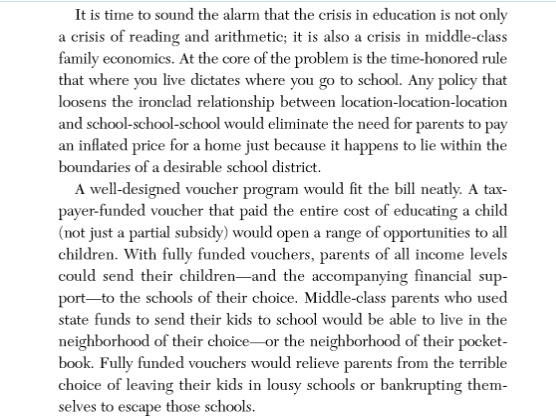
Or consider her endorsement of school vouchers in The Two-Income Trap: Why Middle-Class Parents are Going Broke (2003):
Warren’s specific position on vouchers has changed, but not her deeper philosophy.
Her stance deserves very serious consideration, and a case can be made that it is the best path forward for the American left. But I would raise these questions:
Should the consumer identity satisfy us? What about criticisms (cultural, environmental, and spiritual) about consumerism? Would it be better to see us all as producers? And what about other identities that differentiate Americans, such as race and ethnicity?
Should the implicit role left for citizens satisfy us? Is our job to critically evaluate candidates’ plans for solving our problems, or must we take deeper action?
Do competition and transparency work? (I think Warren herself would say: only sometimes.)
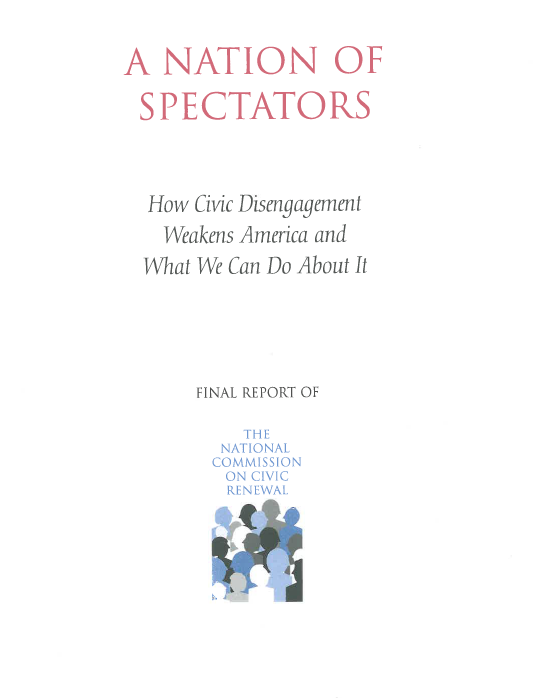
In 1997, the National Commission on Civic Renewal published its report, A Nation of Spectators: How Civic Disengagement Weakens America and What We Can Do About It. The Commission was partly a response to Robert Putnam’s 1995 article, “Bowling Alone.” The Pew Charitable Trust funded and convened it, and Bill Galston directed it, with me as the research director. My main contribution was an Index of National Civic Health (INCH), which is one ancestor of today’s Civic Health Index.
There may have been an echo of the report in George W. Bush’s Inaugural Address: “I ask you to be citizens. Citizens, not spectators. Citizens, not subjects. Responsible citizens, building communities of service and a nation of character.” (Quoted without comment on what followed.)
One of the recommendations was a research center on youth civic engagement, which we founded in 2001 as CIRCLE.
In 1997, the Internet was up and running, and we maintained a website for the Commission and its report. But that is long gone and the report is hard to find. So here it is, scanned as a PDF, as one record in the history of professional efforts to strengthen civic engagement in the USA.