the pivotal significance of reparations for the American left

About one in four Americans supports reparations for slavery. There is a racial split on that question, with up to three in four African Americans–but only 15% of whites–in favor.

If you think that justice demands reparations, you should support them. You might not make reparations your main criterion for choosing candidates in a given political contest, because you might vote on other grounds, but you should endorse proposals that you believe are just.

Here I want to address a different issue. I’ll offer an explanation (not a justification or a critique) of the importance of reparations in the mentality of left-leaning Americans.

I think that many Americans on the left are torn between two political positions, each coherent on its own but in tension with the other:

1. A strong version of New Deal/Great Society liberalism and/or social democracy, in which the nation-state intervenes assertively in the economy to promote equity and environmental sustainability. This stance is compatible with enthusiastic support for voting and democratic processes. It requires a lot of trust in the state and a willingness to entrust state actors with the ability to, for example, investigate how much wealth (not just annual income) you have, which schools your kids will attend, and which health treatments will be paid for, given data about your body.

Martin Luther King, Jr., provides a classic statement of this view when he recalls the launch of the Great Society: “A few years ago there was a shining moment in that struggle. It seemed as if there was a real promise of hope for the poor — both black and white — through the poverty program. There were experiments, hopes, new beginnings.”

2. A deep suspicion of the United States government as white-supremacist, patriarchal, and colonialist: as a continuous entity that has played a leading role in genocide, enslavement, and apartheid, in part because those policies have sometimes been popular among the white majority of the country.

It’s debatable what positive program follows from the second position, but in practice, it can mean support for local initiatives, nonprofits, women- and minority-owned businesses, and autonomy at the neighborhood level. Malcolm X provides a classic text for this view:

The white man, the white man is too intelligent to let someone else come and gain control of the economy of his community. But you will let anybody come in and control the economy of your community, control the housing, control the education, control the jobs, control the businesses, under the pretext that you want to integrate. 

… we haven’t had sense enough to set up stores and control the businesses of our community. … But the political and economic philosophy of black nationalism…the economic philosophy of black nationalism shows our people the importance of setting up these little stores, and developing them and expanding them into larger operations. Woolworth didn’t start out big like they are today; they started out with a dime store, and expanded, and expanded, and expanded until today they are all over the country and all over the world and they getting some of everybody’s money. …

So our people not only have to be reeducated to the importance of supporting black business, but the black man himself has to be made aware of the importance of going into business. And once you and I go into business, we own and operate at least the businesses in our community. 

Note that this position is compatible with certain forms of libertarian thought but not with social democracy.

It is not embarrassing to be drawn to two incompatible views. The social world is complicated, and there are good reasons in favor of many positions. However, when you feel the pull of two incompatible ideas, a deciding factor becomes very important.

Reparations play that role for the American left. If the United States government were to pay reparations, that would tilt many left-leaning people from the second position to the first: from Malcolm to Martin, if those labels are helpful. The impact would be especially strong if Congress and the president decided to pay reparations of their own volition–not by grudgingly negotiating with a social movement–and if the payment were substantial.

The underlying theory here is similar to Homer-Dixon et al (2020). An ideology is a complex system that consists of numerous ideas with logical links among them. It cannot be described adequately by placing it on one left/right spectrum, nor even several such continua at once. It is not a point in logical space but a structure of ideas.

In complex systems, we frequently see multiple equilibria, and specific nodes have surprisingly large impact because of their location. A single node can tilt the system from one equilibrium to another.

My conjecture is that reparations plays such a role in the system of the ideology of the American left. Left-leaning people may not rate it as the most important issue. They may not even endorse it whole-heartedly. But it (perhaps uniquely) can tilt them from a libertarian equilibrium to a social-democratic equilibrium.

This is an empirical conjecture for which I do not have data. To test it, we would have to explore the epistemic network of left-leaning Americans, either by analyzing large bodies of text or by surveying individuals about their ideas and perceived connections among their ideas.

See also: on Hillary Clinton and Julius Jones of #blacklivesmatter; ideologies and complex systems; and unveiling a systems map for k-12 civic education (for a methodological analog).

the Biden-Trump polling gap

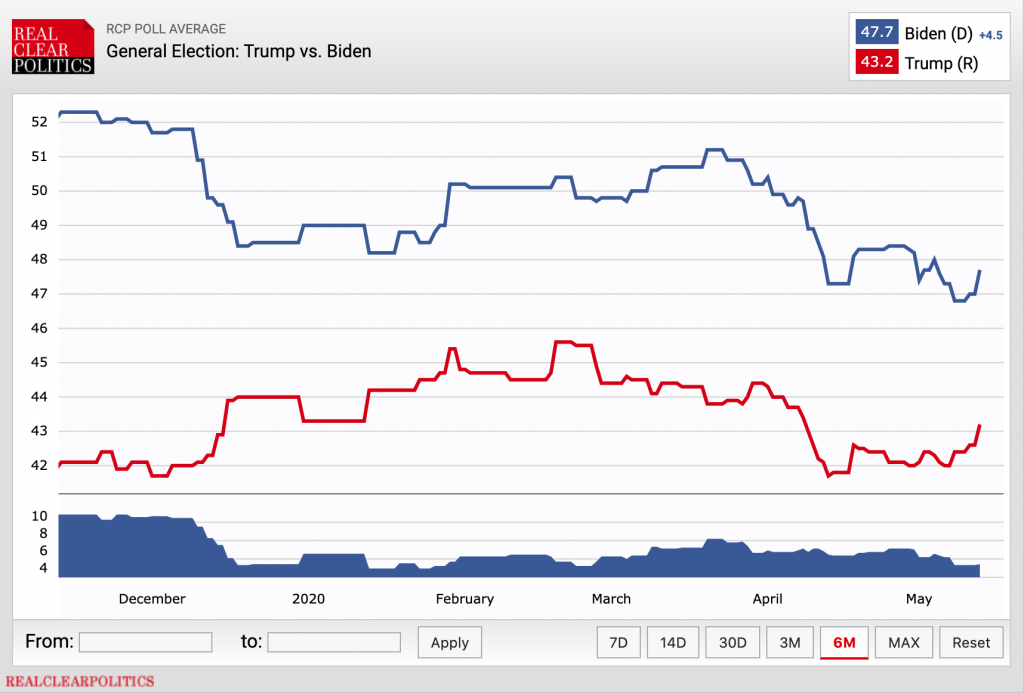
I have been watching these lines for months:

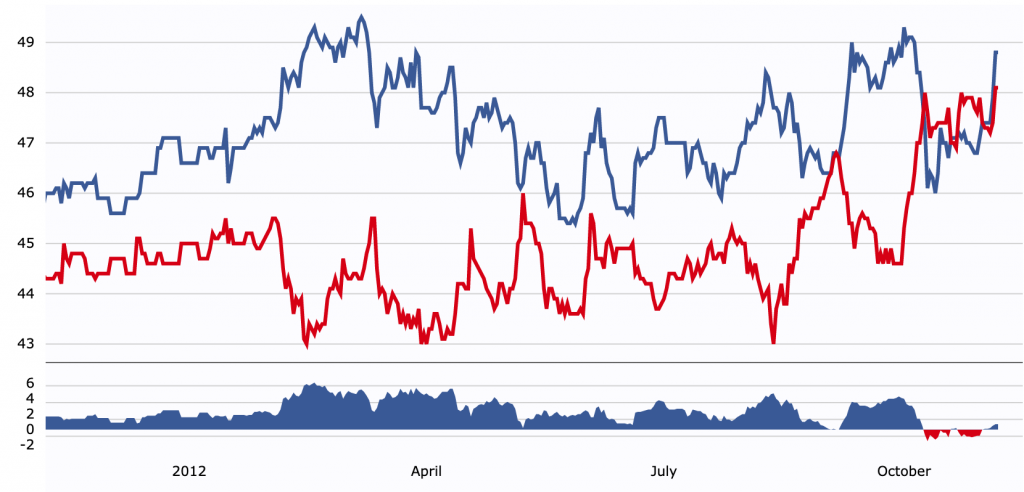
The gap is very steady, which means that every time Trump moves up, so does Biden–at the expense of undecideds–and vice-versa. By way of contrast, this is how the 2012 election looked:

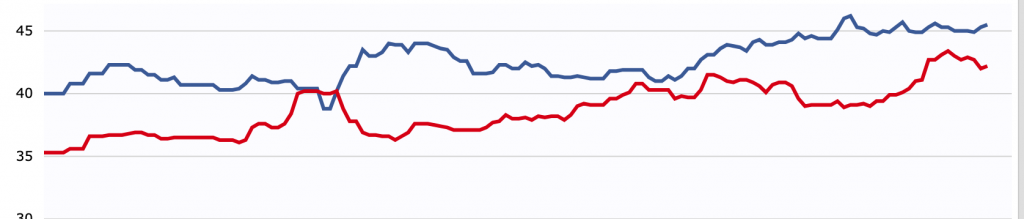
Granted, the scale is even tighter in the 2012 graph than in 2020, and the length of the trend is longer. Still, we saw points when the lines converged, crossed, or moved apart.

Likewise in 2016:

Or 2008, according to Gallup’s polling:

Henry Enten does better and compares Biden/Trump 2020 polling to historical trends going back to the beginning of polling. He says, “The steadiness in the polls is record breaking. Biden’s advantage is the steadiest in a race with an incumbent running since at least 1944.” Enten adds: “all the [national] polls taken since the beginning of 2019 have [Biden] up 6 points.” He means an average of six points, but that has a small standard deviation. The Real Clear Politics chart, reproduced above, suggests that the full range has been 4-10 points.

The consistency of this gap is noteworthy in an extraordinarily tumultuous period, marked by impeachment, a competitive Democratic primary campaign, a global pandemic, and the worst economic decline since 1929. Donald Trump’s own support has risen and fallen–although only within a five-point range. Biden has had his own ups and downs: near defeat in the primary, a serious accusation of sexual impropriety. Yet the gap between the candidates has been virtually unchanged since December.

Polls this far out are not necessarily very predictive. National polls don’t map exactly onto Electoral College outcomes. Polls conducted now include all adults or self-described “registered voters”; actual voters will be a subset of those. Turnout in 2020 is particularly hard to predict given the practicalities of voting in what may still be a pandemic.

But all these caveats are about whether the graph foretells the result in November 2020. Even if it doesn’t, it tells a very interesting story about now. As Matthew Continetti writes

It is not foolish to suppose that these world-shaking events would affect the presidential election. On the contrary: One would expect a dramatic swing toward either the incumbent or the challenger. But look at the polls. Not only has there been no big shift. There has been no shift. … Neither good nor bad news has an effect.

I think that almost all Americans have formed such firm and well-anchored beliefs about both Trump and Biden that even epoch-making events don’t shift us. We already have enough information to judge these men, whatever the news throws at us. By six percentage points, we like Biden more than Trump.

(By the way, Biden also leads in battleground states’ averages: by 3 points in WI and NC, by 4 in NV and FL, by 7 in PA and NH, and by 8 in Michigan. That would bode well for an Electoral College win, if we want to get into forecasting November.)

the neo-feudalism thesis

A little knowledge is a dangerous thing. I’ve superficially encountered the terms “neo-feudalism” and “refeudalization” and read a few relevant works, e.g., Jodi Dean’s “Neofeudalism: The End of Capitalism?” in the May 12 edition of the LA Review of Books and Robert Kuttner’s “The Rise of Neo-Feudalism” in the March/April American Prospect. I know my Habermas (who proposed a thesis about neo-feudalism in 1962 that still attracts attention). Years ago, I made a somewhat serious study of actual feudalism as I tried to understand and assess Karl Polanyi’s The Great Transformation. But I have missed everything else in this debate–so caveat emptor.

The basic idea is that capitalism has not continued as such, nor has it transformed into socialism, as the Marxian left predicted. Instead, it has morphed into a new system that resembles feudalism in important respects. If this is true, it means that the left should stop opposing neoliberalism or late capitalism, because those are not the reigning systems of the day. And the center-right should stop defending capitalism, because it’s gone.

Definitions would be helpful. I start with these:

A market is any venue in which individuals choose whether or not to exchange goods or services that they own for things that other people own. Markets seems almost ubiquitous–for example, they are found in communist states, inside bureaucracies, and in a huge range of cultures. Market choices are never without constraint and necessity. Nevertheless, it is a mistake to doubt the genuine experience of choosing whether or not to exchange what you own for something you want.

Feudalism–at least in its European medieval version–was a political/economic system in which land represented the vast majority of wealth and was not actually understood as marketable. Although people sometimes traded land for land or land for goods, such exchanges were frowned upon and made difficult. Most people were born with an inalienable link to a specific place. Whether you were a peasant, a lord of a manor, a higher lord, or a sovereign, you had both obligations and rights with respect to particular acres. Your name even incorporated that place: you were from it if you were a commoner, and of it if you were gentry. The gentry did not own demesnes as they owned carpets and tables; they held their places as their “seats.”

Rights and obligations were massively unequal; feudalism was hierarchical. However, a peasant had inalienable rights (e.g., to take firewood from the manor’s commons); and even the king had many feudal obligations. Status came in shades and degrees.

Meanwhile, government in the Weberian sense–the legitimate use of violence–was profoundly decentralized. The lord of the manor was a landlord but also the law. The king was a higher law but had very little capacity for governing anyone outside the royal court itself, unless assisted by feudal vassals who had interests of their own. Parliaments emerged as places where sovereigns bargained with local leaders (lords, bishops, and towns) because they could not govern on their own.

Capitalism is a system in which the most important assets are heavily “capitalized”: subject to investments that make them highly productive. Although farms can be capitalized, the classic example is a factory or manufacturing plant. Thanks to concentrated physical, intellectual, human, and social capital, a factory produces an impressive flow of goods. Because it is complex, it requires a bureaucracy to operate. Therefore, a capitalist economy requires firms, not just individuals coming to market with things they privately own.

As a matter of definition, capitalism involves investment in these productive assets. Some people can live from the proceeds of such investments. Other people are paid to work in a capitalized industry. That distinction produces two classes (at least in Marxian theory–in reality, lines may blur).

Capitalism is incompatible with feudalism because feudalism’s refusal to allow a market for land and agricultural labor prevents investment. Also, capitalism cannot operate efficiently when governance is decentralized in the way we see under feudalism, with many independent rulers wielding legitimate force and making discretionary decisions in their various domains.

Capitalism is, however, compatible with a range of political institutions. The US republic, the Austro-Hungarian Empire, and today’s one-party People’s Republic of China have all been capitalistic. Capitalism can certainly co-exist with political systems that involve equal legal rights, democratic elected governments, and even social welfare systems. In fact, some people think that the most robust and sustainable capitalist systems (for better or for worse) are also democratic, liberal, and at least mildly socialistic.

It would appear that a world dominated by Google, Facebook, Apple, Airbnb, Uber, and the like is still capitalistic. It certainly isn’t feudal in the classical sense, with barriers preventing people from exchanging the most important goods and with inherited status prevailing over contracts. But it might have certain features that make it different from high capitalism and might dimly resemble feudalism.

First, the capitalism that Marx and Engels observed involved great masses of people working in the most productive firms. These workers constituted the proletariat. Today, the most powerful companies in the world don’t employ many people. Google has 118,000 employees and about $1 trillion in market capitalization (measured before the current downturn). That approaches $10 million in capital per employee.

Imagine that Manchester, England, had become the powerhouse of the British Empire with cotton mills that employed … a few hundred workers in total. Engels would have needed a different theory.

To put it a different way, in 1850 it seemed as if most people were being recruited into the “armies” of workers who labored for the most important firms in the world. In 2020, a minuscule proportion of the world’s labor force is employed by the biggest companies.

Second, we are “governed” (in the full sense of that word) by a whole set of overlapping and decentralized rule-makers. Nation-states make rules, but so do companies. They establish and enforce elaborate terms that regulate their employees, contractors, and customers. Kuttner provides examples:

Gated residential communities, such as Disney’s Celebration, are privately controlled municipalities that make and enforce their own laws. Private mercenary armies, such as Blackwater (now rebranded as Academi), are hired by the Pentagon so that their “soldiers” will be less accountable for what might otherwise be war crimes. Eminent domain, the inherent public prerogative to claim private property for a public purpose, has been commandeered by private developers. And courts—the ultimate embodiment of law in a democracy—have been privatized by the vast expansion of compulsory arbitration.

Speaking for myself: I am OK with polycentrism, with layers and overlapping Venn diagrams of power. I believe very strongly in pluralism or a mixed economy, in the sense of a society that incorporates different kinds of institutions, with different logics and incentives. I am not a statist socialist, because I observe that systems in which the nation-state monopolizes power simply enrich the rulers and their families; they do not deliver the equity they promise. It is no coincidence that the sons of Chinese revolutionaries are now capitalist princelings.

Therefore, the very fact that centers of governance have proliferated doesn’t bother me. But one question is whether centers of governance have actually consolidated instead of ramifying. Whereas millions of firms previously established law-like rules within their own domains, now Google makes rules for billions of people. From a global perspective, the fact that most of the world’s most powerful organizations have headquarters on the coast of the USA between San Jose and Seattle is also a worrying sign of concentration. These firms may compete, but their cultural capital, norms, and social networks overlap.

Another question is whether we have preserved robust forums in which to debate whether power has been allocated appropriately. (Surely not.)

A world with consolidating centers of power and a weak public sphere doesn’t sound to me like feudalism, but like something new and bad.

See also: the oscillation between dictatorship and parliamentary institutions (a game theory model); why is oligarchy everywhere? and why is oligarchy everywhere? (part 2); Thomas Jefferson and Thomas Picketty; the gentry as caste and class; when chivalry died; China teaches the value of political pluralism; and how a mixed economy shapes our mentalities

Educational Equity During a Pandemic

In lieu of a post here today, I have an article up on the American Federation of Teachers’ Shanker Institute blog, entitled “Educational Equity During A Pandemic.” It begins:

My wife and I have each spent many hours teaching by video this spring. While sitting in the same house, I meet online with college students who attend a selective private university; she meets with 5-to-9-year olds in an urban public school system, helping them learn to read. 

Both of us think and worry about equity: how to treat all students fairly within our respective institutions and across the whole country (even the world). And both of us discuss these issues with our respective colleagues. I suspect that many other educators are similarly wrestling with the challenges of teaching equitably while schools are closed. 


I hope it may have some value for people currently teaching remotely (at any level) or for parents and other adults concerned about education while schools are shut.