how change is made

From June 1-June 11, 2020, “support for the [anti-racism] protests grew 10 points among Mixed Feelings voters, 14 points among Lean Biden voters, and a head-spinning 25 points among Lean Trump voters. ‘I had never in my research career seen public opinion shift on the scale in this time frame,’ Michiah Prull said.’”

But how much does this change matter? Beyond affecting the vote in November, what does the shift in public opinion portend?

I’d offer the following general observations.

Public opinion is subject to fairly quick and major shifts when people assess something that doesn’t affect them directly and substantially. For instance, the Civil Rights Movement persuaded many white Northerners to turn strongly against segregation in the South ca. 1958-65. This mattered because it changed votes in the US Congress, yet Northerners were not asked to renounce any of their own advantages. The Civil Rights Movement struggled when it shifted to the North and the issue became White Northerners’ behavior.

People will voluntarily renounce advantages over other people (“privileges”) so long as they don’t have to pay a tangible price or undergo a serious risk as a result. Most straight people have decided that it’s no problem if gay people also marry. In a way, this means renouncing a privilege or a status advantage. But since straight people can still marry, it’s not really a sacrifice. Marriage equality is win/win. To be sure, some people take challenges to their status advantage as threats, but they can often be outvoted by people who are willing to give up merely symbolic privileges.

It is not true that people always act out of self-interest. More than 600,000 Americans died in the US Civil War (putting both sides together), which is hard to explain in terms of individual self-interest — or coercion. Many were eager to sacrifice. But when human beings sacrifice, it is very rarely for other people. It is usually for some “we” to which the individual feels loyalty. And that “we” usually takes a tangible, concrete form as well as an abstract one. Maybe Americans will sacrifice for America because it’s part of our identity, but each soldier is more likely to sacrifice for his own buddies in the squad.

Although people sacrifice when they belong to cohesive groups or during moments of dramatic change, self-interest tends to prevail over the longer term. Relative advantages are astoundingly durable, surviving even revolutions and invasions. The descendants of pagan, Roman gentry became medieval French bishops. Even in the hardest circumstances, people find ways to pass relative advantage to their own offspring and justify doing so using the ideological materials of their time and place.

Still, we are capable of building fairer societies, ones that guarantee more security and opportunity to the least advantaged. Typically, those societies are also democratic, and a substantial majority sees the social contract as beneficial to them.

People will also make concessions to organized groups who can extract a price. For instance, we’ll pay more for a good if the people who manufacture it can strike for better wages. We’ll give up a social advantage to calm a restive group so that they leave us alone. In these cases, a majority yields to a minority for pragmatic reasons.

If these generalizations generally apply, then it’s unlikely that White Americans will voluntarily change their behavior in ways that are actually costly to them or their descendants. I believe that efforts to educate people about their relative advantage are apolitical in the sense that they do not reflect a coherent strategy for addressing power. I fear that these efforts can actually alert people to their own advantages and cause them to dig in. As Steve Biko wrote, “No amount of moral lecturing will persuade the white man to ‘correct’ the situation.” Trainings in diversity, equity and inclusion may be ways for institutions to maintain the status quo, not tools for changing it.

But that does not mean that change is impossible. In fact, I am optimistic that change is coming. It will come in other ways.

First, a majority of the American electorate is shifting on issues that they see as not directly costly to themselves, although these issues matter. Aggressive, racially biased policing and mass incarceration really don’t benefit you if you happen to be white and middle class. In fact, you may suffer collateral damage. Even though African Americans are much more likely than whites to report discriminatory treatment by the police, a plurality of all the people who report such treatment are white. White people can definitely be persuaded to oppose militarized, muscle-bound (and expensive) policing.

We may shift toward a new social contract that prevails because a broad cross-section of voters see it as beneficial to them–and it reduces racial injustice. Many Americans will vote for universal health care or cheaper college because of their self-interest. A society with better access to health and education should also be more racially equitable.

Second, the composition of the public shifting. Although a majority of the electorate remains White, about half of Democrats are now people of color. Their concentration on one side of the aisle poses risks but also offers advantages. When Republicans falter for any reason, people of color suddenly have a lot of leverage.

Third, skillfully organized people of color can (and are) extracting concessions by protesting, boycotting, and otherwise challenging institutions that need them in various ways.

Finally, change can result from random events that are skillfully exploited. I think, for example, that both childhood and gender have been transformed by the rise of girls’ team sports. One reason was Title IX (1972), which was not intended to popularize girls’ athletics. Girls’ sports didn’t arise automatically as a consequence of Title IX; many women and girls (and some men) had to work hard to create teams, leagues, training programs, role models, etc. However, the law created an opening–more or less by accident–and people took advantage of it. We should look for such opportunities today.

See also: the significance of the progressive primary victories; when social advantage persists for millennia; why some forms of advantage are more stubborn than others; the remarkable persistence of social advantage.
Differences in COVID-19 response

Women, college graduates, Democrats more likely to self-isolate to reduce coronavirus risks

Survey also finds differences in prevalence of COVID-19 testing based on geographic, personal and socio-economic factors

MEDFORD/SOMERVILLE, Mass (July 20, 2020)—Women, older Americans, Democrats and people with more education are more likely to try to isolate themselves from contact with other people to reduce COVID-19 transmission risks, according to a new Tufts University national survey.

The survey also identified notable differences in whether people have received testing for COVID-19 based on geographic regions, age group, educational level, political affiliation, income, race/ethnicity and gender. Those who have been tested for COVID-19 most commonly live in the Northeast, are affiliated with the Democratic party, and are African American, according to the research.

“The results of our survey indicate that there are significant demographic and geographic differences in how people respond to COVID-19 pandemic risks, and that these disparities in protective responses need to be taken into account by public health and public policy officials,” said Tom Stopka, an epidemiologist at Tufts School of Medicine, and a co-lead on the study.

“As public health officials continue to increase access to testing  across the U.S. in light of persistent surges in COVID-19 infections in many states, they need to consider how to increase testing in geographic hotspots and the highest-risk groups to better understand infection patterns and inform data-driven public health and clinical responses,” Stopka added.

The survey was designed and analyzed by Tufts University’s Research Group on Equity in Health, Wealth and Civic Engagement. The research group previously released data showing that only 57 percent of Americans plan to get vaccinated for COVID-19. The group will soon release additional research about the economic impacts of the pandemic.

Self-isolation rates differ

Overall, 71% of adult Americans say they have tried to separate themselves from others to avoid COVID-19.

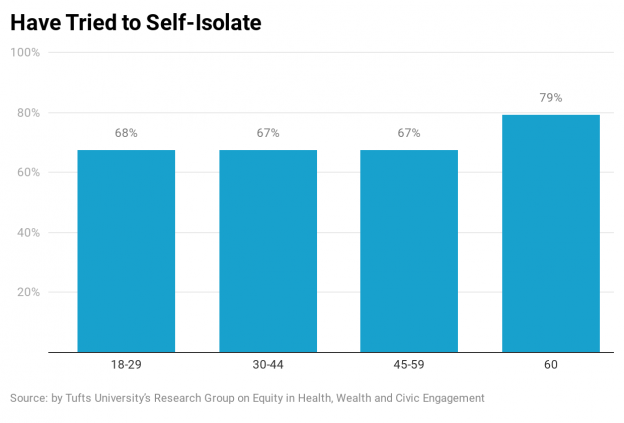
Women are about nine percentage points more likely to self-isolate (75% versus 66% for men). People with a bachelor’s degree are almost 20 percentage points more likely to self-isolate than those with a high school diploma (79% versus 59.3%, respectively). Democrats (77.5%) and Independents (73%) are about 10 points more likely to self-isolate than Republicans (66%). Almost eight out of ten Americans who are 60 or older report trying to self-isolate, while two-thirds of respondents in all other age categories report similar attempts.                        

The disparities among those who are more likely to self-isolate may reflect opportunities and perceived risks, according to the researchers. For instance, retired people and people who work at computers can isolate more easily than people who provide in-person services. Also, people in older age groups may be paying close attention to the elevated risks that they face based on national and international epidemiological data and news.

“Below age 60, all age groups are self-isolating at the same rate. That may counter speculation that the young are flouting restrictions,” said Peter Levine, an associate dean of academic affairs at Tufts’ Tisch College.

Testing rates vary by geographic region

Overall, 7% of those polled say that they have personally been tested for COVID-19, and 17% report that someone in their family has been tested.

These testing rates vary by region. In the Northeast, 10% have been tested, and 21% have a family member who has been tested, compared to 5% and 14% in the Midwest, respectively, with the other regions in between. Democrats are significantly more likely to have been tested (9%) or to have a tested family member (22%) than Republicans (6% and 13.5%, respectively). African Americans are the most likely to be tested (10%) or to have had a test in the family (26%), compared to 5% and 14% for Whites, respectively. Increased testing may reflect the higher rate of infection among African Americans that has been widely reported.

About the survey

The survey was fielded online by Ipsos between May 29 and June 10, 2020, using its KnowledgePanel. The sample was nationally representative, and the number of complete responses was 1,267 non-institutionalized adult residents of the United States. More technical information about the survey is at https://equityresearch.tufts.edu/the-survey/.

Tufts University’s Research Group on Equity in Health, Wealth and Civic Engagement was established in 2019 as part of a strategic effort to use resources and expertise across the university to address major global issues. It brings together researchers from across Tufts campuses and schools to discuss and investigate aspects of equity and inequity in the United States and the world. The research has been funded by Tufts University’s Office of the Vice Provost for Research as one of several such initiatives.

The group’s principal investigators are Jennifer Allen, professor of Community Health in the Tufts School of Arts and Sciences; Levine; and Stopka. Other members of the group can be found here.

By September 2020, the Research Group will launch a website at https://equityresearch.tufts.edu that will allow anyone to explore numerous dimensions of equity and inequity with an interactive data-visualization tool. Tufts’ Jonathan M. Tisch College of Civic Life is funding the data-visualization tool.

###

About Tufts University

Tufts University, located on campuses in Boston, Medford/Somerville and Grafton, Massachusetts, and in Talloires, France, is recognized among the premier research universities in the United States. Tufts enjoys a global reputation for academic excellence and for the preparation of students as leaders in a wide range of professions. A growing number of innovative teaching and research initiatives span all Tufts campuses, and collaboration among the faculty and students in the undergraduate, graduate and professional programs across the university’s schools is widely encouraged.

Shelley: England in 1819

England in 1819

by Percy Bysshe Shelley

An old, mad, blind, despised, and dying King;
Princes, the dregs of their dull race, who flow
Through public scorn,—mud from a muddy spring;
Rulers who neither see nor feel nor know,
But leechlike to their fainting country cling
Till they drop, blind in blood, without a blow.
A people starved and stabbed in th' untilled field;
An army, whom liberticide and prey
Makes as a two-edged sword to all who wield;
Golden and sanguine laws which tempt and slay;
Religion Christless, Godless—a book sealed;
A senate, Time’s worst statute, unrepealed—
Are graves from which a glorious Phantom may
Burst, to illumine our tempestuous day.

This is one sentence. Minus the adjectives and adjectival phrases, it says: “A king, princes, rulers, people, army, laws, religion, and senate are graves from which a phantom may burst to illumine our day.” (It’s interesting that one phantom will arise from all these separate graves.)

The “king” is George III, suffering by now from advanced dementia. He has seven surviving sons, which would be the narrowest definition of “princes.” But Shelley could mean a broader category–“princes” in the sense of the crowned heads of Europe. They are back on their thrones after Waterloo, erecting a system of reactionary absolutism that will last until 1830.

“Rulers” would mean the whole government, starting with the Prime Minister, Robert Jenkinson, 2nd Earl of Liverpool, who suspended civil liberties from 1817-19. The “people” are suffering from the Corn Laws (which prohibit importation of grain) and early industrialization. The “army” refers to the cavalry who charged a peaceful demonstration for parliamentary reform (the Peterloo massacre of August 16). The “senate” is parliament, although I don’t quite follow how that noun relates to “Time’s worst statute.” And the “Phantom” is something like liberty.

The situation is bad but unsustainable. The rulers may be evil, but they “drop, blind in blood, without a blow.” The army wields a two-edged sword, liable to slice its own bearer. The people, however, seem passive: they think and do nothing in particular but are “starved and stabbed in th’ untilled field.” The Phantom may (or may not) burst forth; it’s not clear that the people can decide that.

The poem is a sonnet: fourteen 10-syllable lines, rhymed, with a final couplet that answers the question posed by the rest of the poem: What will happen? However, the form is not strictly conventional. Shelley uses just four endings (-ing, -ow, -ield, and -ay) in an ABABAB CDCD CC scheme.

Christopher Spaide says that the poem was too radical to publish in 1819. By the time Mary Shelley included it in Shelley’s posthumous Poetical Works (1839), she thought it needed an explanation, since the “younger generation … cannot remember the scorn and hatred with which the partisans of reform were regarded some few years ago.” In other words, the sonnet went from revolutionary to quaint in 20 years–not because an actual revolution ensued in Britain, but because the political situation mellowed as reforms eased the crises of the day. No Phantom burst, but the laws arguably became less sanguine and the people less likely to be starved and stabbed.

See also Brecht, To Future Generations.

there has been no decrease in toleration of differences

The Harper’s Letter decries “A new set of moral attitudes and political commitments that tend to weaken our norms of open debate and toleration of differences in favor of ideological conformity.”

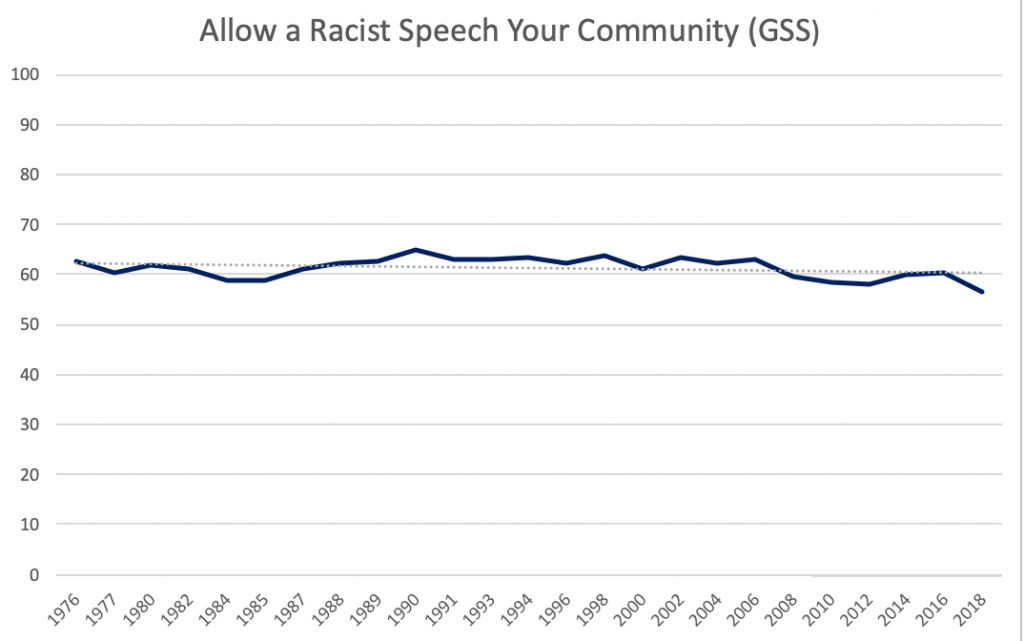
If the Letter is reasonable at all, such claims must be testable. I think that someone who fully endorses the Letter should hypothesize that Americans have–for better or worse–grown less likely to tolerate hateful speech, such as explicit expressions of anti-Black racism.

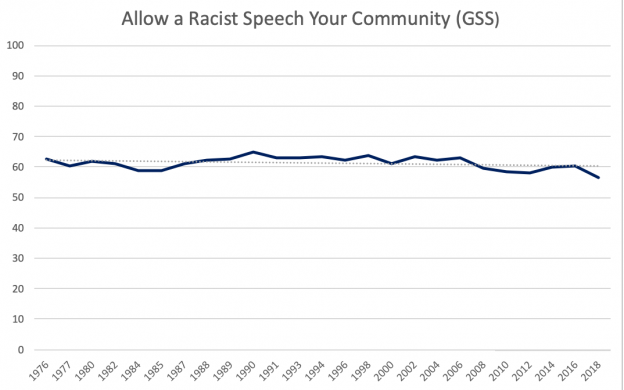
Have they? Since 1976, the General Social Survey has asked Americans whether someone should be allowed to give an anti-Black racist speech in their community. There is no significant change in responses to this item. It is true that the lowest rate was measured in the most recent year: 2018. But the difference between 2018 and the average year was within the margin of error (+/- 2.6 points), and the line has long wobbled around the mean.

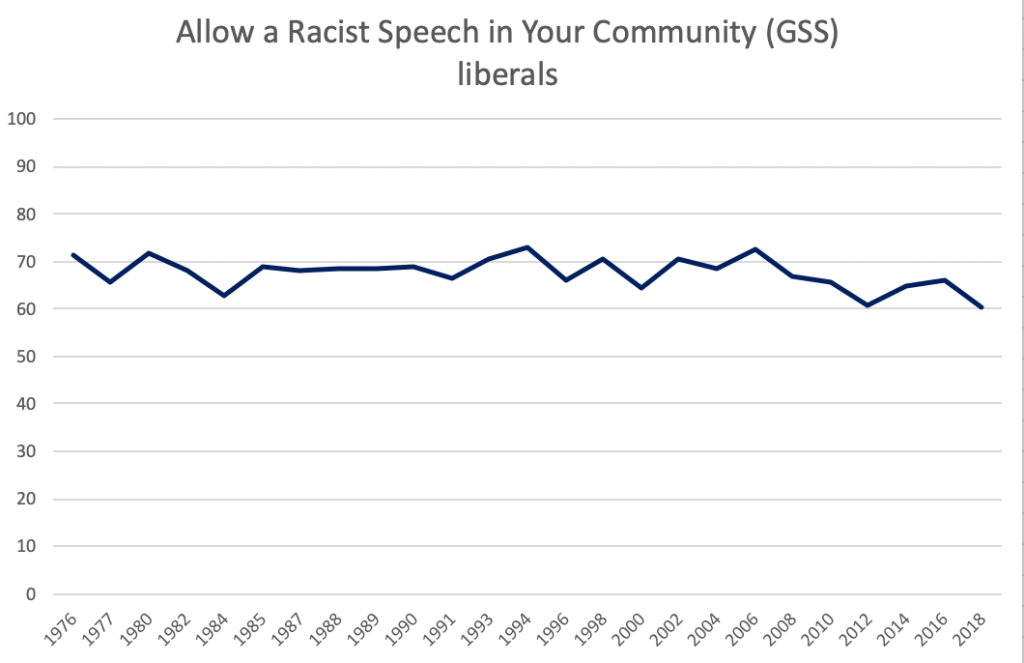
Maybe the left has forgotten about the First Amendment? Here is the trend for people who identify on the left end (1 or 2) of a 7-point ideology scale:

Liberals (as the survey names this group) have been a bit more likely than the population as a whole to think that a racist speech should be allowed (mean = 67.6% vs 61.3% for the whole sample). The only reason this second line wiggles more than the first is that the sample is smaller. The trend is again essentially flat.

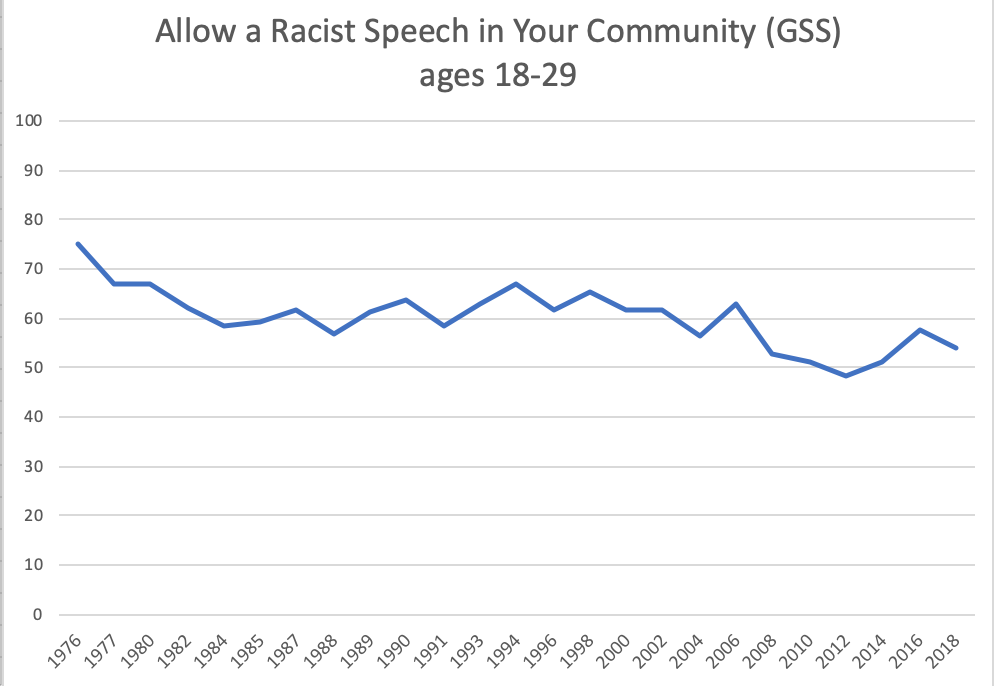
Or perhaps it is “the young” who have forgotten the First Amendment?

Maybe, to a limited extent. The third graph shows the trend for people who were 18-29 at the time of each survey. There has not been much change since 1982, but the 2018 result is well below the 1976 number.

By the way, I am not sure that I believe a racist speech should be allowed in my community. The First Amendment applies–there should be no state censorship–but if my “community” is something like my school, religious congregation, university, or town council, I’m against a sanctioned, formal speech “claiming that Blacks are inferior” (which is how the GSS phrases the question).

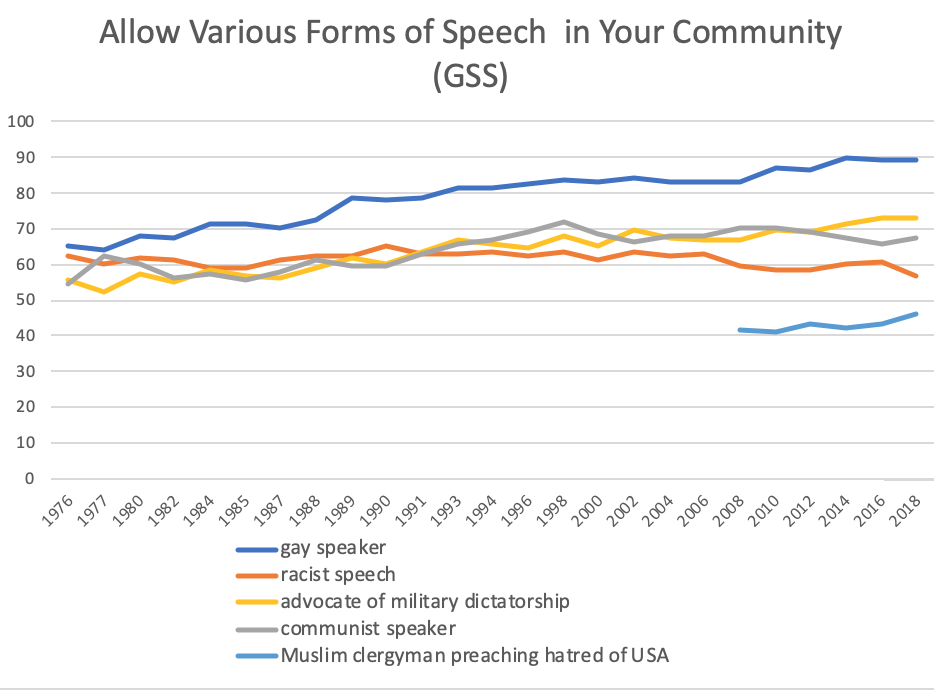
The GSS has also asked about other forms of speech or speakers: a speaker who is gay, a speech advocating military dictatorship in the USA, a communist speaker, or a Muslim clergyman preaching hatred of the USA.

Generally, the trends are up. I find it troubling that ten percent still don’t want to permit a person who is gay to speak in their community. I also find the level of tolerance for the Muslim clergy-person worrying, although the question is worded in a particular way that’s arguably Islamaphobic itself. But overall, the trend is that more people would tolerate more differences.

Of course, another trend is taking place–albeit harder to quantify. Nowadays, an incident that reinforces the beliefs or concerns of a given group can easily “go viral.” Given our tendency to confirmation bias, we can select and share news items that confirm almost any belief. Incidents that are widely shared represent severe selection bias. I have read about true stories of problematic (or even scandalous) intolerance on the left. I see no evidence that these stories are common or becoming more so. Absent empirical evidence, can we avoid making sweeping empirical claims?

See also: the Harper’s letter is fatally vague; a civic approach to free speech; what sustains free speech?