design challenges for civics in higher education

The Educating for American Democracy (EAD) initiative works to improve k12 history and civic education. One of EAD’s contributions is a list of five “Design Challenges.” Each challenge names tensions between a pair of valid principles.

The tensions are not resolvable. Instead, we encourage teachers (and everyone else involved in civics and history education) to keep the five challenges in mind as they design and offer classes and other programs. We propose that materials, curricula, and pedagogy will be better if people always hold these tensions in mind.

At a meeting this weekend sponsored by the Alliance for Civics in the Academy, it occurred to me that a similar list might be useful for civic educators in higher education. But I don’t think the actual items would be the same. Here is a preliminary list of design challenges for college-level educators, just for consideration.

Realism and Inspiration

  • How can we analyze and understand institutions’ tendency to limit or even suppress human agency while also inspiring students to participate?

Honesty and Appreciation

  • How can we seriously study and discuss deep historical injustices without missing the value of excellent texts and other legacies from the past?

The Personal and the Institutional

  • How can we explore the potential and the limitations of two sometimes competing ways of improving the world: strengthening our own character (broadly defined) and preserving or reforming institutions?

Text and Context

  • How can we read and discuss common texts while also benefitting from the contextual knowledge that specialists offer about each specific work?
  • How can we learn from both the arguments and testimony of exceptional people, such as great writers, and also from empirical patterns in large-scale human behavior?
  • How can we learn from observations and analyses written long ago and from the latest social science?

Science and Values

  • How can we learn by using techniques that minimize the influence of the observer’s values (science) while also rigorously investigating questions of value (normative inquiry)?

Citizens’ Roles and Career Pathways

  • How can we educate students to play the generalist’s role of a citizen (in various contexts and communities) while also helping them to become professionals whose work can have civic benefits?

Pluralism and Shared Fate

  • How can we seriously explore deep differences among human beings–as reflected in our topics of study and in our students’ and teachers’ backgrounds–while also teaching students to reason and work together at various scales, from the classroom though the nation to the globe?
  • How can our assignments and discussions connect to students’ diverse cultural experiences and also stretch them to learn about ideas beyond their experience or contrary to their values?

Study and Experience

  • How can students learn from being responsibly involved in communities despite not having extensive academic knowledge, and how can they study civic topics in the classroom without having extensive civic experience? (In other words, how can students do good in the world if they don’t already know a lot, and how can they grasp and assess texts and ideas about civic life if they have not already experienced much civic engagement?)

Choice and Commonality

  • How can we encourage individuals to choose and display their diverse interests and agendas related to civics while also offering common experiences?
  • How can we offer courses or other experiences for many or all students in a given institution without compromising quality?

Heritage and Innovation

  • How can we introduce students to ideas, institutions, and practices inherited from the past while also helping them to learn to innovate beneficially in civic life?
  • How can we develop both trustees and designers?

(The fact that this list is longer than the EAD’s list of challenges should not imply that college-level education is more complicated or fraught than k12 education is. Quite the contrary. Instead, this list captures my own most recent thinking, and I would probably apply it to K12 as well.)

See also: The Educating for American Democracy Roadmap; Educating for American Democracy: the work continues
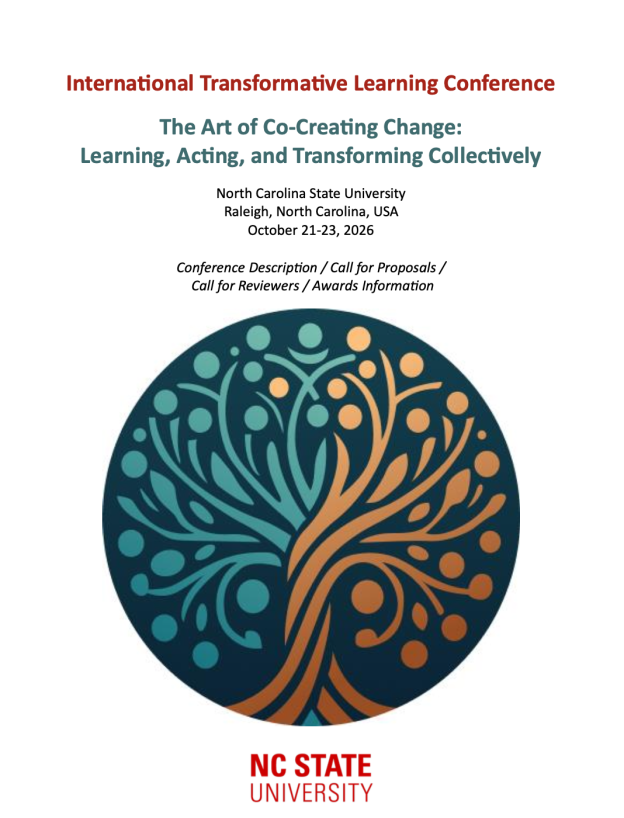
The 2026 International Transformative Learning Conference and a Civic Studies preconference

Please hold the date and consider proposing a presentation for the 2026 International Transformative Learning Conference:

The Art of Co-Creating Change: Learning, Acting, and Transforming Collectively

North Carolina State University

Raleigh, North Carolina, USA

October 21-23, 2026

Website: https://itlc2026.intertla.org/

“Transformative learning (TL) is an area of research and theory that addresses the potential of learning for profound personal and social change. The theme of this conference centers on the transformative power of learning to address the collective challenges of our time—both locally and globally. … We invite participants to explore how transformative learning can catalyze both large- scale and small-scale transformations necessary to navigate today’s interconnected challenges.”

I will be one of several keynote speakers. There will also be a preconference on October 20, 2026, in which one strand will be “Civic Studies: Co-creating Our Shared Worlds.” That portion will be facilitated by Tetyana Hoggan-Kloubert (Universität Augsburg, Germany) and me. According to the blurb:

“This workshop invites participants to reflect on the possibilities and challenges of co-creating our worlds—exploring civic politics, initiatives, capacity, society, and culture. It is open to newcomers curious about civic studies, as well as former participants of the Institute of Civic Studies, offering a space to connect, think globally, and act transformatively.

“Since 2009, Peter Levine, and since 2015, Tetyana Hoggan-Kloubert (with colleagues) have hosted the Institute of Civic Studies in different countries as a living tradition of learning, acting, and co-creating change.”

Join us!

Trump, Modi, Erdogan

I am flying back to the USA after a meeting in Istanbul with activists and NGO leaders from six or more countries. (By the way, I don’t think that all of them could have met in the USA because of our government’s visa policies and treatment of visitors.)

One of the many benefits of the meeting was to challenge a framework that I have been using which treats leaders like Donald Trump, Narendra Modi, and Recep Tayyip Erdogan as examples of the same phenomenon. These men are both similar and different, and it’s important to keep the differences in mind.

All three (it seems to me) are national narcissists, meaning that they believe their own country is the best yet disrespected (Cislak & Cichocka 2023). All espouse a form of populism: the idea that they enjoy the united support of the true nation, whereas opponents and critics are enemies of the people. All identify a favored ethnic and/or religious majority as the authentic country and its rightful rulers.

All favor aggressive state economic interventions while favoring allied businesses and industries (and making money from these alliances). All prefer splashy infrastructure projects to providing consistently decent public services. To be generous, we could say that they each “see like a state” (Scott 1998). And they all use a similar toolkit. They don’t cancel elections or openly suspend (most) constitutional rights but rather prosecute opponents and use economic pressure against the producers of speech: publishers and universities (Levitsky & Ziblatt, 2018).

As for the differences:

Modi represents a century-old effort to establish Hindu supremacy in India. Islamophobia is central to this project (Bhatia 2024). It already inspires regular violence, and it has the potential to spark vast destruction. Modi’s party and government are disciplined. Their agenda is not only social control or personal profit but also redefining a nation in a way that would exclude 200 million of its citizens.

Erdogan, I think, began by opening Turkish politics and civil society to groups and perspectives that deserved representation, including but not limited to observant Muslims. He made appropriate reforms. He is the kind of leader who should have retired a decade ago, in which case he could now travel the international circuit as an elder statesman with some genuine contributions to his name. Alas, he crossed many bright lines by jailing opponents and crushing opposition, perhaps in part because he sincerely believes that he is indispensable. But his managerial record is now quite poor.

Trump represents political views that he did not invent. He espouses familiar forms of xenophobia, chauvinism, and aggrieved nationalism. But I interpret Trump as more transactional than his counterparts in Turkey and India. For many voters, he offers a deal: better economic outcomes in return for legal impunity, the ability to settle scores, praise and monuments, and lots of sheer cash.

Since Trump’s relationships are always self-interested, they are also relatively fragile. I think an economic downturn would break his implicit contract with voters, lowering his approval by 10 points, and that would make him an increasingly problematic ally for Republican politicians. I can see him being discarded (not necessarily impeached, but rendered a lame duck) in a way that I cannot quite see for the regimes represented by Modi or Erdogan.


Sources: Cislak, A., & Cichocka, A. (2023). National narcissism in politics and public understanding of science. Nature Reviews Psychology2(12), 740-750; James C . Scott, Seeing Like a State: How Certain Schemes to Improve the Human Condition Have Failed (Yale, 1998)  Stevnb Levitsky and Daniel Ziblatt, How Democracies Die (Crown 2018), and Rahul Bhatia,, The New India (Abacus, 2025)

See also: national narcissism; countering selective harassment in the Trump Administration; Trump: personalist leader or representative of a right-wing movement?; the Constitution is crumbling etc.

youth activism now

I am grateful to have frequent opportunities to talk with grassroots democracy groups about tactics and methods. My current standard talk is here (but I like to offer it as a discussion rather than a lecture).

The groups that have invited me this year tend to be quite grey–well populated by retirees. I actually believe that it is important for large, nonviolent democracy movements to draw heavy participation from people who are relatively safe from state violence, including older and wealthier white people. But I encounter some anxiety about how to engage younger people.

I suspect that part of the issue is simply age-segregation: younger activists have separate groups. But there also may be some discouragement and confusion among American youth at this moment.

CIRCLE surveyed a representative national sample of youth shortly after the 2024 election and found relatively high levels of engagement. For example, 18% of young adults said they had recently participated in a protest, up from 15% in 2022. Another 29% said they would protest if they had the opportunity. (This was before Trump had been sworn in.) An outright majority had signed a petition.

For the population as a whole, the rate of participation in protests has risen rapidly during 2025, surpassing the increase in 2017. I am not sure whether youth are keeping pace with that growth.


See also: the state of nonviolent grassroots resistance; tools people need to preserve and strengthen democracy etc.

Freud on mourning the past

In 1915, Sigmund Freud wrote a short essay entitled “Transience.” Just over a century later, during the Coronavirus pandemic, the philosopher Jonathan Lear wrote “Transience and Hope” about returning to Freud’s essay in a time of COVID-19, the climate emergency, and the resurgence of authoritarianism. Now, Lear has passed, adding one more layer of pathos to their dialogue.

Freud’s piece turns out to be political, but it begins with a personal memory. “Not long ago,” he says, he went on a “summer walk through a smiling countryside” with a “taciturn friend” and a “young but already famous poet.” Many commentators have identified this poet as Rilke, but Lear thinks the whole story is fiction.

In any case, Freud and the poet argue. The poet is unable to enjoy the beauty of nature because it will fade with the coming fall, “like all human beauty and all the beauty and splendour that men have created or may create.” Freud has the opposite feeling, that transience only “raises the value of the enjoyment.” He adds, “A flower that blooms only for a single night does not seem to us on that account any less lovely.” But neither the poet not the silent friend is convinced by Freud.

Freud says that his friends could not accept the transience of beauty because there was “a revolt in their minds against mourning.” He explains that we have a natural inclination to love–first ourselves, then other objects. When an object of love is lost, we cling to it anyway, which is the painful stage that we call mourning. However, mourning “comes to a spontaneous end,” allowing our love to move to new objects. In a later essay, Freud will explicitly distinguish the healthy, temporary process of mourning (which ultimately frees us to love something new) from “melancholia,” which is stuck in place.

The final paragraph of “On Transience” explains what the story is really about:

My conversation with the poet took place in the summer before the war. A year later the war broke out and robbed the world of its beauties. It destroyed not only the beauty of the countrysides through which it passed and the works of art which it met with on its path but it also shattered our pride in the achievements of our civilization, our admiration for many philosophers and artists and our hopes of a final triumph over the differences between nations and races. It tarnished the lofty impartiality of our science, it revealed our instincts in all their nakedness and let loose the evil spirits within us which we thought had been tamed forever by centuries of continuous education by the noblest minds. It made our country small again and made the rest of the world far remote. It robbed us of very much that we had loved, and showed us how ephemeral were many things that we had regarded as changeless.

In 1914, Europeans like Freud had lost an object of their love–life before the war–and they were mourning it. To make matters harder, they had strongly identified with prewar culture and taken pride and hope in it. They were like a widower who not only misses his deceased partner but also mourns his own lost role or place in the world as a spouse. (This is my analogy, not Freud’s or Lear’s.)

Dr. Freud has a prescription. Mourning passes, and the same will happen to Europeans as the war moves into the past. “When once the mourning is over, it will be found that our high opinion of the riches of civilization has lost nothing from our discovery of their fragility. We shall build up again all that war has destroyed, and perhaps on firmer ground and more lastingly than before.”

Mourning involves, among other emotions, a recognition of the value of what was lost. Thus, for someone like Freud to mourn his optimistic youthful days before August 1914 was to recognize their worth. His sadness reveals that it had been good to pursue medical science in Vienna.

In this case, however, the prewar culture had yielded an unspeakably terrible war. Therefore, the culture was not only over but also discredited. If Freud could travel back in time, perhaps he should not enjoy prewar Vienna (or Paris) but regard it with dismay as the predecessor of a global slaughter. Perhaps Freud and his contemporaries were not like people mourning loved-ones who had died innocently, but like people whose lovers had been unmasked as villains. Worse, the mourners had been part of the lost and discredited world.

When Freud went for his country walk, he and his friends knew that the flowers would fade. But that was not the flowers’ fault. Watching them wither would not negate their value while they bloomed, and the friends could fully appreciate new buds when they returned (as normal) the following spring. In contrast, the First World War revealed that prewar European society, which had seemed so progressive to Freud’s generation, had been deeply corrupt all along.

I am disagreeing here with Freud. He thinks that the negative feelings of his contemporaries are symptoms of mourning, which is healthy but should not be allowed to last forever. Their mourning reflects an authentic and appropriate appreciation for life before the war. They now realize that the past was “fragile,” but this recognition should not detract from its value. Their job is to create good things anew.

It is much harder if we think that something that we have lost is not only transient and absent but was never as valuable as we had previously believed.

I am often nostalgic for the polity and society that I knew as a young adult and up through the Obama Administration. I realize that many people who were less fortunate than I felt less positive about things then, as did people who were more radical than I. I am simply reporting my subjective state. I now experience mourning for that time. The questions is whether my mourning is appropriate because the past was good, or whether it is naive and self-justifying.

Lear’s main objective is to help us to see that mourning reflects a degree of appropriate appreciation for the past, and we can continue to make good things. We should recognize the fragility of what we had built but not reject it all. This is difficult if we blame the past that we miss for what has gone wrong.


Source: Sigmund Freud, “On Transience,” 1915 (just “Vergänglichkeit” in the original, without a preposition), translated by James Strachey in the Standard Edition of the Complete Psychological Works, pp. 305-7, discussed in Jonathan Lear, Imagining the End: Mourning and Ethical Life (Harvard, 2022). See also: the politics of nostalgia just isn’t what it used to be; nostalgia in the face of political crisis; there are tears of things; and Rilke, The Grownup