this is what deliberative democracy looks like

We are having a passionate, complex, deeply informed discussion about race in America and related topics, such as policing.

If you believe that a deliberative democracy means one conversation that convenes representatives of all perspectives, who decide, without rancor and recrimination, what they should do next as a unified group, then the current discussion misses the standard. But I never had that ideal in mind. I always assumed that a national deliberation would result from demands and critiques and would unfold in many settings. I always assumed it would be impassioned and challenging.

In the current debate, some prominent people can be interpreted as wanting to silence their opponents. When Barack Obama called “defund the police” a “snappy slogan” that “lost a big audience,” that sounded like advice to drop the slogan. On the other hand, to equate opposition to defunding police with white supremacy could also be interpreted as silencing.

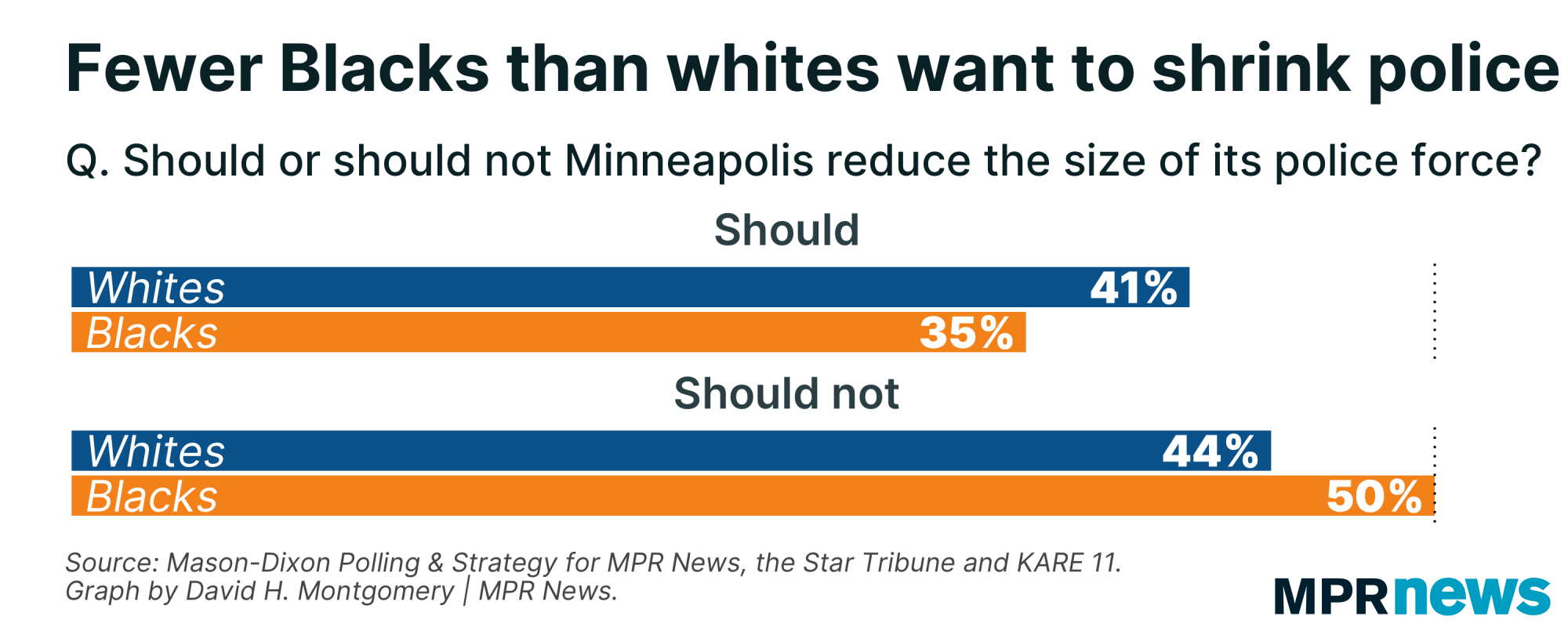
These statements do not worry me much, because they will not actually silence anyone. They are acts of free speech, not restrictions on it. And, by the way, they are probably both true. If we defeated white supremacy, we would not have to consider defunding police. Yet defunding police polls badly among constituencies that should matter, like Black people in the Twin Cities:
Although Barack Obama may not be the best messenger for a certain kind of pragmatic meliorism, telling him not to say what he thinks is just as silencing as his own statement might be. The conversation should continue–and it will. It’s not really in danger of being suppressed by anyone.

Concerns about polarization and echo chambers are valid. When people talk only to others who agree, they can fail to learn, they may weaken their own influence, and they can encourage the spread of false information. However, we wouldn’t want to go too far in the opposite direction. If everyone (or a representative sample of everyone) is involved in the same discussion, then it will have a white, suburban plurality and it will marginalize ostensibly radical ideas, like defunding the police. The conversation is richer if it unfolds in many different settings with different majorities.

If you want to make policing more equitable in the short term, then you are probably better off advocating police accountability plus social services, not defunding cops. But not everyone should promote short-term ameliorative solutions. Some people should pose more fundamental questions, like “Do we need police at all?” Note, however, that if you pose this question, you should expect to hear the answer “Yes, we do” from a lot of people, not just conservative whites. And if Barack Obama tells you that the slogan polls badly–well, surely he’s entitled to that view.

Deliberative democracy was never supposed to be cool and calm, and if you can’t take the heat, stay out of the kitchen. My only desire would be for more prominent presentations of more concrete and compelling alternatives. How would a safe community without any police actually work? On the other hand, how does an accountable and equitable police force function?

It might feel like a burden to have to spell out alternatives–with tradeoffs, costs, enforcement mechanisms, and contingency plans–but that’s what self-governing people do. The great Ernesto Cortés, Jr. says:

Most people have an intuitive grasp of Lord Acton’s dictum about the tendency of power to corrupt. To avoid appearing corrupted, they shy away from power. But powerlessness also corrupts — perhaps more pervasively than power itself. So IAF leaders learn quickly that understanding politics requires understanding power.

I wonder whether some of the strongest proponents of abolishing the police are actually pessimistic about that ever happening. They may endorse the syllogism: All racist societies have unjust police; America is a racist society; therefore, America police will (always) be unjust. This logic is fundamentally disempowered. If you think that you don’t have to show what a police-free community would look like, then you are acting powerless in a corrupting way. In fact, everyone has the power to envision and present alternatives.
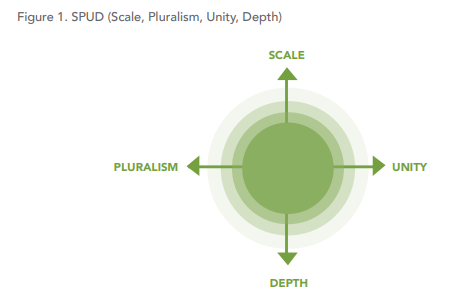
I have been advocating what I call the SPUD framework for assessing movements. In this framework, “S” stands for scale: movements should strive to recruit large numbers of individuals and groups, because they have more power if they are large. “P” stands for pluralism: movements are more effective and learn and react better if they encompass people with diverse perspectives, backgrounds, and social roles. “U” stands for unity: movements must come together behind shared demands at any given time, or else they can’t make effective demands. And “D” stands for depth: movements must help their participants to grow in knowledge, skill, experience, and wisdom.

The Movement for Black Lives has achieved almost unprecedented scale. It also demonstrates impressive depth, at least among its core members. Like all movements, it is pulled between pluralism and unity, and that tension can be fruitful. It would be a mistake to move all the way to the unity pole by excluding a robust and diverse debate about matters like criminal justice. Yet it makes sense to try to project unity and even to try to marginalize certain positions that would undermine the movement’s unity. People are always free to exit if they don’t like the mainstream of a movement; large numbers of exits serve as a form of regulation. Meanwhile, the society as a whole needs an even larger and more plural discussion of the same topics, enriched by more than one social movement.

And all of that is more or less what we are seeing. I take a generally positive view of the present debate as an example of deliberative democracy, even though, like everything human beings do, it leaves room for improvement.

See also: some remarks on Elinor Ostrom and police reform; on the phrase: Abolish the police!; “The Role of Social Movements in Fostering Sounder Public Judgment,” and “Habermas with a Whiff of Tear Gas: Nonviolent Campaigns and Deliberation in an Era of Authoritarianism

open webinar on civic renewal: Dec. 10

The Promise of Civic Renewal To Revive Our Democracy

Peter Levine, an expert on civic engagement, will talk with Mass Humanities Program Officer Jennifer Hall-Witt about a promising vision for reviving our democracy, focusing on the role that ordinary citizens can play in fostering more deliberative, collaborative, and engaged communities. This conversation will be based on the findings in his book, We are the Ones We Have Been Waiting For: The Promise of Civic Renewal in America, which advocates for a new, citizen-centered politics capable of tackling problems that cannot be fixed in any other way.

This event will include small-group discussion in breakout rooms amongst members of the audience. Please come ready to listen and participate.

Peter Levine is the Associate Dean of Academic Affairs and Lincoln Filene Professor of Citizenship & Public Affairs in Tufts University’s Jonathan Tisch College of Civic Life. He was the director of CIRCLE, the Center for Information and Research on Civic Learning and Engagement at Tisch, and organizes Tisch’s annual Frontiers of Democracy conference. In addition to We Are the Ones We Have Been Waiting For: The Promise of Civic Renewal in America (2013), he is also the author of The Future of Democracy: Developing the Next Generation of American Citizens (2007) and The New Progressive Era: Toward a Fair and Deliberative Democracy. We hope you will join us for this important conversation!

To register: Click here to register. A few days before the event, we will email you the link to access this online event. We hope to see you on Dec. 10!

Questions? Please email Jennifer Hall-Witt at jhall-witt@masshumanities.org.

Civic Studies call for APSA 2021

The Civic Studies Group of the American Political Science Association (which I co-chair) has a call for proposals for papers, panels, workshops, roundtables, and other formats. The deadline is Jan 14. The call says:

The Civic Studies Related Group invites proposals for panels, round tables, and individual papers that make a significant contribution to the civic studies field; articulate a civic studies perspective on some important issue; or contribute to theoretical, empirical, or practical debates in civic studies.

We especially encourage proposals that emphasize actual or potential civic responses to the social and political crises of 2020, their origins, and possible consequences.

Civic studies is a field defined by diversity yet connected by participants’ commitments to promoting interdisciplinary research, theory, and practice in support of civic renewal: the strengthening of civic (i.e., citizen-powered and citizen-empowering) politics, initiatives, institutions, and culture. Its concern is not with citizenship understood as legal membership in a particular polity, but with guiding civic ideals and a practical ethos embraced by individuals loyal to, empowered by, and invested in the communities they form and re-form together. Its goal is to promote these ideals through improved institutional designs, enhanced public deliberation, new and improved forms of public work among citizens, or clearer and more imaginative political theory. The civic studies framework adopted in 2007 cites two ideals for the emerging discipline: “public spiritedness” (or “commitment to the public good”) and “the idea of the citizen as a creative agent.” Civic studies is an intellectual community that takes these two ideals seriously. Although new, it draws from several important strands of ongoing research and theory, including the work of Elinor and Vincent Ostrom and the Bloomington School, of Juergen Habermas and critical social theory, Brent Flyvbjerg and social science as phronesis, and more diffuse traditions such as philosophical pragmatism, Gandhian nonviolence, the African American Freedom Struggle. It supports work on deliberative democracy, on public work, on civic engagement and community organizing, among others.

You can submit proposals here. (Once you click to “submit,” choose “Submit A Division, Related Group, or Partner Association Proposal,” then scroll down to “Related Groups,” and then find “Civic Studies” on the list.)

putting the civic back in civil service

Problem 1: Donald Trump has left the federal civil service demoralized and denuded. The Partnership for Public Service reports:

The Department of Education, for example, which has championed many controversial policies, lost more than 14% of its career workforce, while employment at the Department of Agriculture fell by almost 8%. … Non-foreign-service employment at the State Department fell by nearly 9% from December 2016 to December 2019, a period that saw nine senior positions turn over at least once. Currently, more than one-third of the assistant secretary or undersecretary positions are vacant or filled by acting officials, leaving career diplomats and civil-service staff without direction and many initiatives adrift. 

Problem 2: new and recent college graduates need jobs, yet few (at least in my experience) look to the federal civil service. That was true even when they admired the president. Note that the federal government employs 2.1 million civilians, so it is a big part of the labor market. It is ironic that many college students favor a larger role for the government but wouldn’t think of working for it.

Problem 3: many people do not trust the federal government or see it as their friend. As I wrote yesterday, “Maybe progressives are wrong about the advantages of government; maybe white working-class people are wrong about the drawbacks of government; but either way, it is hard to build a party of the left if the largest racial group in the lowest income stratum wants less government.” (Support for government among other racial and class groups is not very impressive, either.)

Problem 4: Affective polarization (meaning hatred of people from the other party) is a real threat to democratic institutions, and specifically to any chance of progress during the Biden Administration.

There might be one solution to all four problems. Federal civil servants can be, and often have been, very capable organizers and supporters of local collaborations. They have helped Americans to come together and address problems that communities define. See Carmen Sirianni’s Investing in Democracy: Engaging Citizens in Collaborative Governance (Brookings Institution Press, 2009) and his Sustainable Cities in American Democracy (University Press of Kansas, 2020) for good examples. Although the latter book is about cities, see p. 37 and elsewhere for the constructive role of federal agencies.

To strengthen this federal role requires leadership at the cabinet level, professional development for civil servants at all levels, conferences and other gatherings to share best practices, awards for excellent work, and other concrete steps. It does not require congressional action.

The objective would be to repopulate the federal civil service with capable civic actors who strengthen communities, bring people together across lines of difference, make government actually work better, and help people to feel that it is their instrument.

See also from government to collaborative governance; welcome to CivicGreen; public participation helps environmental policy; the path not taken (so far): civic engagement for reform; investing in democracy: the case of CARE, etc

who wants less government?

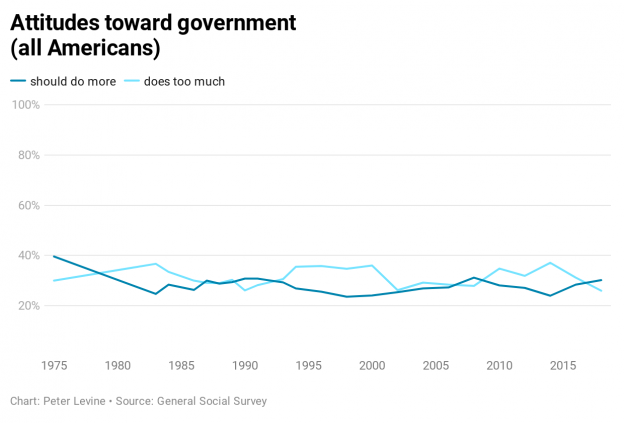
The General Social Survey asks respondents whether the government should do more or whether it already does too much. Here are the responses over time for representative samples of Americans (omitting those who place themselves halfway between those two views):

The balance of opinion swings back and forth. Sometimes, more people want to expand government; sometimes, more people think it already does too much. Obama saw a rise in government skepticism; Trump saw the opposite trend, culminating in the strong Democratic year of 2018.

And here are the results for two groups that are much debated right now.

First, white members of the working class, here defined as white people with family incomes in the bottom quintile.

These are the people who, according to progressives, would benefit from more government but don’t see things that way. Maybe progressives are wrong about the advantages of government; maybe white working-class people are wrong about the drawbacks of government; but either way, it is hard to build a party of the left if the largest racial group in the lowest income stratum wants less government.

Note, however, that the anti-government stance of this group is not hard-wired. In several years, a plurality of them have wanted more government. That was clearly true in 1975, and the next year, Jimmy Carter won the whole of Appalachia and the whole Gulf Coast. Instead of (only) complaining about the tilted electoral map, Democrats should be asking–as some are–why they aren’t the majority party in the country’s poorest states.

And here is the trend for African Americans. Combining all the years together would suggest that Blacks are more favorable than other Americans to government. But note their rising level of support for “government does too much.” I wouldn’t read much into the zigzag pattern; given the number of African American respondents, the margin of error for each year is +/- 8 points. But pretty clearly, African Americans were more favorable to government until ca. 1992 than since.

Finally, I should acknowledge that the question is very simplistic. The government should do more of what? Banning abortions? Stopping-and-frisking? Sending me checks? Covering the cost of seeing private-sector physicians? Curing cancer? I’m treating the results as proxy measures of support for social welfare, but that is not necessarily accurate.

See also: white working class alienation from government; what do the Democrats offer the working class?