how Trump and Biden supporters think about their identities

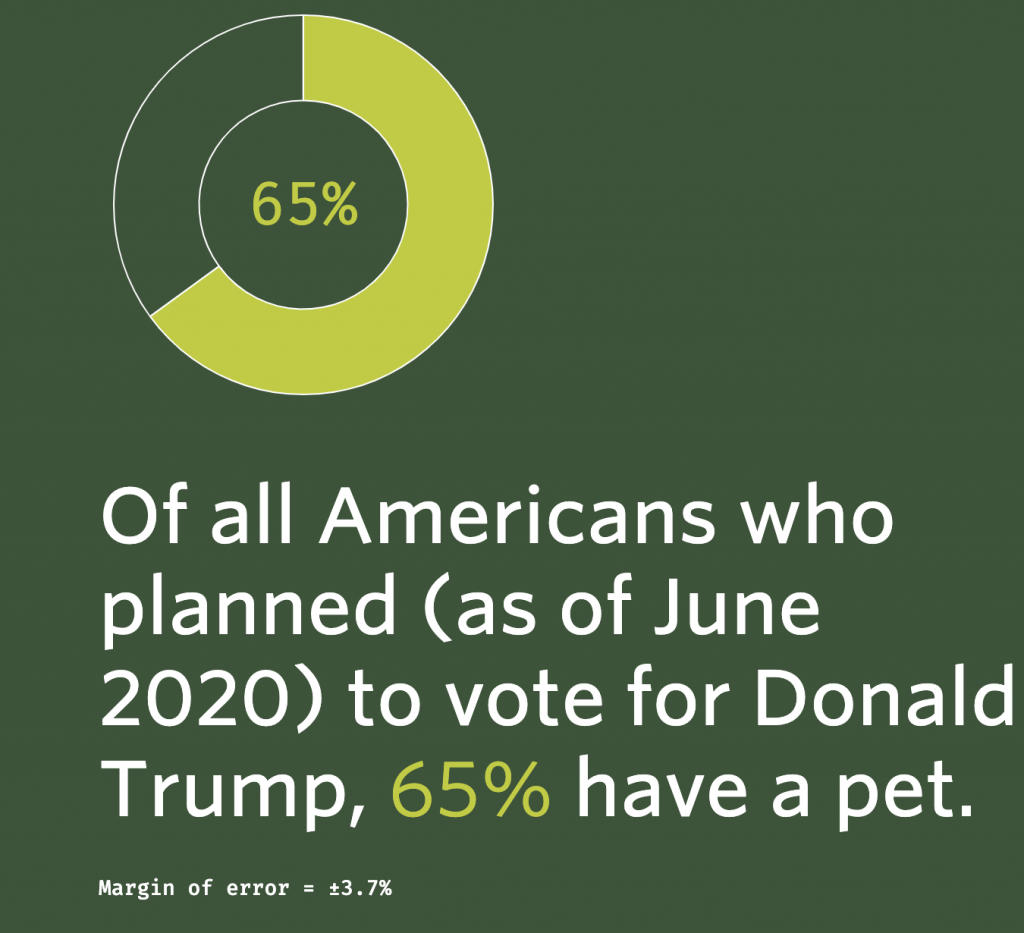
We surveyed a nationally representative sample of 1,267 Americans from May 29-June 10, 2020. Biden led by 50.5%-37%. That result is now far out of date. However, respondents answered more than 350 questions either in this survey or in surveys that they had taken previously. As a result, we are able to look at many more attributes of the electorate than in a typical political poll: matters like which chronic diseases Biden and Trump supporters have, whether they donate money to colleges, how they define their identity, and whether they have pets. (In case you’re wondering, Trump voters are 8 points more likely to have pets.) Given the remarkable stability of the race, I am confident these patterns still apply.

This new article on the Equity Research website provides a lot of detail. Here I’ll just share the portion about identity. All the statistics reported here are for likely voters: those who rated their own chances of voting in November 2020 as seven or higher on a 10-point scale.

Only 10% of whites said that race was important to their own identity (or “salient”). Among that group, Trump led by 61.5%-31%, whereas Trump’s lead among other whites was just 5 points (47%-42%–less than a majority).

More than half of African Americans (57%) said that their race was salient, and those African Americans supported Biden over Trump by 96%-3%. The margin was somewhat closer (80%-10%) among African Americans who did not report that race was salient

About one third (31%) of Latinos said that race was salient, and they favored Biden by 67%-23%. Among the majority of Latinos who said that race was not salient, Biden’s margin was somewhat narrower (60%-19%).

Biden led narrowly (48%-42%) among women who see gender as salient, but by a wide margin (52%-30%) among those who do not. Women who see gender as salient were also more likely to identify as conservative compared to women who do not see gender as important to their own identity (26% versus 18%). It appears that women who see gender as salient are more often expressing traditionalist views of gender rather than feminist views. Biden also performed better among men if they did not see gender as important to their identities.

Twenty-eight percent of voters reported that religion was important to their identity. Trump led 58%-31% among those voters, whereas Biden led by a similar margin, 58%-29.5%, among voters who did not see religion as salient.

As shown in Fig. 1, Biden led among all categories of people who felt that class was not important to their own identities, and especially among those in the lowest and highest income categories who felt that way. Trump led by substantial majorities among people who felt that class was important to their identities and were in either the low- or high-income brackets. In other words, Trump led among working-class people who identified with their class and among wealthy people who identified with their class.

More on the Equity Research website.

the debate shows why we need civic education

Imagine young Americans watching last night’s debate. Try telling yourself that we have a special problem with youth. Try telling yourself that young people’s understanding of the system, commitment to democracy, or civic and personal virtues represent particular deficits.

Young Americans do urgently need and deserve more and better civic education–meaning not only courses and curricula by that name, but a whole k-12 education that prepares them to be active and responsible citizens. This need is critical.

But the reason is not a decline in civic education since Donald Trump’s youth (or mine), nor a decline in young people’s knowledge, skills, and virtues. The evidence about how courses and requirements have changed over time is mixed and ambiguous, but we never offered much civic education. Outcome measures such as the NAEP Civics Assessment are remarkably flat. Certainly, American history is presented much better now than in my day, in part due to mountains of valuable scholarship.

Improving civics is an urgent need not because it used to be better but because older people have handed today’s youth a republic in disastrous condition. The fiasco of the debate serves as an apt metaphor for the whole system. One can assign most, or even almost all, of the blame for last night to Donald J. Trump; nevertheless, the debate encapsulates our whole era.

Civic education is not well positioned to address some aspects of the problem. For instance, presidential overreach is on Suzanne Mettler’s and Robert C. Lieberman’s list of Four Threats, but it is not something that civics can directly fix; nor is gerrymandering; nor is income inequality. Trump himself is a threat (according to me), and he must be dealt with at the polls and then perhaps in the courtroom, not in the classroom.

However, on their list are two problems that civic education can address: hyper-polarization and conflicts over who belongs in the citizenry. Students can learn to deliberate with people who disagree and can learn to understand, appreciate and include all their fellow Americans. Some would add misinformation as yet another threat, and it is also something that civics addresses.

Saving the republic is not the only reason to teach American history, government, and civics. These are intrinsically interesting and worthy topics. Learning about them enriches the mind and soul. And teaching social studies demonstrably improves reading scores. But saving the republic is a pretty good reason to focus on civics, now.

welcome to CivicGreen

Please check out CivicGreen, a project (and website) hosted at the Tisch College of Civic Life. Carmen Sirianni is the editor-in-chief; I’m the executive editor; and Ann Ward is the managing editor. The 15 or so other key people are listed here.

Per the website:

CivicGreen is a collaborative project among scholars and practitioners to enrich our democratic imagination and to expand our policy options for sustainable, resilient, and just responses to climate crisis in the United States in the coming decades. Our perspective is to locate civic engagement at the heart of work that needs to occur in communities of all kinds, across cities and regions, and among professional and other institutional partners that are key to solving problems for the long run.

CivicGreen is fundamentally about civic democracy at the intersection of green strategies to address our ecological and climate crises and to build healthy and sustainable communities for all.

I would add that the project is all about practical environmental solutions that engage the public. It’s less about public pressure to accomplish environmental policies (although pressure is essential) than about public engagement in the work of saving the climate.

Four Threats to American Democracy video

This is the video-recording of last Friday’s SNF Agora Conversation on Four Threats: The Recurring Crises of American Democracy. Suzanne Mettler and Robert C. Lieberman discussed their new book–with me as the moderator–and we got great questions from the audience.

what if the traditional and student-centered pedagogies go together?

I’m helping with the evaluation of a civic education curriculum. I don’t want to go into details because this is an unpublished evaluation for a specific organization in a particular context. However, I have observed an interesting pattern and wonder what explains it and whether it generalizes.

We asked both the students and the teachers about various pedagogies. For instance, the students were asked to evaluate statements like these (among others):

  • Memorizing facts was the best way to get a good grade from teachers my classes.
  • Teachers lectured, and the students took notes.
  • Students were encouraged to make up their own minds about issues.
  • Teachers encouraged students to express their opinions during class.

Their teachers were asked about the same list of pedagogies, but the questions for them were phrased in terms of how much they used each approach.

The goal was to distinguish various approaches and then correlate them with things like the number of correct answers to factual questions, students’ skills, and their beliefs about democracy. Then we could see whether, for example, students who discussed issues more in class were more confident about their skills for discussion. The findings wouldn’t be causal, but they would be suggestive.

In the actual data, the most teacher-centric and the most student-centric approaches (if you can accept those descriptions) correlated. For instance, there was a positive correlation (0.29) between “Teachers encouraged students to discuss political or social issues about which people have different opinions” and “Memorizing facts was the best way to get a good grade from teachers in my classes.” Likewise, there was positive correlation (0.28) between “Most students felt free to express opinions in class even when their opinions were different from most of the other students” and “Teachers required students to memorize facts or definitions.” The correlations were even larger in the teacher data.

Most of the student outcomes–especially their ability to answer factual questions–correlated positively with all of the pedagogies. Students were more likely to know the facts if their teachers lectured and if they discussed issues–not surprisingly, since these two pedagogies correlated with each other.

One interpretation is that some students just got more of everything than the others–their “dosage” was higher. But I don’t think so, based on what I know about the intervention. Besides, the questions weren’t phrased in a way that should measure dosage.

Another interpretation is that these approaches should and do complement each other. I can certainly see why good teachers might say both “I encouraged students to express their opinions during class” and “I placed great importance on students learning facts.” (These responses were correlated at 0.8).

A third interpretation is that these questions don’t yield valid data, because teachers and students are not very aware of the pedagogies they experience, and are especially unaware of how their experiences compare to others’.

I’m wondering whether the positive correlation between apparently contrasting teaching styles is commonly observed.