Putnam and Garrett, The Upswing

This is a video of Robert D. Putnam and Shaylyn Romney Garrett discussing their new book, The Upswing: How America Came Together a Century Ago and How We Can Do It Again in a Tisch College Distinguished Speaker event last night. Our dean, Alan Solomont, introduced everyone and then I interviewed and moderated Putnam and Garrett.

I really do recommend the book and intend to write about it in more detail. It’s methodologically and conceptually interesting. More importantly, it’s a hopeful and patriotic book that comes at an urgent moment.

During our conversation, I proposed a summary of the book’s position that the authors seemed willing to accept. They advocate an appropriate balance between individualism and communitarianism. They believe that a society can be too communitarian, and perhaps that was even true of the US ca. 1960. But now we are far too individualistic. The balance can be restored, as it was in the half-century after 1900. To accomplish that change requires a decentralized and pluralistic effort that encompasses social innovation and social entrepreneurship, organizing and advocacy, cultural work, leadership, and policy changes at all levels of government. This effort should be pragmatic, not ideological, although it can attract people with a mix of ideological views and agendas who overlap on the idea that America should be more of a “we” and less of an “I” society.

An excellent example was the “high school revolution,” a decentralized movement that raised the proportion of Americans who completed high school from less than 10% to more than 70% in a few decades, fueling economic growth and equity. No single law accomplished this revolution; no individual is especially associated with it. It was a “viral” movement that, in turn, contributed to a much broader movement to strengthen American community. I’m guessing that various agendas converged to make this happen, from local boosterism and immigrant assimilationism to ambitious reform agendas, including socialism.

The implication is that we can do the same again, and it might even turn out that leaders as disparate as Barack Obama, Alexandria Ocasio-Cortez, Patrisse Cullors, and Mike Lee–plus countless founders of nonprofits and community organizers–will turn out to be early participants in a new upswing. We certainly need it.

some notes on identity from a civic perspective

In a course on Civic Studies, we recently began a unit on identity. The first readings were the biblical Book of Nehemiah; Audre Lorde, “The Master’s Tools Will Never Dismantle the Master’s House; and ”Steve Biko, “Black Consciousness and the Quest for a True Humanity.” Here are some notes.

1. The overall civic question is: “What should we do?”  An identity is an answer to the question: “Who am I?” (Or, “Who is he/she/they?”) For instance, Lorde self-identified as “black, lesbian, mother, warrior, poet.”

How are these two questions related?

  1. You must consider who you are in order to figure out what “we” you are part of.
  2. Sometimes the “we” is defined badly, and that is the civic problem. People are excluded unjustly or included against their will.
  3. Even when the “we” is right, it may encompass differences of identity that create or reinforce injustices.

2. When discussing Elinor Ostrom and others in the first segment of our course, we were primarily focused on interests. The main solutions included various forms of negotiation and management. When discussing Jürgen Habermas and others in that segment of the course, we were primarily focused on opinions. The main solutions involved various forms of dialogue, deliberation, and communication. Now we turn to identities.

3. Interests, opinions, and identities are interconnected but are not the same. 

  1. Interest: “I want/need …”
  2. Opinion: “We should …”
  3. Identity: “Speaking as a …”

When interests conflict, they can be negotiated, and it is sometimes possible to design and maintain systems to manage interests fairly. When opinions conflict, they can be discussed, and well-structured conversations may (sometimes) convince individuals to converge on the same opinions. When identities clash, it is not clear that individuals should negotiate, compromise, or give reasons for their differences. But it can be controversial whether a given characteristic, such as adhering to a religion, constitutes an interest, an opinion, an identity, or more than one of these. Disagreements about such questions can lead to disputes about whether individuals should be open to negotiation and responsive to arguments, or not.

4. It can be problematic to talk about identity in general terms. Some identities are vastly more significant to social justice than others. For instance, racism is the USA is not just an example of an identity-difference. You can imagine two random groups that don’t happen to like each other and who demonstrate bias or division. That is a challenge, but it is not a good description of the differences that matter to our assigned authors. For Biko: conquest, colonialism, apartheid. For Lorde: 400 years of slavery, terror, and subjugation.

5. Each form of identity has a unique history. It may also have a particular logic. For instance, it’s possible to imagine a society with significant racial diversity that is also equitable. It is not possible to imagine a society with an upper class and a lower class that are equal.

6. Nevertheless, we can also gain some insights into important differences among identities by developing general theories of identity.

7. Two general theories are worth contrasting:

  1. When two groups of people act and think very differently and have little contact, a powerful identity distinction emerges that can be hard to bridge.
  2. When people are very similar, intimately connected, and liable to mix or exchange places, there is a powerful incentive to erect and insist on identity distinctions.

Examples of (a): Europeans encountering indigenous peoples, and vice-versa. Examples of (b): Modern antisemitism in Europe or the invention of race in 17th century Virginia. My understanding of the 17th-century story is that slavery came first; racism followed. The first rationale for enslaving people from Africa was religious: Christians could enslave “heathens.” But once the enslaved people converted, a different rationale was necessary. For a few decades, colonists tried the idea of “hereditary heathenism” (Goetz 2012), but that was incompatible with core Christian doctrine. So they invented, or re-invented, race. Since then, whites and African Americans have been in constant and intense interaction and have exhibited profound similarities. White privilege is a “common pool resource” in the specific sense that it benefits all white people, whether they want it or not, yet any of us can undermine it by promotion equity. All common pool resources are fragile, and it has taken concerted, sustained effort to maintain white supremacy in the face of actual similarities and actual interactions.

8. A synthesis? Identity distinctions are made by people in response to incentives created by institutions (such as states and markets), power differentials, network ties, and path-dependence, among other factors (Wimmer 2008).

9. Identities are made, but it does not follow that they are easily unmade. They become powerful realities. E.g., modern Americans racially classify a photo of a face in less than one tenth of a second and form affective reactions to that classification (Kubota & Ito, 2007).

10. Power influences how identities are created, but it does not follow that identity-creation is necessarily bad. It can be creative and empowering.

Lorde: “Advocating the mere tolerance of difference between women is the grossest reformism. It is a total denial of the creative function of difference in our lives. Difference must be not merely tolerated, but seen as a fund of necessary polarities between which our creativity can spark like a dialectic.” 

11. Questions from the readings:

  1. Do identity distinctions and boundaries enable collective action? If so, can we solve collective action problems without perpetuating unjust exclusions?

The Nehemiah story is about building a common pool resource and excluding outsiders. (A city wall is a common pool resource. The Jerusamelites have strong social capital. They apply many of Ostrom’s design principles, such as taking turns and enforcing the rules on the leaders) Must self-governance and exclusion go together?

  1. When should we accentuate “many differences,” and when should we look for “solidarity”?

Lorde: “It is a particular academic arrogance to assume any discussion of feminist theory without examining our many differences, and without a significant input from poor women, Black and Third World women, and lesbians.” Biko uses “the black man” as a category that explicitly encompasses Zulus, Xhosas, Vendas, and South Africans of Indian origin, and implicitly includes black women. He discusses a “strong solidarity” that allows Blacks to “respond as a cohesive group.”

  1. Who has what responsibility for learning and teaching about what?

“Let us talk more about ourselves and our struggles and less about whites” (Biko). Asking oppressed peoples to educate their oppressors “is an old and primary tool of all oppressors to keep the oppressed occupied with the master’s concerns.” For instance, to say that women of color must educate white women “is a diversion and a tragic repetition of racist patriarchal thought” (Lorde)

  1. How radical a change is needed?

Lorde: tolerance is “the grossest reformism.” We need to “seek new ways of being in the world.”

revolutionary art without a revolution: remembering the eighties

When the 1980s began, I was a nerdy little white boy in middle school in the rapidly de-industrializing Rust Belt city of Syracuse, NY. When it ended, I was a grad. student in England, but I had lived in New Haven, London, Florence, and New York City. I was interested in classical music and the history of (European) philosophy and was pretty much the opposite of hip. However, I walked around with my eyes and ears open, and my friends were less nerdy than I. So I went in tow to venues like CBGB or Dingwalls. Much more often, I rode graffitied subway cars or watched breakdancers with boom boxes.

Two recent exhibitions have brought back the aesthetics of that period and helped me to understand it a bit better.

Mike Kelley and Jim Shaw were a decade older than me and from further north in the Rustbelt (Michigan), but I recognize the world they grew up in. They collected doodles drawn in ball-point pen on lined paper while the teacher wasn’t looking, fundamentalist tracts, album covers, semi-professional local ads, cable-access shows, comics, sci-fi paperbacks, D&D manuals, second-hand children’s book covers, toy packages from the dime store, pinups, and posters for high school plays. They imitated that material and mashed it together in their gallery art and for the stage performances of their punk band Destroy All Monsters.* I got to see samples of their work in “Michigan Stories: Mike Kelley and Jim Shaw” (MSU Broad Museum).

Born 6-8 years later than Shaw and Kelley, but famous when he was very young, Jean-Michel Basquiat mashed up Gray’s Anatomy (the book), old master paintings, documents from Black history, graphic symbols, sci-fi, jazz album covers, expressionist and pop art, found objects, and graffiti to make his groundbreaking work, which is featured in the Boston MFA’s Writing the Future: Basquiat and the Hip-Hop Generation.

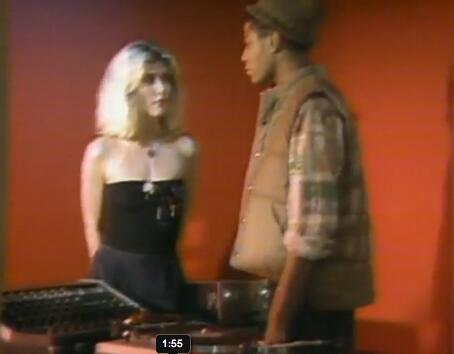
Basquiat’s drawings and paintings are very striking, but it’s possible that the music videos steal the show. In Blondie’s Rapture (1981), which you can watch any time on YouTube, Basquiat is the DJ because Grandmaster Flash failed to show up for the filming. As Debbie Henry switches from punk to rap, she sings:

Fab Five Freddie told me everybody’s high
DJ’s spinnin’ are savin’ my mind
Flash is fast, Flash is cool
Francois sez fas, Flashe’ no do

That Haitian creole must be for Basquiat. Henry was the first person to purchase one of Basquiat’s works. It was news to me how closely punk and rap were intertwined.

Six years before this video, New York City had narrowly averted municipal bankruptcy. The subway had the highest crime rate of any mass transit system in the world and suffered from severe maintenance problems. A big part of the reason that graffiti artists could live in squats in lower Manhattan and paint whole trains was the economic crisis of the city. Meanwhile, the US auto industry that had sustained both urban Michigan and my Upstate New York hometown was shedding jobs. Between 1978 and 1982, 43% of automotive jobs (about half a million positions) were lost. No wonder Henry sings:

You go out at night, eatin’ cars
You eat Cadillacs, Lincolns too
Mercury’s and Subaru’s
And you don’t stop, you keep on eatin’ cars

“Rapture” was filmed in the deep recession year of 1981, when the Dow was down along with the rest of the economy. But as the decade progressed, markets rebounded and the culture celebrated finance—more, I would say, than industry or small business. It was the decade of Wall Street. And Wall Street’s Zuccotti Park is just 2.4 miles from Tomkins Square Park, the center of the bohemia portrayed in “Rapture.”

Basquiat’s art is explicitly anti-capitalist. I assume that artists who covered whole subway cars with their work considered the government that owned those trains as basically illegitimate and proposed a different form of ownership. Yet Basquiat started to make a lot of money in Manhattan gallery shows. Several of his close associates also moved from the economic margin to the center of the economic universe. For instance, in 1983, Basquiat and his girlfriend Madonna lived together in the Venice, CA studio of the art dealer Larry Gagosian (later known as “Go-Go” for his business acumen). Madonna was a legitimate member of the same bohemia as Basquiat, but she was on her way to selling 300 million records as the Material Girl. Even “Rapture,” which depicts a bunch of East Villagers who wouldn’t have a lot of money in their pockets, was beamed into millions of suburban rec. rooms through MTV.

Race was another dynamic. In places like Syracuse, Black/white racial integration reached its historic high. The school district implemented an ambitious desegregation plan. The ratio of African Americans to whites in the city’s population was also more balanced than it is in today’s “hyper-segregated” metro area. Syracuse has lost 35% of its population since 1950 in a process of suburbanization and re-segregation that was just getting started in the ’80s. Kelley and Shaw were white, and their musical genre was punk, but you can observe them admiring their Black counterparts from close up. Basquiat became famous in a predominantly white world but remained socially very close to Black and Caribbean New Yorkers. There was money to be made packaging rap for white teenagers, and money to be made subverting Reagan’s America in art or music.

A hostile critic would charge the ’80s bohemians with hypocrisy or even nihilism. (Those trains didn’t belong to them; most citizens preferred a subway without graffiti.) But I see pathos. This was revolutionary art without a revolution, an expression of left radicalism at a time when the deep cultural movement was rightward.

*this paragraph is self-plagiarized from Mike Kelley, Jim Shaw, and memories of Rust Belt adolescence.

Campus Compact podcast

This is the audio of my friend Andrew Seligsohn, the President of Campus Compact, interviewing me earlier this week about the election, what it tells us about civic life, and what we should do next. I enjoyed it and appreciated the opportunity. Follow Campus Compact for other #CompactNation podcasts.

modus vivendi theory

I am preparing for a weekend conference on modus vivendi–on how people can coexist peacefully even if they do not like each other one bit. The conference was planned a long time ago and has a global scope. Nevertheless, it feels timely to an American after the 2020 election.

Some of the papers are works of abstract political theory, with references to Hobbes and modern liberal or communitarian philosophers. Some are empirical, discussing the possibilities of trust and agreement when people differ. Some of them are about consociational and polycentric governance arrangements–when there isn’t one centralized state or one big market but several heterogeneous entities govern simultaneously. And some of the readings are about concrete situations. For instance, I highly recommend Informal Order and State in Afghanistan, by Jennifer Brick Murtazashvili.

I think one of the unresolved issues is whether to reduce interaction in order to preserve peace and liberty or to encourage interaction by decentralizing power so that people who dislike each other can still negotiate intensively without feeling that one group might use the state to dominate the others.

Murtazashvili depicts local governance in Afghanistan as a complex network of local leaders who have overlapping and limited powers and who collaborate quite often and compete for public support. This implies a lot of negotiation and communication. The overall system is adaptive, not rigidly traditionalist. One of the advantages of polycentrism, Paul Dragos Aligica emphasizes, is its openness to local experiments that others can observe and imitate (pp. 66-69). In short, polycentrism is helpful for learning, and we might expect people in a polycentric order to converge about what they learn over time. They would become more similar.

A different model is a classic consosiational arrangement, such Belgium, which allows different religious and linguistic communities to manage their own affairs independently and without much interaction. Shadi Hamid is convinced that religions are divided by fundamental normative assumptions, and when such divisions arise, it can be wisest to reduce interaction–to send the parties into their respective corners. “Sometimes, reducing contact between opposing sides and allowing for autonomous communities are ways of accepting that some differences cannot be bridged” (p. 36).

In the US context, it seems plausible that reducing the imprint of the national government might lower the temperature of partisan division. The problem with that solution is that some of us have strong commitments to federal intervention, whether on climate change, racial equity, or responses to COVID-19. Telling everyone to disengage at the national level so that the states and localities can do their own thing is biased toward some of the states and localities–the ones that vote for less rather than more social welfare. And it leaves minorities in each state exposed. I don’t think you can predict that progressives will stop demanding national policies, and I am not sure that we should stop.

But we could think about ways to address genuine common problems with a minimal footprint on the values that divide us most deeply. And you can think about that even when the values (e.g., racial or gender equity) are very worthy. I have long favored emphasizing cash transfers over behavioral interventions for this reason. I think that trying to change people’s behavior threatens liberty. It also provokes distrust that undermines the capacity of the national government. This is true even when the goal of an intervention is most worthy, such as educating against racism.

A strategy of lowering partisan polarization by reducing the explicit footprint of the national government may or may not work. And it doesn’t necessarily tell us clearly what we should actually do. For instance, you could argue that if the Supreme Court overturns Roe v Wade and allows states to ban abortion, the partisan temperature will fall as more people become satisfied by the policy in their own state. (This is the decentralized-democracy argument.) But you could also argue that if the government (at any level) is forbidden to ban abortion, the choice becomes personal, which is much more decentralized and prevents battles over state laws. (This is the liberal argument.) So far, we can see that Roe had worsened polarization, but we don’t know whether repealing it would reduce polarization or take it up another notch.

Another example: Tufts is going through an intense conversation about anti-Black racism. Very few people in our campus community evidently supported Donald Trump. Trump voters appear as an out-group, characterized either as complicit with racism or as people to be understood better–but not as part of the community. If people who voted for Trump were better represented at Tufts, the temperature might rise through the roof. I do not believe that the already complex conversations would survive that extra dimension of plurality.

Modus vivendi theory might say: It’s good that we have a heterogeneous, voluntary system of higher education. Let Tufts people go to their corner and have their own hard, important conversations, while Trump voters assemble in other places if they want to. Or modus vivendi theory might say: We need pluralism within institutions devoted to learning. Places like Tufts are relatively homogeneous ideologically. That is bad, and the solution is for the institution to say less in its own name so that a wider variety of views feel fully welcome. (Or maybe there are other ways of addressing this issue that don’t require modus vivendi at all.)

The idea of modus vivendi theory can be opposed to democratic, liberal, social-welfarist, and deliberative theories, but it’s also possible that negotiating a modus vivendi is the best way to advance those values when antipathies run high. In any case, I think there is much to be learned from this body of thought.

Cited sources: Paul Dragos Aligica, Institutional Diversity and Political Economy: The Ostroms and Beyond (Oxford, 2014); Jennifer Brick Murtazashvili, Informal Order and State in Afghanistan (Cambridge, 2016); and Shadi Hamid, Islamic Exceptionalism: How the Struggle Over Islam is Shaping the World (St Martin’s, 2016). See also: polycentricity: the case for a (very) mixed economy; we need SPUD (scale, pluralism, unity, depth); racial pluralism in schools reduces discussion of politics, and what to do about that;  why the deliberative democracy framework doesn’t quite work for me; structured moral pluralism (a proposal); etc.