individuals’ ideologies as networks

Hypothesis: People not only hold opinions about parties and specific issues; they also explicitly connect their various beliefs together to create more-or-less coherent logical structures. Understanding these structures yields insights about individuals that we would miss if we only knew a list of their opinions.

This thesis challenges a common assumption in political and moral psychology. Although scholars meticulously analyze the structure of the arguments in books, essays, and speeches, several streams of research suggest that ordinary people have no such structures–their political preferences are random, or chosen by elites, or driven by latent variables of which they are unconscious. I think that we won’t find the conscious structure in average people’s thinking unless we develop tools that can detect it.

Looking at some individuals

To that end, last summer I collected data from 100 Amazon Turk participants. I restricted the sample to liberal residents of the USA, in order to control the range of issues that would appeal to them so that I could analyze the small dataset effectively.

I showed each person a list of 30 ideas they might favor, about half of which leaned left. I simply asked, “Which of these would you like to see happen?” and encouraged them to be selective. Consistent with my effort to recruit liberals, they chose almost exclusively liberal items. For instance, 80% chose “health insurance for all” and zero chose “a return to traditional values.”*

After subjecting respondents to a bit of explanation and training, I showed them their own chosen items in pairs (in random order). For each pair, I asked, “Are you in favor of X because you are in favor of Y?” Each time they said yes, that created a link between two nodes (or an edge between two vertices, if you prefer the technical language). From these responses, I was able to generate network maps for each person and for groups.

Here is one such map. This person is a white man, age 32. He places himself as far as possible to the left on a unidimensional ideology scale and he says that he agrees with AOC most often, followed by Bernie, then Warren, then Obama, and finally, Biden. He believes that eight things that he would like to see happen (e.g., health insurance for all) provide reasons to reduce corporate influence on government. He also sees an indirect link between reducing corporate influence and racial justice (by way of reducing incarceration) and an indirect link to the environment (by way of enabling a tax on carbon). However, he doesn’t connect political reform to free college or LGBTQ+ issues, although he cares about those issues and connects them.
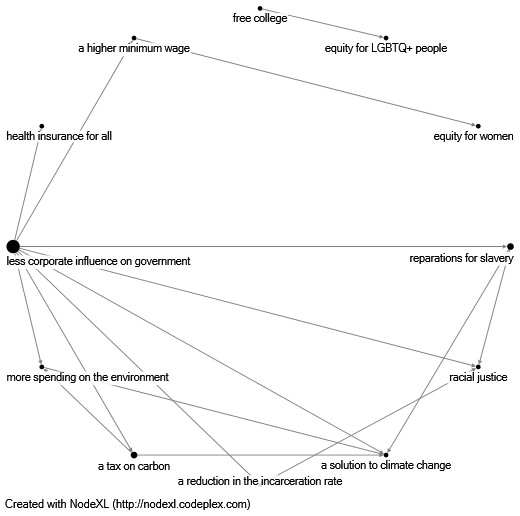
In short, his network is highly centralized around reducing corporate influence. This seems like an important fact about how he thinks.

Below is another map, this time for a white woman, age 30, who ranks the Democratic politicians in precisely the opposite order as the man did (Biden first; OAC last). However, she ranks herself as a one on a 0-10 ideology scale, i.e., very liberal.
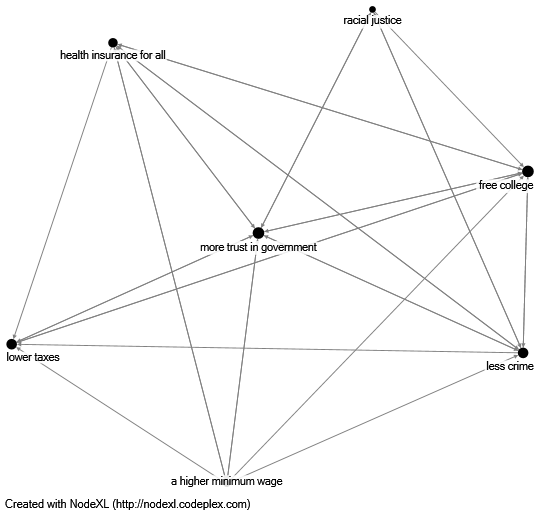
Her graph is more complex than the man’s. She is 3.6 times more likely than he was to see any given pair of ideas as a connection. Two-thirds of her arrows are double-headed. (She favors less crime because she favors more trust in government, and vice-versa.) You can move around her graph from one item to the next, and then onward. It is not centralized around any single node.

As noted, I first asked respondents whether each of their goals provided a reason for another goal. It was up to them what counted as a “reason.” I believe, however, that we can put ideas together in numerous ways, with a range of logical connectors. A justification is one link; a cause is another.

Therefore, I next showed respondents pairs of outcomes and asked whether each one would cause the other one. I included outcomes that they had not selected in the first place, because you might not select something as a high value even though it causes an outcome that you do value highly.

Here is the first respondent’s map with the causal connections added in:
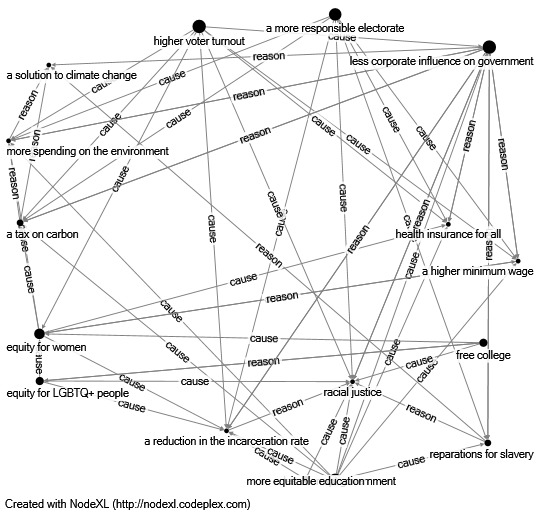
It becomes complicated–perhaps too complicated to understand visually. But it’s clear that he believes higher voter turnout and a more responsible electorate are “upstream” factors–they cause many desirable outcomes–even though he did not initially choose them as his priorities. It makes sense to me that they are means to the ends he favors.

Finally, I showed respondents random pairs of items and asked, “Imagine x happened. Would that change your opinion by making you more supportive of y?” This produced another kind of connection (hypotheticals), which I can add to the first respondent’s map along with the causes and reasons:
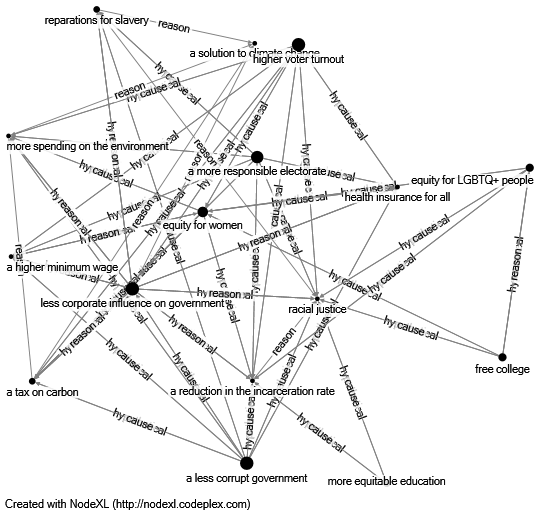
Metrics suggest that this addition doesn’t actually change this person’s map very much, although it adds a few ideas at the end of arrows.

An example: the role of reparations in the mentality of the left

Months ago, I hypothesized that reparations for slavery play an important role in the thinking of left-liberal Americans. Progressives oscillate between hostility to the US government and desire to expand federal economic action. If the government paid reparations, progressives would trust it more and would therefore tilt to democratic socialism.

I can identify some individuals who may exhibit this logic. For instance, here is a 40-year-old white woman who favors a set of progressive outcomes and sees all of them as reasons to reduce corporate power over government (rather like the first man discussed earlier):

She did not select reparations as one of her original priorities, but she was asked whether actually seeing reparations happen in the world would make her more favorable toward other outcomes. She said it would make her more supportive of 10 things, including trust in government and civility. One can imagine that she thinks: if the government paid reparations, I would want people to trust it and would want citizens to be civil to each other, because the regime would be more legitimate. However, this is largely my inference about her responses, and it’s not a common pattern in the data.

These are three examples from the 100 cases that I collected. I have many more to look at, and I have IRB permission to interview selected respondents about their reasoning.

Aggregate results

I am also interested in examining the aggregate data. One evident finding is that people’s top priorities for how they would like to see the world change are not the same as the factors they see as most influential.

In my sample, the most frequently chosen goals are:

  1. health insurance for all
  2. a solution to climate change
  3. a higher minimum wage
  4. racial justice
  5. more school choice

The items that are seen as having the most direct effects on other items are:

  1. health insurance for all
  2. a less corrupt government
  3. less corporate influence on government
  4. a more responsible electorate
  5. more equitable education

And the items that have the most links of any kind to other items are:

  1. health insurance for all
  2. a less corrupt government
  3. racial justice
  4. more trust in government
  5. economic growth

Healthcare hangs in there as the top priority however you slice it. However, better government and economic growth–which are not chosen as high priorities from a simple list–emerge when people think about various kinds of premises or causes for the things they do value.

Another method would be to measure the relationships between people’s networks of ideas and a different variable of interest. I was planning to look at self-placement on an ideological scale, but my sample clusters together too closely. Seventy-four percent rate themselves between 0 and 2 on a 0-10 scale.

Instead, I am using as the dependent variable how people rank AOC compared to other Democratic politicians. I chose that outcome because her ranking correlates most strongly with ideological placement, and also because the biggest negative correlation in the whole matrix is between her rankings and Joe Biden’s (-0.67). Plus, her rankings have a nice distribution: the median is 3 on a 1-5 scale. So I take her strong supporters and opponents to mark the ends of a meaningful spectrum within the US left.

If we simply correlate the priorities that people choose (or don’t choose) with their rankings of AOC, then the correlations that are significant are:

  • more school choice and racial justice (which were chosen by identical people*)
  • equity for LGBTQ+ people
  • (not choosing) economic growth
  • (not choosing) less crime
  • (not choosing) a reduction in government debt

These correlations make intuitive sense to me. Among liberals, those who care less about crime, deficits, and growth would like OAC best.

If you put all the choices together with the demographics and ideology in one linear regression model to predict support for OAC, it does a decent job (r-squared = 0.488).** However, none of the individual items (including ideology) are statistically significant. One could conclude that knowing which items people pick helps you to predict their opinion of AOC, but you need to know most of the items.

If, instead, you look at which items people thought were reasons for other items, the model is more predictive (r-squared = .608 with the same number of variables) and ten items become stat. sig. on their own (p <.05). Knowing that an individual sees one of these items as a reason for other items gives a basis to predict that this same individual likes (or dislikes) AOC.

That seems like confirmation of my original hypothesis. The structure of people’s beliefs–more than the things they support–predicts a consequential opinion. However, I am still working on the regression and other aggregate methods; suggestions are welcome.

*Increasing school choice was also popular. I am not surprised to see support for that idea among liberals. One thing that may be surprising is a perfect correlation between racial justice and school choice: the same 49 people chose both of those items. **For this model, I omitted the people who placed themselves in the right half of the ideology scale, who looked to me like outliers. See also: ideologies and complex systems;  it’s not just what you think, but how your thoughts are organizedthe pivotal significance of reparations for the American left; etc.
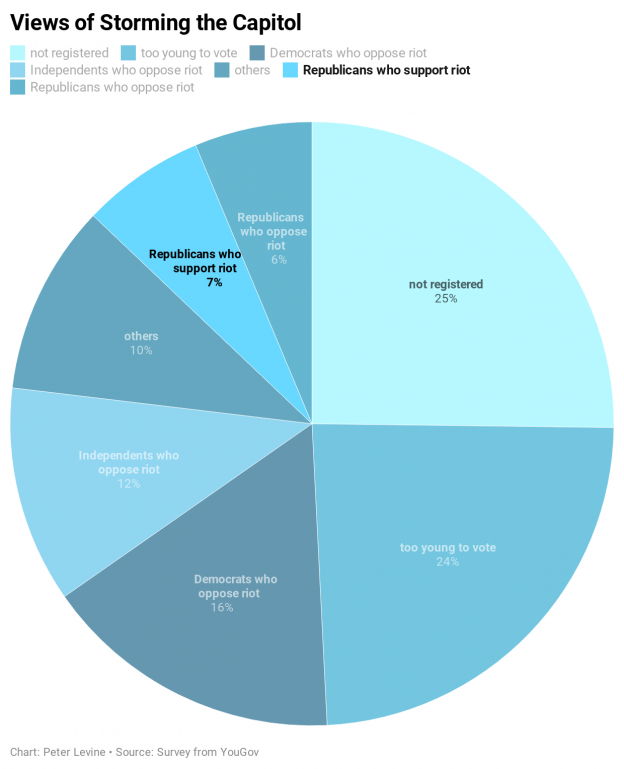
7% of Americans are the hard core problem

YouGov reports: “One in five voters – including 45% of Republicans – approve of the storming of the Capitol building.” This is important and bad news. I do not want to minimize it, but I would put it in context.

A bit under half of Republicans support the riot in DC. Republicans represent about 29% of registered voters. Registered voters represent about two-thirds of adults. Adults represent about three-quarters of Americans. By the time you isolate Republican registered voters who support the riot, it’s down to about 6.6% of the population.

To be sure, some of the people in the other pie slices are also part of the problem. For instance, within the “other” slice are 2% of the registered Democrats and 21% of the registered Independents who support the riot. (A total of 10.1% of all Americans support the storming.) Most of that slice consists of people who don’t have an opinion, which is a problem in itself. And among the under-18s and the non-registered people, some probably hold views aligned with Trump.

Still, it is worth putting the hard-core problem in some degree of perspective. My guess is that the images from yesterday will basically become the capsule summary of the Trump years, except for a smallish and dwindling proportion of Americans.

(Survey data from YouGov. Registration percentages from Pew, 2018. Age distribution from Census, 2010.)

three new cases for learning how to organize and make collective change

The SNF Agora Institute at Johns Hopkins University has published three cases about the choices and dilemmas that confront groups of people who strive to make social change. These are like business-school cases: they are factual narratives that conclude with moments of choice that are meant to be discussed in groups, whether in high school, college, or in movements and organizations.

I am proud to have played a role in the project from the start. We felt that cases are really useful for teaching and professional development, but most actual cases provided by business schools, schools of public policy, and wonderful initiatives like The Pluralism Project and Justice in Schools focus on individual protagonists. We were interested in voluntary groups that must deliberate before they can choose. David Moss’s excellent Case Method Project does some of what we intended, but its focus is on high schools and American history, whereas we wanted to serve social movements with some current examples.

These are free, and we would love to know how they work in various settings.

The Montgomery Bus Boycott

What objectives, targets, strategies, demands, and rhetoric should a nascent social movement choose as it confronts an entrenched system of white supremacy? How should it make decisions?

The Montgomery, Alabama, Bus Boycott of 1955–1956 is a classic example of a social movement episode that accomplished its immediate goals despite severe obstacles. It catapulted the 26-year-old Rev. Martin Luther King Jr. into international prominence and launched similar episodes in many American cities across the South and then also the North. By investigating their situation and choices, you can develop skills and insights to use as activists today.

The ISAIAH Trash Referendum

Should a faith-based organization take on an issue not of its choosing? Can relational organizing help its leadership support a new mayor while also engaging their base and holding their coalition together?

This is a case study about an organization in Minnesota called ISAIAH, a faith-based organization that works to expand the power and influence of people who have often been overlooked, especially poor people and people of color.

This case examines what happened when, to support a new mayor with whom the organization wanted to work,  ISAIAH became involved in a divisive issue—not of its own choosing—that revolved around garbage. ISAIAH faced at least three choices: 1) stay out of the fight over garbage; 2) use mobilizing techniques to help the mayor win the garbage issue; or 3) use relational organizing to enter into a power relationship with the mayor in the garbage fight—even though most of the people in ISAIAH’s networks didn’t care much about the issue.

The AMOS Project and the Campaign for Universal Preschool

Can faith-based organizers garner enough support to win universal preschool in a racially divided city? How should a grassroots group manage a disagreement with its own powerful coalition partners?

This case study is about the AMOS Project, an organization in Cincinnati, Ohio, and its grassroots efforts to pass legislation that would provide preschool education for most of the city’s children. AMOS’s grassroots efforts increased the political pressure to pay for the program, but at one point, the whole effort seemed likely to fall apart. How could a grassroots network of congregations manage a disagreement with allies in the business community and achieve its goals?

Complexities of Civic Life

Below is an excerpt from a new article of mine in a special issue of The Bridge on “complex unifiable systems.” The Bridge is a quarterly journal of the National Academy of Engineering. The article and the whole special issue are available free. Several other contributions may also be interesting to civic and political people. I would cite this piece as: Peter Levine, “The Complexity of Civic Life,” The Bridge, vol. 50, no. 4 (Winter 2020), pp. 34-6


Imagine that some college students have volunteered to serve meals at a homeless shelter. They love the experience because they are helping others. During the reflection session after the meal, one student remarks, “Serving the homeless was so great! I hope this shelter will still be open 50 years from now so that my grandchildren can also serve here.”

The progressive educator who has organized this experience is horrified and says, “No! Our goal must be to end homelessness. You must think about root causes, not treat the most superficial symptoms. What are the fundamental causes of homelessness?”

Chastened, the students debate the root causes. Some argue that homelessness results from poverty, which, in turn, is a byproduct of capitalism. Others counter that the root cause is the cost of real estate, which is inflated by -zoning laws. They are deep into a discussion of capitalism and the state when the Brazilian legal theorist and former cabinet minister Roberto Mangabeira Unger happens to walk by.

“Stop this!” cries Unger. “You are looking for fixed, simple, law-like causal relationships. We human beings have made the social world. What we have made, we can also change—not just the components, but also the many ways they fit together and affect each other.”

Unger (who is famous for long speeches) continues, “By looking for root causes, you are limiting your imaginations, assuming that the only important changes are the hardest ones to accomplish. Be more creative. What if we got rid of all zoning and rent control but also gave everyone a voucher for free rent? What if public buildings were retrofitted to allow people to sleep comfortably in them at night? What if houses were shared, and homeless people occupied the temporarily empty ones? What if…?”

The Myth of the Root Cause

I have invented this fable and Unger’s words, but I am paraphrasing portions of his False Necessity (2004) to support a serious point.

root cause is a metaphor. The root is literally the vital part of a plant that is hidden from sight; digging it up will kill the whole organism. The word radical derives from the Latin word for root. The educator in my fable thinks he is radical because he directs his students to the deepest, least visible, and least tractable aspect of the problem, assuming that attacking a root is the way to a permanent solution.

But a social problem rarely has one root cause or leverage point. Many factors combine to determine results. The same variables that are outcomes are also inputs or causes. Virtuous and vicious circles and feedback loops are common phenomena that illustrate a broader point: any society is a complex network of causes and effects. Interventions are possible at multiple points.

Strategies and Skills for Networks of Causes

Like a root, a network is a metaphor (or mental model) for describing reality, but the difference is important. To improve a society viewed as a complex network requires particular skills and strategies—not those favored by would-be “radicals” who insist on focusing only on “the root.”

First, strategies should be tailored to an individual’s or organization’s location in the network. Management scholar Alnoor Ebrahim (2019) argues that organizations differ in how reliably they can predict outcomes in a system as a whole. They also differ in how much control they can exercise over their portions of the system.

These are two distinct dimensions. With low control but the ability to make reliable causal predictions, a wise strategy may be to identify a specific niche where the organization can operate effectively. …

[The rest is here.]

American exceptionalism, revisited

“We are unique among militaries,” [Acting defense secretary Christopher] Milley said in a Nov. 12 speech at the new National Museum of the United States Army. “We do not take an oath to a king or a queen, a tyrant or a dictator. We do not take an oath to an individual. No, we do not take an oath to a country, a tribe or a religion. We take an oath to the Constitution.”

This claim is very easy to fact-check. It takes seconds to find these examples:

  • Germany: “I swear to loyally serve the Federal Republic of Germany and to courageously defend the right and the liberty of the German people, so help me God.”
  • France: “I swear to fulfill my duties well and faithfully, to observe the duties and the reserve they impose on me. I will strictly comply with the orders received with respect for the human person and the law. I promise to demonstrate dedication to the public good, righteousness, dignity, prudence and impartiality. I undertake to make only legitimate use of the force and powers entrusted to me and not to reveal or use anything that will be brought to my attention during the exercise of my functions” (for reservists).
  • Israel: “I swear and obligate myself on my word of honor to remain loyal to the State of Israel, its laws and its legitimate administration and to devote all of my strength, and even to sacrifice my life, in the defence of the homeland and the freedom of Israel.”
  • Finland: “Everywhere and in every situation, whether in peace or war, I will defend the inviolability of my fatherland, its legal system of government and the legal authority of the realm. If I perceive or gain knowledge of activity to overthrow the legal authority or to subvert the system of government of the country, I will report it to the authorities without delay.” (excerpt)
  • Switzerland: “I swear to serve the Swiss Confederation with all my might; to courageously defend the rights and freedom of the Swiss people; to fulfill my duty, at the cost of my life if necessary; to remain faithful to my troops and to my comrades; to respect the rules of the law of nations in time of war.”
  • China: “I pledge to be loyal to the Constitution of the People’s Republic of China, safeguard the authority of the Constitution, fulfill the legal responsibilities of my position, be loyal to the Motherland, be loyal to the people, show the utmost respect for my duty, pursue public affairs with integrity, accept the supervision of the people, and to work for a great modern socialist country that is prosperous, strong, democratic, culturally advanced, harmonious, and beautiful!” (This is for the Central Military Commission, not for regular officers, to my knowledge).

I am fascinated by the tendency to assume that good things about the USA are unique in the world. My favorite example was when a judge told me and my peers on a jury pool that we should be proud to live in the only country that provides a right to trial-by-jury (overlooking about 50 others).

One interpretation is that this is just harmless enthusiasm. Instead of saying, “Yay, America!” people say, “Only in America!”, meaning the same thing.

Another interpretation is xenophobia. To assume that all other other militaries of the world (including our NATO partners) swear oaths to a “king or a queen, a tyrant or a dictator” is to hold a very dark view of the world beyond our borders.

I suppose Mr. Milley’s claim could be partially defended on technical grounds. Many oaths mention the country or law, not the constitution, per se. Canadian and British officers swear oaths to the Queen, although that’s a way of expressing loyalty to a constitutional democracy. The oath to uphold the constitution of the PRC is a bit hollow, given one-party control. Then again, what about Germany, Israel, France, etc., etc.?

My own theory is anxiety. If Americans do something wise (like requiring our soldiers to swear to uphold our constitution)–and so do many other countries–then comparative questions naturally arise. How do various countries manage their civilian-military relations? How seriously do their commanders-in-chief take their oaths? Sometimes, the USA looks good in comparative perspective; but sometimes it does not look good at all. And deep down, I think a lot of Americans are conscious of relative decline compared to the competition. One way to avoid facing that anxiety is to proclaim, “Only in America!” and refrain from looking overseas at all.

I’d like to see the question of American exceptionalism become more empirical and less ideological. In what respects is the USA unique? That is a question that can be answered. Students, civil servants, judges, and all Americans should have the courage to ask it seriously and see what they find.

See also only in America!; American exceptionalism and anxieties about American exceptionalism.