explore equity and inequity in the USA

On the Tufts Equity Research website is a user-friendly tool that allows anyone to explore data from our May 2021 national survey. The tool requires no specialized background or vocabulary to use. You can just select pairs of variables and see the results.

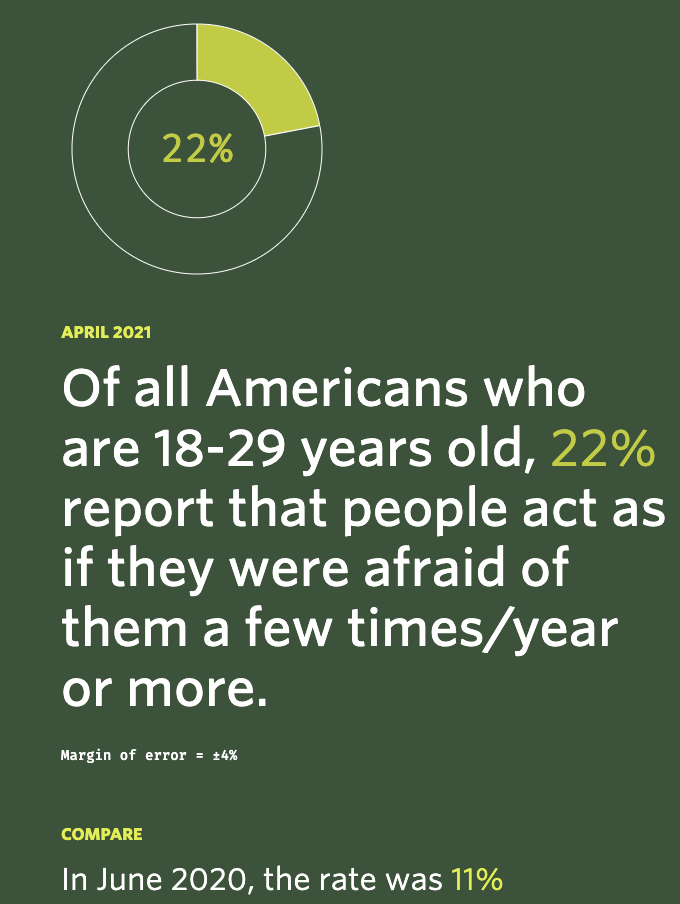
For instance, I looked at the proportion of Americans who report that other people act afraid of them because of their identity. The graphic shows the result for the whole population. The rate has doubled since last year, and I suspect that’s because we have feared each other during this year of pandemic and political conflict.

One can also look at differences by demographic category. For instance, 33% of Black Americans–versus 15% of whites–believe that they are feared because of their identity.

You can explore hundreds of other combinations on the site.

debating politics in a pandemic

A few months ago, I published Levine, P. (2020). Theorizing Democracy in a PandemicDemocratic Theory7(2), 134-142, with the following abstract:

The COVID-19 pandemic raises questions about the future of democracy and civil society. Some recent predictions seem to use the suffering to score points in ongoing political arguments. As a better example of how to describe the future during a crisis, I cite the prophetic voice of Martin Luther King, Jr. King does not merely predict: he calls for action, joins the action, and makes himself responsible for its success or failure. With these cautions about prediction in mind, I venture two that may guide immediate responses. First, communities may erect or strengthen unjustifiable barriers to outsiders, because boundaries enhance collective action. Second, although the pandemic may not directly change civic behavior, an economic recession will bankrupt some organizations through which people engage.

Today, Faculti released the video of an interview with me based on this article. In the interview, I also mention Levine P. (2021) Why protect civil liberties during a pandemic?J Public Health Policy. 42(1):154-159. `

By the way, I think my second prediction (or worry) proved too pessimistic, at least in the USA, mainly because of the federal aid packages.

the new dean of Tisch College: Dayna Cunningham

I’m pasting the official announcement below; and here is a link to a longer article. As a member of the search committee, I share this news with enthusiasm and excitement, and I second the sentiments about Alan Solomont, who has built the college into the force it is today.

Dear members of the Tufts community,

We are delighted to announce the appointment of Dayna Cunningham as the Pierre and Pamela Omidyar Dean of the Jonathan M. Tisch College of Civic Life. She will assume the deanship on July 1.

With decades of leadership experience in not-for-profit organizations and higher education, Dayna has devoted her career to promoting civic participation, building robust community partnerships, and advocating for underrepresented communities.

Dayna comes to Tufts from MIT, where she was the founder and executive director of the Community Innovators Lab (CoLab), a center for urban planning and development that engages students and community groups to build large-scale collaborations that strengthen civic infrastructure in marginalized communities. One example of CoLab’s work is a partnership with the Bronx Cooperative Development Initiative on infrastructure projects that build an ecosystem for economic democracy for people of color. Another example is CoLab’s Inclusive Regional Development program, which works with communities and practitioners to support innovative models for equitable development and well-being in Latin American countries.

Prior to founding CoLab, Dayna was the program director of the ELIAS Project at MIT, which was a collaboration between businesses, NGOs, and government to create initiatives that supported economic, social, and environmental sustainability.

Before her career in higher education, Dayna spent several years as a civil rights attorney with the NAACP Legal Defense and Educational Fund, litigating voting rights cases in Arkansas, Tennessee, Louisiana, Mississippi, and other Southern states. She also worked in philanthropy as an associate director at the Rockefeller Foundation, where she integrated racial equity into resource spending and designed an annual grants program addressing civil rights and policy issues in the U.S.

Dayna earned an MBA from MIT Sloan School of Management, a JD from New York University School of Law, and an undergraduate degree from Harvard and Radcliffe Colleges.

Dayna’s experience and accomplishments are complemented by her longstanding commitment to active citizenship and community impact—values that are foundational to Tisch College. We are confident that Dayna will make invaluable contributions both in her leadership of Tisch College and as a member of the university administration.

We are grateful to Alan Solomont, A70, A08P, for eight years of outstanding service as the dean of Tisch College. A beloved member of the Tufts community who has had a profound impact on the university, he will be retiring at the end of June. We would also like to acknowledge the diligence and thoughtful recommendations of the search advisory committee, led by School of Arts and Sciences Dean Jim Glaser.

Please join us in welcoming Dayna Cunningham to her role as the Omidyar Dean of Tisch College.

Sincerely,

Anthony P. Monaco
President

Nadine Aubry
Provost and Senior Vice President

results of the Civic Spring Project

Last spring, the Institute for Citizens and Scholars (formerly the Woodrow Wilson National Fellowship Foundation) jumped into action to support community-based organizations that would help young people to address the crisis of the pandemic. Their Civic Spring Project funded Groundwork Elizabeth (NJ); The Institute of Engagement (Houston, TX); Kinston Teens, Inc (NC); the Prichard Committee for Academic Excellence (KY); Youthprise (MN), and the Newark (NJ) Youth One Stop and Career Center. Along with funds, these organizations received in-kind support and were included in a professional learning community.

Now CIRCLE has published a detailed evaluation. (I did not play any role in it, although at an earlier stage, I was one of many colleagues who had advised on the design of the project and then helped to select the grantees.)

Almost all the youth in these projects said they learned the kind of content that they would learn in a civics class, which demonstrates that hands-on, out-of-school projects can teach the facts and skills that we also value in an academic context.

Sixty-one percent felt that they had made their communities better places to live. For instance, “the Kentucky Student Voice Team members extensively documented the experiences of Kentucky students during the pandemic and used those findings to inform policymakers. … Minnesota Young Champions recruited young Minnesotans to engage in advocacy work to extend unemployment benefits to young people.”

CIRCLE also presents nuanced findings about the conversations that included youth and adults or that convened people from various programs and roles. They report some challenges: power dynamics, lack of clarity about roles, and some issues with communication. For instance, “The same behaviors regarding [the Community of Practice] were interpreted differently–the CoP planners intended for flexibility and responsiveness, but CoP participants perceived this as unclear purpose and lack of intentionality in the planning, schedule, design, and implementation of the CoP. Different stakeholders held different goals and they were communicated at different times and through different fora.”

Collaboration is hard, especially when people come from different walks of life; and we’re not very good at it these days. (See my recent Medium post.) A classic problem is permitting flexibility while also giving clear direction. We get better at these tasks with practice and reflection, which is exactly what this project offered.

why ambitious ethical theories don’t serve applied ethics

Most applied ethicists are skeptical that we can resolve significant problems by applying ambitious moral philosophies or theories of justice.

I report this skepticism anecdotally, but it comes from 15 years working in an applied ethics center and my peripheral involvement with educational ethics, media ethics, political campaign ethics, and related fields. People who teach ethics in college sometimes require students to apply the big moral theories to practical problems. (“What would Kant say about blockchain?” “What does utilitarianism imply about health reform?”) But these assignments are meant to convey the theories, not to resolve the problems. Professional ethicists rarely write their own “What would Kant say about …?” papers.

Why not? I think the following explanations are plausible. Some are mutually compatible, but they push in different directions:

  1. Stalemate: There are several academically respectable moral theories: utilitarianism, deontology, virtue-ethics, and maybe others. Some individuals are drawn to one theory over the rest, but that is a matter of intuition or sheer preference. Arguments have not resolved the disputes among them. To invoke one theory in relation to a concrete ethical problem just neglects the other theories. Invoking more than one often yields a dilemma.
  2. Pluralism (in Isaiah Berlin’s sense): Maybe the truth about the human world is that it involves many different kinds of good thing: various negative and positive rights, welfare outcomes, equity and other relations among people, procedural fairness, etc. These good things conflict, and one must choose among them. Each moral theory tends to illuminate and justify one kind of a good, yet practical wisdom is about balancing them.
  3. Particularism: The appropriate focus for moral assessment is not an abstraction, such as freedom, but a concrete particular, like the school in my neighborhood. In a parallel way, the most important focus for aesthetic evaluation is a whole painting, not all the instances of yellow ochre that appear in different paintings. You can believe that yellow ochre is a nice color, but that doesn’t tell you much about whether or why Vermeer’s “View of Delft” is beautiful, even though that painting does incorporate some yellow ochre. Likewise, you can’t tell much about a given situation in which there is some freedom just from knowing that freedom is generally good. If the appropriate focus of ethical evaluation is a concrete, particular, whole thing, then theorizing about abstractions doesn’t help much. (See Schwind on Jonathan Dancy, p. 36 or Blackburn, “Securing the Nots,” p. 97.)
  4. Complexity: Ethical problems often involve many people who have divergent interests, beliefs, rights, goals, etc., and who continuously affect each other. Their choices and responses are unpredictable. Given the resulting complexity, it is usually hard to model the situation empirically–regardless of whether one is more interested in consequences, rights, procedures, comparisons among people, or all of the above. Once you’ve modeled the situation reasonably well and you think you know what would happen if A did B to C, then a Pareto-optimal choice may become clear. For instance, reducing imprisonment in the USA would (I think) enhance individual rights, equity, utility, non-domination, rule of law, and practically every other value I can think of. However, agreement about Pareto-optimal choices is fairly rare, and the most common reason is persistent debate about the empirics. Moral theory really doesn’t help much.
  5. Narrowness of philosophy: To “apply moral philosophy” often means to apply Kantianism, utilitarianism, 20th-century virtue ethics, social contract theory, or perhaps one or two other idea systems. (Maybe some Levinas; maybe some Marx.) These systems have great value, but also limitations. They usually focus either on individual choices at given moment (Is it OK to lie?), or else on what Rawls called the “basic structure of society,” but not on the overall shape of a single human life, practices for enhancing virtues, deeply ingrained forms of oppression, institutions other than governments, or group processes other than lawmaking. Some of these matters are better explored in Hellenistic and classical Indian and Chinese philosophy or in applied social science fields; some have never received adequate attention. It’s not that abstract theory is irrelevant to concrete choices, but that the most widely respected philosophical theories are too narrow.
Lady Philosophy in Boethius: “On the lower fringe of her robe was woven the Greek letter ? [for practical reason]; on the top, the letter ? [for theory]; and between the two was a staircase from the lower to the upper letter.”

I think that large concepts or themes can help us think about what to do. Among the useful concepts for practical reason are the major concerns of modern Anglophone philosophy, such as rights and forms of equity. These concepts or themes do arise in concrete cases. But many other concepts are also useful. Depending on the circumstances, you might get as much value out of Albert Hirschman’s scheme of exit, voice, and loyalty as from Rawls’ account of justice, even though Hirschman’s theory is not explicitly normative. And examples, narratives, and concrete proposals also provide insights.

A reporter supposedly asked Earl Long, “Governor, should you use ethics in politics?” Long said, “Hell yes, use anything you can get your hands on!” I am inclined to agree with the governor–use whatever ideas help you to reason about what to do.

In turn, studying and discussing concrete problems can generate questions and insights that enrich abstract philosophy and social theory. If we must call pure philosophy the “top,” and practical reasoning the “bottom,” then influence should flow from bottom-up as well as from top-down.

(I am inspired here by a fine conference paper by Julian Müller, but I think these are my own established views rather than his. See also: structured moral pluralism (a proposal); Philosophy as a Way of Life (on Pierre Hadot); the importance of the inner life to moral philosophy; modus vivendi theory; consequences of particularism; etc.