A Festival of Cases, June 24

There is still time to register for the Frontiers of Democracy conference, which will be held on June 24, 2022, from 9:00-4:30 pm.

The in-person version will take place at Tufts Medical School in Boston’s Chinatown. There is also a parallel Zoom version, which will start at 9:30 and end at 4:00.

This is the registration link: https://tinyurl.com/2p976shr. Note that there are several prices and options. If you wish to attend, please register soon so that we can plan the details and you can receive updates.

This year’s conference has a special format. The main activity will be to deliberate in small groups about the issues raised in selected “civic cases.” People will participate either in face-to-face or Zoom deliberations, not in hybrid discussions, but there will be a few concise plenary presentations.

Civic cases describe difficult choices faced by real groups of activists, social-movement participants, or colleagues in nonprofit organizations. By discussing what we would do in similar situations, we can develop civic skills, explore general issues, and form or strengthen relationships with other activists and thinkers.

Most of the cases for Frontiers 2022 have been developed by the SNF Agora Institute at Johns Hopkins University, Justice in Schools, or the Pluralism Project at Harvard, all co-sponsors of Frontiers this summer. Unlike most cases about business, public policy, or ethics, these stories involve groups of voluntary participants who must make decisions together.

You will be able to indicate your preference for which cases to discuss. This is the working list, still subject to additions and changes: https://sites.tufts.edu/civicstudies/case-studies/.

Before the pandemic, Frontiers of Democracy drew 140 people annually, and some people attended primarily to connect to a professional network. So far, about 45-50 people are registered for the 2022 conference, and about half of those will be remote. People should be aware that the conference will be smaller than usual, although I still anticipate some additional registrants. The “civic cases” format will work well for an intimate conference, but the network will be smaller than usual.

a Hegelian meditation

This is a breath: in and out.

That sentence is true; if the mind knows anything, it’s the reality of a breath.

By the time that thought has formed, it is false. This is not a breath—that thing is gone; it does not exist. Perhaps there is a new breath, and the sentence is true again, but it has a new object. It is true and false that “This is a breath.”

The mind turns to an abstraction: breath in general. Surely there are many breaths, all exemplifying one concept. In contemplating that concept, the mind can only think of a breath, and by the time it has that thought, that breath is gone. It is false that this is breath and that there is breath.

Nevertheless, a new breath comes. This one has a certain sound, familiar since the cradle. This breath has a certain feel, swelling the chest. The sound is not the feeling, yet the breath is one thing. Its aspects are distinct because of the nature of the one who perceives them.

The mind perceives the one that hears and feels the breath. It finds a subject that perceives and forms the sentence: “I perceive my breath.” That sentence is false. The ‘I’ is what perceives the breath, but that breath no longer exists. The ‘I’ that perceived the breath is no longer. The ‘I’ that perceived the ‘I’ is no longer. What no longer is, is nothing.

Surely there is a very general concept, thisness, of which this breath and this I are examples. In considering this concept, the mind can only think of this breath and this mind, and the concept that this mind forms of this breath is false by the time it forms it. That mind, too, is gone by then.

The mind conceives a mind in motion, a restless mind, a mind detached from the things it perceives and from itself, yet always compelled back to them. The mind had sought to calm itself by reflecting on its breath, but close inspection of its own experience has opened a whole box of things, none of which stays still when examined separately. Experience has revealed itself as something complicated, which the mind somehow already knew and which it cannot ever quite grasp. It strives to embrace and accept this manifold complexity, of which it is part.

These words are about a mind; a mind has been the subject of many of these sentences. Yet that mind is not the subject that reads these words. That subject is you, the reader. When you read the words “I perceive my breath,” they are not about your breath but somehow about a writer’s thoughts.

What you directly perceive is a string of words. I, the writer, had thoughts that I wanted to convey and had motives for writing them. You are entitled to question my motives. (Self-promotion? Self-indulgence?) But my motives are gone now, and so are your thoughts about my motives, like the words above the ones before your eyes right now.

You may have new thoughts, and they may happen to look identical to your previous thoughts; but they are not the same thoughts, because each thought occurs in time. You can form the idea of thought in general, but the only way you can think of that idea is to form a particular thought, which occurs in time and is then gone. You both have a thought about me and you do not have that thought about me.

I presume that I know who I am and what I think. Since this text is published on a public website, I don’t know who you are and may never have even heard your name. For your part, you know who you are, but not much about what I am thinking, except for whatever these words may mean to you. Yet in reality, I do not know what I think until I express it, trying to make meaningful sentences for a “you” that I envision in vague ways. And you do not know what I have written except insofar as you make your own sense of these sentences.

You may chafe at my control. I chose and arranged the words that might influence your mind. Yet I would not write at all if not in hopes of being read. The writer needs the reader as much as the reverse–as much as the mind needs its objects and the objects need the mind. You know that I need you. I know that you know that I need …

The topic of this text is meditation on the breadth, anapanasati. That practice is widely prescribed to address a restless, unsettled, unhappy mind. If we ask why it is recommended today, one kind of answer cites its effectiveness. Perhaps people teach and practice anapanasati because it works. In that case, the test is to try it, as we do here. The results will depend on what specific thoughts the specific mind generates.

Another kind of answer is a long story that could involve Californian beat poets who turned into Dharma bums after encountering GIs home from Japan, and General Tojo meditating in Zen monasteries while conquering China and attacking Pearl Harbor, and Dosho bringing Chan to Japan as Zen, and Bodhidharma bringing Buddhism to China, and the Buddha teaching breath-mindfulness in the Anapanasati Sutta, and people teaching Siddhartha Gautama the words and ideas that he used as he became the Buddha, and people teaching those people. We know just tiny fragments of this story, to which unsung thousands have contributed, both for good and for evil, yet it is inherent in the fashions of our moment.

Each mind recapitulates the work of countless minds, from which it derives all its words and ideas. A mind without history would be empty. For example, “This is a breath” is a sentence in English with thousands of years of thought embedded in it.

We can say that the Buddha already knew everything under the Bodhi tree, but to say what he knew requires explicating the various schools that have analyzed experience into its components, and then declared the components also to be illusions of the consciousness, and then declared the consciousness to be an illusion, and then analyzed negation, and so on, in a logical progression like the one accomplished by stoicism, skepticism, and their successors. To explicate the truth requires excavating this “conceptually grasped history” (begriffne Geschichte), these successive turnings of the Wheel that constitute the present.

Although my topic here is anapanasati, my method and structure come from Hegel’s Phenomenology of Spirit. Why? Because I studied that text in a seminar at age 20. Rereading it 35 years later, I find that I had forgotten most of it, although certain familiar phrases signify that it has been there all along, even when I was reading Shantideva or focusing on my breath. Perhaps you know Hegel better than I. Perhaps you have never heard of him, but his mind has already influenced yours by way of Marx and Dewey and Martin Luther King, Jr. and the tangible structures that those three, and many others, have inspired.

Each mind, all minds, and nature are one.

That is a vacuous cliché and false, in just the same way that “This is a breath” is false. It is also true, in the same way. To know it requires unfolding what the mind already knew and can never fully know, one stage at a time, recapitulating the work of many minds with many objects, which are also one mind with one object.

Sources: GWF Hegel, The Phenomenology of Spirit, trans. & ed. by Terry Pinkard (Cambridge University Press, Kindle Edition, 2018), especially the Preface (sec. 72) and sections A.I, B.IV.A-B, and DD; and Shantideva, The Bodhicaryavatara, translated by Kate Crosby and Andrew Skilton, especially chapters 8 (on meditation) and 9 (dialectics among the Buddhist schools). See also: Philosophy as a Way of Life (on Pierre Hadot); Foucault’s spiritual exercises; the grammar of the four Noble Truths; on philosophy as a way of life; my self, your self, ourselves; Buddhism as philosophy; freedom of the will or freedom from the will? (comparing Harry Frankfurt and Buddhism); how to think about other people’s interests: Rawls, Buddhism, and empathy; compassion, not sympathy; “you should be the pupil of everyone all the time”; and the sublime and other people
what to keep and what to let go

Here is a podcast episode by Tufts’ Julie Flaherty & Anna Miller. Their summary says:

Sometimes we don’t even know why, but we hold onto things. We’re not talking about bad relationships or lousy jobs, but the actual stuff that takes up space. How do you decide what’s worth keeping and what you would be happier getting out of your life?

In this episode, we get advice from a home organizer on how to pare down and from an archivist who knows something about what’s worth keeping for the next generation.

Even if you decide you want to donate your stuff, we learn that it’s not always easy to find the right home for it, especially if it’s a 30-ton book collection you inherited from your father. 

That 30-ton book collection belonged to our family, and in the podcast, I share a few thoughts about giving and receiving.

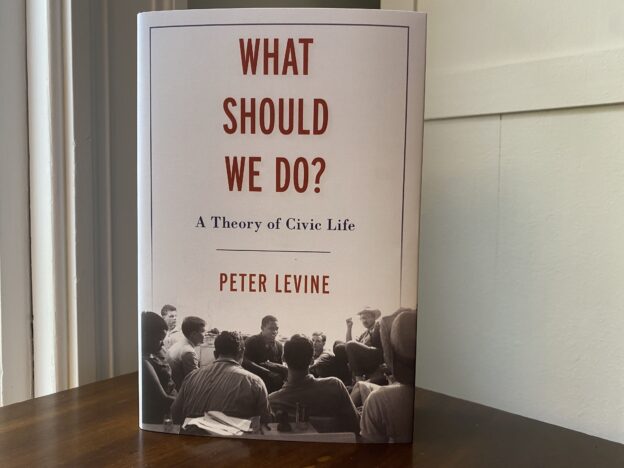
What Should We Do? A Theory of Civic Life

It is real: I have received my author’s copies, and the print and electronic versions are available for purchase. Citation: Levine, Peter. What Should We Do?: A Theory of Civic Life. Oxford University Press, 2022

This is a companion website that is meant for practitioners and students: https://sites.tufts.edu/civicstudies/. It can be used without reading the book; it employs the same structure to present a collection of practical tools, examples, and short explanations of theory. The book offers much more argumentation and detail.

From the back cover:

“Peter Levine is among the leading philosophers of civic life of his generation. What Should We Do? is his magnum opus. It ranges widely from a masterly review of political philosophy to practical suggestions for addressing issues like the Black Lives Matter movement. For anyone concerned about the state of our democracy and what our role should be, this book is must reading.” — Robert D. Putnam, Research Professor of Public Policy, Harvard Kennedy School, and coauthor of The Upswing: How America Came Together a Century Ago and How We Can Do It Again

What Should We Do? offers a compelling, thought-provoking, and urgently-needed framework for anyone trying to understand how we can relate to and act with each other to co-create a more just world. I love this book and you will too.” — Hahrie Han, Stavros Niarchos Foundation Agora Institute Professor of Political Science, Johns Hopkins University

“Peter Levine makes everyone think more clearly about everything. How fortunate for our country that he’s applied this gift to the realm of civic life. In this insightful and wise book, Levine reveals what it truly means to cooperate, deliberate, and activate—and challenges us to do all three more mindfully.” — Eric Liu, CEO of Citizen University, and author Become America

what does it mean that 130 million adult Americans lack literacy?

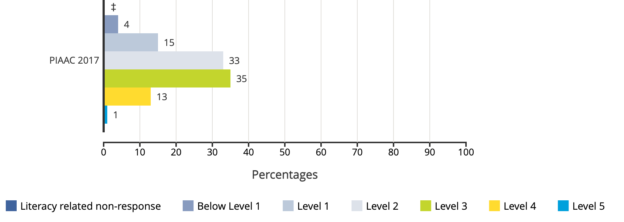
According to data from the Programme for the International Assessment of Adult Competencies (PIAAC), about 130 million Americans between the ages of 16 and 74 cannot read beyond the fourth-grade level. The graph shows the distribution (where level 3 = fourth grade).

Taken at face value, this statistic has troubling implications for politics (as well as economics, health, and other matters). It does require some caution, however.

First, especially for adults, literacy is very heterogeneous or multidimensional. It’s easy to imagine that one adult could manage the King James Version, a different one could interpret instructions for installing an HVAC system, and a third could enjoy reading a thriller.

Texts present diverse challenges. The Bible can be forbidding unless you are familiar with its vocabulary and cadences from sermons. The Associated Press’ “inverted pyramid” style begins each news story with the latest developments and then explains the broader picture several paragraphs later. This is off-putting for people who have not been following the story, even if their vocabulary is good. For instance, I have paid zero attention to the Johnny Depp trial and don’t happen to know who Amber Heard is, which makes the breaking news stories actually a bit hard for me to understand. Yet my job involves reading hard texts all day.

Sample items from the PIAAC are here. They are appropriately diverse, but mostly oriented to work or news. There would be no way to design a fully comprehensive adult literacy assessment or to score it on only one metric.

Second, some texts are unnecessarily hard to read. US ballot initiatives are scandalously dense. (Compare the Brexit referendum, which asked, in full, “Should the United Kingdom remain a member of the European Union or leave the European Union?”) The inverted pyramid style is problematic, and good explanatory journalism is too scarce. Many academics write impenetrably. (Including me: why did I use “impenetrably” instead of “badly?”)

Third, we live in a profoundly audiovisual culture, and you can obviously learn an enormous amount from sound and images. Nor are books necessarily preferable. Leaving aside children’s books, the best selling book in the US last year was a right-wing screed, Mark R. Levin’s American Marxism, which is worse than much TV and radio. In Russia in the 1990s, 39% of all publications were related to the occult, which is hardly a sign of rigorous review. (On the other hand, people who learn a lot from sound and images ought to be able to perform well on the PIAAC assessment.)

Despite these caveats, I’m worried not only that a lack of conventional literacy blocks the flow of valuable information but also that it may be alienating. Imagine that the government, reporters, medical professionals, and others keep sending messages that you literally cannot read. That is not a basis for trust.

We already accept that literacy for children is a public need. To be sure, we don’t succeed with all children, and there are complex questions about why good learning experiences aren’t consistently available for all youth. But no one doubts that the issue merits attention. Adult literacy is also important. Even if we suddenly made K-12 schools work well for all our youth, we would still have about 130 million Americans over school age who cannot score above 3 on the PIAAC.

Adults cannot (and should not be) compelled to do anything to improve their own literacy. But there is a case for much more attractive adult learning opportunities–not only as a path to better jobs but also in the interest of democracy. In my idea world, adult civic education would be literacy education, and vice-versa.

See also a way forward for high cultureseparating populism from anti-intellectualism; a German/US civic education discussion; etc.