In 1983, David P. Billington began his book The Tower and the Bridge with words that could be written today:
While automation prospers, our roads, bridges, and urban civil works rot. Children control computers while adults weave between potholes. The higher that high technology sails the worse seem our earthbound services for water, transportation, and shelter. Yet civilization is civil works and insofar as these deteriorate so does society, our high technology notwithstanding. We forget that technology is as much structures as it is machines, and that these structures symbolize our common life as much as machines stand for our private freedoms. Technology is frequently equated only with machines, those objects that save labor, multiply power, and increase mobility. In reality, machines are only one half of technology, the dynamic half, and structures are the other, static, half — objects that create a water supply, permit transportation, and provide shelter.
This book is devoted to the idea that structures, the forgotten half of modem technology, provide a key to the revival of public life.
Billington offers several provocative distinctions. We have already seen how he distinguishes structures from machines. He also differentiates engineers from architects:
Structural designers give the form to objects that are of relatively large scale and of single use, and these designers see forms as the means of controlling the forces of nature to be resisted. Architectural designers, on the other hand, give form to objects that are of relatively small scale and of complex human use, and these designers see forms as the means of controlling the spaces to be used by people. The prototypical engineering form–the public bridge–requires no architect. The prototypical architectural form–the private house–requires no engineer.
And he distinguishes (structural) engineering from science–even from applied science. In his account, engineering depends on experience and judgment, not on the application of mathematical principles or laws. If I understand correctly, he wants us to realize that a suspension bridge is not a line with mathematical qualities that can be derived from physics. It is a whole bunch of stuff (including joints, hinges, and other components) that works in a particular location. Engineers use thought-experiments, physical models, and experience to draft their designs and often correct them during the construction.
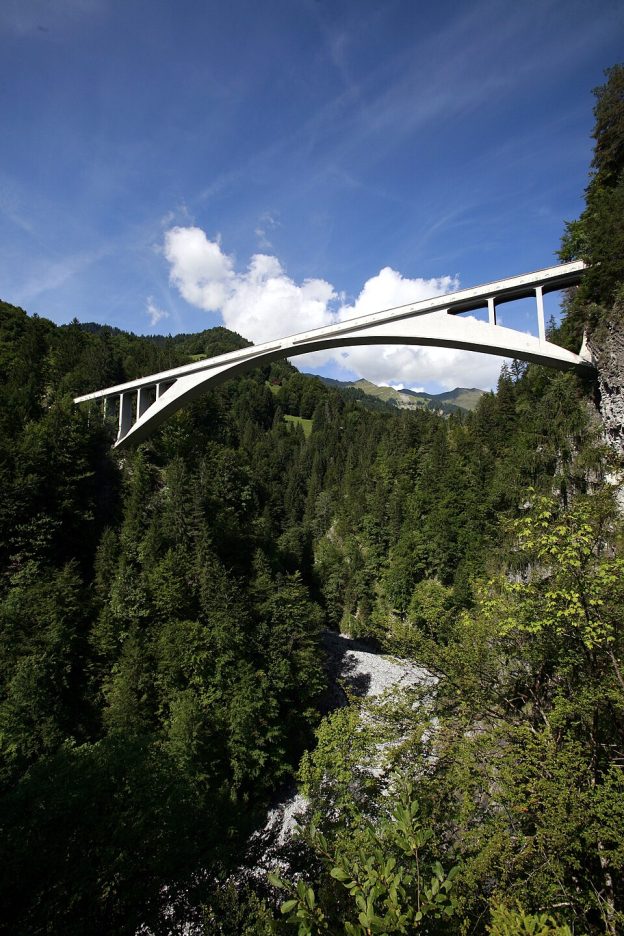
Central to his argument is the claim that engineers have been compelled (since ca. 1790) to pursue, or even to maximize, “efficiency, economy, and elegance.” Whereas an architect might be hired to make an attractive version of something that we already know how to design, a structural engineer’s job is to solve a new problem (such as spanning a river) at minimal cost. But Billington insists that great engineers have been deeply aesthetic and that judgments of beauty have spurred more efficient and economical designs. A good example is the Salginatobel Bridge (1930) by Robert Maillart, which illustrates this post.
Before reading Billington, I would have cited cultural reasons for the turn away from ornamentation and other explicit forms of “style” in modernist architecture, and I would have observed the same turn in other arts, including painting and poetry. I would have said that a recognition of cultural variation–the idea that each time and place has its own style–convinced modernists that style was arbitrary and contingent and turned them toward minimalism and functionalism. Walter Gropius wrote:
We have had enough and to spare of the arbitrary reproduction of historical styles … The modern building should derive its architectural significance solely from the vigour and consequence of its own organic proportions. It must be true to itself … A breach has been made with the past. … The morphology of dead styles has been destroyed; we are returning to honesty of thought and feeling.
For Billington, however, Gropius and other modernist architects were not the driving force. Structural engineers made beautiful things without ornamentation because their job was to maximize efficiency.
Engineers’ most prominent and influential creations have been public objects, like the Brooklyn Bridge and the Eiffel Tower. “Technological forms live also in the social world. Their forms are shaped by the patterns of politics and economics as well as by the laws of nature.” And successful structural engineers are good at navigating those social “patterns.”
Billington even wants to connect democracy to the modern advances of structural engineering:
These forms imply a democratic rather than an autocratic life. When structure and form are one, the result is a lightness, even a fragility, which closely parallels the essence of a free and open society. The workings of a democratic government are transparent, conducted in full public view, and although a democracy may be far from perfect, its form and its actual workings (its structure) are inseparable. Furthermore, the public must continually inspect its handiwork; constant maintenance and periodic renewal are essential to its exposed structure. Politicians do not have life tenure; they must be inspected, chastised and purified from time to time, and replaced. when found corrupt or inept. So it is with the works of structural art. They, too, are subject to the weathering and fatigue of open use. They remind us that our institutions belong to us and not to some elite. If we let them deteriorate, as we flagrantly have in our older cities and transportation networks, then that outward sign betokens an inner corruption of the common life in a free democratic society
I find this paragraph moving but not necessarily persuasive. When George Orwell wanted to distinguish radical and genuinely democratic socialism from Stalinism, he urged the left to stop bragging about Soviet “mechanical progress, tractors, the Dnieper dam, and the latest salmon-canning factory in Moscow.” For Orwell, excellent structural engineering did not equal democracy.
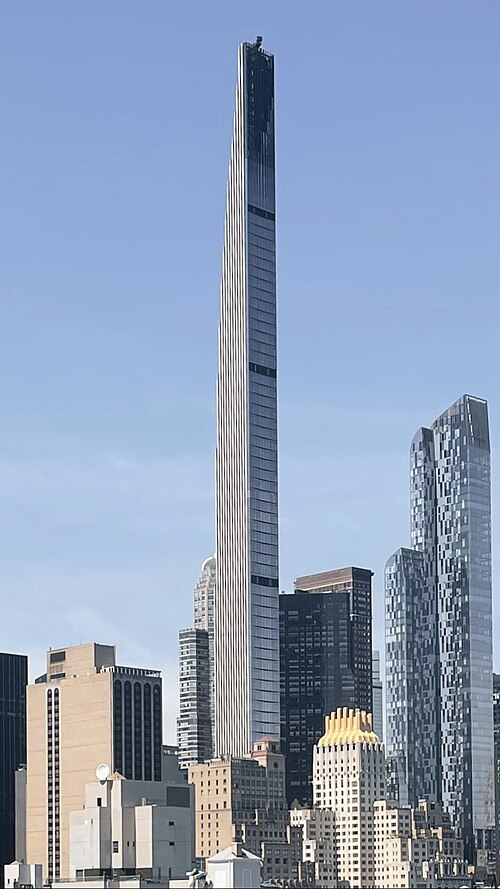
I’m not even sure that impressive structural engineering always depends on a state. Whether you approve or disapprove of it, Steinway Tower at 111 West 57th Street, NYC (2021) is an impressive engineering feat, extending the tradition of slender simplicity to house 84 stories of private, luxury condominiums.
I have some other questions for Billington. He suggests that structural engineering–in the form that he describes–is a modern development. I can accept that no one had explicitly defended its principles or distinguished engineering from architecture before Thomas Telford in 1812. But surely the practice of engineering is very old on all inhabited continents, and perhaps previous engineers (or master builders) saw themselves in similar ways without writing articles about it.
For Billington, the Eiffel Tower is a paradigm of structural engineering. I would ask: Why isn’t it architecture? Its sheer size can’t be the criterion, because architects have also designed very large objects. Perhaps the Eiffel Tower accomplishes its task with maximum efficiency, but its task is not utilitarian. Its job is to reach as high as possible. Maybe it is a gigantic sculpture?
Finally, Billington argues that the beautiful minimalist structures of the 1800s and 1900s resulted from the application of new technologies (plentiful iron; then steel and concrete) under constraints of efficiency and economy. But earlier I suggested a different origin for minimalism, one that can explain free verse and abstract expressionist paintings as well as glass-clad skyscrapers. Could it be that there have always been efficiency-maximizing engineers, but the public gained aesthetic appreciation for their work as a result of cultural changes after 1800? In that case, structural engineering is old, but we see it in new ways thanks to modernist artists.
Any provocative and compelling book will prompt critical questions, but Billington’s 1983 work endures as an argument for good structural engineering as a component of democratic public life.
See also: explaining the crisis in architecture (with the Gropius quote and other background); three great paintings in dialogue. I quote Orwell from The Road to Wigan Pier.