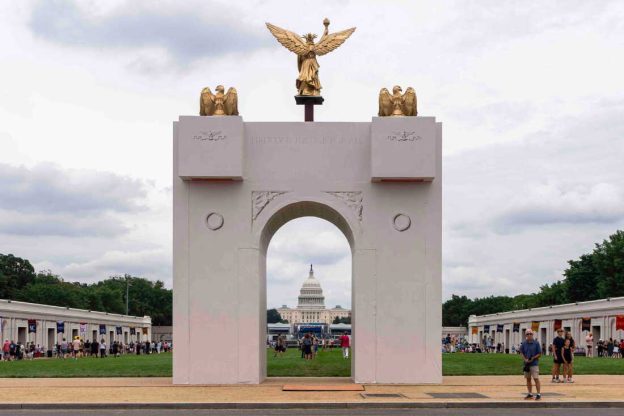
Imagine that it’s 2029 and you have been inaugurated as the President of the United States. (Congratulations and good luck.) You can look out from your bedroom window or during a helicopter ride and see a new ballroom, a huge arch, a helipad, a sculpture garden, and other major physical constructions that your predecessor ordered. Which would you do?
- Order them taken down to restore the legitimate status quo ante. If by any chance a court or Congress blocked your unilateral executive action (despite the precedents that Trump had set), treat the restoration of a limit on presidential power as a victory. Otherwise, act promptly to demonstrate the frailty of Trump’s unilateralism and to restore the capital city.
- Ask Congress to consider legislation to authorize a complete or partial restoration and to appropriate the necessary funds. Encourage Congress to hold hearings and a public debate. Use your veto power if you believe that you must, but lean in favor of honoring the legislative process. Treat the debate as a restoration of legislative primacy and the rule of law.
- Convene a representative body of citizens (perhaps randomly selected) to decide what to do, recognizing that there are genuinely competing values at stake. Some people may love the new buildings, or simply want to use the money that could be spent on restoration for other purposes. You would use a deliberative process to symbolize that the capital’s buildings belong to the people, not to the president or even to Congress. You would be trying to set a precedent for other deliberations.
- Ask Congress to authorize a citizen deliberation on the topic and to honor the results.
- Do nothing.
Before choosing, you might want to get reliable legal advice about whether Trump’s projects were illegal or else within the bounds of unilateral presidential power as that is currently understood. The answer might affect your thinking but would probably not determine your decision.
For example, if I believed that Trump had acted unlawfully, I might order the buildings removed to remedy the violation, or I might hesitate to order a demolition that would also be illegal. If I were told that Trump’s actions were lawful, I might either see a green light to demolish the buildings or else work to narrow presidential discretion by deferring to Congress.
I would also think about this very practically. The fourth option is appealing but would lose its appeal if a bill got nowhere in Congress. I might do nothing instead of expending considerable political capital. After all, an arch can be taken down now or another year, whereas other problems are truly urgent.
That said, this highly symbolic issue could be used to convey worthy points.